7 Jaw‑Dropping Rituals in Saraswati Pooja
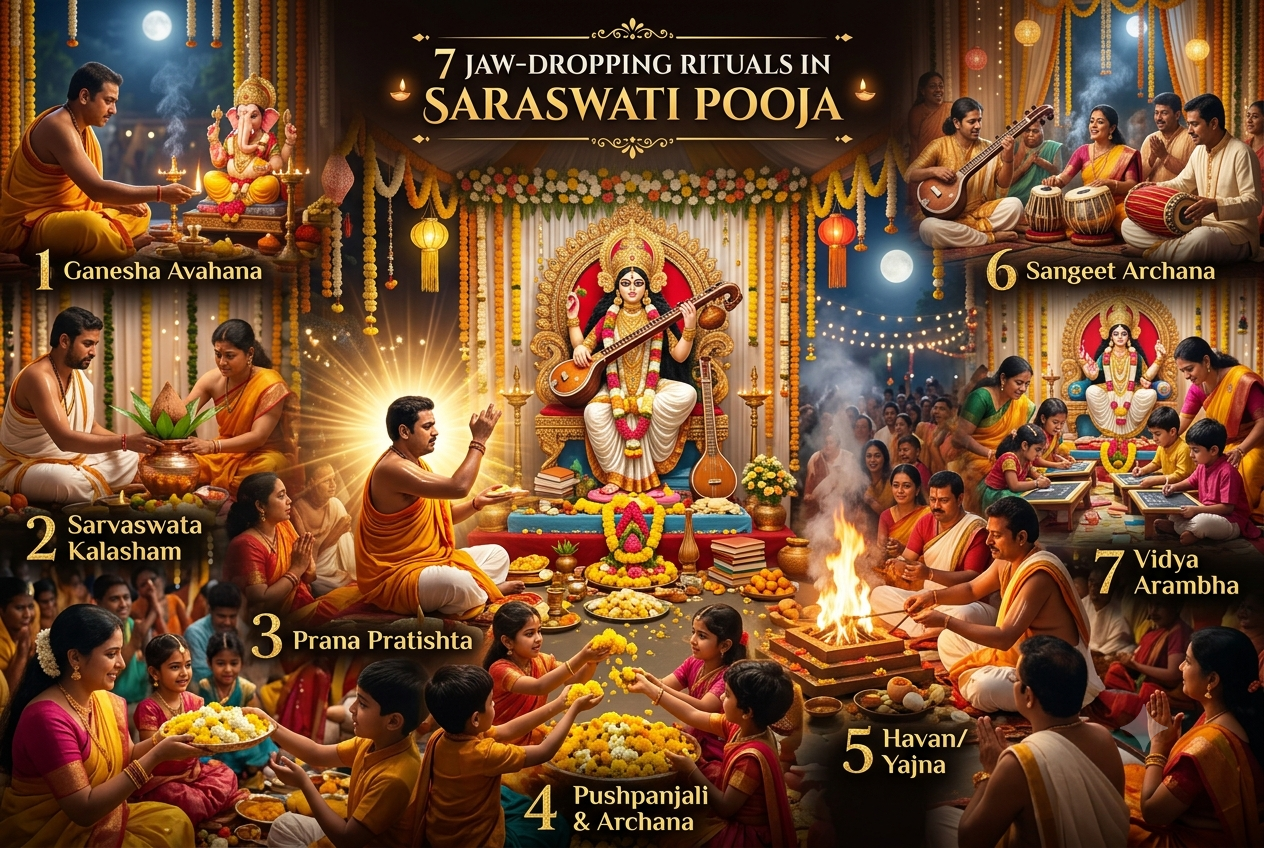
Beyond common rituals, India has rare regional Saraswati Puja traditions: Bengal's midnight Nishita Puja, Tamil Nadu's Veena Abhishekam, Kerala's Vidyarambham (children's first writing ceremony), Himalayan swan-feather scripture writing, Assam's floating knowledge boats, Odisha's devotional Saraswati Nritya dance, and Gujarat's Maun Tapasya silence fast—each honoring wisdom, art, and spiritual discipline in unique ways.
- ◦🌙 1. Midnight Saraswati Puja (Nishita Puja) – Bengal’s Secret Ritual
- ◦🎵 2. Veena Abhishekam – Tamil Nadu’s Musical Devotion
- ◦👶 3. Vidyarambham – Children Begin Learning in Kerala
- ◦🪶 4. Swan Feather Writing – Himalayan Mystical Practice
- ◦🚣 5. Floating Knowledge Boats – Assam’s River Offering
- ◦💃 6. Saraswati Nritya – Odisha’s Devotional Dance
- ◦🤫 7. Maun Tapasya – Gujarat’s Silence Fast
- ◦Why These Rare Saraswati Puja Rituals Matter
- ◦Frequently Asked Questions About Lalita Sahasranama Chanting
Saraswati Puja is more than yellow attire, books at the altar, and incense-filled rooms. Celebrated on Vasant Panchami, this sacred Hindu festival honors Goddess Saraswati — the deity of wisdom, learning, music, arts, and knowledge.
While most people are familiar with the common rituals, India’s cultural depth reveals lesser-known traditions that are symbolic, mystical, and regionally unique.
In this guide, we explore rare Saraswati Puja rituals practiced across India, along with their spiritual meaning and regional significance.
🌙 1. Midnight Saraswati Puja (Nishita Puja) – Bengal’s Secret Ritual
Unlike the usual morning worship, some spiritual practitioners in Bengal observe Nishita Puja, a midnight Saraswati ritual performed in silence.
Key Elements:
- Chanting Saraswati mantras in darkness
- Meditation for intellectual awakening
- Deep spiritual focus
- Popular among artists and students
This practice symbolizes inner illumination — the awakening of knowledge through silence.
Related Ritual: You may also explore our guide on Durga Puja celebrations in India to understand regional devotional variations.
🎵 2. Veena Abhishekam – Tamil Nadu’s Musical Devotion
In Tamil Nadu, the Saraswati Veena is worshipped as a living embodiment of the goddess.
Ritual Highlights:
- Bathing the veena with milk, honey, and rose water
- Decorating it with silk and flowers
- Offering prayers before musical performance
Musicians believe this ritual invites divine blessings into their art.
Explore More: Learn about Navgraha Puja Vidhi and Significance for deeper insights into Devi worship traditions.
👶 3. Vidyarambham – Children Begin Learning in Kerala
In Kerala, Saraswati Puja marks the beginning of a child’s educational journey through Vidyarambham.
What Happens:
- Children write their first letters in rice or sand
- Elders guide and bless them
- Ritual symbolizes knowledge initiation
This ceremony highlights the sacred connection between education and spirituality.
You can also read about Lakshmi Puja during Diwali for more insights into Hindu festival traditions.
🪶 4. Swan Feather Writing – Himalayan Mystical Practice
In Himalayan villages influenced by Tibetan traditions, monks write Sanskrit verses using swan feathers dipped in saffron ink.
Symbolism:
- Swan (Hamsa) represents wisdom and discrimination
- Saffron ink signifies purity
- Palm leaves preserve sacred knowledge
These writings are believed to carry spiritual insight and divine inspiration.
For more on sacred scriptures, explore Ganesh Chaturthi Puja Rituals and Meaning.
🚣 5. Floating Knowledge Boats – Assam’s River Offering
Along the Brahmaputra River in Assam, devotees release paper boats filled with handwritten prayers.
This ritual, known locally as Gyan Vahini, represents offering knowledge to the universe.
Belief:
- A smoothly floating boat symbolizes academic success
- Sharing wisdom invites prosperity and growth
💃 6. Saraswati Nritya – Odisha’s Devotional Dance
In Odisha, classical dancers perform Saraswati Nritya, a trance-like devotional dance.
Preparation:
- Fasting or meditation
- Offering the dance as prayer, not performance
- Complete surrender to rhythm
This ritual expresses devotion through movement and artistic discipline.
🤫 7. Maun Tapasya – Gujarat’s Silence Fast
Some Gujarati households observe Maun Tapasya, a day-long silence during Saraswati Puja.
Observances:
- No speaking
- Meditation and reflection
- Soft evening chant
The belief: True wisdom arises from silence.
For more spiritual discipline practices, read about Maha Shivratri Puja Vidhi and Benefits.
Why These Rare Saraswati Puja Rituals Matter
These traditions reflect how deeply India connects knowledge, art, devotion, and spirituality.
They show that Saraswati Puja is not just a festival — it is a celebration of:
- Education
- Creativity
- Music
- Inner awareness
- Spiritual discipline
Frequently Asked Questions About Lalita Sahasranama Chanting
Many devotees who celebrate Saraswati Puja also chant Lalita Sahasranama, a sacred hymn dedicated to Goddess Lalita Tripura Sundari.
1. Is it possible to chant Lalita Sahasranama without a priest?
Yes. One can chant it at home without a priest as long as it is done with sincerity and devotion.
While elaborate Sri Vidya practices require proper guidance, simple recitation of the Sahasranama as a devotional hymn can be performed by anyone and is considered auspicious.
2. Is initiation (Sri Vidya Deeksha) required to chant Lalita Sahasranama?
Basic chanting does not require initiation.
However, for advanced worship of Sri Chakra or specific Beej Mantras, guidance from a qualified guru is recommended.
3. When is the best time to perform Lalita Sahasranama Puja?
Fridays, Navratri, and Full Moon (Purnima) days are particularly favorable.
Morning or evening prayers performed with faith and focus are effective.
4. Can Lalita Sahasranama reduce dosha or planetary influences?
Many devotees believe regular chanting:
- Reduces negative planetary effects (graha dosha)
- Protects against negative energies
- Promotes spiritual harmony
Spiritually, it enhances inner strength and divine protection.
5. How long does it take to see results?
Some individuals experience immediate mental peace, while others notice gradual life improvements.
Consistency, faith, and karma influence the experience.
6. What if I mispronounce some names?
Minor pronunciation errors are generally forgiven when chanting is done with sincerity.
Listening to authentic recitations and practicing slowly helps improve accuracy.
7. Is Lalita Sahasranama only for women?
No. Anyone, regardless of gender, can chant Lalita Sahasranama.
The Divine Mother represents universal energy and blesses all devotees who approach her with faith.
Final Thoughts
Whether through rare Saraswati Puja rituals or chanting sacred hymns like Lalita Sahasranama, devotion is deeply personal.
Knowledge is sacred.
Art is divine.
Silence is powerful.
And Goddess Saraswati lives in every sincere act of learning and creativity.
Related Blogs

Saraswati Puja: Science Behind Yellow Sweets
Yellow sweets on Saraswati Puja aren't just tradition—they're science, emotion, and energy in one. Find out how colour, food, and devotion come together in this surprising story of wisdom and wellness
Are You Doing Shiv Puja In The Right Way?
Shiv Pooja isn’t about perfection—it’s about presence. Discover the small yet powerful steps you might be skipping, and how they can transform your prayer into a deeper, more personal experience.
Easy Lakshmi Pooja Steps For Inner Peace
You don’t need perfection to feel divine peace. Just a diya, a flower, and a moment of stillness. This gentle Lakshmi Pooja is a soft reminder that grace begins within.
Navgraha Pooja: A Powerful Spiritual Start
Struggling with delays, confusion, or emotional heaviness? Navgraha Pooja might be the spiritual shift you need. Learn how this ancient practice helps you align with cosmic energy and reclaim inner peace.