Choosing an Online Vedic Astrology Platform: An Honest Comparison Framework
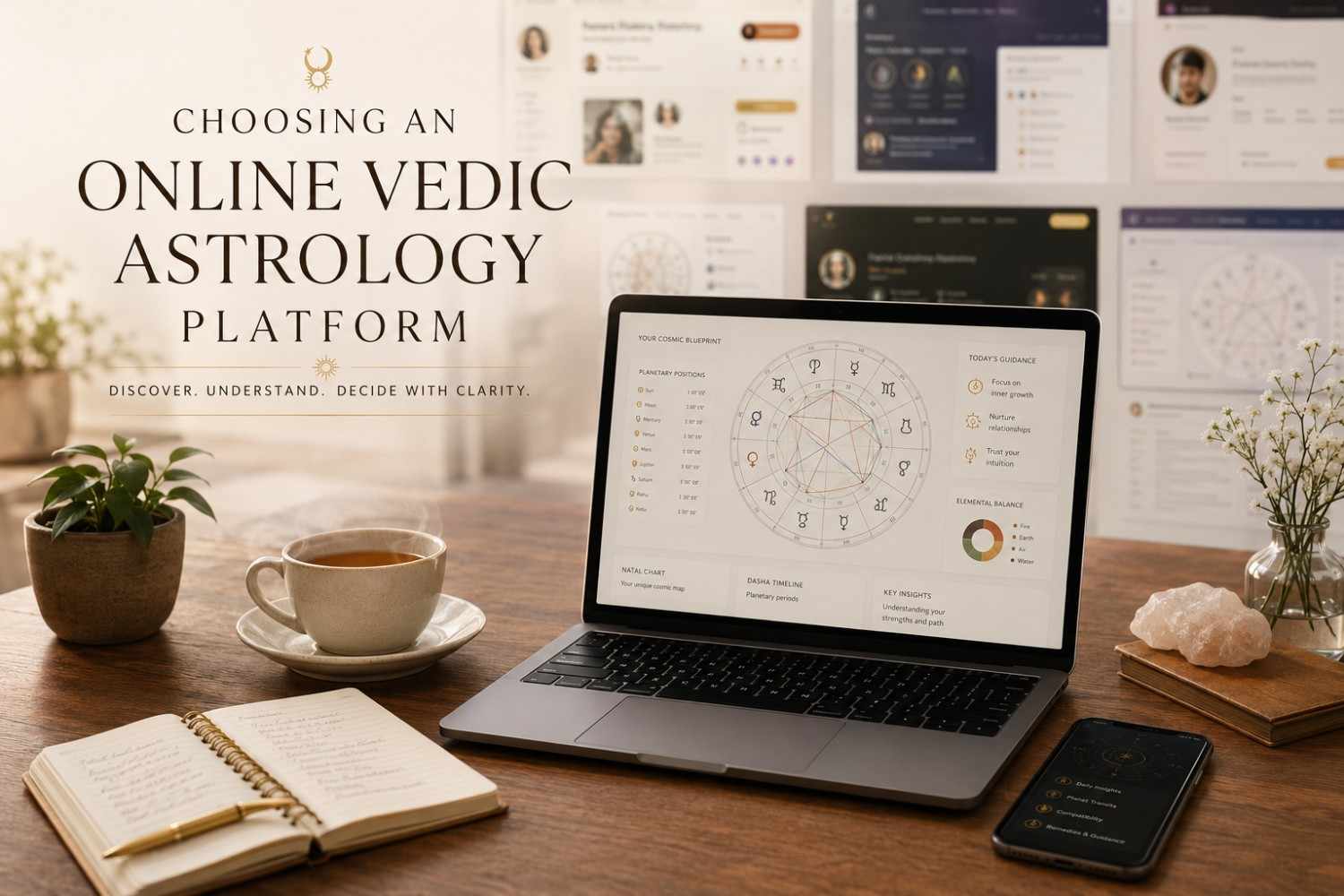
Choosing an online Vedic astrology platform can feel confusing because every platform claims to be the most accurate or trusted. This guide looks beyond marketing and explores what actually matters: honest framing, transparent pricing, exploitation safeguards, useful tools, and whether a platform leaves you informed and empowered rather than pressured.
Choosing an online astrology platform should be simple.
But after visiting a few websites or apps, it often becomes harder, not easier.
Every platform claims to be accurate. Some say they have the best astrologers. Others talk about trust, ratings, celebrity clients, AI technology, or millions of users. After a while, the differences start to blur together.
The problem is that the things platforms advertise most heavily are often not the things that matter most when you actually use them.
A platform can have thousands of astrologers and still give poor guidance. It can have impressive marketing and still pressure users into expensive remedies. It can have glowing reviews and still leave people feeling confused rather than informed.
That is why this guide does not try to tell you which platform is "the best."
Instead, it offers a simple framework for comparing any online Vedic astrology platform fairly. The goal is to focus on the things that genuinely affect your experience, not just the things that look good in advertisements.
Because the best platform is rarely the one making the loudest claims.
It is usually the one that helps you understand more, fear less, and make better decisions.
Quick Facts
| Topic | Honest Reality |
|---|---|
| What marketing usually talks about | Accuracy claims, ratings, celebrity endorsements, and number of astrologers |
| What actually matters | Honest guidance, pricing transparency, user protection, and useful tools |
| Main difference between platforms | Marketplace platforms vs tool-first platforms |
| Biggest risk everywhere | Fear-based remedy upsells |
| Simple test | Does the platform help you understand your chart or mainly sell solutions? |
| Honest truth | Be careful with guaranteed accuracy claims |
Why "Most Accurate Platform" Claims Are Not Very Useful
Almost every major astrology platform claims to be accurate.
Many go a step further and claim to be the most accurate.
At first glance, that sounds important. But the more you think about it, the harder it becomes to understand what the claim actually means.
Unlike exam results or product specifications, astrology does not come with a universally accepted way to measure accuracy. Different astrologers can interpret the same chart differently. Different traditions can focus on different techniques. Even within Vedic astrology itself, there is often room for judgment and interpretation.
That is why guaranteed accuracy claims deserve caution.
Honest astrology usually talks about tendencies, timing windows, strengths, challenges, and possibilities. It does not honestly work as a system that predicts every event with certainty.
So instead of asking, "Which platform is the most accurate?" it is often more useful to ask:
-
Does the platform explain astrology honestly?
-
Does it acknowledge limits?
-
Does it avoid impossible promises?
-
Does it help users understand rather than simply impress them?
Those answers often tell you much more than any accuracy claim ever will.
People comparing platforms may also benefit from setting expectations around what astrology can realistically offer before deciding which tools or services fit their needs best.
The Dimensions That Actually Matter

The factors that genuinely shape your experience are often much simpler than the things platforms spend money advertising.
Honest Framing
One of the first things worth paying attention to is how the platform talks about astrology itself.
Does it present astrology as guidance, reflection, and self-understanding?
Or does it constantly talk about certainty, guaranteed outcomes, and fixed predictions?
The more a platform relies on certainty, the more carefully it deserves to be evaluated. Honest astrology usually leaves room for uncertainty because real life is uncertain too.
Pricing Transparency
You should know what something costs before you use it.
That sounds obvious, but many users only discover additional costs later.
Look beyond the consultation fee and pay attention to:
-
Per-minute charges
-
Subscription plans
-
Follow-up consultations
-
Remedy recommendations
-
Additional services
Transparent pricing creates trust. Hidden costs usually create frustration.
User Protection
Some platforms actively try to protect users from fear-based selling. Others do very little.
Pay attention to whether the platform seems focused on education and understanding or whether it quickly moves people toward expensive solutions.
The difference is often surprisingly easy to spot once you start looking for it.
Tool Quality
Good tools help people learn.
A useful platform should help users understand their chart, houses, planetary placements, dashas, and major themes in simple language.
Poor tools often exist mainly to push people toward bookings or paid services.
A simple question helps here:
Does the tool teach you something, or does it mainly try to sell you something?
Treatment of Serious Matters
Responsible platforms know where astrology ends.
If someone is dealing with serious health concerns, legal problems, financial emergencies, or mental health issues, the platform should encourage professional help rather than acting as though astrology can replace qualified experts.
This is often one of the clearest signs of a mature platform.
Respect for User Independence
A good platform should make users more informed over time.
You should gradually understand your own chart better.
You should not feel like every new question requires another consultation.
Platforms that encourage learning tend to create informed users. Platforms that encourage dependence often create repeat customers.
Those are not always the same thing.
The Two Core Models — Trade-offs
Most online astrology platforms generally fall into one of two broad categories.
Marketplace Platforms
Marketplace platforms connect users with large numbers of astrologers.
The biggest advantage is flexibility.
You can usually choose from different languages, different experience levels, different specialties, and different price points. Appointments are often available throughout the day, making access convenient.
For many people, this variety is extremely useful.
But marketplace platforms also have trade-offs.
Quality can vary significantly because there may be hundreds or even thousands of astrologers available. The experience you have depends heavily on the individual practitioner you choose.
Per-minute billing can also create subtle incentives for longer conversations. And when consultations are closely connected with remedy marketplaces, there can be more opportunities for upselling.
Tool-First Platforms
Tool-first platforms work differently.
Instead of making consultations the center of the experience, they focus more heavily on helping users understand their charts through dashboards, explanations, calculators, reports, and educational tools.
The goal is often to help users learn before they seek guidance.
This approach can reduce dependence because users gain more direct understanding of their own charts.
At the same time, some people prefer human interaction and personalized discussions. For those users, large consultation marketplaces may feel more appealing.
Neither model is automatically better.
Both have strengths.
Both have weaknesses.
The important thing is understanding the trade-offs before choosing.
The Risk Common to All Platforms

Despite their differences, most astrology platforms share one common risk.
The pattern appears surprisingly often.
A problem is introduced. Then fear appears. Then a solution appears.
And very often, that solution costs money.
A difficult dasha becomes a crisis. A dosha suddenly sounds frightening. A challenge becomes something urgent.
And then a remedy appears as the answer.
This pattern can happen on large platforms, small platforms, consultation marketplaces, and tool-based services alike.
That is why one simple question cuts through most of the marketing.
After using a platform, ask yourself:
Do I feel more informed and clearer?
Or:
Do I feel more worried and pressured?
The answer often tells you more than ratings, downloads, or popularity ever will.
How to Evaluate Any Platform
You do not need a complicated checklist.
A few simple questions can reveal a surprising amount. Many of the same ideas also overlap with the booking checklist, particularly when comparing consultation styles, pricing transparency, and approaches to remedies.
Look at How They Talk About Astrology
Do they rely heavily on fear?
Do they constantly promise certainty?
Do they present astrology as guidance or as guaranteed prediction?
The language matters.
Test the Free Tools
Before paying for anything, spend some time with the free features.
Ask yourself:
-
Did I learn something useful?
-
Was the explanation clear?
-
Did the platform actually help me understand my chart?
Good free tools often reveal a lot about the platform's philosophy.
Understand the Pricing Structure
Make sure you know how the platform charges.
Transparent platforms make this easy.
Confusing pricing structures often become expensive later.
Notice How Serious Topics Are Handled
Pay attention to whether the platform encourages professional help when appropriate.
Responsible guidance is usually a positive sign.
Watch for Fear Followed by Remedies
This remains one of the clearest warning signs in astrology.
If anxiety appears first and spending appears immediately afterward, slow down and think carefully.
Ask One Final Question
Does this platform want me informed?
Or does it want me dependent?
That single question often cuts through most marketing claims.
Where Vedaz Sits — Stated Honestly
In the spirit of the same framework this guide recommends, Vedaz follows a more tool-first approach.
The platform is designed around helping users understand their charts through explanations, dashboards, reports, and educational tools before consultations become the center of the experience.
People comparing astrology platforms may also find Buddhi AI useful for exploring charts, asking questions, and understanding astrological concepts through a lens of clarity, critical thinking, and realistic expectations rather than certainty or marketing claims.
People who prefer discussing chart questions conversationally while maintaining perspective may also find Mitra AI helpful as a reflective companion alongside their own research and decision-making process.
It also aims to avoid fear-based remedy selling and encourages professional help for serious health, legal, financial, and mental health matters.
But there is an important point here.
Do not simply accept those claims because Vedaz makes them.
Apply the same framework from this article.
Ask the same questions.
Use the same standards.
A good comparison framework should work for every platform, including the one writing the guide.
Because the goal is not blind trust.
The goal is helping users make informed decisions.
Final Thought
Choosing an online astrology platform feels difficult mostly because the loudest signals are often the least useful ones.
Accuracy claims, celebrity endorsements, ratings, and astrologer counts can all sound impressive. But they do not necessarily tell you much about the experience you will actually have.
The questions that matter most are usually much simpler.
Is the platform honest about limits?
Is pricing clear?
Does it explain things well?
Does it protect users from fear-based selling?
Does it help people learn?
And perhaps most importantly, does it leave users feeling more informed than when they arrived?
Because astrology is at its healthiest when it increases understanding.
Not when it increases dependence.
The platform that helps you understand your chart, think more clearly, and make decisions with greater confidence is usually worth far more than one making the biggest promises.
And that is a much better standard than simply asking which platform claims to be the best.
Rohan Dev Shukla
Digital Astrology, Online Consultation Practices & Jyotish Education | 11+ Years
Rohan Dev Shukla is an astrology researcher and writer specializing in digital astrology platforms, online consultation experiences, and astrology education. His work focuses on helping readers navigate modern Jyotish services, understand how online predictions are generated, evaluate different consultation formats, and engage with Vedic astrology with informed expectations and practical awareness.
Frequently Asked Questions
1. Which is the most accurate online astrology platform?
Almost every major platform claims to be highly accurate, but those claims are difficult to verify in any objective way. Astrology is not something that can be measured like exam scores or product specifications. Instead of focusing on accuracy claims, it is usually more useful to evaluate honesty, transparency, educational value, and user protection.
2. What actually matters when choosing an astrology platform?
The most important factors are honest guidance, transparent pricing, useful tools, responsible handling of serious matters, and protection from fear-based selling. These things often have a much bigger impact on your experience than marketing claims.
3. Are large marketplace astrology platforms better than smaller ones?
Not necessarily. Marketplace platforms offer more astrologer choices, more languages, and greater flexibility. Tool-first platforms often focus more on chart understanding and user education. Both models have strengths and trade-offs.
4. What is the biggest risk across all astrology platforms?
The biggest risk is usually the same everywhere: fear followed by an expensive solution. When a problem is presented dramatically and immediately followed by remedy recommendations, it is worth slowing down and thinking carefully.
5. How do I evaluate a platform myself?
Look at how it talks about astrology, test the free tools, understand the pricing structure, notice how serious issues are handled, and pay attention to whether the platform leaves you feeling informed or dependent.
6. Should I trust a platform that says it is the most trusted or most experienced?
It is usually best to treat those statements as marketing claims rather than proof. A genuinely good platform should still hold up when you evaluate it carefully using a clear framework rather than relying on slogans alone.
Related Blogs

Boost Your Health with Astrology
Boost your health with astrology using zodiac-based habits, wellness tips, and simple routines for better physical and mental balance.

The Socking Truth Behind Wearing A Black Thread
Uncover the mystery behind the black thread. From protection to spiritual energy—here’s why everyone’s suddenly wearing one.

Hidden Messages In Your Moles
What if that little mole on your cheek is more than just a mark? Explore the fascinating meanings behind mole placements and what they reveal about your future.
Who Is Your Ishta Devata?
Explore the concept of your personal God in Hinduism. Learn how to discover, connect with, and build a relationship with your Ishta Devata for inner peace and spiritual growth.