Griha Pravesh Muhurat September 2027: Is There a Good Day to Enter a New Home?
Updated 28 Nov 2026 · Verified by Vedaz Astro Team
Planning a wedding, griha pravesh or a new car?
A general date list doesn't account for your own kundli. An astrologer can pick a date and time that does.
Why there is no Griha Pravesh Muhurat in September 2027
September 2027 falls within Chaturmas. It also includes Pitru Paksha, the fortnight traditionally set aside for rites and remembrance of ancestors. During these periods, many families avoid major celebrations, new beginnings, and certain purchases. The reference Panchang list therefore shows no Griha Pravesh Muhurat for the month.
In Hindu tradition, Chaturmas is associated with Lord Vishnu's yogic rest. It begins around Devshayani Ekadashi and ends around Dev Uthani Ekadashi. Since griha pravesh is a formal ceremony in which a family seeks blessings for its home, many communities prefer to hold it after this period.
That does not mean every household follows exactly the same rule. Customs vary by region, community, and family tradition. Some regional calendars may treat particular periods differently, but the major North Indian Panchangs generally do not use September for apurva griha pravesh. If your family follows a specific regional almanack, check that calendar and speak with your family pandit before fixing the date.
The reference Hindu Panchang list shows no Griha Pravesh Muhurat in September 2027 because the month falls within Chaturmas. The last window before this break is 26 June 2027. The next listed window is 1 November 2027; families who prefer to wait until after Dev Uthani Ekadashi can look at 10 November onward.
Imagine this: the keys are finally in your hand, the boxes are packed, and you are already picturing where the sofa will go. Then you check the calendar and discover that September has no listed house-entry muhurat. Does that mean the move has to stop? Not necessarily. It helps to understand what the Panchang is saying, what your family tradition expects, and which practical steps you can take in the meantime.
If you are searching for Griha Pravesh Muhurat September 2027, this guide explains why the reference list has no dates, how Griha Pravesh in Chaturmas is commonly approached, and what comes next. Whether you call it a housewarming in September 2027 or are asking if we can do Griha Pravesh in September or simply need to plan a new house entry in September 2027, the key is to separate the formal ceremony from the practical business of moving.
September 2027 at a glance
| Fact | Detail |
|---|---|
| Griha pravesh windows | None in the reference list |
| Reason | Chaturmas (mid-July to early November 2027) |
| Hindu lunar months | Bhadrapada and Ashwin |
| Season | Late monsoon |
| Last window before the break | 26 June 2027 |
| Next window | 1 November 2027 (10 November for families who wait for Dev Uthani Ekadashi) |
The short version: September is a preparation month in this reference calendar, not a month with a listed apurva griha pravesh date. The dates above are a general reference; always check the timings for your own city and family custom before making arrangements.
What if you need to move in now?
Sometimes a house move cannot wait for an auspicious date. A new job may have a fixed joining date, children may need to start at a new school, a rental agreement may be ending, or the home loan EMI may already have begun. In that situation, families commonly consider one of three approaches:
Move in with a simple puja. Some families bring their belongings into the home and begin living there with a small Ganesh puja and a lit lamp. They then arrange the full griha pravesh, including havan and Vastu puja, on a later muhurat.
Use the home without a formal entry ceremony. If circumstances allow, a family may keep the house closed or use it for storage until a suitable date. This is a personal and practical choice, not something every household can do.
Request for a personal muhurat. Either a family’s pandit or a Vedaz astrologer could study the horoscopes of the owners and come up with options based on family customs.
Calendar planning should not create any worry or financial burden. Tradition aims to help families begin important and meaningful events.
What is Griha Pravesh?
From one generation to the next, griha pravesh is the traditional ceremony that marks a family's formal entry into a home. It is more than carrying furniture across the threshold: it is a way of welcoming the family into the space, praying for well-being and beginning domestic life with a sense of gratitude.
Tradition describes three types:
- Apurva griha pravesh: the first formal entry into a newly built or newly acquired home.
- Sapurva griha pravesh: a return to a home after a long absence.
- Dwandwah griha pravesh: re-entry after a home has been rebuilt or renovated following damage.
The muhurat lists discussed in this guide are prepared for apurva griha pravesh. Families moving into a rented home often choose a smaller ceremony, such as a Vastu puja or Satyanarayan katha, on a convenient auspicious day rather than following a strict house-entry muhurat.
How is a Griha Pravesh Muhurat calculated?
A muhurat is not selected simply by looking for a date that feels convenient. Several Panchang factors are considered together:
- Nakshatra: Fixed or soft nakshatras are generally preferred. Common examples include Rohini, Mrigashira, Uttara Phalguni, Chitra, Anuradha, Uttara Ashadha, Uttara Bhadrapada, and Revati.
- Tithi: Rikta tithis like Chaturthi, Navami, and Chaturdashi, and Amavasya are generally avoided.
- Weekday: Tuesday is widely avoided. Some calendars also avoid Saturday and Sunday, which is one reason published lists can differ.
- Seasonal restrictions: Chaturmas, Pitru Paksha, and, for many families, Kharmas are excluded.
- Lagna and local timing: Even on a suitable date, the usable window is narrowed to the hours when the rising sign is considered favorable. Local sunrise affects the calculation.
Vedaz states that it runs these calculations using the Swiss Ephemeris and the Lahiri ayanamsa. This is why the September list is empty: Chaturmas is applied as a seasonal filter first, so dates within that period are removed before the nakshatra and lagna checks begin.
Festivals and Pitru Paksha
September sits within a season that includes important observances. Ganesh Chaturthi is celebrated widely in Maharashtra, Karnataka, Goa, and the Telugu states. Since Ganesha is invoked at the beginning of a griha pravesh ceremony, many families use the festival as an occasion to pray for a smooth move and a happy home—even if they plan the formal housewarming for a later date.
Pitru Paksha follows as a fortnight dedicated to shraddha rites and remembrance of ancestors. Many families avoid new purchases, celebrations, and major beginnings during this period. This is one reason it is important not to assume that a date suitable in one calendar or community will automatically suit another.
Festival dates and observance details can vary with the calendar followed. Confirm the 2027 dates using the Vedaz Panchang (/panchang) and your family's regional almanack.
Regional calendars
A single all-India rule does not describe every regional practice. In Kerala, the Malayalam month of Chingam overlaps part of September and is considered favorable for housewarming in that calendar. In Tamil Nadu, Purattasi begins in mid-September and is generally avoided for housewarming because of its association with devotion to Lord Venkateswara.
These differences are a useful reminder: a date that appears unsuitable in one regional tradition may be treated differently in another. If your family follows the Malayalam, Tamil, or another regional calendar, check that almanack rather than relying only on a general North Indian list.
Using the gap well
A month without a listed muhurat can still be a productive month for your move. Think of September as the time to take care of all the small arrangements that are easy to forget when the ceremony date finally arrives.
For example, get electricity, water, gas, and internet connections transferred or activated in the owners' names. Fill out any paperwork necessary for society or RWA, and arrange parking and get any move-in clearance you may need from your apartment complex. Determine the location of puja and how many guests can comfortably fit in the space.
These jobs may not feel as exciting as choosing a nameplate or planning the first meal, but they make a real difference. Once the muhurat arrives, you can focus on the ceremony and your family instead of chasing paperwork or waiting for an internet technician.
Use September to prepare.
Use the weeks before the next listed window to get the home ready. A little planning now can make the actual housewarming day feel calm rather than rushed.
- Finish construction, painting, and repairs. Give fresh paint and repair work enough time to settle, and make sure the house is clean before the ceremony.
- Register the property. If registration is still pending, arrange it on a suitable date. Remember that legal property registration and the religious griha pravesh ceremony are separate steps.
- Set up the kitchen. The milk-boiling ritual and the first meal both require a working stove, gas connection, and water supply.
- Book the pandit and caterer early. November and December dates can be in demand after Chaturmas, so contact service providers once your date is confirmed.
- Plan the guest list. Think about how many people the home can comfortably hold, then send invitations after the muhurat is final.
A basic checklist on your phone or family note will keep everybody informed of what is done and what is still to be done.
Griha pravesh samagri checklist
Your pandit will usually provide a list of puja samagri based on the rituals planned and your family's tradition. The following items are commonly used, so it is helpful to know what may be needed before shopping:
- A kalash, mango leaves, and a coconut
- Roli, haldi, rice, and flowers
- Betel leaves and betel nuts.
- A ghee lamp, incense, and camphor
- A havan kund, wood, ghee, and havan samagri, if a havan is planned
- A new pot, milk, and sugar or jaggery for the kitchen ritual
- Grain, salt, and a broom, if these are part of your family's entry custom
Some families bring grain, salt, and a broom into the home as symbols of plenty and cleanliness. The exact list can differ, so confirm it with your pandit rather than buying every item in advance. Keep the essentials ready a day before the ceremony. That way, the morning or evening of the muhurat can begin peacefully.
Getting the home ready: a short Vastu checklist
The goal is to make the home welcoming and ready for the ceremony. Before the muhurat:
- Clean the rooms and finish pending painting or repair work.
- Set up the kitchen and decide where the puja will take place.
- Keep the northeast corner light and uncluttered if that is part of your family's Vastu practice.
- Make the entrance welcoming with a tour and good lighting.
- Keep the hallways free of clutter so that other people and family can walk around without any restrictions.
In an apartment, the layout may not allow major changes. That is normal. Simple adjustments to furniture, lighting, and color may be enough for families who follow these practices. If you have a specific concern about the layout, a Vedaz astrologer with Vastu expertise can help you understand possible options.
What other activities are possible during Chaturmas?
Different ceremonies and activities follow different customs, which is why questions about Chaturmas can become confusing. A family that postpones griha pravesh may still go ahead with ordinary purchases. Some calendars also list dates for buying a vehicle or gold during this period.
By contrast, bhoomi pujan, weddings, and major samskaras are usually postponed by families who observe the seasonal restrictions. Property registration is a legal process, so many families complete it when the paperwork is ready; some may still choose a favorable date from the Panchang.
There is no single answer for every community or every activity. If you are unsure whether a particular purchase, ceremony, or legal step should be delayed, ask your family pandit. A Vedaz astrologer can also check a specific date for you.
The next Griha Pravesh dates after September 2027.
The reference list gives the following dates after September. Notice that the first three windows fall before Dev Uthani Ekadashi. Families who strictly wait until Chaturmas has ended may prefer the dates from 10 November onward.
| Date | Day | Muhurat window | Nakshatra | Tithi |
|---|---|---|---|---|
| 1 November 2027 | Monday | 6:47 AM to 9:57 AM | Anuradha | Tritiya |
| 4 November 2027 | Thursday | 9:40 PM to 6:47 AM (5 Nov) | Uttara Ashadha | Saptami |
| 5 November 2027 | Friday | 6:50 AM to 6:15 PM | Uttara Ashadha | Saptami |
| 10 November 2027 | Wednesday | 6:53 AM to 9:10 AM | Uttara Bhadrapada | Ekadashi |
| 11 November 2027 | Thursday | 10:10 AM to 6:45 AM (12 Nov) | Revati | Trayodashi |
These are reference windows, not timings to use blindly for every location. Sunrise and lagna can change the start and end times from one city to another. Check the Vedaz Panchang for your location before booking the ceremony. You can also read the complete November 2027 and December 2027 guides.
What to do during the muhurat when it comes?
The ceremony is typically the same after the date is set. Your pandit may do some adjustments as per your family traditions, but the following are some of the common rituals performed:
- Toran and rangoli: The main entrance is decorated beautifully with mango leaves and flowers, and a rangoli is applied on the doorway to welcome the festival.
- A kalash filled with water, with mango leaves and a coconut on top, is prepared and placed at the threshold.
- First step: At the beginning of the muhurat, the family enters the home with the right foot. Many families also carry an image of Lord Ganesha, the kalash, and grains inside.
- Puja: Ganesh puja, Vastu puja, and navagraha shanti are performed; many households also arrange a havan.
- Milk ceremony: Milk is boiled in a new pot in the kitchen, often until it overflows, as a symbol of prosperity and abundance.
- Meal: Food is prepared and shared with family, neighbors, and priests.
One detail that often surprises first-time homeowners: the furniture and boxes do not necessarily have to arrive during the muhurat. The physical move can take place earlier. It is the formal entry and puja that need to be planned within the chosen window, according to the family's practice.
Common mistakes to avoid
A little planning can prevent the most common housewarming-day problems:
- Confusing the move with the muhurat. Furniture can be delivered earlier. The formal entry and puja are the parts to plan around the window.
- Using another city's timings. Muhurat windows can shift with the local sunrise and lagna. Check the Vedaz Panchang for your own city.
- Leaving the kitchen unfinished. There should be a working stove and water supply for the milk ceremony and first meal.
- Late booking of the pandit. The dates are very popular and sell out fast, particularly after Chaturmas.
- Making decisions out of fear. If September has no suitable date in the reference list, waiting a few weeks is a normal option. A muhurat is meant to support a good beginning; it does not determine the future of the household.
The bottom line
September 2027 has no Griha Pravesh Muhurat in the reference Panchang list, but that does not mean your housewarming plans have to become stressful. If you need to move, discuss a practical approach with your family pandit. If you can wait, use the month to finish repairs, arrange utilities, prepare the puja space, and book the people you will need.
When the right date arrives, the ceremony can be about what it is meant to be: welcoming your family into a new space with care, gratitude, and hope. After all, a house becomes a home through the people, memories, and everyday moments that fill it.
Find your city's timings on the Vedaz Panchang, explore our Vedic calculators, or talk to a Vedaz astrologer.
← Griha Pravesh Muhurat August 2027 | Griha Pravesh Muhurat October 2027 →
Muhurat & Vastu experts online
Acharya Raghuji
Muhurat, Vastu · हिंदी
Acharya Punit
Vivah muhurat · हिंदी, English
Griha Pravesh Muhurat September 2027: Is There a Good Day to Enter a New Home?
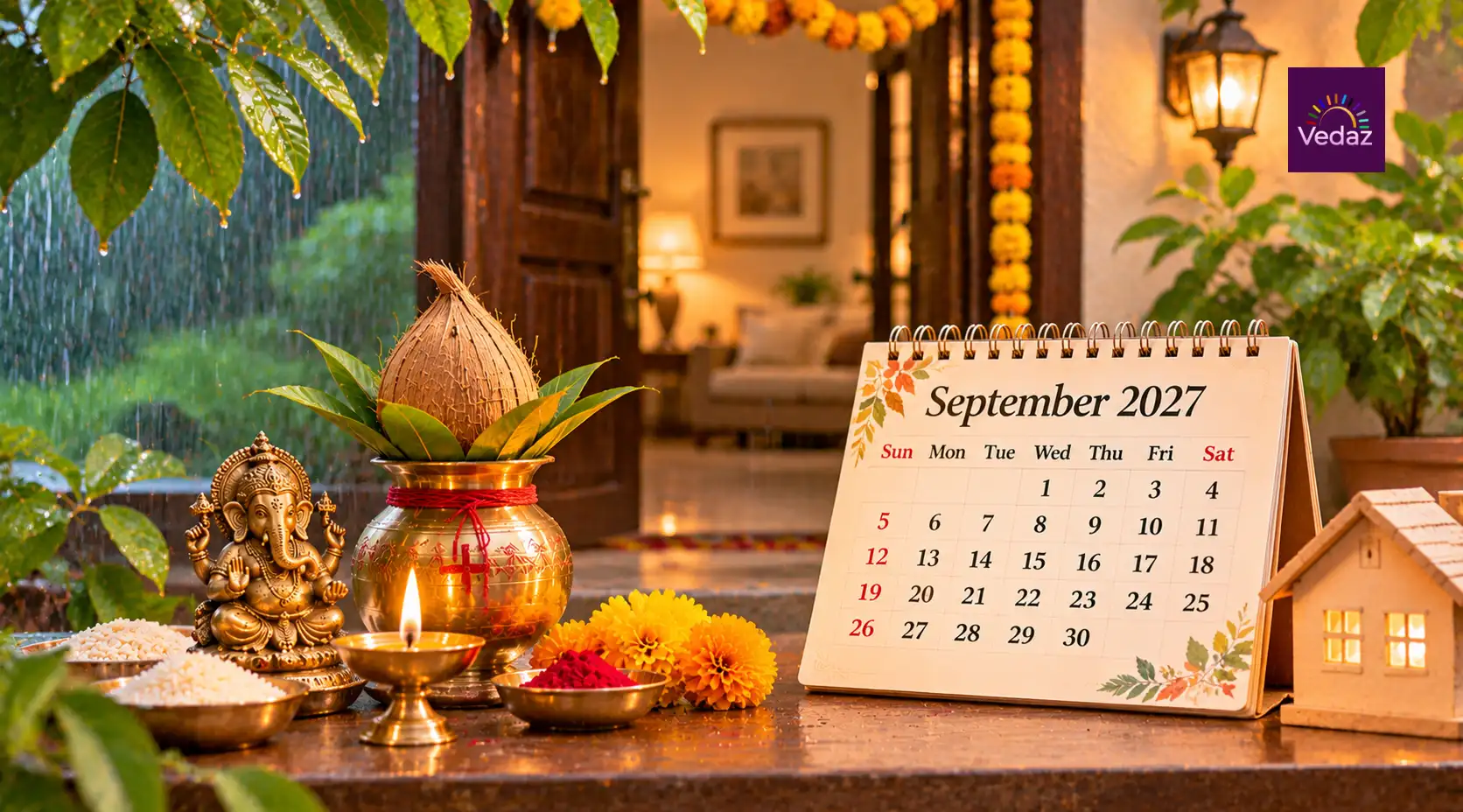
The reference Hindu Panchang list shows no Griha Pravesh Muhurat in September 2027 because the month falls within Chaturmas. The last window before this break is 26 June 2027. The next listed window is 1 November 2027; families who prefer to wait until after Dev Uthani Ekadashi can look at 10 November onward.
- ◦September 2027 at a glance
- ◦Why there is no Griha Pravesh Muhurat in September 2027
- ◦What if you need to move in now?
- ◦What is Griha Pravesh?
- ◦How is a Griha Pravesh Muhurat calculated?
- ◦Festivals and Pitru Paksha
- ◦Regional calendars
- ◦Using the gap well
- ◦Use September to prepare.
- ◦Griha pravesh samagri checklist
- ◦Getting the home ready: a short [Vastu checklist](https://www.vedaz.io/blogs/category/vastu)
- ◦What other activities are possible during Chaturmas?
- ◦The next Griha Pravesh dates after September 2027.
- ◦What to do during the muhurat when it comes?
- ◦Common mistakes to avoid
- ◦The bottom line
Imagine this: the keys are finally in your hand, the boxes are packed, and you are already picturing where the sofa will go. Then you check the calendar and discover that September has no listed house-entry muhurat. Does that mean the move has to stop? Not necessarily. It helps to understand what the Panchang is saying, what your family tradition expects, and which practical steps you can take in the meantime.
If you are searching for Griha Pravesh Muhurat September 2027, this guide explains why the reference list has no dates, how Griha Pravesh in Chaturmas is commonly approached, and what comes next. Whether you call it a housewarming in September 2027 or are asking if we can do Griha Pravesh in September or simply need to plan a new house entry in September 2027, the key is to separate the formal ceremony from the practical business of moving.
September 2027 at a glance
| Fact | Detail |
|---|---|
| Griha pravesh windows | None in the reference list |
| Reason | Chaturmas (mid-July to early November 2027) |
| Hindu lunar months | Bhadrapada and Ashwin |
| Season | Late monsoon |
| Last window before the break | 26 June 2027 |
| Next window | 1 November 2027 (10 November for families who wait for Dev Uthani Ekadashi) |
The short version: September is a preparation month in this reference calendar, not a month with a listed apurva griha pravesh date. The dates above are a general reference; always check the timings for your own city and family custom before making arrangements.
Why there is no Griha Pravesh Muhurat in September 2027
September 2027 falls within Chaturmas. It also includes Pitru Paksha, the fortnight traditionally set aside for rites and remembrance of ancestors. During these periods, many families avoid major celebrations, new beginnings, and certain purchases. The reference Panchang list therefore shows no Griha Pravesh Muhurat for the month.
In Hindu tradition, Chaturmas is associated with Lord Vishnu's yogic rest. It begins around Devshayani Ekadashi and ends around Dev Uthani Ekadashi. Since griha pravesh is a formal ceremony in which a family seeks blessings for its home, many communities prefer to hold it after this period.
That does not mean every household follows exactly the same rule. Customs vary by region, community, and family tradition. Some regional calendars may treat particular periods differently, but the major North Indian Panchangs generally do not use September for apurva griha pravesh. If your family follows a specific regional almanack, check that calendar and speak with your family pandit before fixing the date.
What if you need to move in now?
Sometimes a house move cannot wait for an auspicious date. A new job may have a fixed joining date, children may need to start at a new school, a rental agreement may be ending, or the home loan EMI may already have begun. In that situation, families commonly consider one of three approaches:
Move in with a simple puja. Some families bring their belongings into the home and begin living there with a small Ganesh puja and a lit lamp. They then arrange the full griha pravesh, including havan and Vastu puja, on a later muhurat.
Use the home without a formal entry ceremony. If circumstances allow, a family may keep the house closed or use it for storage until a suitable date. This is a personal and practical choice, not something every household can do.
Request for a personal muhurat. Either a family’s pandit or a Vedaz astrologer could study the horoscopes of the owners and come up with options based on family customs.
Calendar planning should not create any worry or financial burden. Tradition aims to help families begin important and meaningful events.
What is Griha Pravesh?
From one generation to the next, griha pravesh is the traditional ceremony that marks a family's formal entry into a home. It is more than carrying furniture across the threshold: it is a way of welcoming the family into the space, praying for well-being and beginning domestic life with a sense of gratitude.
Tradition describes three types:
- Apurva griha pravesh: the first formal entry into a newly built or newly acquired home.
- Sapurva griha pravesh: a return to a home after a long absence.
- Dwandwah griha pravesh: re-entry after a home has been rebuilt or renovated following damage.
The muhurat lists discussed in this guide are prepared for apurva griha pravesh. Families moving into a rented home often choose a smaller ceremony, such as a Vastu puja or Satyanarayan katha, on a convenient auspicious day rather than following a strict house-entry muhurat.
How is a Griha Pravesh Muhurat calculated?
A muhurat is not selected simply by looking for a date that feels convenient. Several Panchang factors are considered together:
- Nakshatra: Fixed or soft nakshatras are generally preferred. Common examples include Rohini, Mrigashira, Uttara Phalguni, Chitra, Anuradha, Uttara Ashadha, Uttara Bhadrapada, and Revati.
- Tithi: Rikta tithis like Chaturthi, Navami, and Chaturdashi, and Amavasya are generally avoided.
- Weekday: Tuesday is widely avoided. Some calendars also avoid Saturday and Sunday, which is one reason published lists can differ.
- Seasonal restrictions: Chaturmas, Pitru Paksha, and, for many families, Kharmas are excluded.
- Lagna and local timing: Even on a suitable date, the usable window is narrowed to the hours when the rising sign is considered favorable. Local sunrise affects the calculation.
Vedaz states that it runs these calculations using the Swiss Ephemeris and the Lahiri ayanamsa. This is why the September list is empty: Chaturmas is applied as a seasonal filter first, so dates within that period are removed before the nakshatra and lagna checks begin.
Festivals and Pitru Paksha
September sits within a season that includes important observances. Ganesh Chaturthi is celebrated widely in Maharashtra, Karnataka, Goa, and the Telugu states. Since Ganesha is invoked at the beginning of a griha pravesh ceremony, many families use the festival as an occasion to pray for a smooth move and a happy home—even if they plan the formal housewarming for a later date.
Pitru Paksha follows as a fortnight dedicated to shraddha rites and remembrance of ancestors. Many families avoid new purchases, celebrations, and major beginnings during this period. This is one reason it is important not to assume that a date suitable in one calendar or community will automatically suit another.
Festival dates and observance details can vary with the calendar followed. Confirm the 2027 dates using the Vedaz Panchang (/panchang) and your family's regional almanack.
Regional calendars
A single all-India rule does not describe every regional practice. In Kerala, the Malayalam month of Chingam overlaps part of September and is considered favorable for housewarming in that calendar. In Tamil Nadu, Purattasi begins in mid-September and is generally avoided for housewarming because of its association with devotion to Lord Venkateswara.
These differences are a useful reminder: a date that appears unsuitable in one regional tradition may be treated differently in another. If your family follows the Malayalam, Tamil, or another regional calendar, check that almanack rather than relying only on a general North Indian list.
Using the gap well
A month without a listed muhurat can still be a productive month for your move. Think of September as the time to take care of all the small arrangements that are easy to forget when the ceremony date finally arrives.
For example, get electricity, water, gas, and internet connections transferred or activated in the owners' names. Fill out any paperwork necessary for society or RWA, and arrange parking and get any move-in clearance you may need from your apartment complex. Determine the location of puja and how many guests can comfortably fit in the space.
These jobs may not feel as exciting as choosing a nameplate or planning the first meal, but they make a real difference. Once the muhurat arrives, you can focus on the ceremony and your family instead of chasing paperwork or waiting for an internet technician.
Use September to prepare.
Use the weeks before the next listed window to get the home ready. A little planning now can make the actual housewarming day feel calm rather than rushed.
- Finish construction, painting, and repairs. Give fresh paint and repair work enough time to settle, and make sure the house is clean before the ceremony.
- Register the property. If registration is still pending, arrange it on a suitable date. Remember that legal property registration and the religious griha pravesh ceremony are separate steps.
- Set up the kitchen. The milk-boiling ritual and the first meal both require a working stove, gas connection, and water supply.
- Book the pandit and caterer early. November and December dates can be in demand after Chaturmas, so contact service providers once your date is confirmed.
- Plan the guest list. Think about how many people the home can comfortably hold, then send invitations after the muhurat is final.
A basic checklist on your phone or family note will keep everybody informed of what is done and what is still to be done.
Griha pravesh samagri checklist
Your pandit will usually provide a list of puja samagri based on the rituals planned and your family's tradition. The following items are commonly used, so it is helpful to know what may be needed before shopping:
- A kalash, mango leaves, and a coconut
- Roli, haldi, rice, and flowers
- Betel leaves and betel nuts.
- A ghee lamp, incense, and camphor
- A havan kund, wood, ghee, and havan samagri, if a havan is planned
- A new pot, milk, and sugar or jaggery for the kitchen ritual
- Grain, salt, and a broom, if these are part of your family's entry custom
Some families bring grain, salt, and a broom into the home as symbols of plenty and cleanliness. The exact list can differ, so confirm it with your pandit rather than buying every item in advance. Keep the essentials ready a day before the ceremony. That way, the morning or evening of the muhurat can begin peacefully.
Getting the home ready: a short Vastu checklist
The goal is to make the home welcoming and ready for the ceremony. Before the muhurat:
- Clean the rooms and finish pending painting or repair work.
- Set up the kitchen and decide where the puja will take place.
- Keep the northeast corner light and uncluttered if that is part of your family's Vastu practice.
- Make the entrance welcoming with a tour and good lighting.
- Keep the hallways free of clutter so that other people and family can walk around without any restrictions.
In an apartment, the layout may not allow major changes. That is normal. Simple adjustments to furniture, lighting, and color may be enough for families who follow these practices. If you have a specific concern about the layout, a Vedaz astrologer with Vastu expertise can help you understand possible options.
What other activities are possible during Chaturmas?
Different ceremonies and activities follow different customs, which is why questions about Chaturmas can become confusing. A family that postpones griha pravesh may still go ahead with ordinary purchases. Some calendars also list dates for buying a vehicle or gold during this period.
By contrast, bhoomi pujan, weddings, and major samskaras are usually postponed by families who observe the seasonal restrictions. Property registration is a legal process, so many families complete it when the paperwork is ready; some may still choose a favorable date from the Panchang.
There is no single answer for every community or every activity. If you are unsure whether a particular purchase, ceremony, or legal step should be delayed, ask your family pandit. A Vedaz astrologer can also check a specific date for you.
The next Griha Pravesh dates after September 2027.
The reference list gives the following dates after September. Notice that the first three windows fall before Dev Uthani Ekadashi. Families who strictly wait until Chaturmas has ended may prefer the dates from 10 November onward.
| Date | Day | Muhurat window | Nakshatra | Tithi |
|---|---|---|---|---|
| 1 November 2027 | Monday | 6:47 AM to 9:57 AM | Anuradha | Tritiya |
| 4 November 2027 | Thursday | 9:40 PM to 6:47 AM (5 Nov) | Uttara Ashadha | Saptami |
| 5 November 2027 | Friday | 6:50 AM to 6:15 PM | Uttara Ashadha | Saptami |
| 10 November 2027 | Wednesday | 6:53 AM to 9:10 AM | Uttara Bhadrapada | Ekadashi |
| 11 November 2027 | Thursday | 10:10 AM to 6:45 AM (12 Nov) | Revati | Trayodashi |
These are reference windows, not timings to use blindly for every location. Sunrise and lagna can change the start and end times from one city to another. Check the Vedaz Panchang for your location before booking the ceremony. You can also read the complete November 2027 and December 2027 guides.
What to do during the muhurat when it comes?
The ceremony is typically the same after the date is set. Your pandit may do some adjustments as per your family traditions, but the following are some of the common rituals performed:
- Toran and rangoli: The main entrance is decorated beautifully with mango leaves and flowers, and a rangoli is applied on the doorway to welcome the festival.
- A kalash filled with water, with mango leaves and a coconut on top, is prepared and placed at the threshold.
- First step: At the beginning of the muhurat, the family enters the home with the right foot. Many families also carry an image of Lord Ganesha, the kalash, and grains inside.
- Puja: Ganesh puja, Vastu puja, and navagraha shanti are performed; many households also arrange a havan.
- Milk ceremony: Milk is boiled in a new pot in the kitchen, often until it overflows, as a symbol of prosperity and abundance.
- Meal: Food is prepared and shared with family, neighbors, and priests.
One detail that often surprises first-time homeowners: the furniture and boxes do not necessarily have to arrive during the muhurat. The physical move can take place earlier. It is the formal entry and puja that need to be planned within the chosen window, according to the family's practice.
Common mistakes to avoid
A little planning can prevent the most common housewarming-day problems:
- Confusing the move with the muhurat. Furniture can be delivered earlier. The formal entry and puja are the parts to plan around the window.
- Using another city's timings. Muhurat windows can shift with the local sunrise and lagna. Check the Vedaz Panchang for your own city.
- Leaving the kitchen unfinished. There should be a working stove and water supply for the milk ceremony and first meal.
- Late booking of the pandit. The dates are very popular and sell out fast, particularly after Chaturmas.
- Making decisions out of fear. If September has no suitable date in the reference list, waiting a few weeks is a normal option. A muhurat is meant to support a good beginning; it does not determine the future of the household.
The bottom line
September 2027 has no Griha Pravesh Muhurat in the reference Panchang list, but that does not mean your housewarming plans have to become stressful. If you need to move, discuss a practical approach with your family pandit. If you can wait, use the month to finish repairs, arrange utilities, prepare the puja space, and book the people you will need.
When the right date arrives, the ceremony can be about what it is meant to be: welcoming your family into a new space with care, gratitude, and hope. After all, a house becomes a home through the people, memories, and everyday moments that fill it.
Find your city's timings on the Vedaz Panchang, explore our Vedic calculators, or talk to a Vedaz astrologer.
← Griha Pravesh Muhurat August 2027 | Griha Pravesh Muhurat October 2027 →
Planning a wedding, griha pravesh or a new car?
Frequently Asked Questions
1. Is there any Griha Pravesh Muhurat in September 2027?
No. The reference Panchang list shows no Griha Pravesh Muhurat in September 2027 because of Chaturmas. The next listed window is 1 November 2027. Families who prefer to wait until after Dev Uthani Ekadashi can consider 10 November onward.
2. Can we move into a new house during Chaturmas?
Many families move in with a simple puja when practical circumstances require it, then hold the full griha pravesh after Chaturmas. Others prefer to wait before entering formally. Ask your family pandit which practice is followed in your household and region.
3. Is it inauspicious to start living in a new home without griha pravesh?
Griha pravesh is a religious and family tradition, not a fixed rule that determines whether a home will be happy. Many families begin living in the house and arrange the formal ceremony later on a suitable muhurat.
4. Which nakshatras are best for griha pravesh?
Nakshatras that are said to be the best are Rohini, Uttara Phalguni, Uttara Ashadha, and Uttara Bhadrapada. Then there are soft nakshatras, i.e., Mrigashira, Chitra, Anuradha, and Revati, which are among those most commonly recommended.
5. Do griha pravesh timings differ by city?
Yes. Start and end times depend on local sunrise and the rising sign, so the window can differ from one city to another. Check the Vedaz Panchang for your city rather than relying on timings published for a different location.
Related Blogs

Boost Your Health with Astrology
Boost your health with astrology using zodiac-based habits, wellness tips, and simple routines for better physical and mental balance.

The Socking Truth Behind Wearing A Black Thread
Uncover the mystery behind the black thread. From protection to spiritual energy—here’s why everyone’s suddenly wearing one.

Hidden Messages In Your Moles
What if that little mole on your cheek is more than just a mark? Explore the fascinating meanings behind mole placements and what they reveal about your future.

Who Is Your Ishta Devata?
Explore the concept of your personal God in Hinduism. Learn how to discover, connect with, and build a relationship with your Ishta Devata for inner peace and spiritual growth.