KP Astrology and Nadi Astrology: How Two Precise Indian Systems Work
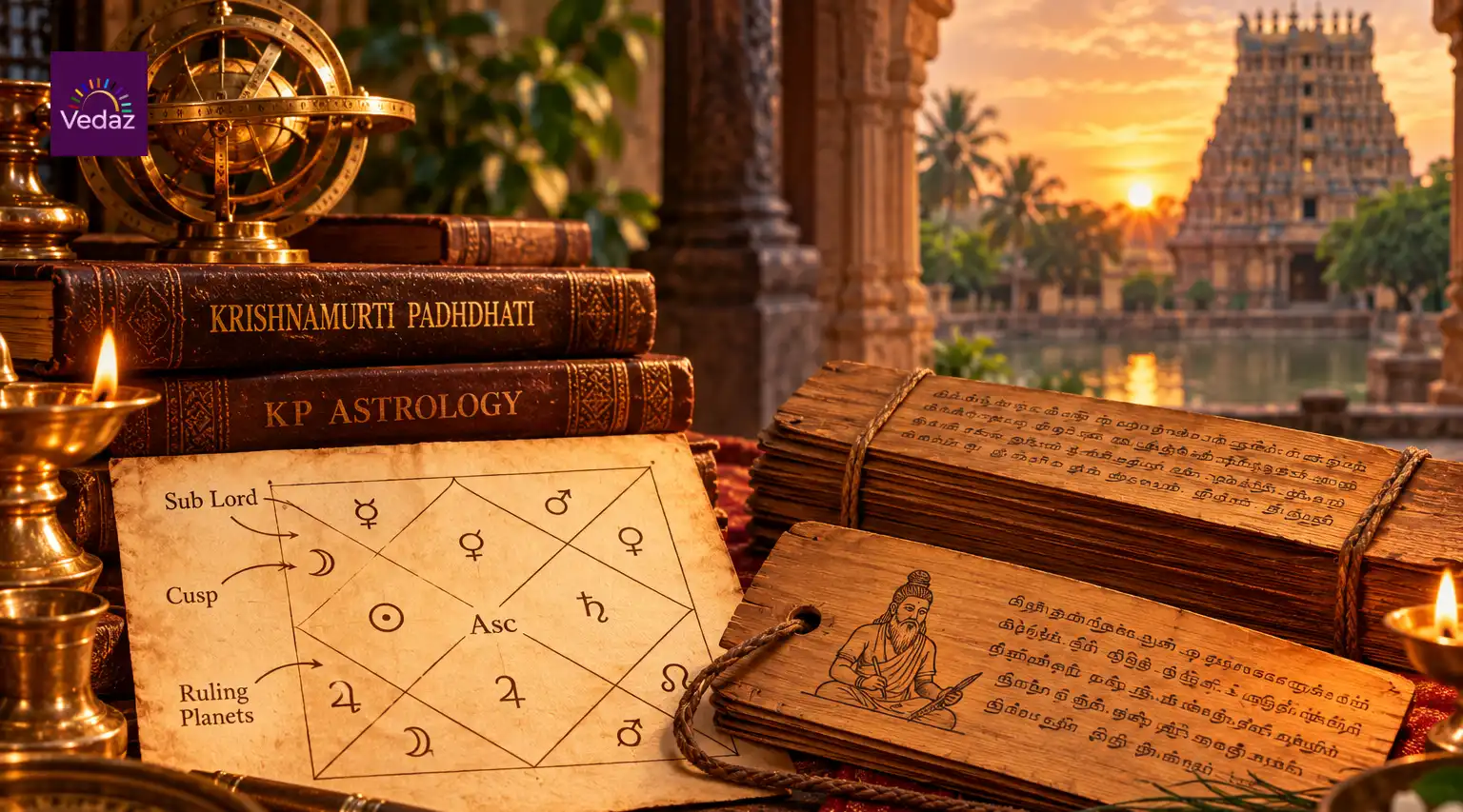
KP astrology (Krishnamurti Paddhati) is a 20th-century Indian system. It splits each nakshatra into unequal "sub" portions and uses the sub-lord of each house cusp to judge whether and when an event will happen. Nadi astrology is a tradition of readings from ancient palm-leaf manuscripts, found through a person's thumbprint. It's also a set of planetary techniques. Both aim to be more precise than general Parashari readings.
- ◦Part 1: KP Astrology (Krishnamurti Paddhati)
- ◦Part 2: Nadi Astrology
- ◦A KP Walkthrough (Hypothetical): "Will I Get This Job?"
- ◦Nadi Kandams: The Chapters of a Palm-Leaf Reading
- ◦KP vs Nadi vs Parashari: A Comparison
- ◦KP Kundli and KP Calculators
- ◦KP Marriage Matching
- ◦Which System Should You Choose?
- ◦Where KP and Nadi Fit in Modern Practice
- ◦A Note on Expectations
- ◦Choosing a KP or Nadi Practitioner
- ◦The Bottom Line
Interest in "Nadi astrology" (about 12,000 searches a month) and "KP astrology" (about 6,600, plus calculator and kundali versions) shows how many people want something more precise than a general horoscope. Both systems are Indian, both use the nakshatras, and both are famous for specific predictions. But they work in completely different ways.
This guide explains KP and Nadi astrology in plain terms. It covers where they came from, how they work, their strengths and limits, and how they compare with mainstream Parashari astrology. If you want to see your own chart first, you can generate your free Vedic chart.
Part 1: KP Astrology (Krishnamurti Paddhati)
Origins
KP astrology was developed by Prof. K. S. Krishnamurti (1908–1972) of Tamil Nadu. He was frustrated by contradictory results in traditional methods, so he built a system focused on precise, testable timing. He published his method in a series of KP Readers and in the magazine Astrology and Athrishta. Today KP has a large following, especially in South and West India.
The core idea: sub-lords
Every nakshatra (13°20') is ruled by one planet. KP divides each nakshatra further into nine unequal "subs," in the same proportions as the Vimshottari dasha years:
| Sub lord | Vimshottari years | Share of the nakshatra |
|---|---|---|
| Ketu | 7 | 7/120 |
| Venus | 20 | 20/120 |
| Sun | 6 | 6/120 |
| Moon | 10 | 10/120 |
| Mars | 7 | 7/120 |
| Rahu | 18 | 18/120 |
| Jupiter | 16 | 16/120 |
| Saturn | 19 | 19/120 |
| Mercury | 17 | 17/120 |
The order of the subs starts from the nakshatra's own lord. Across the zodiac, this creates 249 subdivisions, each with a sign lord, a star lord and a sub lord.
How KP judges an event
For any question, KP looks at the cusp (the starting point) of the relevant house:
- Find the sub-lord of the cusp. For example, use the 7th cusp for marriage.
- See which houses that sub-lord signifies, through its star lord's placement and ownership.
- If it signifies the favourable houses for the event (for example, 2, 7 and 11 for marriage), the event is promised. If it signifies the houses that oppose it (for example, 1, 6 and 10 for marriage), the event is denied or delayed.
KP uses the Placidus house system (unequal houses based on time and latitude) and its own KP ayanamsa, which is very close to Lahiri.
Significators and ruling planets
- Significators: For each house, KP lists planets in a set order of strength. These are the planets in the star of the house's occupants, the occupants themselves, the planets in the star of the house lord, and the house lord.
- Ruling planets: These are the planets that rule the moment of judgement (the day lord, the Moon's sign, star and sub lords, and the ascendant's sign, star and sub lords). KP uses them to confirm significators and to time events. It's a distinctive and popular technique.
KP horary (number method)
In KP prashna, the person asking picks a number from 1 to 249. Each number matches one of the 249 subdivisions, which becomes the ascendant for the question chart. This lets KP answer questions without birth details.
Strengths and limitations of KP
Strengths: precise yes/no answers, specific timing, a clear rule-based method, and excellent for horary questions.
Limitations: it's extremely sensitive to birth time (the sub-lords of cusps can change within minutes), it puts less weight on personality and the broad life story, and results depend a lot on how careful the practitioner is.
Part 2: Nadi Astrology
What Nadi astrology is
Nadi astrology (Nadi Jyotisham) means two related things:
- Palm-leaf Nadi readings. This is the tradition that ancient sages recorded individual life readings on palm leaves, which are now looked after by families of Nadi readers.
- Nadi techniques. These are astrological methods taken from Nadi texts (such as Bhrigu Nandi Nadi) and used with an ordinary birth chart.
Palm-leaf Nadi readings
According to tradition, sages such as Agastya, Bhrigu, Vasishtha and Kaushika foresaw the lives of individual people and wrote them down in Tamil verse on palm leaves. The best-known centre is Vaitheeswaran Koil in Tamil Nadu.
How a typical reading works:
- The person gives a thumbprint (traditionally the right for men and the left for women).
- The reader finds the bundles that match the thumbprint category.
- The reader reads the leaves aloud and asks yes/no questions (parents' names, siblings, profession) to find the "right" leaf.
- Once the leaf is found, the general chapter (kandam) is read. It gives a life overview. Then come the specific chapters on career, marriage, children, health, foreign travel, past life and remedies.
- Remedies (parikaram) are often suggested in a separate chapter.
People's experiences vary widely. Many describe remarkable accuracy. Others report vague or leading readings. Finding the leaf through questions means the reader learns a lot about you during the session.
Approaching palm-leaf Nadi readings wisely
- Note what you reveal during the identification questions.
- Record the reading if you're allowed to.
- Be careful with expensive remedy chapters, especially costly pujas presented as urgent.
- Treat predictions as possibilities, not certainties.
- Never let a reading frighten you into decisions. Fear is not a diagnosis.
Nadi techniques with a birth chart
Separately, modern astrologers use Nadi methods with ordinary charts. The best known is Bhrigu Nandi Nadi (BNN). It reads planets through their sign-based relationships (planets in the 1st, 5th, 9th, 2nd, 12th and 7th from each other) and uses Jupiter's transit to time events. These techniques don't need palm leaves, and they're getting more popular among Vedic astrologers.
A KP Walkthrough (Hypothetical): "Will I Get This Job?"
Here's how a KP astrologer might handle a simple job question, step by step.
Houses involved: In KP, job or service matters are judged mainly from the 2nd (income), 6th (service, employment) and 10th (profession, status) houses. The 11th (fulfilment of desires) is a key confirming house. Houses that oppose a new job include the 1st, 5th and 9th (the 12th from the 2nd, 6th and 10th respectively), and the 12th (loss).
Step 1 — Check the 10th cusp sub-lord. Say the 10th cusp falls in a sub ruled by Jupiter. Jupiter's star lord sits in the 6th house and owns the 11th. So Jupiter signifies 6 and 11, which supports service and gain.
Step 2 — Check the 6th cusp sub-lord. Say it's Mercury, whose star lord is in the 10th and owns the 2nd. That signifies 2 and 10, which is also supportive.
Step 3 — Look at the current dasha–bhukti–antara. If the running periods belong to planets that signify 2, 6, 10 and 11, say a Saturn dasha and Jupiter bhukti, the timing lines up.
Step 4 — Confirm with ruling planets. At the moment of judgement, the ruling planets (the day lord, the Moon's sign, star and sub lords, and the ascendant's sign, star and sub lords) are noted. If Jupiter and Mercury are among them, KP practitioners treat the promise as confirmed.
Step 5 — Time the event. The job is expected when the transiting Sun or Moon passes through the sign, star or sub of the strongest ruling planets within the favourable bhukti or antara.
Result: "The chart promises the job, and the window opens during Jupiter bhukti, most likely when the transiting Sun moves through a sign ruled by one of the ruling planets."
This shows KP's logic: houses, then cusp sub-lords, then significators, then dasha, then ruling planets, then the transit trigger. It's rule-based and precise, and it's only as good as the birth time behind it.
Nadi Kandams: The Chapters of a Palm-Leaf Reading
Palm-leaf Nadi readings are arranged in chapters called kandams. A common layout is:
| Kandam | Covers |
|---|---|
| 1 | General life overview (identification chapter) |
| 2 | Family, wealth, education, speech |
| 3 | Siblings and courage |
| 4 | Mother, home, property, vehicles |
| 5 | Children |
| 6 | Health, debts, disputes |
| 7 | Marriage |
| 8 | Longevity |
| 9 | Father, fortune, spirituality |
| 10 | Career |
| 11 | Gains and income |
| 12 | Expenses, foreign travel, liberation |
| 13 | Shanti / parikaram (remedies for past karma) |
| 14 | Deeksha (protective mantras) |
Some centres offer more special chapters (for specific questions or later stages of life). You usually don't have to buy every chapter. Choose only the ones that match your questions.
KP vs Nadi vs Parashari: A Comparison
| Parashari | KP | Palm-leaf Nadi | Nadi techniques (e.g., BNN) | |
|---|---|---|---|---|
| Basis | Signs, houses, yogas, dashas | Cusp sub-lords, significators | Pre-written palm-leaf readings | Planetary sign relationships |
| Houses | Whole sign | Placidus | — | Sign-based |
| Needs birth time | Yes (for houses) | Yes, very precisely | No (thumbprint) | Less dependent on time |
| Best for | Overall life, character, timing | Precise yes/no, timing | Narrative life reading | Event patterns, Jupiter timing |
| Main risk | Over-generalisation | Birth-time sensitivity | Leading questions, costly remedies | Over-simplification |
Many astrologers mix methods. They read the chart with Parashari principles, confirm the timing with KP, and note Nadi patterns. Learn more about the mainstream system in our Vedic and Hindu astrology guide.
KP Kundli and KP Calculators
A KP kundli is a birth chart worked out with:
- KP ayanamsa.
- Placidus cusps for all 12 houses.
- Sign, star and sub lords for every cusp and planet.
- Significator tables and ruling planets.
When you use a KP calculator, accuracy depends on a precise birth time, ideally verified or rectified. Even a few minutes can change the cusp sub-lords. You can make a standard Vedic chart with the free Vedaz kundli calculator, and ask Vedaz, the AI astrologer, about your nakshatra and sub-lord placements.
KP Marriage Matching
KP practitioners often handle compatibility differently from Ashtakoota:
- Check whether each person's 7th cusp sub-lord promises marriage.
- Compare the ruling planets at the time of judgement with each person's significators.
- Time the marriage by the dasha–bhukti–antara of planets that signify 2, 7 and 11.
Many families combine this with the traditional kundli matching score.
Which System Should You Choose?
- For a broad life reading (character, strengths, life phases): Parashari.
- For a specific question like "Will this job offer come through?": KP, especially horary.
- For a narrative reading without birth details: palm-leaf Nadi, approached with care.
- For a second opinion on timing: KP or Nadi techniques alongside Parashari.
Whichever you choose, the same principles apply: accurate data, clear reasoning, no guarantees and no fear-based remedies. See our guide to finding a genuine astrologer.
Where KP and Nadi Fit in Modern Practice
Today, many astrologers use KP and Nadi techniques as cross-checks instead of standalone systems. They confirm a Parashari reading with KP's cusp sub-lords, or note Bhrigu Nandi Nadi patterns alongside dashas. Online platforms have also made KP horary and Nadi-style techniques easier to reach, though palm-leaf readings are still closely tied to traditional centres.
A Note on Expectations
Systems built for precision can make you feel that every answer has to be exact. In reality, KP and Nadi both work best when they inform your decisions instead of making them. Take a "yes" from a KP chart as encouragement to prepare. Take a Nadi reading as a reflection on your life story. Effort and judgement still decide the outcome.
Choosing a KP or Nadi Practitioner
For KP astrology, look for someone who:
- Uses KP ayanamsa and Placidus cusps, and shows you the cusp sub-lords.
- Explains significators and ruling planets instead of handing you bare verdicts.
- Asks about birth-time accuracy and offers rectification if needed.
- Gives time windows, not guaranteed dates.
For palm-leaf Nadi readings, look for a centre that:
- Explains its fees for each kandam clearly upfront.
- Lets you record the session or take notes.
- Doesn't push you into remedy chapters or costly rituals.
- Doesn't scare you with predictions of disaster.
For both: prepare your questions, note what you share during the session, and treat any prediction as one view among many. See our guide to finding a genuine astrologer.
The Bottom Line
KP and Nadi astrology are two of India's most intriguing systems. One is a modern, rule-based method for precise timing. The other is an ancient tradition of palm-leaf readings and pattern-based techniques. Both reward accuracy and careful practice, and both are best used alongside good judgement, not as sources of certainty or fear.
Generate your free Vedic chart, explore your nakshatras, or ask Vedaz about your chart's timing.
Pooja Menon
KP astrology, Nadi astrology, specialized chart-reading methods | 9 years
Pooja Menon explores specialized astrological systems through structured, comparison-based explanations. She aims to clarify how different schools approach chart interpretation, define technical terminology, and help readers understand the distinctive methods associated with KP and Nadi astrology.
Frequently Asked Questions
1. What is KP astrology?
KP astrology, or Krishnamurti Paddhati, is an Indian system developed by Prof. K. S. Krishnamurti. It splits each nakshatra into nine unequal subs and uses the sub-lord of each house cusp to judge whether and when events will happen.
2. What is a sub-lord in KP astrology?
A sub-lord is the planet that rules one of the nine subdivisions of a nakshatra, sized in proportion to Vimshottari dasha years. The sub-lord of a house cusp is the key decider for that house's matters in KP.
3. What is Nadi astrology?
Nadi astrology means readings from ancient palm-leaf manuscripts credited to sages like Agastya and Bhrigu, found through a person's thumbprint. The term also covers Nadi techniques such as Bhrigu Nandi Nadi, used with ordinary charts.
4. Is Nadi astrology accurate?
Experiences vary. Some people report striking accuracy, while others find readings vague or shaped by the identification questions. Approach it with an open but careful mind, and be careful with expensive remedies.
5. Where is Nadi astrology practised?
Palm-leaf Nadi reading is most closely linked with Vaitheeswaran Koil in Tamil Nadu, with centres in other parts of India and abroad.
Related Blogs

Boost Your Health with Astrology
Boost your health with astrology using zodiac-based habits, wellness tips, and simple routines for better physical and mental balance.

The Socking Truth Behind Wearing A Black Thread
Uncover the mystery behind the black thread. From protection to spiritual energy—here’s why everyone’s suddenly wearing one.

Hidden Messages In Your Moles
What if that little mole on your cheek is more than just a mark? Explore the fascinating meanings behind mole placements and what they reveal about your future.
Who Is Your Ishta Devata?
Explore the concept of your personal God in Hinduism. Learn how to discover, connect with, and build a relationship with your Ishta Devata for inner peace and spiritual growth.