Kuber Yantra: Meaning, Placement and How to Use It Wisely
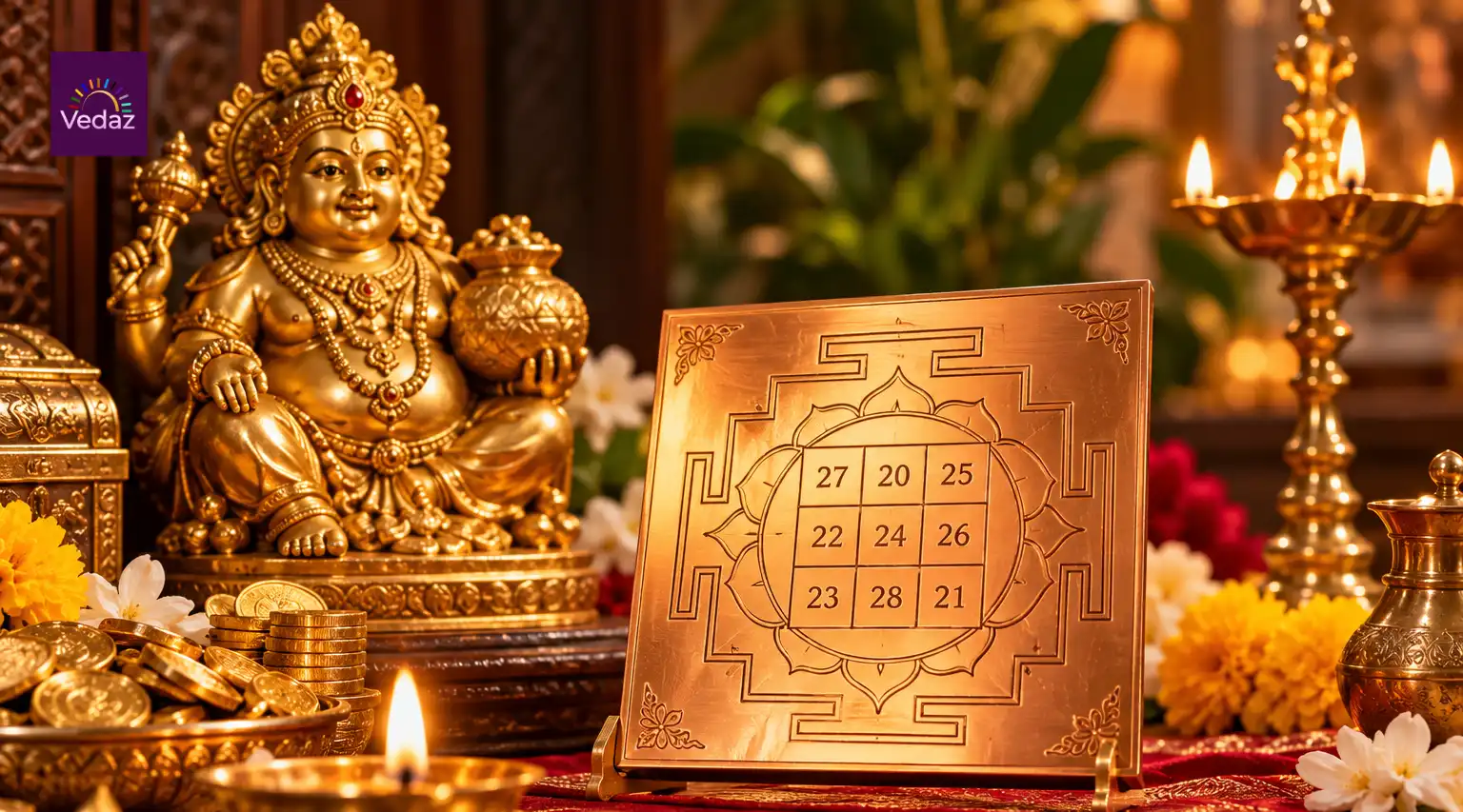
The Kuber Yantra is a sacred diagram for Lord Kubera, the Hindu god of wealth and guardian of the north. It's built around a 3×3 magic square where every row, column and diagonal adds up to 72. Traditionally, it's set up facing north in a clean place of worship or by the cash area, often on Dhanteras, Diwali or Akshaya Tritiya, and used with prayer and the Kubera mantra.
- ◦Who Is Lord Kubera?
- ◦Kubera in Stories and Temples
- ◦What Is a Yantra?
- ◦The Kuber Yantra's Magic Square
- ◦The Kubera Mantra
- ◦Where to Place a Kuber Yantra
- ◦When to Install a Kuber Yantra
- ◦How to Install a Kuber Yantra: Simple Steps
- ◦Choosing a Genuine Kuber Yantra
- ◦What a Kuber Yantra Can — and Can't — Do
- ◦A Five-Minute Daily Practice
- ◦Money Habits Kubera Would Approve Of
- ◦Kuber Yantra vs Shri Yantra vs Lakshmi Yantra
- ◦Wealth in Your Birth Chart
- ◦Related Prosperity Traditions
- ◦Kuber Yantra for Businesses
- ◦Gratitude: The Heart of Kubera Worship
- ◦A Simple Dhanteras Kubera Puja
- ◦Common Mistakes With Kuber Yantra
- ◦The Bottom Line
The Kuber Yantra is searched about 12,000 times a month in India, especially around Dhanteras and Diwali. Many homes and shops keep one near the safe or cash counter as a symbol of prosperity and responsible wealth.
This guide explains who Kubera is, what the numbers on the Kuber Yantra mean, how and where it's traditionally placed, the mantra used with it, and how to choose a genuine yantra. It also covers what a yantra can and can't do.
Who Is Lord Kubera?
Kubera (also Kuber or Vaishravana) is the lord of wealth and treasures in Hindu tradition. He's described as:
- The treasurer of the gods, who guards the wealth of the universe.
- The guardian of the north (Uttara dikpala), one of the eight directional guardians.
- King of the Yakshas, who rules from the city of Alaka near Mount Kailash.
- A devotee of Lord Shiva, who gave him his position.
In many traditions, Goddess Lakshmi is the source of wealth, and Kubera is the one who keeps and shares it out. That's why Diwali worship often honours both together, in the Lakshmi–Kubera puja.
One important theme in Kubera's stories is that wealth is a trust to be handled responsibly, not just piled up.
Kubera in Stories and Temples
Kubera appears in many Hindu stories. Two are especially well known:
Kubera and Lanka: In the Ramayana tradition, Kubera first ruled the golden city of Lanka and owned the flying chariot Pushpaka Vimana. His half-brother Ravana took both, and Kubera moved north to Alaka near Kailash. The story reflects a theme that keeps coming back: wealth held without wisdom can be lost.
Kubera and Lord Venkateswara: According to a popular legend of Tirumala (Tirupati), Lord Venkateswara borrowed a huge sum from Kubera to pay for his wedding to Goddess Padmavati. Devotees' offerings at Tirumala are traditionally said to help repay this divine loan. The story ties together generosity, devotion and responsible debt.
Kubera also appears in Buddhist tradition as Vaishravana, a guardian of the north and of wealth. That shows how widely the figure of a "keeper of treasure" resonates across Indian culture.
What Is a Yantra?
A yantra is a sacred geometric diagram used as a focus for worship and meditation. In the tantric and agamic traditions, a yantra is seen as the visual form of a deity or energy, much as a mantra is its sound form. Yantras are drawn or engraved on copper, silver, gold, bhojpatra (birch bark) or paper. They're traditionally "consecrated" (prana pratishtha) before worship.
The Kuber Yantra's Magic Square
At the heart of the most common Kuber Yantra is a 3×3 grid of numbers:
| 27 | 20 | 25 |
|---|---|---|
| 22 | 24 | 26 |
| 23 | 28 | 21 |
Every row, column and diagonal adds up to 72:
- Rows: 27+20+25 = 72; 22+24+26 = 72; 23+28+21 = 72.
- Columns: 27+22+23 = 72; 20+24+28 = 72; 25+26+21 = 72.
- Diagonals: 27+24+21 = 72; 25+24+23 = 72.
This kind of grid is called a magic square. In yantra tradition, the perfect balance of the numbers stands for harmony, completeness and a steady flow, which are qualities linked with well-managed prosperity. The grid is usually surrounded by geometric borders, lotus petals and sometimes the Kubera mantra.
Some yantras use different designs (for example, a Shri Kuber Yantra with extra geometry), but the 72-square is the most widely known.
The Kubera Mantra
The mantra traditionally chanted with the Kuber Yantra is:
ॐ यक्षाय कुबेराय वैश्रवणाय धनधान्याधिपतये धनधान्यसमृद्धिं मे देहि दापय स्वाहा॥
Om Yakshaya Kuberaya Vaishravanaya Dhana-dhanyadhipataye Dhana-dhanya-samriddhim Me Dehi Dapaya Swaha.
Meaning: "Om, salutations to Kubera, lord of the Yakshas, son of Vishrava, lord of wealth and grain. Please grant me prosperity of wealth and grain."
Many families use a shorter form: "Om Shreem Hreem Kleem Shreem Kuberaya Namah."
Traditionally, the mantra is chanted 108 times with a mala, often on Thursdays or Fridays, or on festival days.
Where to Place a Kuber Yantra
Traditional guidance, drawing on Vastu principles:
| Guideline | Traditional recommendation |
|---|---|
| Direction | North (Kubera's direction), or the north-east puja area |
| Location at home | Puja room, or near the locker/safe where valuables are kept |
| Location at work | Near the cash counter or safe, facing north |
| Height | At or above eye level, not on the floor |
| Surroundings | Clean, well-lit, uncluttered |
| Avoid | Bathrooms, under staircases, the bedroom floor, dirty or dark corners |
The yantra is usually placed on a clean red or yellow cloth or a small wooden stand.
When to Install a Kuber Yantra
Traditionally auspicious days include:
- Dhanteras, the most popular day, two days before Diwali.
- Diwali, during Lakshmi–Kubera puja.
- Akshaya Tritiya, seen as auspicious for all prosperity-related beginnings.
- Guru Pushya Yoga, when Pushya nakshatra falls on a Thursday.
- Thursdays or Fridays in a shukla paksha (waxing Moon) period.
Avoid Rahu Kaal and Bhadra when installing, and check the panchang - panchang for the day's tithi and nakshatra.
How to Install a Kuber Yantra: Simple Steps
- Choose an auspicious day and time (see above).
- Clean the space where the yantra will be kept.
- Purify the yantra. Traditionally, you sprinkle Ganga jal on it or wash it gently with water (and in some traditions raw milk), then wipe it dry.
- Place it on a clean cloth facing north or in your puja area.
- Offer a lamp (diya), incense, flowers (yellow or red), rice grains and a sweet.
- Chant the Kubera mantra 108 times, or as many times as you comfortably can, with a clear intention.
- Pray for wisdom in handling wealth, not only for more of it.
- Look after it. Keep it clean, light a lamp regularly, and say a short prayer, especially on Thursdays or Fridays.
Many families ask a priest to perform a formal prana pratishtha. Either way, sincerity matters more than elaborate ritual.
Choosing a Genuine Kuber Yantra
| Check | Why it matters |
|---|---|
| Correct numbers | Check that the magic square adds up to 72 in all directions |
| Clear engraving | Numbers and geometry should be precise and easy to read |
| Material | Copper is traditional and affordable; silver and gold are optional |
| Fair price | Yantras don't need to be expensive |
| No pressure claims | Avoid sellers who promise guaranteed riches or use fear |
A word of caution about "energised" yantras: You'll find yantras sold at very high prices with claims of special energisation. The traditional view is that the yantra comes alive through your own worship and sincerity. You don't need to pay extra for claims you can't check.
What a Kuber Yantra Can — and Can't — Do
What it's traditionally meant for:
- A focus for prayer and gratitude around wealth.
- A reminder to handle money responsibly. Kubera is the keeper, not the spender.
- A symbol of auspicious beginnings for a home, shop or new financial year.
What it can't do:
- Guarantee wealth or replace effort, skill and planning.
- Fix money problems on its own. Debt, losses and business trouble need practical action and, where right, advice from qualified financial professionals.
- Override your chart. In astrology, money themes come from the 2nd and 11th houses, Jupiter, Venus and your dashas.
The healthiest way to use a Kuber Yantra is alongside practical money habits, like budgeting, saving, avoiding debt traps and dealing honestly. These are, after all, exactly what Kubera stands for.
A Five-Minute Daily Practice
You don't need elaborate rituals. Here's a simple daily or weekly practice:
- Light a diya near the yantra.
- Offer a flower or a few grains of rice.
- Chant the Kubera mantra 11, 21 or 108 times.
- Say thanks for what you already have.
- Set one money intention for the day: "I'll stick to my budget," "I'll pay that pending bill," or "I'll save a fixed amount."
The fifth step is what turns worship into change.
Money Habits Kubera Would Approve Of
Kubera is the keeper of wealth, so the traditional symbolism points to responsible management:
- Budget. Know where your money goes each month.
- Save first. Set aside savings before spending on extras.
- Avoid debt traps. Be wary of high-interest borrowing.
- Keep your accounts in order, just as the yantra is kept clean.
- Give. Charity is part of every Hindu prosperity tradition.
- Seek advice. For investments, talk to a qualified financial advisor.
Kuber Yantra vs Shri Yantra vs Lakshmi Yantra
| Yantra | Deity | Traditional focus |
|---|---|---|
| Kuber Yantra | Kubera | Preserving and managing wealth; the cash box and treasury |
| Shri Yantra | Tripura Sundari / Lakshmi | Abundance, harmony and spiritual prosperity; seen as the "king of yantras" |
| Lakshmi Yantra | Goddess Lakshmi | Prosperity, grace and good fortune in the home |
Many families keep the Shri Yantra in the puja room and the Kuber Yantra near the safe, and worship both during Diwali's Lakshmi–Kubera puja.
Wealth in Your Birth Chart
If you're curious about prosperity themes in your own chart, Vedic astrology looks at:
- 2nd house: saved-up wealth, family resources, savings.
- 11th house: income, gains, networks.
- Jupiter: growth, wisdom, prosperity.
- Venus: comforts and luxuries.
- Dhana yogas: combinations linking the 2nd, 5th, 9th and 11th lords.
- Dashas and transits that activate these houses.
You can generate your kundli free and ask Vedaz about the wealth houses in your chart. Remember that astrology describes tendencies and timing, not guaranteed outcomes, and it's never a substitute for financial advice.
Related Prosperity Traditions
- Shri Yantra: dedicated to Goddess Lakshmi/Tripura Sundari, and seen as the "king of yantras."
- Lakshmi–Kubera puja: performed on Diwali.
- Dhanteras purchases: buying metal utensils or gold as a symbol of prosperity.
- Akshaya Tritiya: a day when beginnings are said to "never diminish."
Kuber Yantra for Businesses
Shops and offices often keep a Kuber Yantra near the cash counter or safe, facing north. They also do a small puja at the start of the financial year (Chopda Pujan in Gujarat on Diwali is a famous example). The yantra is a reminder of honest dealing, accurate accounts and gratitude to customers, which are the real foundations of a prosperous business.
Gratitude: The Heart of Kubera Worship
Every Kubera tradition comes back to gratitude: for what you have, for the people who help you earn it, and for the chance to share it. A Kuber Yantra kept with gratitude and honest effort is the truest form of the practice.
A Simple Dhanteras Kubera Puja
Dhanteras is the most popular day to honour Kubera. Here's a simple home puja:
- Clean the home and puja area, and light diyas at the entrance in the evening.
- Place images of Goddess Lakshmi, Lord Ganesha and Kubera, along with the Kuber Yantra, on a clean cloth.
- Offer flowers, rice, kumkum, sweets and a coin or small silver item.
- Chant Ganesha's mantra first, then Lakshmi's, then the Kubera mantra.
- Pray for prosperity that's managed wisely and shared generously.
- Light a lamp for Yama (Yama deepam) outside the home, as many families do on Dhanteras.
Common Mistakes With Kuber Yantra
- Placing it in a cluttered or dirty spot. The yantra stands for order.
- Buying an incorrect yantra. Always check that the square adds up to 72.
- Expecting overnight results. The yantra supports intention. Action creates results.
- Paying inflated prices for "energisation" you can't verify.
- Neglecting it after installation. Regular, simple worship matters more than a grand first day.
- Using it as a substitute for financial planning. It isn't one.
The Bottom Line
The Kuber Yantra is a beautiful expression of Hindu tradition: a balanced square of numbers that honours the guardian of wealth. Place it with care, worship it with sincerity, and let it remind you of what Kubera really stands for. That's wealth earned honestly, kept wisely and shared generously.
Check today's panchang - panchang for an auspicious time, explore your chart's wealth houses with KundliGPT - kundligpt, or ask Vedaz about prosperity themes in your kundli.
The Kuber Yantra is a sacred diagram for Lord Kubera, the Hindu god of wealth and guardian of the north. It's built around a 3×3 magic square where every row, column and diagonal adds up to 72. Traditionally, it's set up facing north in a clean place of worship or by the cash area, often on Dhanteras, Diwali or Akshaya Tritiya, and used with prayer and the Kubera mantra.
{{TOC}}
The Kuber Yantra is searched about 12,000 times a month in India, especially around Dhanteras and Diwali. Many homes and shops keep one near the safe or cash counter as a symbol of prosperity and responsible wealth.
This guide explains who Kubera is, what the numbers on the Kuber Yantra mean, how and where it's traditionally placed, the mantra used with it, and how to choose a genuine yantra. It also covers what a yantra can and can't do.
Who Is Lord Kubera?
Kubera (also Kuber or Vaishravana) is the lord of wealth and treasures in Hindu tradition. He's described as:
- The treasurer of the gods, who guards the wealth of the universe.
- The guardian of the north (Uttara dikpala), one of the eight directional guardians.
- King of the Yakshas, who rules from the city of Alaka near Mount Kailash.
- A devotee of Lord Shiva, who gave him his position.
In many traditions, Goddess Lakshmi is the source of wealth, and Kubera is the one who keeps and shares it out. That's why Diwali worship often honours both together, in the Lakshmi–Kubera puja.
One important theme in Kubera's stories is that wealth is a trust to be handled responsibly, not just piled up.
Kubera in Stories and Temples
Kubera appears in many Hindu stories. Two are especially well known:
Kubera and Lanka: In the Ramayana tradition, Kubera first ruled the golden city of Lanka and owned the flying chariot Pushpaka Vimana. His half-brother Ravana took both, and Kubera moved north to Alaka near Kailash. The story reflects a theme that keeps coming back: wealth held without wisdom can be lost.
Kubera and Lord Venkateswara: According to a popular legend of Tirumala (Tirupati), Lord Venkateswara borrowed a huge sum from Kubera to pay for his wedding to Goddess Padmavati. Devotees' offerings at Tirumala are traditionally said to help repay this divine loan. The story ties together generosity, devotion and responsible debt.
Kubera also appears in Buddhist tradition as Vaishravana, a guardian of the north and of wealth. That shows how widely the figure of a "keeper of treasure" resonates across Indian culture.
What Is a Yantra?
A yantra is a sacred geometric diagram used as a focus for worship and meditation. In the tantric and agamic traditions, a yantra is seen as the visual form of a deity or energy, much as a mantra is its sound form. Yantras are drawn or engraved on copper, silver, gold, bhojpatra (birch bark) or paper. They're traditionally "consecrated" (prana pratishtha) before worship.
The Kuber Yantra's Magic Square
At the heart of the most common Kuber Yantra is a 3×3 grid of numbers:
| 27 | 20 | 25 |
|---|---|---|
| 22 | 24 | 26 |
| 23 | 28 | 21 |
Every row, column and diagonal adds up to 72:
- Rows: 27+20+25 = 72; 22+24+26 = 72; 23+28+21 = 72.
- Columns: 27+22+23 = 72; 20+24+28 = 72; 25+26+21 = 72.
- Diagonals: 27+24+21 = 72; 25+24+23 = 72.
This kind of grid is called a magic square. In yantra tradition, the perfect balance of the numbers stands for harmony, completeness and a steady flow, which are qualities linked with well-managed prosperity. The grid is usually surrounded by geometric borders, lotus petals and sometimes the Kubera mantra.
Some yantras use different designs (for example, a Shri Kuber Yantra with extra geometry), but the 72-square is the most widely known.
The Kubera Mantra
The mantra traditionally chanted with the Kuber Yantra is:
ॐ यक्षाय कुबेराय वैश्रवणाय धनधान्याधिपतये धनधान्यसमृद्धिं मे देहि दापय स्वाहा॥
Om Yakshaya Kuberaya Vaishravanaya Dhana-dhanyadhipataye Dhana-dhanya-samriddhim Me Dehi Dapaya Swaha.
Meaning: "Om, salutations to Kubera, lord of the Yakshas, son of Vishrava, lord of wealth and grain. Please grant me prosperity of wealth and grain."
Many families use a shorter form: "Om Shreem Hreem Kleem Shreem Kuberaya Namah."
Traditionally, the mantra is chanted 108 times with a mala, often on Thursdays or Fridays, or on festival days.
Where to Place a Kuber Yantra
Traditional guidance, drawing on Vastu principles:
| Guideline | Traditional recommendation |
|---|---|
| Direction | North (Kubera's direction), or the north-east puja area |
| Location at home | Puja room, or near the locker/safe where valuables are kept |
| Location at work | Near the cash counter or safe, facing north |
| Height | At or above eye level, not on the floor |
| Surroundings | Clean, well-lit, uncluttered |
| Avoid | Bathrooms, under staircases, the bedroom floor, dirty or dark corners |
The yantra is usually placed on a clean red or yellow cloth or a small wooden stand.
When to Install a Kuber Yantra
Traditionally auspicious days include:
- Dhanteras, the most popular day, two days before Diwali.
- Diwali, during Lakshmi–Kubera puja.
- Akshaya Tritiya, seen as auspicious for all prosperity-related beginnings.
- Guru Pushya Yoga, when Pushya nakshatra falls on a Thursday.
- Thursdays or Fridays in a shukla paksha (waxing Moon) period.
Avoid Rahu Kaal and Bhadra when installing, and check the panchang - panchang for the day's tithi and nakshatra.
How to Install a Kuber Yantra: Simple Steps
- Choose an auspicious day and time (see above).
- Clean the space where the yantra will be kept.
- Purify the yantra. Traditionally, you sprinkle Ganga jal on it or wash it gently with water (and in some traditions raw milk), then wipe it dry.
- Place it on a clean cloth facing north or in your puja area.
- Offer a lamp (diya), incense, flowers (yellow or red), rice grains and a sweet.
- Chant the Kubera mantra 108 times, or as many times as you comfortably can, with a clear intention.
- Pray for wisdom in handling wealth, not only for more of it.
- Look after it. Keep it clean, light a lamp regularly, and say a short prayer, especially on Thursdays or Fridays.
Many families ask a priest to perform a formal prana pratishtha. Either way, sincerity matters more than elaborate ritual.
Choosing a Genuine Kuber Yantra
| Check | Why it matters |
|---|---|
| Correct numbers | Check that the magic square adds up to 72 in all directions |
| Clear engraving | Numbers and geometry should be precise and easy to read |
| Material | Copper is traditional and affordable; silver and gold are optional |
| Fair price | Yantras don't need to be expensive |
| No pressure claims | Avoid sellers who promise guaranteed riches or use fear |
A word of caution about "energised" yantras: You'll find yantras sold at very high prices with claims of special energisation. The traditional view is that the yantra comes alive through your own worship and sincerity. You don't need to pay extra for claims you can't check.
What a Kuber Yantra Can — and Can't — Do
What it's traditionally meant for:
- A focus for prayer and gratitude around wealth.
- A reminder to handle money responsibly. Kubera is the keeper, not the spender.
- A symbol of auspicious beginnings for a home, shop or new financial year.
What it can't do:
- Guarantee wealth or replace effort, skill and planning.
- Fix money problems on its own. Debt, losses and business trouble need practical action and, where right, advice from qualified financial professionals.
- Override your chart. In astrology, money themes come from the 2nd and 11th houses, Jupiter, Venus and your dashas.
The healthiest way to use a Kuber Yantra is alongside practical money habits, like budgeting, saving, avoiding debt traps and dealing honestly. These are, after all, exactly what Kubera stands for.
A Five-Minute Daily Practice
You don't need elaborate rituals. Here's a simple daily or weekly practice:
- Light a diya near the yantra.
- Offer a flower or a few grains of rice.
- Chant the Kubera mantra 11, 21 or 108 times.
- Say thanks for what you already have.
- Set one money intention for the day: "I'll stick to my budget," "I'll pay that pending bill," or "I'll save a fixed amount."
The fifth step is what turns worship into change.
Money Habits Kubera Would Approve Of
Kubera is the keeper of wealth, so the traditional symbolism points to responsible management:
- Budget. Know where your money goes each month.
- Save first. Set aside savings before spending on extras.
- Avoid debt traps. Be wary of high-interest borrowing.
- Keep your accounts in order, just as the yantra is kept clean.
- Give. Charity is part of every Hindu prosperity tradition.
- Seek advice. For investments, talk to a qualified financial advisor.
Kuber Yantra vs Shri Yantra vs Lakshmi Yantra
| Yantra | Deity | Traditional focus |
|---|---|---|
| Kuber Yantra | Kubera | Preserving and managing wealth; the cash box and treasury |
| Shri Yantra | Tripura Sundari / Lakshmi | Abundance, harmony and spiritual prosperity; seen as the "king of yantras" |
| Lakshmi Yantra | Goddess Lakshmi | Prosperity, grace and good fortune in the home |
Many families keep the Shri Yantra in the puja room and the Kuber Yantra near the safe, and worship both during Diwali's Lakshmi–Kubera puja.
Wealth in Your Birth Chart
If you're curious about prosperity themes in your own chart, Vedic astrology looks at:
- 2nd house: saved-up wealth, family resources, savings.
- 11th house: income, gains, networks.
- Jupiter: growth, wisdom, prosperity.
- Venus: comforts and luxuries.
- Dhana yogas: combinations linking the 2nd, 5th, 9th and 11th lords.
- Dashas and transits that activate these houses.
You can generate your kundli free and ask Vedaz about the wealth houses in your chart. Remember that astrology describes tendencies and timing, not guaranteed outcomes, and it's never a substitute for financial advice.
Related Prosperity Traditions
- Shri Yantra: dedicated to Goddess Lakshmi/Tripura Sundari, and seen as the "king of yantras."
- Lakshmi–Kubera puja: performed on Diwali.
- Dhanteras purchases: buying metal utensils or gold as a symbol of prosperity.
- Akshaya Tritiya: a day when beginnings are said to "never diminish."
Kuber Yantra for Businesses
Shops and offices often keep a Kuber Yantra near the cash counter or safe, facing north. They also do a small puja at the start of the financial year (Chopda Pujan in Gujarat on Diwali is a famous example). The yantra is a reminder of honest dealing, accurate accounts and gratitude to customers, which are the real foundations of a prosperous business.
Gratitude: The Heart of Kubera Worship
Every Kubera tradition comes back to gratitude: for what you have, for the people who help you earn it, and for the chance to share it. A Kuber Yantra kept with gratitude and honest effort is the truest form of the practice.
A Simple Dhanteras Kubera Puja
Dhanteras is the most popular day to honour Kubera. Here's a simple home puja:
- Clean the home and puja area, and light diyas at the entrance in the evening.
- Place images of Goddess Lakshmi, Lord Ganesha and Kubera, along with the Kuber Yantra, on a clean cloth.
- Offer flowers, rice, kumkum, sweets and a coin or small silver item.
- Chant Ganesha's mantra first, then Lakshmi's, then the Kubera mantra.
- Pray for prosperity that's managed wisely and shared generously.
- Light a lamp for Yama (Yama deepam) outside the home, as many families do on Dhanteras.
Common Mistakes With Kuber Yantra
- Placing it in a cluttered or dirty spot. The yantra stands for order.
- Buying an incorrect yantra. Always check that the square adds up to 72.
- Expecting overnight results. The yantra supports intention. Action creates results.
- Paying inflated prices for "energisation" you can't verify.
- Neglecting it after installation. Regular, simple worship matters more than a grand first day.
- Using it as a substitute for financial planning. It isn't one.
The Bottom Line
The Kuber Yantra is a beautiful expression of Hindu tradition: a balanced square of numbers that honours the guardian of wealth. Place it with care, worship it with sincerity, and let it remind you of what Kubera really stands for. That's wealth earned honestly, kept wisely and shared generously.
Check today's panchang - panchang for an auspicious time, explore your chart's wealth houses with KundliGPT - kundligpt, or ask Vedaz about prosperity themes in your kundli.
Aarav Sharma
Vedic astrology, Kundli interpretation, planetary placements, birth charts | 12 years
Aarav Sharma's approach to astrology centers on understanding traditional Jyotish concepts and explaining them in everyday language. He focuses on breaking down complex birth charts into understandable sections, helping readers explore planetary placements, house meanings, and their traditional interpretations without feeling overwhelmed by technical terminology.
Frequently Asked Questions
1. What is a Kuber Yantra?
A Kuber Yantra is a sacred geometric diagram for Lord Kubera, the Hindu god of wealth. Its best-known form is a 3×3 magic square where every row, column and diagonal adds up to 72.
2. Where should a Kuber Yantra be placed?
Traditionally in the north direction, which is Kubera's direction. It goes in a clean puja area or near the safe or cash counter, at or above eye level. Avoid bathrooms, the floor and cluttered spaces.
3. What is the best day to install a Kuber Yantra?
Dhanteras and Diwali are the most popular days. Akshaya Tritiya, Guru Pushya Yoga, and Thursdays or Fridays in the waxing Moon phase are also seen as auspicious.
4. What does the number 72 mean in the Kuber Yantra?
It's the fixed sum of every row, column and diagonal in the yantra's magic square. The perfect balance of the numbers stands for harmony and a steady, balanced flow of prosperity.
5. What is the Kubera mantra?
A traditional Kubera mantra is "Om Yakshaya Kuberaya Vaishravanaya Dhana-dhanyadhipataye Dhana-dhanya-samriddhim Me Dehi Dapaya Swaha," often chanted 108 times.
Related Blogs

Boost Your Health with Astrology
Boost your health with astrology using zodiac-based habits, wellness tips, and simple routines for better physical and mental balance.

The Socking Truth Behind Wearing A Black Thread
Uncover the mystery behind the black thread. From protection to spiritual energy—here’s why everyone’s suddenly wearing one.

Hidden Messages In Your Moles
What if that little mole on your cheek is more than just a mark? Explore the fascinating meanings behind mole placements and what they reveal about your future.

Who Is Your Ishta Devata?
Explore the concept of your personal God in Hinduism. Learn how to discover, connect with, and build a relationship with your Ishta Devata for inner peace and spiritual growth.