Kundali Matching for Marriage: The Complete Guide to Guna Milan
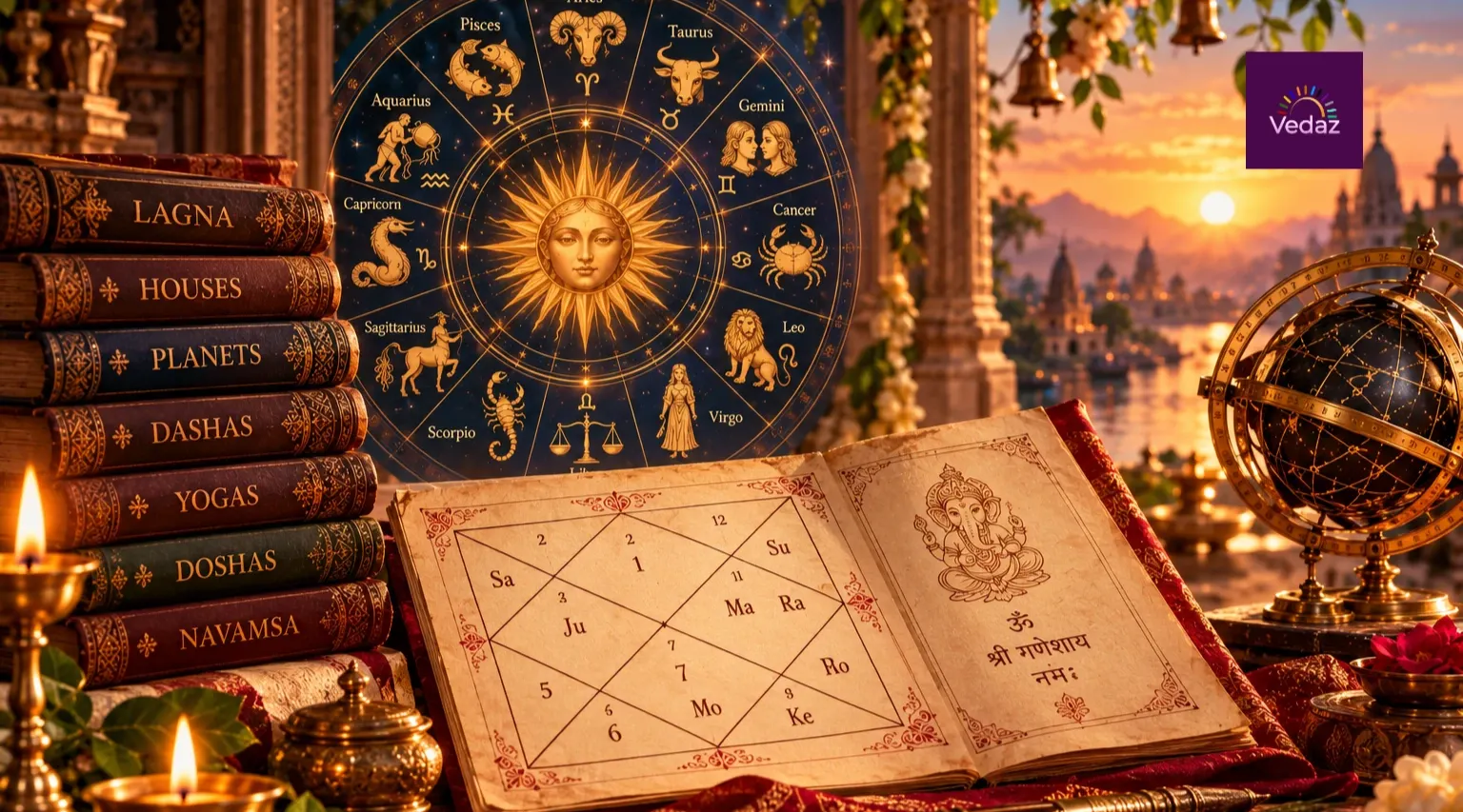
Kundali matching (also called patrika, janmakshar or horoscope matching) compares two birth charts to see how well a couple may fit for marriage. The most common method is Ashtakoota Guna Milan. It scores eight factors, based on both partners' Moon nakshatras, for a total of 36 points. A score of 18 or more is traditionally seen as acceptable. But the doshas, their cancellations and the full charts matter more than the score alone.
- ◦What Is Kundali Matching?
- ◦What You Need for Kundali Matching
- ◦The 8 Kootas of Ashtakoota Guna Milan
- ◦What Does Your Guna Milan Score Mean?
- ◦Understanding the Major Doshas and Their Cancellations
- ◦Regional Systems: Patrika, Janmakshar and Porutham
- ◦Beyond Guna Milan: What a Full Chart Match Looks At
- ◦How to Use Kundali Matching Sensibly
- ◦Kundali Matching for Love Marriage vs Arranged Marriage
- ◦Kundali Matching Online: What a Good Calculator Should Show
- ◦Common Kundali Matching Myths
- ◦The Bottom Line
In India, kundali matching is often the first formal step once two families agree to talk. People call it kundali milan in Hindi, patrika matching in Bengal and Maharashtra, janmakshar matching in Gujarat, and jathaka porutham in Tamil Nadu. The idea is the same everywhere. You compare two birth charts to understand how the couple's nature, health, family life and future may fit together.
But kundali matching is also easy to get wrong. A single number like "we got 22 out of 36" gets treated as a final verdict. Doshas like Nadi or Manglik are announced without mentioning the rules that cancel them. Some couples are told "don't marry" after a two-minute online score.
This guide explains how kundali matching really works. You'll see what each part of the score means, how doshas and their cancellations are checked, and how to use the result sensibly.
What Is Kundali Matching?
A kundali (also called kundli, janam patrika or jathakam) is your birth chart. It's a map of where the planets were at the exact time and place you were born. Kundali matching puts two of these charts side by side to check them for marriage.
It works at two levels:
- Guna Milan (Ashtakoota): A points system based mainly on the two partners' Moon nakshatras and Moon signs. This is what most online calculators show you.
- Full chart matching: An astrologer reads both charts in detail. They look at the 7th house (marriage) and its lord, Venus and Jupiter, the position of Mars (Manglik), the dashas running at the time of marriage, and the D9 (Navamsa) chart.
Guna Milan is a good place to start. The deeper questions about a couple's fit are answered in the full chart reading.
You can try a free kundli matching by date of birth on Vedaz. It shows your Guna Milan score along with any dosha cancellations.
What You Need for Kundali Matching
For both partners, you need:
- Date of birth
- Exact time of birth, as close as you can get
- Place of birth (city or town)
Birth time matters because it decides the Moon's exact degree, and that decides the nakshatra and pada. It also decides the Ascendant and house positions, which you need for Manglik and 7th house checks.
Don't have birth details? Many families use kundali matching by name. It picks a nakshatra using the first syllable of each person's name. It's an old fallback method, but it's only as good as the original naming. If you can, use real birth details instead.
The 8 Kootas of Ashtakoota Guna Milan
Guna Milan scores eight factors, called kootas. Each one has a maximum number of points. The points go up from 1 to 8 and add up to 36.
| # | Koota | Max points | What it looks at |
|---|---|---|---|
| 1 | Varna | 1 | Values, ego and work temperament |
| 2 | Vashya | 2 | Attraction and how much partners influence each other |
| 3 | Tara (Dina) | 3 | Health and well-being, based on the birth star link |
| 4 | Yoni | 4 | Physical and intimate compatibility (animal symbols) |
| 5 | Graha Maitri | 5 | Mental match, based on how the Moon sign lords get along |
| 6 | Gana | 6 | Nature: Deva, Manushya or Rakshasa |
| 7 | Bhakoot (Rashi) | 7 | Emotional bond, family welfare and money |
| 8 | Nadi | 8 | Health, genes and children (Aadi, Madhya, Antya) |
| Total | 36 |
1. Varna (1 point)
Every Moon sign belongs to one of four varnas: Brahmin (water signs), Kshatriya (fire signs), Vaishya (earth signs) and Shudra (air signs). The old rule says the groom's varna should be equal to or higher than the bride's. Today, most astrologers read it as a match in values and work ethic. It has nothing to do with social status.
2. Vashya (2 points)
Signs are grouped into types such as human, four-legged, water, wild and insect. Vashya shows who naturally leads or influences whom, and how strong the pull between two people is.
3. Tara (3 points)
You count from one partner's birth nakshatra to the other's, then check the result against the nine-tara cycle. Good taras support health and good fortune in the relationship.
4. Yoni (4 points)
Each of the 27 nakshatras is linked to an animal, such as a horse, elephant, sheep, serpent, dog, cat, rat, cow, buffalo, tiger, deer, monkey, mongoose or lion. Same or friendly animals score high. Natural enemies, like a cat and a rat, score low. This koota reflects physical and instinctive compatibility.
5. Graha Maitri (5 points)
This compares the planets that rule the two Moon signs. If those planets are friends, the couple's minds tend to think alike. If they are enemies, talking things through may take more effort. This koota also carries a lot of weight when cancelling Bhakoot dosha.
6. Gana (6 points)
Every nakshatra belongs to a gana. Deva is gentle and idealistic. Manushya is balanced and practical. Rakshasa is strong-willed and independent. The same gana scores highest. A Deva and Rakshasa pair scores lowest. It points to different temperaments, not to one partner being "bad."
7. Bhakoot (7 points)
This looks at where the two Moon signs sit in relation to each other. If they are 2/12, 5/9 or 6/8 from each other, it creates Bhakoot dosha and scores 0. Every other combination scores 7.
8. Nadi (8 points)
Each nakshatra belongs to one of three nadis: Aadi (Vata), Madhya (Pitta) or Antya (Kapha). If both partners have the same nadi, the score is 0. That is Nadi dosha. It is traditionally linked to health and children, which is why it carries the most points.
What Does Your Guna Milan Score Mean?
| Score (out of 36) | Traditional meaning |
|---|---|
| Below 18 | Below the usual cut-off. Needs a closer look at the charts |
| 18 – 24 | Acceptable or average match |
| 25 – 32 | Good match |
| 33 – 36 | Excellent match (rare) |
A few things to keep in mind:
- The score only measures Moon-based compatibility. It doesn't look at the 7th house, Venus, Jupiter, Mars or dashas.
- A high score can still come with serious doshas. A lower score can come with strong cancellations and a very good full-chart match.
- Classical texts say that if Graha Maitri and Bhakoot are favourable, or the Moon sign lords are the same or friendly, many shortfalls get softened.
- A score below 18 is a sign to look deeper. It is not a reason to drop a relationship. At Vedaz, a low score always leads to a suggestion to consult an astrologer. It never leads to a "do not marry" verdict.
Understanding the Major Doshas and Their Cancellations
Most of the worry around kundali matching comes from doshas. But in classical astrology, every dosha comes with cancellation rules (called dosha bhanga or parihara). A fair reading always checks them.
Nadi Dosha
What it is: Both partners have the same nadi.
Classical cancellations include:
- Both partners have the same Moon sign but different nakshatras.
- Both have the same nakshatra but different Moon signs.
- Both have the same nakshatra but different padas (many authorities accept this).
- The lords of both Moon signs are the same planet or are friends.
Many "Nadi dosha" results from basic calculators get cancelled under these rules.
Bhakoot Dosha
What it is: The Moon signs are 2/12, 5/9 or 6/8 from each other.
Classical cancellations include:
- The lords of both Moon signs are the same planet (for example, Aries and Scorpio are both ruled by Mars).
- The lords of both Moon signs are friends.
- Strong Graha Maitri and Tara scores.
Want more detail? Read our full Bhakoot dosha guide.
Manglik (Mangal) Dosha
What it is: Mars sits in the 1st, 2nd, 4th, 7th, 8th or 12th house of a chart. Houses are counted from the Ascendant, and in many traditions from the Moon and Venus too. Mars is a fiery, forceful planet. In these houses, it is said to bring friction into marriage.
Common cancellations include:
- Both partners are Manglik. This is the most widely accepted cancellation.
- Mars is in its own sign (Aries or Scorpio) or exalted (Capricorn).
- Mars is aspected by, or sits with, Jupiter.
- Special sign and house exceptions in the classical texts. For example, Mars in the 2nd house in Gemini or Virgo, or Mars in the 12th house in Taurus or Libra.
- Many traditions say the effect becomes weaker after age 28.
Manglik dosha is one of the most over-diagnosed doshas. The math shows why. Six of the twelve houses count, so Mars lands in a "Manglik" house in about half of all charts just from the Ascendant. Add the Moon and Venus as starting points, and the number goes up even more. It should always be judged in the full chart. Our Manglik dosha guide has a calculator that shows cancellations.
Regional Systems: Patrika, Janmakshar and Porutham
Patrika matching (Bengal, Maharashtra, Odisha) and janmakshar matching (Gujarat, Rajasthan) are regional names for the same Ashtakoota method. It's the same 36-point Guna Milan.
South India often uses Dashakoota, also called 10 Porutham matching. It checks factors like Dina, Gana, Mahendra, Stree Deergha, Yoni, Rasi, Rasiyathipathi, Vasya, Rajju and Vedha. Rajju and Vedha are seen as the most important. The core idea is shared with Ashtakoota. Both compare nakshatras and Moon signs.
Marriage matching by nakshatra and rashi-nakshatra matching charts are simple tables built from these systems. They work for a quick check. But a calculation using exact birth time is more reliable.
Beyond Guna Milan: What a Full Chart Match Looks At
When a family meets an experienced astrologer, the reading usually covers:
- The 7th house and its lord in both charts. This is the main marker of marriage.
- Venus and Jupiter. Venus (in both charts, and traditionally more in the husband's chart) and Jupiter (traditionally in the wife's chart) point to the spouse.
- The D9 Navamsa chart. It is seen as the chart of marriage and life purpose.
- Dashas at the time of marriage. Ideally both partners are in supportive periods.
- Mars and Saturn. These show Manglik and other friction, along with any cancellations.
- The 5th house. It relates to children and family growth.
- Health and long life indicators. These are handled with care and never used to predict illness.
This is why two couples with the same 24/36 score can get very different advice.
How to Use Kundali Matching Sensibly
- Treat the score as a way to start a conversation. It points to areas worth talking about, like temperament (Gana), communication (Graha Maitri) and family (Bhakoot).
- Always ask about cancellations. If someone tells you there is Nadi or Manglik dosha without checking cancellations, get a second opinion.
- Be careful with fear-based remedies. Don't trust anyone who insists that an expensive puja is the only fix.
- Respect the couple's choice. Astrology can help with a decision. It shouldn't override understanding, shared values and consent.
- Take health questions to a doctor. If Nadi dosha makes the family worry about health or children, see a doctor. Astrology can't diagnose anything.
- Love marriages can use it too. Couples who have already chosen each other often use matching to understand their differences and pick a good timing.
Kundali Matching for Love Marriage vs Arranged Marriage
In arranged marriages, kundali matching is usually an early filter. Families compare scores before deciding to meet. The biggest risk here is turning down a good match because of a dosha that looks uncancelled, or because the score is 17. Always ask for the koota-by-koota breakdown and the cancellation check before you decide.
In love marriages, the couple has already chosen each other. So matching serves a different purpose. It helps you see where differences in temperament (Gana), communication (Graha Maitri) or family expectations (Bhakoot) may need extra care. It can also help you pick a good muhurat for the wedding. Many couples find the koota breakdown a handy talking point. For example: "Our Gana score says we handle stress differently. How do we want to manage that?"
In both cases, the chart is a guide to help you be aware. It is not a gatekeeper.
Kundali Matching Online: What a Good Calculator Should Show
A free online calculator is convenient. A good one should:
- Use the sidereal zodiac with Lahiri ayanamsa and accurate planet position data.
- Show the score for each of the 8 kootas, not just the total.
- Point out Nadi, Bhakoot and Manglik dosha, and show whether cancellations apply.
- Explain the results in plain language.
- Give you a way to reach a human or AI astrologer for deeper questions.
Vedaz's kundli matching tool does all of this, using Swiss Ephemeris precision. After that, you can ask Vedaz follow-up questions like "What does our Gana mismatch mean in daily life?"
Common Kundali Matching Myths
- "Below 18 means the marriage will fail." No. It only means Moon-based compatibility is low on some factors. The full charts may still be very supportive, and many low-score couples have strong marriages.
- "36/36 guarantees a perfect marriage." No score guarantees anything. Effort, respect and good communication matter most.
- "Nadi dosha always causes health problems for children." Nadi dosha is often cancelled, and astrology can't predict medical outcomes. Talk to a doctor about any health concerns.
- "A Manglik must only marry a Manglik." Manglik dosha has many cancellations, and its strength differs a lot from chart to chart.
- "Name matching is as good as birth chart matching." Name matching is a fallback. Birth details give a much more accurate result.
The Bottom Line
Kundali matching is a simple way to explore compatibility before marriage. Guna Milan gives you a quick 36-point picture. Doshas point out areas to look at more closely. Cancellations and a full chart reading bring the balance. Used with a calm mind, it helps two people and two families have better conversations. Used out of fear, it can cause heartbreak that wasn't needed.
Run your free kundli matching with cancellations shown. Try matching by name if you don't have birth details. Or talk to Vedaz about what your score really means.
Raghav Mishra
Guna Milan, Ashtakoot matching, marriage compatibility, doshas. | 14 years
Raghav Mishra approaches marriage astrology by explaining the reasoning behind traditional compatibility systems rather than focusing on scores alone. He breaks down matching factors, unfamiliar terminology, and common misconceptions so readers can better understand Kundli matching reports and their cultural context.
Frequently Asked Questions
1. What is kundali matching?
Kundali matching compares two people's birth charts to check marriage compatibility. The standard method, Ashtakoota Guna Milan, scores eight factors based on both partners' Moon nakshatras and signs. They add up to 36 points. Dosha checks and a full chart reading usually follow.
2. How many gunas should match for marriage?
Traditionally, 18 or more out of 36 is seen as acceptable, 25 to 32 as good, and 33 to 36 as excellent. But the full charts, dosha cancellations and the Graha Maitri and Bhakoot factors matter more than the total score.
3. Is patrika matching the same as kundali matching?
Yes. Patrika matching is the Bengali and Marathi name for kundali matching. Janmakshar matching (Gujarati) and horoscope matching are also the same Ashtakoota process.
4. Can kundali matching be done without birth time?
Yes, it can be done with just the date of birth or with names. But it will be less accurate. The Moon's nakshatra may be unclear, and Manglik dosha can't be checked properly without the Ascendant. Use exact birth details when you can.
5. What happens if Nadi dosha is present?
Check the cancellations first. These include the same Moon sign with different nakshatras, the same nakshatra with different signs or padas, or friendly sign lords. If the dosha is not cancelled, an astrologer will go through the full charts. Talk to a doctor about any health worries.
Related Blogs

Dreaming of moving abroad? Check Foreign Travel Astrology
Is your destiny written in the stars? Discover if the universe is guiding you toward a life abroad!
The Best Places to Travel Abroad Foreign Travel Astrology
Is foreign travel written in your stars? Explore how astrology influences your journeys and uncover the best destinations for your zodiac sign!
Can Your Birth Chart Predict Depression Symptoms?
This article examines whether astrological birth charts can predict depression symptoms, contrasting astrological beliefs with psychological research on personality traits and mental health.
The Manifestation Secrets Hidden in Celebrity Birth Charts
Find out what makes fame unique and special. This guide lets you know how some of the biggest celebrities use planetary help to become successful—and how you can do the same.