Kundli Explained: How to Make Your Free Online Kundali and Read It Step by Step
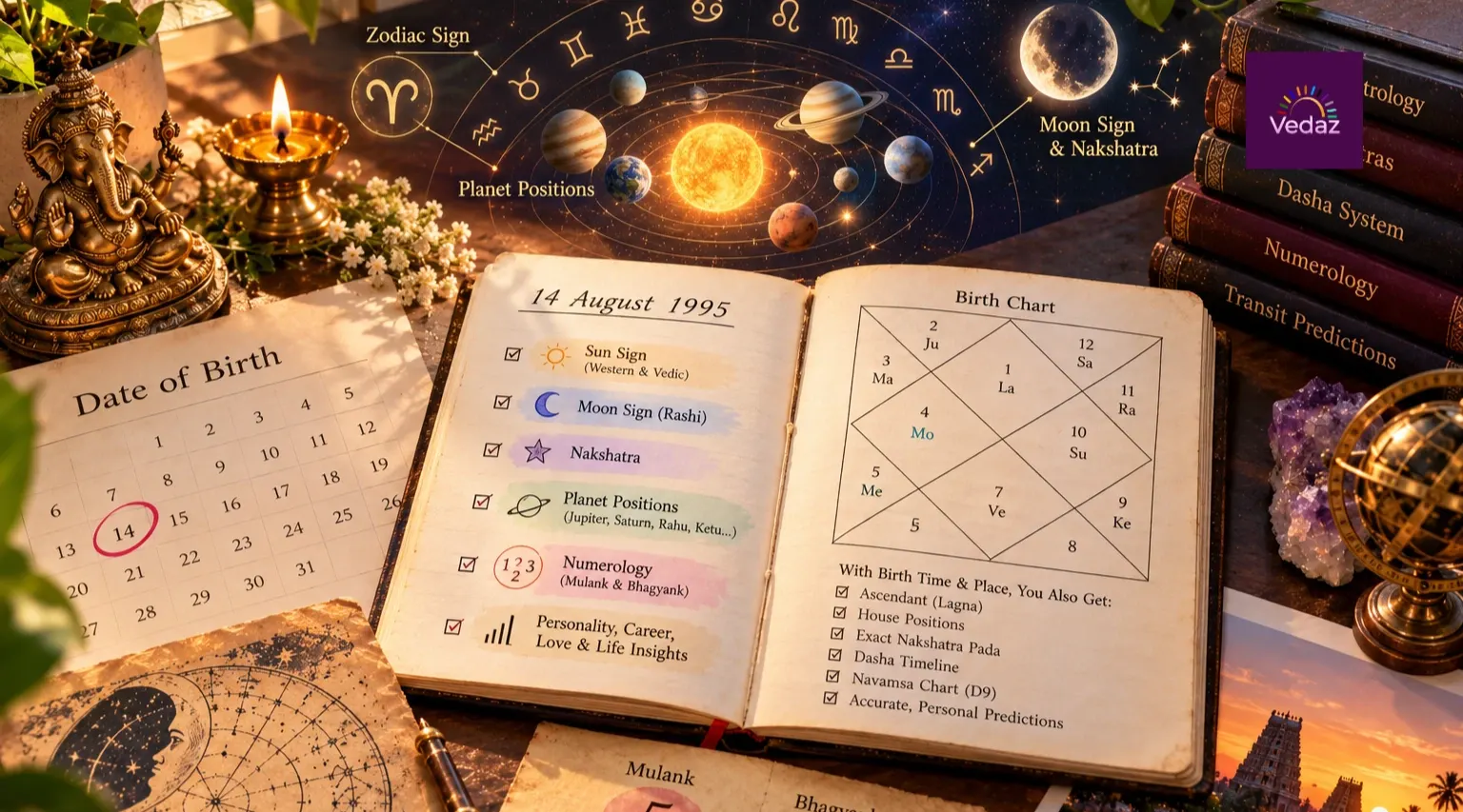
A kundli (also called kundali or janam kundli) is your Vedic birth chart. It is a map of where the Sun, Moon, planets, Rahu and Ketu were at the exact time and place you were born, spread across 12 houses. To make one for free online, type your date, time and place of birth into a kundli calculator. To read it, start with your lagna (Ascendant), your Moon sign and the planets sitting in each house.
- ◦What Is a Kundli?
- ◦What You Need to Make a Kundli
- ◦How to Make Your Kundli Online Free (Step by Step)
- ◦Understanding Kundli Chart Styles
- ◦How to Read Your Kundli: A Step-by-Step Method
- ◦What a Full Kundli Report Includes
- ◦Doshas in Your Kundli: Read Them With Context
- ◦Yogas Worth Knowing in Your Kundli
- ◦Common Mistakes When Making a Kundli Online
- ◦Practical Ways to Use Your Kundli
- ◦The Bottom Line
In most Indian homes, a kundli is made within a few days of a baby's birth. Families use it for the naming ceremony, for choosing studies and careers, for marriage matching, and for picking a good time for big life events. These days, many people make their own kundli online. Searches for "kundli," "kundali" and free kundli online add up to well over half a million every month in India.
But making a kundli is the easy part. Reading it is where most people get stuck. This guide helps with both. You will learn how a kundli is made, what the boxes and numbers mean, how to read your chart step by step, and which parts of a full kundli report matter most.
What Is a Kundli?
A kundli (कुंडली) is a picture of the sky at the moment you were born, as seen from the place you were born. You may also see it spelled kundali, or called janam patrika, janam kundli, jathakam (Telugu/Malayalam) or jathagam (Tamil). All of these mean the same thing.
It shows three things:
- 12 houses (bhavas): Each house stands for one area of life, like self, money, home, marriage and career.
- 12 signs (rashis): These are spread across the houses, starting from your Ascendant.
- 9 grahas: The Sun, Moon, Mars, Mercury, Jupiter, Venus, Saturn, Rahu and Ketu. Each one sits in the house and sign it was in when you were born.
Almost everything else in Vedic astrology comes from this chart. Your rashi, nakshatra, dashas, doshas, yogas and marriage matching are all worked out from your birth chart.
What You Need to Make a Kundli
| Detail | Why it matters |
|---|---|
| Date of birth | Tells us where all the planets were, especially the slow-moving ones |
| Exact time of birth | Decides your lagna (Ascendant), your house positions and the exact Moon degree |
| Place of birth | Gives the latitude, longitude and time zone needed for a correct chart |
Birth time is the detail that matters most. Your Ascendant changes about every two hours. Divisional charts like the Navamsa can change every few minutes. If you can, use the time written on your birth certificate or hospital record.
Don't know your birth time? You can still make a kundli. The planet signs will be right, and your Moon sign will usually be right too. But the houses won't be reliable. An astrologer can try birth-time rectification, which means matching big events in your life to the chart to find the likely birth time. They can also use prashna (horary) astrology to answer one specific question.
How to Make Your Kundli Online Free (Step by Step)
- Open a reliable kundli calculator, like the free Vedaz kundli maker.
- Enter your name. This is optional and only shows on the report.
- Enter your date of birth in the right format.
- Enter your exact time of birth, and don't forget AM or PM.
- Enter your place of birth and pick the correct city from the list, so the coordinates and time zone are right.
- Generate the chart. In a few seconds, you will see your lagna chart, Moon chart, planet positions, nakshatra and dasha periods.
- Save or download your kundli so you can use it later for matching and consultations.
What makes an online kundli accurate?
- Precise planet data. Vedaz uses the Swiss Ephemeris, which is the professional standard for planet positions.
- The right ayanamsa. Vedic charts need a small correction called the ayanamsa. The Lahiri ayanamsa is India's official standard.
- The right time zone and daylight-saving history for your birthplace and birth year.
- The right coordinates for your birthplace.
If two calculators use different ayanamsas, or have weak time-zone data, their charts can differ by a whole sign or a nakshatra. That is why results sometimes don't match from one website to another.
Understanding Kundli Chart Styles
A kundli can be drawn in three regional styles. The information inside is the same. Only the layout changes.
North Indian chart (diamond style)
This style is used across North and Central India. The houses stay fixed. The top middle diamond is always the 1st house (lagna), and the houses go anti-clockwise. The number in each box tells you which sign sits in that house (1 = Aries, 2 = Taurus ... 12 = Pisces). So if the top diamond shows "7," your lagna is Libra.
South Indian chart (square style)
This style is used in Tamil Nadu, Karnataka, Kerala and Andhra Pradesh. The signs stay fixed. Pisces is always in the top-left box, and the signs go clockwise around the square. Your lagna is marked with a diagonal line or the letters "Asc" or "La." Count the houses clockwise from that marked box.
East Indian chart (Bengal/Odisha style)
This is a square split into nine sections, with fixed signs that go anti-clockwise, starting from Aries in the top-middle. The lagna is marked separately.
If you are used to one style, another can feel confusing at first. Most online kundli tools let you pick the format you like.
How to Read Your Kundli: A Step-by-Step Method
Step 1: Find your Lagna (Ascendant)
Look at the 1st house. The sign in it is your lagna. The planet that rules that sign is your lagna lord, and it is one of the most important planets in your chart. Your lagna tells you about your body, your nature and the overall direction of your life.
| Lagna | Lagna lord |
|---|---|
| Mesh / Vrishchik | Mars |
| Vrishabh / Tula | Venus |
| Mithun / Kanya | Mercury |
| Kark | Moon |
| Simha | Sun |
| Dhanu / Meen | Jupiter |
| Makar / Kumbh | Saturn |
What to check: Which house is your lagna lord in? If it sits in the 10th, your life may be centred on career. In the 4th, home and peace of mind matter most. In the 7th, partnerships shape your path.
Step 2: Find your Moon sign (rashi) and nakshatra
Look for Mo, Ch or Chandra in the chart. The sign it sits in is your rashi. You use it for daily rashifal, Sade Sati and your naam akshar. Your kundli report also lists your birth nakshatra and pada. These decide the order of your dashas and are used in kundali matching.
Step 3: Read the houses one by one
Count each house from the lagna. Note which planets are in it and which sign it holds.
| House | Ask yourself |
|---|---|
| 1st | Who am I? Health, personality, direction |
| 2nd | Money, family, speech, food habits |
| 3rd | Courage, siblings, skills, communication |
| 4th | Home, mother, property, inner happiness |
| 5th | Intelligence, education, children, romance |
| 6th | Health problems, debts, competition, service |
| 7th | Marriage, spouse, partnerships |
| 8th | Sudden events, research, inheritance, long life |
| 9th | Luck, father, guru, higher learning, dharma |
| 10th | Career, status, your work in the world |
| 11th | Income, gains, friends, goals |
| 12th | Expenses, foreign lands, sleep, spirituality |
A few groups of houses are good to know:
- Kendras (1, 4, 7, 10) are the pillars of the chart.
- Trikonas (1, 5, 9) are the houses of good fortune.
- Dusthanas (6, 8, 12) are the houses of challenge. They are also houses of growth, research and letting go.
- Upachaya houses (3, 6, 10, 11) get better with time and effort.
Step 4: Check how strong each planet is
How well a planet gives results depends on how comfortable it is in its sign.
| Planet | Exalted in | Debilitated in | Own sign(s) |
|---|---|---|---|
| Sun | Aries | Libra | Leo |
| Moon | Taurus | Scorpio | Cancer |
| Mars | Capricorn | Cancer | Aries, Scorpio |
| Mercury | Virgo | Pisces | Gemini, Virgo |
| Jupiter | Cancer | Capricorn | Sagittarius, Pisces |
| Venus | Pisces | Virgo | Taurus, Libra |
| Saturn | Libra | Aries | Capricorn, Aquarius |
Also look for these:
- Retrograde planets, marked "R."
- Combust planets, which sit too close to the Sun.
- Conjunctions, where two or more planets share a house.
A weak (debilitated) planet is not simply "bad." Classical rules called neecha bhanga often cancel the weakness.
Step 5: Look at aspects (drishti)
In Vedic astrology, every planet looks at the 7th house from where it sits. Some planets have extra aspects:
- Mars also aspects the 4th and 8th houses.
- Jupiter also aspects the 5th and 9th.
- Saturn also aspects the 3rd and 10th.
- Many astrologers give Rahu and Ketu the 5th and 9th as well.
Aspects show how a planet can affect houses it doesn't sit in. Jupiter's aspect is seen as protective wherever it falls.
Step 6: Check the Navamsa (D9)
The Navamsa splits each sign into nine parts. It is the most important divisional chart. It shows the inner strength of your planets, and it is the key chart for marriage and dharma. A planet that looks weak in your main chart but strong in the Navamsa often gives good results over time. The opposite can happen too. When a planet is in the same sign in both charts, it is called vargottama, and it is considered strong.
Step 7: Find your current dasha
Your kundli report lists your Vimshottari dasha. This shows which planet's mahadasha and antardasha you are running right now. It is the most useful timing tool in Vedic astrology. Say you are in a Venus mahadasha. Look at where Venus sits in your chart and which houses it rules. Those areas of life will be the most active.
What a Full Kundli Report Includes
| Section | What it tells you |
|---|---|
| Lagna (D1) chart | Your main birth chart, the base for everything else |
| Chandra chart | A chart with the Moon as the 1st house, used for transits and rashifal |
| Navamsa (D9) | Marriage, inner strength, dharma |
| Dashamsa (D10) | Career and profession |
| Saptamsa (D7) | Children |
| Hora (D2) | Wealth |
| Planetary table | Sign, degree, nakshatra, pada and retrograde status of each planet |
| Vimshottari dasha | Planet periods with exact dates |
| Ashtakavarga | A number score for the strength of each house and planet |
| Dosha checks | Manglik, Kaal Sarp, Pitra and Sade Sati status |
| Yogas | Raja, Dhana, Gaja Kesari and other combinations |
Doshas in Your Kundli: Read Them With Context
Online kundlis often show doshas in big, bold boxes. Here is what each one means in simple words, and why none of them should make you panic.
- Manglik (Mangal) dosha: Mars sits in the 1st, 2nd, 4th, 7th, 8th or 12th house. It is very common and has many cancellations. It matters mostly for marriage matching.
- Kaal Sarp dosha: All seven planets fall between Rahu and Ketu. Traditions differ a lot on what this means, and many classical texts don't mention it at all. The result depends on the whole chart.
- Sade Sati: Saturn's 7.5-year journey over the 12th, 1st and 2nd houses from your Moon. It is a time of growing up and taking on responsibility. It is not a punishment.
- Pitra dosha: A sign of ancestral karma, often linked to the Sun, Rahu and the 9th house. It is traditionally handled through shraddha and charity.
Every dosha in classical astrology comes with conditions that cancel it. If a calculator or an astrologer points out a dosha without checking for cancellations, or jumps straight to an expensive puja, get a second opinion. Fear is not a diagnosis.
Yogas Worth Knowing in Your Kundli
- Raja Yoga: The lords of a kendra and a trikona are connected. It is linked to status and success.
- Dhana Yoga: The lords of the 2nd, 5th, 9th and 11th houses are connected. It is linked to wealth.
- Gaja Kesari Yoga: Jupiter sits in a kendra from the Moon. It brings wisdom and a good name.
- Budhaditya Yoga: The Sun and Mercury sit together. It is linked to sharp thinking.
- Panch Mahapurusha Yogas: Mars, Mercury, Jupiter, Venus or Saturn sits in its own or exalted sign in a kendra. These are the Ruchaka, Bhadra, Hamsa, Malavya and Shasha yogas.
- Vipreet Raja Yoga: The lords of the 6th, 8th and 12th houses sit in each other's houses. It brings success after hard times.
Yogas mostly show their results during the dashas of the planets that form them.
Common Mistakes When Making a Kundli Online
- AM/PM errors. If you type 7:30 instead of 19:30, your lagna changes completely. Check it twice.
- Picking the wrong city. A town with the same name in another state changes the coordinates, and sometimes the time zone too.
- Using registration time instead of birth time. Hospital records are usually more accurate than municipal certificates.
- Ignoring old time zones. Births in India before 1947, or in countries with daylight saving, need careful time-zone handling. A good calculator does this for you.
- Comparing charts with different ayanamsas. A Western (tropical) chart and a Vedic (sidereal) chart show different signs for the same planets. Always compare like with like.
Practical Ways to Use Your Kundli
- Know your Moon sign so you can read the right daily rashifal.
- Understand your strengths through your lagna, lagna lord and strong planets.
- Plan around your dashas. For example, use a supportive Jupiter period for study or growth.
- Get ready for Sade Sati with discipline, not fear.
- Match for marriage using your nakshatra and full chart through kundli matching.
- Pick muhurats for important events using your chart along with the panchang - panchang.
- Ask clear questions, like "When is a good time to change jobs?", and get answers based on your own chart from Vedaz, the Vedaz AI astrologer.
The Bottom Line
Your kundli is the base of Vedic astrology. It is a clear snapshot of the sky at the moment you were born. Making it online takes about a minute. Reading it is a skill you can build one step at a time: lagna, Moon, houses, planet strength, aspects, Navamsa and dashas. Read it with curiosity, not fear, and it can guide you for life by showing your strengths and your timing.
Make your free kundli now, match it with a partner's through kundli matching, or ask Vedaz to walk you through your chart.
Aarav Sharma
Vedic astrology, Kundli interpretation, planetary placements | 12 years
Aarav Sharma specializes in Vedic astrology and birth-chart interpretation, explaining planetary placements, houses, and traditional astrological principles in accessible language.
Frequently Asked Questions
1. What is a kundli?
A kundli is your Vedic birth chart. It is a map of where the Sun, Moon, planets, Rahu and Ketu were at your exact time and place of birth, placed across 12 houses and 12 signs. All personal Vedic astrology readings are based on it.
2. How can I make my kundli online for free?
Enter your date of birth, exact time of birth and place of birth in a free online kundli calculator. It will instantly give you your lagna chart, Moon sign, nakshatra, Navamsa, dasha periods and dosha checks.
3. Can I make a kundli without birth time?
Yes, but only in part. The planet signs, and usually your Moon sign, will be correct. But your Ascendant and house positions won't be reliable. An astrologer can try birth-time rectification or use prashna astrology.
4. What is the difference between kundli and kundali?
There is no difference. Kundli, kundali, janam kundli and janam patrika are different spellings and names for the same Vedic birth chart.
5. How do I read my kundli?
Start with your lagna (the 1st house) and its lord. Then find your Moon sign and nakshatra, and read the planets in each house. After that, check each planet's strength and aspects, look at the Navamsa chart, and finally note the Vimshottari dasha you are running now.
Related Blogs

Dreaming of moving abroad? Check Foreign Travel Astrology
Is your destiny written in the stars? Discover if the universe is guiding you toward a life abroad!

The Best Places to Travel Abroad Foreign Travel Astrology
Is foreign travel written in your stars? Explore how astrology influences your journeys and uncover the best destinations for your zodiac sign!

Can Your Birth Chart Predict Depression Symptoms?
This article examines whether astrological birth charts can predict depression symptoms, contrasting astrological beliefs with psychological research on personality traits and mental health.
The Manifestation Secrets Hidden in Celebrity Birth Charts
Find out what makes fame unique and special. This guide lets you know how some of the biggest celebrities use planetary help to become successful—and how you can do the same.