Kundli Matching for Marriage: 36 Points, Doshas & Meaning
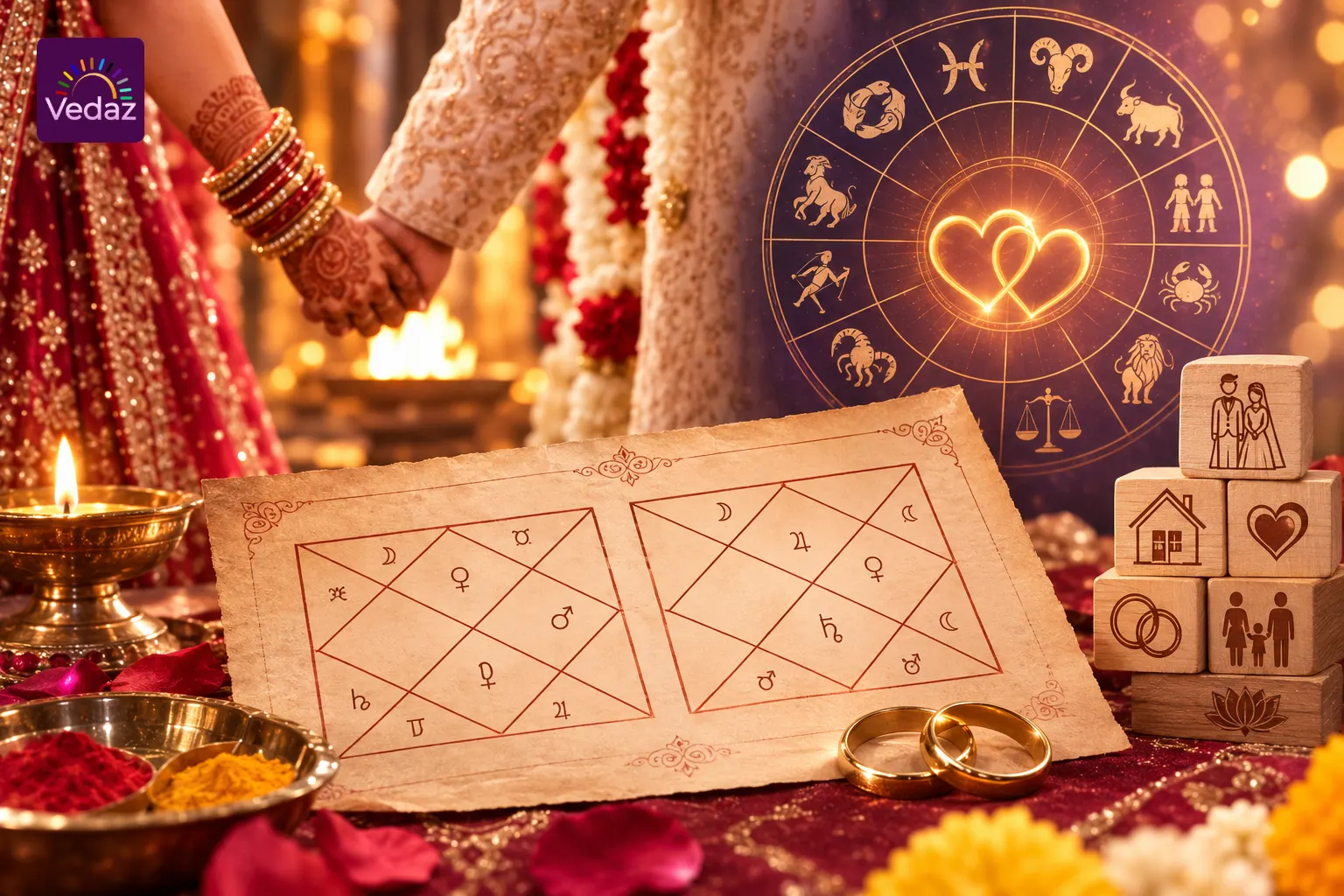
Kundli matching uses the Ashtakoot Guna Milan system — eight compatibility factors scored out of 36. Nadi alone carries 8 points and is the single most heavily weighted koota. A score of 18 or above is the classical minimum; 24 to 31 is considered a good match. Dosha checks run separately from the score.
- ◦What is Kundli Matching in Vedic Astrology?
- ◦The 8 Kootas of Ashtakoot Guna Milan: What Each Factor Actually Measures
- ◦How to Read a Kundli Matching Score Out of 36
- ◦Beyond Guna Milan: The Doshas That Kundli Matching Must Also Evaluate
- ◦What Classical Vedic Astrology Texts Actually Say About Marriage Compatibility
- ◦What to Do if Your Kundli Matching Score is Low
- ◦Modern Critiques of Kundli Matching (and Honest Answers)
- ◦Get a Complete Kundli Match on Vedaz — Not Just a Score
- ◦Final Thought
More than a billion people still treat kundli matching as a serious step before marriage. And honestly? Done well, it holds up. It's a thoughtful way to surface real compatibility risks before two people commit their lives to each other.
The problem is that most online kundli matching isn't done well. It spits out a number out of 36, slaps a "good match" or "bad match" label on it, and calls it a day. Families then treat that number like a verdict — when in reality, it's barely the beginning of the analysis.
This guide covers what kundli matching actually checks, how the Guna Milan scoring works, which doshas get evaluated alongside it, and the things classical Vedic astrology says matter for marriage that a score alone will never tell you.
Quick Answer: What Does a Kundli Match Actually Check?
- Ashtakoot Guna Milan — 8 factors scored out of 36 covering temperament, instinct, biology, and emotional compatibility
- Mangal Dosha — whether Mars creates marital friction in either chart, and whether it's cancelled
- Nadi Dosha — whether both partners share the same constitutional Nadi (the most seriously weighted dosha)
- Bhakoot Dosha — whether Moon sign positions create a hostile 6/8 or 2/12 relationship
- Dasha compatibility — whether planetary periods overlap destructively in the early years of marriage
- 7th house analysis — whether each chart is independently set up for a healthy marriage, before compatibility is even layered on
What is Kundli Matching in Vedic Astrology?
Kundli matching — also called Kundli Milan or Horoscope Matching — is the Vedic process of comparing two birth charts to assess how compatible two people are for marriage. The most common method is Ashtakoot Guna Milan: an eight-factor system that produces a score out of 36.
Traditionally:
- 18 or above is the minimum for a viable match
- 24 to 32 is considered good
- Above 32 is excellent
But the score is just the headline. A complete kundli match also looks at Mangal Dosha, Nadi Dosha, Bhakoot Dosha, and the 7th house in both charts independently. A 30/36 score with an unresolved Nadi Dosha is actually more worrying than a 22/36 where everything else is clean. The number alone doesn't tell you that — which is exactly why people need to stop stopping at the number.
To understand how planets and houses govern marriage in the first place, marriage in astrology: planets and houses gives the foundational context that makes every koota score more readable.
The 8 Kootas of Ashtakoot Guna Milan: What Each Factor Actually Measures
Ashtakoot means "eight categories." Each one measures a different dimension of compatibility, and each carries a different weight. The total possible across all eight is 36.
| Koota | Points | What It Measures |
|---|---|---|
| 1. Varna | 1 | Spiritual and ego compatibility — the broad nature of both partners |
| 2. Vashya | 2 | Mutual influence and dominance dynamics in the relationship |
| 3. Tara | 3 | Health and wellbeing compatibility based on nakshatra positions |
| 4. Yoni | 4 | Sexual and instinctual compatibility (based on the animal symbols of each nakshatra) |
| 5. Graha Maitri | 5 | Mental and intellectual compatibility; friendship between rashi lords |
| 6. Gana | 6 | Temperament — Deva (godly), Manushya (human), or Rakshasa (fierce) nature |
| 7. Bhakoot | 7 | Emotional, financial, and family compatibility based on rashi positions |
| 8. Nadi | 8 | Genetic, biological, and progeny compatibility — the most heavily weighted of all |
A few things jump out when you look at this table carefully.
Yoni and Nadi together carry 12 of the 36 points — a full one-third of the total weight sitting on biological and instinctual compatibility alone. Nadi by itself is worth 8 points — a single mismatch there can drag a score below 18 even if everything else is perfectly aligned.
Meanwhile, Varna and Vashya together are worth just 3 points, and many modern astrologers de-emphasize them anyway since they map to ancient social structures that don't apply the same way today.
The Yoni koota deserves particular attention because it is misunderstood more than any other factor. It isn't purely a measure of physical intimacy — it maps deep instinctual compatibility using each nakshatra's animal symbol, covering how two people's baseline natures interact under pressure. The Yoni matching importance in Kundli Milan guide covers exactly how this scoring works and which pairings are naturally harmonious versus hostile.
Similarly, the Graha Maitri koota — the 5-point factor measuring mental compatibility — works through the relationship between each partner's rashi lord. A high Graha Maitri score means two people are naturally inclined toward understanding each other's thinking.
A low one creates a subtle but persistent friction in communication that no amount of goodwill fully resolves. For a deeper read on how planetary friendships and Graha Maitri specifically shape long-term marital dynamics, Graha Maitri matching and its impact on marriage is the detailed reference.
How to Read a Kundli Matching Score Out of 36
| Score | What It Means |
|---|---|
| Below 18 | Traditionally considered unfavourable. Worth a closer look before proceeding. |
| 18–23 | Acceptable, but with caveats. Worth knowing which specific kootas are pulling the score down. |
| 24–31 | Good match. Most arranged-marriage astrologers treat this as a confident green light. |
| 32–36 | Excellent. Rare in practice. Usually comes with strong Nadi and Bhakoot scores. |
Here's the thing though — the total score can be genuinely misleading without context. Two couples can both score 26/36 with completely different distributions. One might have strong Nadi and Bhakoot but weak Graha Maitri. The other, the reverse. The first will hold up biologically; the second emotionally. The total number tells you neither of those things. You need the breakdown.
Beyond Guna Milan: The Doshas That Kundli Matching Must Also Evaluate
A complete kundli match goes well beyond the Ashtakoot score. Here are the additional checks any serious astrologer runs.
1. Mangal Dosha (Manglik Check) in Kundli Matching
If Mars sits in the 1st, 2nd, 4th, 7th, 8th, or 12th house in either partner's chart, Manglik Dosha is present. The classical correction is to match a Manglik with a Manglik — the doshas neutralize each other — or to look for natural cancellations like Mars in its own sign, a Jupiter aspect, or both partners being over 28.
For matchmaking specifically, the questions to answer are:
- Is the dosha present?
- Is it cancelled by any classical parihar condition?
- Does the partner's chart carry enough strength to handle it?
The way Mars behaves specifically in the marriage house matters enormously here. Mars in 7th house and its impact on marriage breaks down exactly what a 7th-house Mars placement means for the relationship, and when it's genuinely serious versus when it's a routine flag.
2. Nadi Dosha: The Most Seriously Weighted Compatibility Risk
Nadi Dosha happens when both partners share the same Nadi — Adi (Vata), Madhya (Pitta), or Antya (Kapha). It's considered the most serious dosha in matchmaking because of its traditional link to biological compatibility and children. A Nadi mismatch alone costs 8 points, and many traditional families will walk away from a match on this basis alone.
That said — classical texts list specific cancellations:
- Same nakshatra with different padas
- Same rashi with different nakshatras
- Certain nakshatra combinations that explicitly nullify the dosha
A flagged Nadi Dosha should always be checked for cancellation before anyone treats it as final. The full mechanics — including which specific combinations cancel the dosha — are in Nadi Dosha in Kundli and its solutions.
3. Bhakoot Dosha: Emotional and Financial Compatibility Risk
Bhakoot Dosha occurs when the Moon signs of both partners fall in a 6/8 or 2/12 position from each other. It's worth 7 points, and it's associated with financial strain, family discord, and difficulties around children. Cancellations exist here too — when both nakshatra lords are friends, or when both partners are in the same nakshatra. Bhakoot Dosha effects and marriage remedies covers every classical cancellation condition and what the dosha actually predicts in practical terms.
4. Dasha Compatibility: The Check Most Online Tools Completely Skip
Two charts can score beautifully on Ashtakoot and still go through a genuinely rough patch together if both are running difficult mahadashas in the early years of marriage. A serious astrologer looks at the upcoming dasha sequence for both partners and flags any turbulent overlaps — a Saturn dasha colliding with a Rahu dasha in the first five years, for instance.
This is invisible in the Guna Milan score and almost never shown in free online tools. But it matters enormously.
5. The 7th House and Venus/Jupiter Analysis in Each Chart
Beyond compatibility, each chart gets read independently first. A 7th house under heavy malefic pressure, or an afflicted Venus in a man's chart (or Jupiter in a woman's), can generate friction even in a high-scoring match. This is why a serious matchmaker reads each chart on its own merits before layering compatibility on top. The score only tells you how the charts interact — not whether each chart is independently set up for a healthy marriage.
If you're looking at your own birth chart and want to understand what best nakshatra combinations for marriage look like from the Nakshatra angle — which pairings consistently perform well across all the kootas — that guide gives the practical reference.
What Classical Vedic Astrology Texts Actually Say About Marriage Compatibility
The classical texts — Brihat Parashara Hora Shastra, Bhrigu Samhita, Muhurta Chintamani — all treat the Guna Milan score as a triage tool. A starting point. Not a conclusion.
The deeper question they direct astrologers toward is whether the two charts have compatible life trajectories: similar dharmic orientation, complementary strengths, dasha sequences that don't collide destructively at the wrong moments.
As Bhrigu Samhita puts it: "Compatibility is not a number. It is the meeting of two destinies whose karmic flows do not obstruct each other."
A 26/36 score, in this light, is the beginning of a serious analysis. Not the end of one.
If you're exploring whether there are also love marriage yogas in your chart — astrological combinations that indicate the chart itself supports a self-chosen union — love marriage yoga in horoscope signs: is your destiny written in the stars covers those placements in full.
For personalized guidance that interprets both your score breakdown and your individual chart's marriage indicators together, Shubha — Vedaz's AI marriage astrologer reads kundli matching results in the context of your full chart, explains doshas with cancellations, and gives you a clear picture of what the numbers actually mean for your specific situation — free.
What to Do if Your Kundli Matching Score is Low
A low score doesn't automatically mean don't marry. It means specific dimensions need attention. The right questions to ask next are:
- Which kootas are scoring low? Mental? Biological? Temperament? Each one points to a different kind of friction — and a different kind of preparation.
- Are there cancellations active for the doshas? Most online tools skip this entirely. It's where a lot of the actual signal lives.
- How do the dasha periods overlap in the first 7 to 10 years? The early years of a marriage are often the most critical, and hostile dasha overlaps in that window deserve serious attention.
- What does each partner's 7th house say about their own marital wiring? Commitment style, conflict patterns, emotional temperament — these show up in the individual chart before you even look at compatibility.
- Are there classical remedies suggested for this specific profile? Mantra practices, Vivah Sanskar adjustments, gemstones — the tradition doesn't just flag problems, it also offers responses to them.
Modern Critiques of Kundli Matching (and Honest Answers)
"Isn't this just a way to reject alliances on the basis of superstition?"
Sometimes, honestly, yes. The Manglik label and Nadi Dosha have both been used as convenient excuses to reject matches that families wanted to reject for unrelated reasons. But that's a social misuse of the system, not the system itself. The classical tradition is considerably more nuanced — cancellations exist for almost every dosha, and the texts consistently emphasize the full chart over individual flags.
"What if our score is low but we're already in love?"
A low score is information, not a sentence. Couples who marry across low Ashtakoot scores often do perfectly well — especially when they're aware of which specific kootas flagged friction and go in with eyes open. What causes problems isn't the friction itself. It's pretending it isn't there.
"Is online kundli matching actually reliable?"
The math is standardized — any reputable tool will produce the same score. What varies wildly is depth. Most free tools give you the Ashtakoot total and nothing else. They skip Mangal Dosha cancellations, dasha compatibility, and the 7th-house read. That's precisely where the most useful information lives. Use a tool that goes beyond the score.
Get a Complete Kundli Match on Vedaz — Not Just a Score
Vedaz runs the full Ashtakoot Guna Milan, evaluates Mangal Dosha (with all classical cancellations), checks Nadi and Bhakoot Dosha, maps dasha overlap across the first ten years of marriage, and reads each 7th house independently — then explains everything in plain English. Free, in under 60 seconds.
Run your complete Kundli Matching on Vedaz — get the full analysis, not just a number →
Final Thought
Kundli matching isn't magic. It's a structured framework for thinking about compatibility across eight dimensions that every couple — with or without astrology — eventually has to navigate anyway. The Indian tradition just codified those dimensions into a checklist long before psychology or genetics had words for them.
Run the match. Get the score. But then actually read the breakdown. Look at the cancellations. Check the doshas. Look at the dashas. The number is the easiest part of your match to calculate — and the least useful thing to base a decision on.

Tarot Ruchika
Vedic, Tarot, Numerology, Vastu, Crystal reading | 3 years
Tarot Ruchika is a practitioner of Vedic Astrology, Tarot, Numerology, Vastu, and Crystal Reading. She specializes in helping people find clarity in new beginnings, personal growth, and important life decisions while staying grounded and patient through the process.
Frequently Asked Questions
1. What is a good kundli matching score for marriage?
Traditionally, 18/36 is the minimum acceptable threshold. 24 to 31 is a good match. 32 and above is excellent. But the score alone is incomplete — a 28/36 with an active Nadi Dosha is more concerning than a 22/36 where every dosha is clean.
2. Can I marry someone with a low kundli matching score?
Yes. A low score flags specific friction areas — it doesn't predict failure. Many couples who marry across low scores do well, especially when they understand which kootas underperformed and go in prepared. The score is diagnostic, not deterministic.
3. Is Nadi Dosha really that serious in kundli matching?
In classical texts, yes — it's the most heavily weighted koota at 8 points. But cancellations exist: same nakshatra with different padas, same rashi with different nakshatras, and certain specific nakshatra combinations that nullify the dosha entirely. Always check for cancellation before treating a Nadi flag as final.
4. What is the difference between Guna Milan and Kundli Matching?
Guna Milan is the 36-point Ashtakoot scoring system. Kundli matching is the broader process — it includes Guna Milan, plus dosha checks, dasha compatibility, and an independent read of both 7th houses. Guna Milan is one part of a full kundli match.
5. Do horoscope matches really predict marriage success?
They predict structural compatibility, which is different from marriage success. Communication style, individual maturity, life circumstances — none of that is in either chart. What the matching does flag is whether two people's temperaments, biological rhythms, and life trajectories are likely to create friction. That's useful information, whatever weight you choose to give it.
6. What should I do if my partner is Manglik but I'm not?
First, check whether the dosha is actually active — it should show from Lagna, Chandra, and Venus for full effect. Then check whether classical cancellations apply. If it's fully active and uncancelled, classical advice is either to match with another Manglik or to follow specific remedial steps before marriage.
7. Can two Manglik partners cancel each other's dosha in kundli matching?
Yes — this is the most widely accepted classical cancellation. Two Manglik charts paired together neutralize each other's Mars affliction. Traditional matchmaking actively looks for this pairing when both partners carry a strong Manglik Dosha.
More by this writer

606 Angel Number: A Divine Reminder to Prioritize What Truly Matters
Unlock the 606 Angel Number secrets! Learn its spiritual meaning, love, family, and career guidance for a balanced, harmonious life.
Marriage in Astrology: Planets and Houses
Explore planets and houses behind marriage in astrology. Understand 7th house, mangal dosha, love marriage signs, and marriage problem solutions.

Top Shubh Muhurat Dates in May 2026
Know the inauspicious dates in May 2026 to avoid marriage, griha pravesh, business, and property. Stay safe from ashubha yoga timings.
1414 Angel Number Meaning: A Sign to Build Your Life Right
1414 is a powerful sign that your steady effort is finally taking shape. Discover what this angel number reveals about stability, love, and the strong foundation you are building right now.
Related Blogs

Dreaming of moving abroad? Check Foreign Travel Astrology
Is your destiny written in the stars? Discover if the universe is guiding you toward a life abroad!
The Best Places to Travel Abroad Foreign Travel Astrology
Is foreign travel written in your stars? Explore how astrology influences your journeys and uncover the best destinations for your zodiac sign!

Can Your Birth Chart Predict Depression Symptoms?
This article examines whether astrological birth charts can predict depression symptoms, contrasting astrological beliefs with psychological research on personality traits and mental health.
The Manifestation Secrets Hidden in Celebrity Birth Charts
Find out what makes fame unique and special. This guide lets you know how some of the biggest celebrities use planetary help to become successful—and how you can do the same.