Are You Manglik? Full Guide to Dosha, Marriage & Remedies
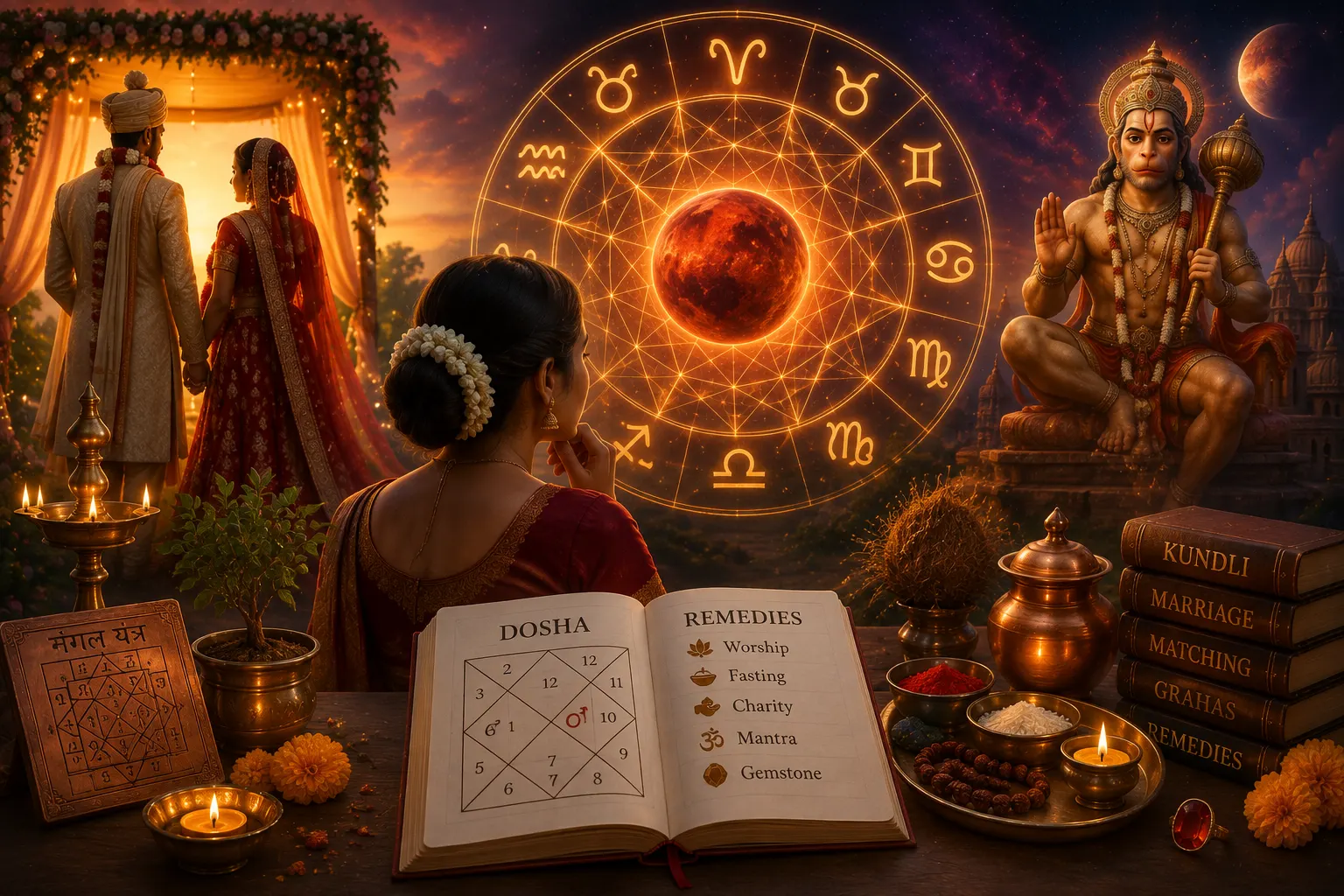
Manglik Dosha occurs when Mars sits in the 1st, 2nd, 4th, 7th, 8th, or 12th house of your Vedic birth chart. It affects roughly 50% of all charts. Classical texts list multiple cancellation conditions — most people flagged as Manglik are never told about them.
- ◦What is Manglik Dosha?
- ◦The 6 Houses That Cause Manglik Dosha
- ◦How to Check if You Are Manglik (3 Steps)
- ◦The Crucial Part Most People Are Never Told: Cancellation (Mangal Dosha Parihar)
- ◦Anshik vs. Purna Mangal Dosha
- ◦Does Manglik Dosha Actually Affect Marriage?
- ◦Remedies That Are Traditionally Recommended
- ◦What Modern Vedic Astrology Says About Manglik Dosha
- ◦Manglik Dosha Doesn't Define You — Your Full Chart Does
- ◦Get a Free, Full Manglik Dosha Analysis on Vedaz
- ◦Final Thought
Almost every Indian family with a marriageable child hits the same wall at some point. Someone in the family says it — sometimes quietly, sometimes loudly: "We need to check for Manglik Dosha." In some homes it's a five-minute conversation. In others, it derails an entire alliance — a perfectly good match shelved because of a single word.
The problem isn't that people take it seriously. The problem is that most of what circulates about Manglik Dosha — in family WhatsApp groups, in aunties' advice, in casual astrologer consultations — is either wrong, half-remembered, or based on rules that the classical texts themselves say can be cancelled.
This is a straightforward guide to what Manglik Dosha actually is, how to check whether you have it, when it genuinely matters, and what Vedic astrology really says about cancellation. Most readers have never been told the full picture. And if you're also curious about how marriage is read in the broader chart, that context will make everything here click faster.
What is Manglik Dosha?
Manglik Dosha — also called Mangal Dosha or Kuja Dosha — happens when Mars sits in specific houses of your Vedic birth chart. If Mars is in your 1st, 2nd, 4th, 7th, 8th, or 12th house, you're considered Manglik.
The traditional concern is that Mars' fiery energy in these positions creates friction in marriage — delays, conflict, and in the more extreme classical readings, danger to the spouse.
Here's the thing though: roughly 50% of all charts have Mars in one of those six houses. That means about half the population is technically Manglik. And yet half of all marriages involve Mangliks, and most of them turn out just fine. That statistic alone should tell you something — the dosha by itself is not the crisis most families treat it as.
The 6 Houses That Cause Manglik Dosha
| House | Why Mars There Causes Concern |
|---|---|
| 1st (Lagna) | Self and personality — Mars here makes someone aggressive, headstrong, quick to argue |
| 2nd | Family and speech — friction with in-laws, harsh words, money disputes |
| 4th | Home and emotional foundation — domestic unrest, instability at home |
| 7th | The marriage house itself — the most direct hit; conflict with the spouse |
| 8th | Longevity and transformation — traditionally linked to health concerns for the spouse |
| 12th | Bed pleasures and isolation — distance, separation, intimacy issues |
Note: Some classical traditions also include the 5th house for what they call "high-grade" Manglik Dosha. Most modern astrologers work with the six houses above.
If you want to understand how Mars specifically behaves when placed directly in the marriage house, the detailed breakdown of Mars in 7th house and its impact on marriage is worth reading alongside this.
How to Check if You Are Manglik (3 Steps)
- Generate your Vedic birth chart using accurate birth time (sidereal / Lahiri ayanamsa).
- Find Mars — it'll be marked as Ma or labelled in the chart.
- Check which house it sits in. If it's the 1st, 2nd, 4th, 7th, 8th, or 12th — you're technically Manglik.
Now here's something most online checkers quietly skip: classical texts say Manglik Dosha should be checked from three reference points — your Lagna (rising sign), your Chandra Lagna (Moon sign), and your Venus position. If Mars falls in those critical houses from any of the three, the dosha is considered active. Some traditions weight Lagna most heavily; others treat Chandra as equally important.
Check all three. Anything less is an incomplete reading.
If you're new to reading a birth chart and need a foundation before running this check, how to read kundli for beginners will walk you through the basics clearly.
The Crucial Part Most People Are Never Told: Cancellation (Mangal Dosha Parihar)
This is the part that almost never makes it into casual family conversations.
Classical Vedic astrology has detailed rules for when Manglik Dosha is automatically cancelled or significantly reduced. The dosha is rarely absolute. Here are the most widely accepted cancellation conditions:
- Both partners are Manglik. The doshas neutralize each other. This is the most common and broadly accepted parihar in matchmaking.
- Mars is in its own sign or exalted sign — Aries, Scorpio, or Capricorn. Mars is comfortable here, and the dosha's harmful effect is substantially reduced.
- Mars is conjoined or aspected by Jupiter or the Moon. Jupiter especially is the great pacifier in Vedic astrology. Its aspect on Mars softens the dosha considerably. A strong Jupiter in the horoscope is one of the most reliable buffers against Manglik Dosha severity.
- Specific sign-house combinations — Mars in the 2nd house in Gemini or Virgo, or in the 12th in Taurus or Libra. Classical texts list these as automatic cancellations.
- The native is older than 28. Several traditions — particularly North Indian schools — reduce the weight of Manglik Dosha after age 28.
- Saturn aspects Mars. Saturn's discipline restrains Mars' aggression. Treated as a partial cancellation in many schools.
When someone tells you a chart is "Manglik" without mentioning any of this, the analysis is incomplete. A serious astrologer always checks for parihar before drawing conclusions.
Anshik vs. Purna Mangal Dosha
Not all Manglik Doshas are the same. The tradition grades them by intensity.
- Anshik (partial) — Mars is in a dosha house but with mitigating factors: a benefic aspect, a friendly sign, or the dosha showing up from only one of the three reference points. Most Mangliks fall here.
- Purna (complete) — Mars is in a dosha house from all three reference points, sitting in a difficult sign, with no benefic aspect softening it. This is rarer than most family conversations suggest. And even then, it's not a verdict. It's a flag — one that calls for a careful match, not a panic.
This grading applies to other doshas in matchmaking too. If you're going through Kundli Milan and want the full picture, reading about Nadi Dosha effects and how to remove it and Bhakoot Dosha effects and marriage remedies will help you understand how the tradition weighs doshas against each other — and when they genuinely matter.
Does Manglik Dosha Actually Affect Marriage?
Honest answer: it depends.
It depends on how strong the dosha is, whether cancellations are present, and how the partner's chart interacts with yours.
What the tradition does suggest — based on classical case studies — is this: a strong, uncancelled Manglik Dosha, especially Mars in the 7th or 8th house in a hostile sign with no Jupiter aspect, does correlate with marital friction. A weak, cancelled, or mitigated Manglik Dosha is mostly a label without real consequence.
The mistake families make is treating any Manglik flag as though it were the strongest version possible.
A Manglik label is the start of the analysis. Not the end of it. The next questions are: how strong is it, what's cancelling it, and what does the partner's chart bring to the equation? For a fuller compatibility view, Graha Maitri matching and its impact on marriage addresses the planetary friendship dimension that often determines whether two charts can sustain each other long-term.
If you want a marriage astrologer who can assess all of this in your specific chart, Shubha — Vedaz's AI marriage astrologer runs full compatibility checks including Manglik Dosha from all three reference points, cancellation evaluation, and dasha compatibility — free.
Remedies That Are Traditionally Recommended
If a chart shows a strong, uncancelled Manglik Dosha, classical Jyotish does offer remedies. Whether you take these literally or symbolically is entirely your call — we're just reporting what the tradition says.
- Kumbh Vivah — a symbolic marriage of the Manglik native to a peepal tree, banana tree, or clay pot before the actual wedding. The idea is that this "absorbs" the first-marriage difficulty.
- Mangal Mantra — chanting Om Angarakaya Namah or the Mangal Beej Mantra on Tuesdays.
- Hanuman Chalisa — daily recitation, especially on Tuesdays. Hanuman is considered the deity who pacifies Mars.
- Donations on Tuesdays — red lentils, red cloth, jaggery, or copper.
- Red coral (moonga) gemstone — only after consulting a competent astrologer. Coral isn't universally indicated and can make things worse if Mars is already afflicted.
- Fasting on Tuesdays — a traditional practice associated with Mars pacification.
The Ruchaka Yoga effects in all houses is also worth reading here — it's the flip side of Mars in strong positions, and understanding both helps you see Mars placements in their full range rather than only through the dosha lens.
What Modern Vedic Astrology Says About Manglik Dosha
Among working astrologers today, the general position is roughly this:
- Manglik Dosha is real — but it's heavily over-diagnosed in casual matchmaking.
- Cancellation rules matter at least as much as the dosha itself.
- A full compatibility check — Ashtakoot Guna Milan, Mangalya Dosha analysis, dasha compatibility — is far more meaningful than a single dosha flag.
Rejecting a match purely on the basis of an uncancelled Anshik Manglik Dosha is, in most cases, an overreaction. Rejecting a match based on a strong Purna Manglik Dosha — when the partner's chart genuinely can't absorb it — may actually be the right call.
The nuance lives in between. That's where the real analysis happens. The best Nakshatra combinations for marriage gives you another layer of that picture — Nakshatra matching often reveals compatibility signals that a dosha-only reading misses entirely.
Manglik Dosha Doesn't Define You — Your Full Chart Does
Manglik Dosha is one of the most misunderstood and overfeared placements in Vedic astrology — but its real impact depends entirely on your Lagna, Mars placement, and the broader chart context. If you're an Aries Lagna or Scorpio Lagna, Mars is your chart ruler, which fundamentally changes how Manglik Dosha expresses itself in your marriage prospects — often cancelling or significantly reducing its malefic effects.
Timing matters just as much as placement. If you're currently running a Mars Mahadasha, Manglik themes around relationships, conflict, and independence will surface with far greater intensity — making it critical to assess the Dosha in context of your active dasha, not in isolation.
Manglik Dosha is one factor in a much larger compatibility picture. Before making any marriage decision based on it alone, explore the full Compatibility Beyond Kundli framework to understand what your chart is truly saying about your partnership potential.
Get a Free, Full Manglik Dosha Analysis on Vedaz
Vedaz checks Manglik Dosha from all three reference points — Lagna, Chandra, and Venus — evaluates every classical cancellation, grades the dosha as Anshik or Purna, and explains the full result in plain English. Not a yes/no scare label.
Try Kundali Matching free at Vedaz →
Final Thought
Manglik Dosha is one of the most misunderstood ideas in popular Vedic astrology. The label gets thrown around the way "type A personality" gets thrown around in the West — with a lot of feeling and not much precision.
The classical tradition itself is actually far more measured than the family-WhatsApp version. It identifies the dosha, yes — but then it immediately spells out half a dozen ways to cancel or reduce it. That nuance just tends to get lost somewhere between the astrologer's mouth and the family group chat.
If you've been told you're Manglik and you're sitting with anxiety about your marriage prospects — do the full analysis first. Half the time, the dosha is already cancelled by something the casual reading never bothered to check.
Check your free Kundali Matching on Vedaz — get the full Manglik picture, not just the label →

Acharya Ritvik
Vedic astrology. love Relationship. Family problems | 5 years
Acharya Ritvik is a practitioner of Vedic Astrology who specializes in helping people understand love and relationships, family challenges, and difficult phases in life. His approach focuses on providing practical guidance and clarity during periods of change, emotional pressure, and uncertainty.
Frequently Asked Questions
1. Can a Manglik person marry a non-Manglik?
Yes, but the details matter. A weak or cancelled Manglik Dosha rarely causes problems regardless of the partner. A strong, uncancelled one is traditionally paired with another Manglik so the doshas neutralize each other — or with a partner whose chart carries strong Jupiter or Moon support that can absorb the Mars energy. The blanket rule of "never marry a non-Manglik" is an oversimplification that's caused a lot of unnecessary grief.
2. Does Manglik Dosha go away after age 28?
Several traditions — particularly North Indian schools — hold that the harmful effects reduce significantly after age 28. This isn't universally accepted, but it is well-attested in classical sources and counts as one of the recognized cancellation conditions.
3. How do you cancel Manglik Dosha?
You don't cancel it yourself — the chart either contains natural cancellations or it doesn't. What you can do is perform traditional remedies like Kumbh Vivah, Mangal mantras, Hanuman Chalisa recitation, or Tuesday fasting to mitigate the effect when natural cancellations aren't present.
4. Is Manglik Dosha worse for women than men?
Classical texts treat the dosha as significant for both sexes equally. The cultural fixation on a "Manglik girl" being a marriage problem is a social distortion of the astrology — not the astrology itself. Mars' placement matters for both partners in any serious analysis.
5. Which house Mars is the most dangerous for marriage?
Traditionally, Mars in the 7th house — the marriage house itself — is considered the most direct, followed by the 8th. The 1st, 2nd, 4th, and 12th house placements are real but generally milder, unless other afflictions in the chart back them up.
6. Can Manglik Dosha cause divorce?
A strong, uncancelled Manglik Dosha is one of several factors classical astrology associates with marital difficulty. It's rarely the single cause. Divorce risk in any chart usually involves a combination of 7th house affliction, weak Venus, a hostile dasha period, and incompatibility across multiple kootas — not a Manglik flag sitting alone.
7. Do online Manglik Dosha calculators give correct results?
Many only check Mars from the Lagna and skip the Chandra and Venus checks entirely — which means they'll over- or under-flag the dosha. They also rarely evaluate cancellations. Use a calculator that checks from all three reference points and explicitly tests for parihar. Otherwise you're getting an incomplete answer dressed up as a complete one.
More by this writer
Extra marital affair combinations in horoscope
Discover which planetary combinations indicate extra marital affairs in astrology and effective remedies for marital peace.
Sade Sati 2026: Check Phases, Effects & Remedies for Your Rashi
Sade Sati Phase: Check 2026 signs, phases, effects & remedies. Understand Saturn transit and how to handle it.
Related Blogs

Dreaming of moving abroad? Check Foreign Travel Astrology
Is your destiny written in the stars? Discover if the universe is guiding you toward a life abroad!

The Best Places to Travel Abroad Foreign Travel Astrology
Is foreign travel written in your stars? Explore how astrology influences your journeys and uncover the best destinations for your zodiac sign!

Can Your Birth Chart Predict Depression Symptoms?
This article examines whether astrological birth charts can predict depression symptoms, contrasting astrological beliefs with psychological research on personality traits and mental health.
The Manifestation Secrets Hidden in Celebrity Birth Charts
Find out what makes fame unique and special. This guide lets you know how some of the biggest celebrities use planetary help to become successful—and how you can do the same.