Find Your Nakshatra: Full Guide to Meaning & Compatibility
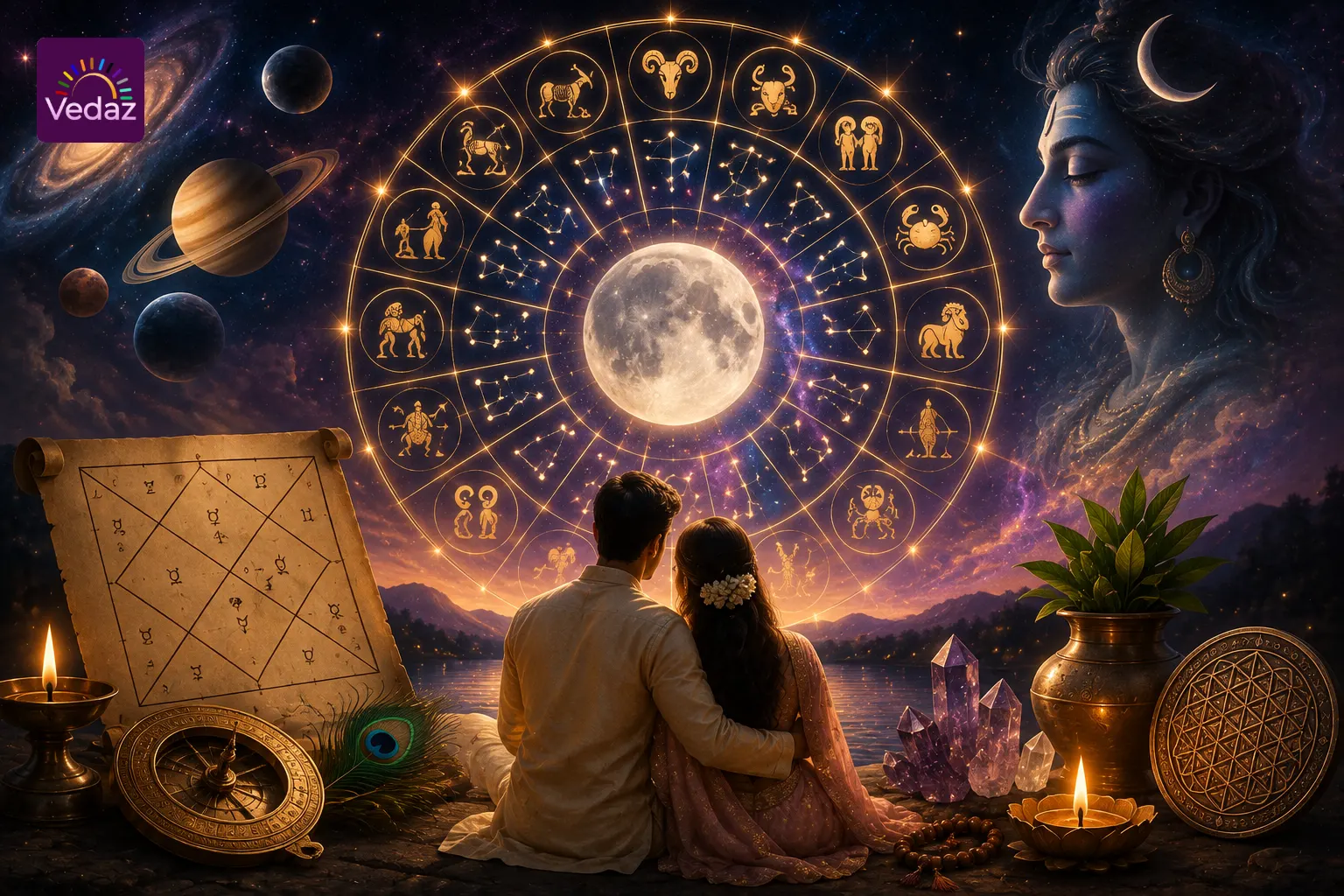
The Vedic zodiac is divided into 27 Nakshatras, each spanning exactly 13°20′. Your Janma Nakshatra — the lunar mansion your Moon occupied at birth — determines your Vimshottari Dasha sequence, drives marriage compatibility scoring, and describes personality with more precision than any sun or moon sign alone.
- ◦What is a Nakshatra in Vedic Astrology?
- ◦Why Nakshatras Matter More Than Rashis in Vedic Practice
- ◦How to Find Your Nakshatra: Step-by-Step
- ◦The 27 Nakshatras: Complete Reference List with Meanings
- ◦The Deeper Layers: Gana, Varna, Yoni, and Nadi Explained
- ◦How Nakshatras Are Used in a Real Vedic Astrology Reading
- ◦How Pada (Quarter) Refines a Nakshatra Reading
- ◦Can Nakshatra Placement Cause Problems? Nakshatra Doshas Explained
- ◦Find Your Nakshatra and Pada Free on Vedaz
- ◦Final Thought
Most people who grow up in the Indian diaspora know two things about astrology: their Western sun sign, and maybe their moon sign if their family was into that sort of thing. Almost none of them know their nakshatra.
But in Vedic astrology, your nakshatra is the layer that actually tells you something. It's more personal than your moon sign, more specific than your sun sign, and it's the first thing a classical Indian astrologer reaches for before they look at anything else. Before the houses, before the chart, sometimes before the rashi. And yet most people have never even been told it exists.
This is the complete guide. What nakshatras are, how they work, how to find yours, and a reference summary of all 27. Bookmark this page — it's the one you'll come back to whenever a chart, a matchmaking conversation, or a muhurta calculation mentions a birth star you're trying to place.
Quick Answer: A nakshatra is one of 27 lunar mansions in Vedic astrology, each covering 13°20′ of the zodiac. Your Janma Nakshatra is determined by where the Moon was at the moment of your birth. It governs your Vimshottari Dasha timing, your instinctive personality, and — critically — your compatibility score in Kundli Milan. To find yours, you need your birth date, time, and place, then check the Moon's position in a sidereal Vedic chart using Lahiri ayanamsa.
What is a Nakshatra in Vedic Astrology?
The word nakshatra literally means "that which never decays." It refers to one of 27 lunar mansions that divide the Vedic zodiac into equal sections. Each nakshatra is exactly 13°20′ wide, and all 27 together cover the full 360° of the sky.
The Moon takes roughly one day to pass through each nakshatra, cycling through all 27 approximately every 27 days — the same length as a sidereal month. So your nakshatra is essentially where the Moon was parked the day you were born.
But each nakshatra is far more than a position. Each one has its own:
- Ruling deity — the divine principle governing its energy
- Ruling planet — the graha that channels its karma
- Animal symbol — its instinctive, embodied nature
- Gana — its temperament class (Deva, Manushya, or Rakshasa)
- Varna, gunas, and Nadi — its constitutional and spiritual classification
- Life themes — the particular motivations and karmic patterns it carries
Where rashis give you broad strokes — "you're a Scorpio type" — nakshatras give you something far more specific: particular motivations, instincts, and karmic patterns that show up in how a person actually lives.
Most experienced Vedic astrologers will tell you this: give me your moon nakshatra and I'll tell you more about yourself in two minutes than your sun sign reveals in a year.
Why Nakshatras Matter More Than Rashis in Vedic Practice
There are three reasons nakshatras carry more diagnostic weight than rashis in actual Vedic practice.
1. They have more resolution. There are 12 rashis but 27 nakshatras — more than twice the granularity. Two people who share the same moon sign can be in completely different nakshatras and behave in noticeably different ways. The rashi tells you the neighborhood. The nakshatra tells you the house. Understanding the full architecture of those houses also means understanding the 12 houses in Vedic astrology — because each nakshatra's expression is colored by which house its ruling sign occupies in your chart.
2. They run the Vimshottari Dasha system. Your Moon's exact nakshatra position at birth determines which planetary period you start life with — and the entire 120-year sequence that follows. This predictive backbone of Vedic astrology is nakshatra-based, not rashi-based. Get the nakshatra wrong and the whole timing system is off.
3. They're central to matchmaking. Yoni Koota (sexual compatibility), Tara Koota (health), and Nadi Dosha are all nakshatra calculations. Two charts can have the same rashis and very different compatibility scores depending entirely on which nakshatras they fall in. For a full breakdown of how Nadi Dosha specifically works and when it genuinely matters, Nadi Dosha in Kundli and its solutions covers the complete picture.
Put simply: rashi tells you what kind of person. Nakshatra tells you what kind of self that person carries on the inside.
How to Find Your Nakshatra: Step-by-Step
You need an accurate birth time and place. The Moon moves about 13° per day, so even a few hours of imprecision can shift you into a different nakshatra. Generate a Vedic chart using sidereal calculation and Lahiri ayanamsa, then look at the Moon's position. Whichever nakshatra the Moon falls in is your Janma Nakshatra — your birth star.
Vedaz gives you this on the home page in under a minute.
Most people also want to know their pada — each nakshatra is divided into four equal quarters of 3°20′, and the pada you fall in refines the reading considerably. Pada 1 and pada 4 of the same nakshatra are both recognizably that nakshatra, but they bring out different qualities. If your astrologer asks for your nakshatra, they'll almost always want the pada too.
If you're new to reading a Vedic chart and want to understand how to locate the Moon and interpret the positions yourself, how to read kundli for beginners is the right starting point before going deeper into nakshatra analysis.
The 27 Nakshatras: Complete Reference List with Meanings
Here's every nakshatra — its zodiacal range, ruling planet, and a one-line essence. Bookmark this section. It answers "what does my nakshatra mean?" quickly enough to be immediately useful.
| # | Nakshatra | Range | Ruler | Essence |
|---|---|---|---|---|
| 1 | Ashwini - ashwini nakshatra | 0°–13°20′ Aries | Ketu | Initiator, healer, racer — the first impulse |
| 2 | Bharani - bharani nakshatra | 13°20′–26°40′ Aries | Venus | Bearer of life and death — transformative passion |
| 3 | Krittika - krittika nakshatra | 26°40′ Aries–10° Taurus | Sun | Cutter, purifier — sharpness with purpose |
| 4 | Rohini - rohini nakshatra | 10°–23°20′ Taurus | Moon | Sensual, fertile, beautiful — the most desired nakshatra |
| 5 | Mrigashira - mrigashira nakshatra | 23°20′ Taurus–6°40′ Gemini | Mars | Seeker, restless explorer — always one search away |
| 6 | Ardra - ardra nakshatra | 6°40′–20° Gemini | Rahu | Storm, tears, breakthrough — destruction that clears |
| 7 | Punarvasu - punarvasu nakshatra | 20° Gemini–3°20′ Cancer | Jupiter | Return of the light — renewal and homecoming |
| 8 | Pushya - pushya nakshatra | 3°20′–16°40′ Cancer | Saturn | Nourisher — the most auspicious nakshatra |
| 9 | Ashlesha - ashlesha nakshatra | 16°40′–30° Cancer | Mercury | The serpent — hypnotic, perceptive, sharp-tongued |
| 10 | Magha - magha nakshatra | 0°–13°20′ Leo | Ketu | Throne, ancestors — inherited authority |
| 11 | Purva Phalguni | 13°20′–26°40′ Leo | Venus | Pleasure, marriage — the love that creates ease |
| 12 | Uttara Phalguni | 26°40′ Leo–10° Virgo | Sun | Patron, contract — generous and dependable |
| 13 | Hasta - hasta nakshatra | 10°–23°20′ Virgo | Moon | The hand — skilled, dexterous, manifesting |
| 14 | Chitra - chitra nakshatra | 23°20′ Virgo–6°40′ Libra | Mars | Brilliant, designed — striking visual gifts |
| 15 | Swati - swati nakshatra | 6°40′–20° Libra | Rahu | Independent reed — self-reliant and adaptable |
| 16 | Vishakha - vishakha nakshatra | 20° Libra–3°20′ Scorpio | Jupiter | The forked goal — ambitious, determined, double-natured |
| 17 | Anuradha - anuradha nakshatra | 3°20′–16°40′ Scorpio | Saturn | Friend, devotee — quiet loyalty and depth |
| 18 | Jyeshtha - jyeshtha nakshatra | 16°40′–30° Scorpio | Mercury | Eldest, protective — powerful with a hidden burden |
| 19 | Mula - mula nakshatra | 0°–13°20′ Sagittarius | Ketu | Root, original cause — ruthless seeker of truth |
| 20 | Purva Ashadha | 13°20′–26°40′ Sag. | Venus | Invincible — confident, persuasive, never gives up |
| 21 | Uttara Ashadha | 26°40′ Sag.–10° Cap. | Sun | Final victory — enduring achievement, dharma-bound |
| 22 | Shravana - shravana nakshatra | 10°–23°20′ Capricorn | Moon | Listener — wise, traditional, communicative |
| 23 | Dhanishta - dhanishta nakshatra | 23°20′ Cap.–6°40′ Aquarius | Mars | Drum, abundance — musical, prosperous, social |
| 24 | Shatabhisha - shatabhisha nakshatra | 6°40′–20° Aquarius | Rahu | Hundred healers — mystical, secretive, scientific |
| 25 | Purva Bhadrapada | 20° Aqu.–3°20′ Pisces | Jupiter | Burning intensity — idealistic, sometimes extreme |
| 26 | Uttara Bhadrapada | 3°20′–16°40′ Pisces | Saturn | Deep waters — wise, calm, patient strength |
| 27 | Revati - revati nakshatra | 16°40′–30° Pisces | Mercury | The shepherd — nurturing, caring, the safe harbor |
The Deeper Layers: Gana, Varna, Yoni, and Nadi Explained
Every nakshatra also belongs to several classification systems that come up constantly in Vedic astrology — especially in matchmaking. Here's a quick reference.
The 3 Ganas (Temperament Classes)
- Deva (Godly) — Ashwini, Mrigashira, Punarvasu, Pushya, Hasta, Swati, Anuradha, Shravana, Revati. Naturally refined, gentle, spiritually inclined.
- Manushya (Human) — Bharani, Rohini, Ardra, Purva Phalguni, Uttara Phalguni, Purva Ashadha, Uttara Ashadha, Purva Bhadrapada, Uttara Bhadrapada. Balanced, ambitious, worldly.
- Rakshasa (Fierce) — Krittika, Ashlesha, Magha, Chitra, Vishakha, Jyeshtha, Mula, Dhanishta, Shatabhisha. Intense, powerful, unyielding. Not evil — just not interested in softening for anyone.
The 4 Varnas (Categories of Drive)
Each nakshatra is classified as Brahmin (knowledge), Kshatriya (action), Vaishya (commerce), or Shudra (service). This shapes what kind of work feels natural and meaningful.
The 14 Yonis (Animal Symbols)
Each nakshatra has an animal that captures its instinctive nature — horse (Ashwini, Shatabhisha), elephant (Bharani, Revati), tiger (Purva Bhadrapada, Dhanishta), and so on. Yoni compatibility is one of the eight kootas checked in marriage matching, and it covers instinctual and sexual compatibility. If you're going deeper into how Yoni Koota is scored and weighted, Yoni matching importance in Kundli Milan has the complete breakdown.
The 3 Nadis (Constitutional Type)
Adi (Vata), Madhya (Pitta), Antya (Kapha). The 27 nakshatras cycle through these three in groups of nine. Nadi Dosha in matchmaking happens when both partners share the same Nadi — it's the most heavily weighted of the compatibility checks.
How Nakshatras Are Used in a Real Vedic Astrology Reading
A practicing Vedic astrologer uses your nakshatras in three main ways.
Personality and instincts. Your Moon nakshatra describes how you actually behave when no one is watching. The deity, gana, and animal symbol of the nakshatra fill in what your moon sign alone can't quite reach.
This is why nakshatra-based personality readings consistently feel more accurate than rashi or sun sign descriptions — the resolution is simply higher. If your reading keeps pointing to how your nakshatra shapes your emotional responses, Rahu Moon conjunction and its influence on mind and emotions shows how lunar placements interact with malefics to either amplify or distort that nakshatra baseline.
Timing. The Vimshottari Dasha period you start life with depends on how much of your moon's nakshatra had already passed at the moment you were born. Your entire 120-year planetary calendar flows from that one calculation — which makes your nakshatra the literal starting point of all Vedic prediction.
Compatibility. In matchmaking, your nakshatra and your partner's are checked across yoni, tara, gana, and nadi koota. A great rashi match with poor nakshatra alignment is treated with caution. The inverse is treated favorably. The nakshatras often tell the more honest story. The best nakshatra combinations for marriage guide covers which pairings consistently score highest and why.
Want a personality reading that goes deeper than generic nakshatra descriptions? Gargi — Vedaz's AI personality astrologer uses your Janma Nakshatra, Moon sign, and Lagna together to build a layered personality analysis — in plain English, for free.
How Pada (Quarter) Refines a Nakshatra Reading
Each nakshatra is divided into four padas of 3°20′ each. Each pada corresponds to a specific Navamsa sign — a sub-chart that classical astrologers consider as important as the main chart, especially for marriage and inner life.
So while two people born under Rohini share the headline traits of that nakshatra, their padas place them in different Navamsa rashis — and that often produces noticeably different personalities. Same nakshatra, meaningfully different expression. If your astrologer asks for your nakshatra, give them the pada too. That's where the real precision lives.
Can Nakshatra Placement Cause Problems? Nakshatra Doshas Explained
Not all nakshatra placements are neutral. Some specific nakshatras — or nakshatra combinations between two charts — are flagged as problematic in classical Vedic texts.
Nakshatra Dosha in marriage is one of the most searched but least understood topics in this space. It's distinct from Manglik Dosha and Nadi Dosha — it refers to specific birth star placements that are traditionally said to delay or complicate marriage timing. If you've been told your nakshatra is creating friction in your marriage prospects and want to understand what that actually means, can Nakshatra Dosha delay marriage addresses the classical rules, which nakshatras are flagged, and when the concern is genuine versus overstated.
Find Your Nakshatra and Pada Free on Vedaz
Vedaz tells you your exact Janma Nakshatra, your pada, your starting dasha, and a clear English explanation of what each one means. No Sanskrit transliteration left unexplained. No vague horoscope-speak. Most people are genuinely surprised by how accurately their nakshatra describes them.
Generate your free Kundali and find your Nakshatra on Vedaz →
Final Thought
The 27 nakshatras are the most under-discussed layer of Vedic astrology in English — and easily one of the most rewarding to actually learn.
Once you know your moon nakshatra, you have a description of yourself that tends to be startlingly precise. Not "you might be sensitive or you might be bold depending on other factors" — but something that actually lands. The way a great Enneagram reading lands, except with a few thousand years of accumulated literature sitting behind it.
Find yours. Read the description. See if it fits.
Most people read their nakshatra for the first time and feel, for the first time, like the astrology is actually talking about them — not a general archetype they half-recognize, but something closer to a mirror. That recognition is the doorway into the rest of the system.
Find your Janma Nakshatra, pada, and starting dasha free on Vedaz →

Astro Parvati
Vedic Astrology, Numerology, Face reading | 5 Years
Astro parvati is one of the best astrologers in Uttar Pradesh. Known for her warm, wise presence and a deep mastery of Vedic Astrology, Numerology, Face reading , she provides insight that feels like truth and comfort rolled into one.
Frequently Asked Questions
1. What is the difference between rashi and nakshatra?
Your rashi (moon sign) is one of 12 signs, each covering 30° of the zodiac. Your nakshatra is one of 27 lunar mansions, each covering 13°20′. Rashis are broader; nakshatras are more specific. Each rashi contains roughly 2 to 2.25 nakshatras. In Vedic astrology, your nakshatra is generally considered more diagnostic than your rashi alone.
2. How do I find my nakshatra without my exact birth time?
You need at least an approximate time. The Moon moves about 13° per day, staying in a single nakshatra for roughly 24 hours. If you know your birth date, you can usually narrow it down to one or two possible nakshatras. To identify your pada precisely, you need a birth time accurate to within about an hour.
3. Which nakshatra is the most powerful?
Every nakshatra has its own kind of strength. That said, three are traditionally singled out: Pushya is often called the most auspicious, Rohini the most sensual and fertile, and Magha the most regal. Mula and Jyeshtha are considered the most spiritually intense — powerful, but demanding.
4. Which nakshatra is best for marriage?
Rohini, Mrigashira, Pushya, Uttara Phalguni, Hasta, Anuradha, Uttara Ashadha, Uttara Bhadrapada, and Revati are all considered favorable. Some nakshatras — like Mula and Ashlesha — are traditionally approached with more care in marital contexts, not because of any inherent flaw, but because of the intensity they carry. Compatibility ultimately depends on how two nakshatras interact, not just what each one is on its own.
5. Can my nakshatra change?
No. Your Janma Nakshatra — the nakshatra your Moon was in at birth — is fixed for life. You do have other nakshatra positions in your chart (your Lagna nakshatra, your Sun nakshatra, and so on), but none of those change either. They all play a role in a full reading.
6. Is the nakshatra system used in Western astrology?
No. Nakshatras are unique to Vedic astrology and a small number of related sidereal traditions (some Tibetan and Burmese lineages). Western astrology works with fixed stars and lunar nodes but has nothing equivalent to the 27-fold lunar division.
7. How does my nakshatra affect my dasha?
The Vimshottari Dasha system assigns your starting planetary period based on which nakshatra your Moon occupies at birth, and how much of that nakshatra had already passed. Each nakshatra is ruled by one of nine planets, and that planet's mahadasha is where your life begins in the dasha sequence. Your Janma Nakshatra, in effect, sets the entire 120-year timer of your life.
8. What is the most rare nakshatra?
Statistically, all 27 are equally common — the Moon spends roughly the same amount of time in each over a lifetime. What gets called "rare" usually refers to specific combinations: a particular nakshatra-pada pairing, a nakshatra falling exactly on a sandhi (a zodiac junction point), or a nakshatra paired with unusual planetary aspects. Those configurations are genuinely uncommon.
More by this writer

Left Eye Blinking for a Female: Good News or Warning
Left eye blinking in women can indicate luck, caution, or emotional shifts. Explore its meaning, causes, and when to stay calm.
Venus in 9th House Fortune and Luck: Marriage, Spouse & Destiny Secrets
Explore Venus in 9th house effects on luck, marriage life, spouse profession, appearance, meeting timing, and Navamsa chart influence.
Vastu for Home Explained: Best Directions, Room Placement & Easy Fixes
Complete Vastu guide for home: directions, kitchen, bedroom, entrance & remedies. Improve energy, health & prosperity easily.
Related Blogs
Boost Your Health with Astrology
Boost your health with astrology using zodiac-based habits, wellness tips, and simple routines for better physical and mental balance.
The Socking Truth Behind Wearing A Black Thread
Uncover the mystery behind the black thread. From protection to spiritual energy—here’s why everyone’s suddenly wearing one.
Hidden Messages In Your Moles
What if that little mole on your cheek is more than just a mark? Explore the fascinating meanings behind mole placements and what they reveal about your future.
Who Is Your Ishta Devata?
Explore the concept of your personal God in Hinduism. Learn how to discover, connect with, and build a relationship with your Ishta Devata for inner peace and spiritual growth.