The 27 Nakshatras: A Complete Guide to the Lunar Mansions of Vedic Astrology
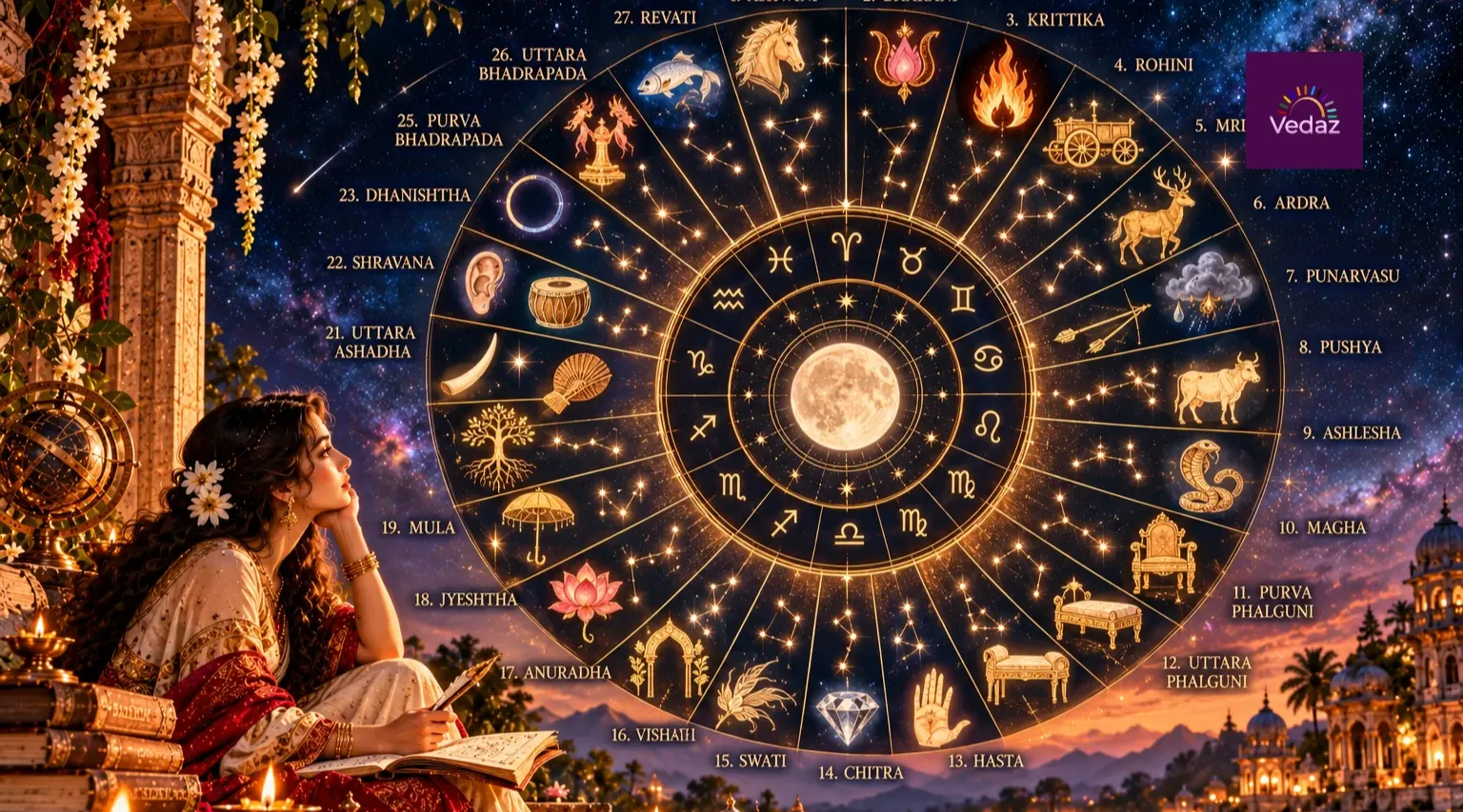
Nakshatras are the 27 lunar mansions of Vedic astrology. They are equal parts of the zodiac, each 13°20' wide, and each has a ruling planet, a deity, a symbol and a nature. Your birth nakshatra (janma nakshatra or birth star) is where the Moon was when you were born. It shapes your personality, sets the order of your Vimshottari dasha and your name syllables, and is the base of marriage matching.
- ◦What Is a Nakshatra?
- ◦Nakshatra vs Rashi: What's the Difference?
- ◦The Complete Nakshatra Chart
- ◦The 27 Nakshatras, One by One
- ◦The Three Ganas and Three Nadis
- ◦How to Find Your Birth Nakshatra
- ◦How Nakshatras Shape Your Life in Vedic Astrology
- ◦Gandmool Nakshatras, Without Fear
- ◦Nakshatra Myths, Busted
- ◦Frequently Asked Questions
- ◦The Bottom Line
If the twelve rashis are the chapters of Vedic astrology, the 27 nakshatras are its paragraphs. They are finer, richer and far more personal. Western astrology barely uses them, but in Jyotish they are a must. Your nakshatra decides the first letter of your traditional name, the order of your planetary periods, your compatibility score in kundali matching and the lucky days in your panchang - panchang.
This guide gives you the complete nakshatra chart, with rulers, deities, symbols, gana, nadi and name syllables. It also gives a short portrait of each nakshatra, shows how to find your birth star, and explains how nakshatras are used in dashas, matching and muhurat.
What Is a Nakshatra?
The word nakshatra (नक्षत्र) is often translated as "star" or "lunar mansion." The Moon takes about 27.3 days to go around the zodiac, so ancient astronomers split its path into 27 parts. That gives roughly one "mansion" for each night of the Moon's journey. Each one is tied to a recognisable star or group of stars.
Key numbers:
- 27 nakshatras × 13°20' each = 360°.
- Each nakshatra has 4 padas (quarters) of 3°20', which makes 108 padas in total. (That is one reason 108 is sacred in Indian tradition.)
- Every 9 padas make one rashi (30°). So each sign holds 2¼ nakshatras.
- Some muhurat traditions add a 28th nakshatra, Abhijit, between Uttara Ashadha and Shravana.
Nakshatra vs Rashi: What's the Difference?
| Rashi (sign) | Nakshatra (lunar mansion) | |
|---|---|---|
| Number | 12 | 27 |
| Size | 30° | 13°20' |
| Based on | Sun's yearly path, divided by 12 | Moon's monthly path, divided by 27 |
| Used for | Broad temperament, houses, rashifal | Fine personality, dasha, naming, matching, muhurat |
| Example | Your Moon in Vrishabh | Your Moon in Rohini (within Vrishabh) |
Your rashi tells you the Moon's sign. Your nakshatra tells you exactly where in that sign the Moon was, or whether it crossed into the next one. Two people with the same rashi but different nakshatras can be quite different. To learn more about rashis, see our zodiac signs guide.
The Complete Nakshatra Chart
| # | Nakshatra | Rashi | Lord | Deity | Symbol | Gana | Nadi | Name syllables (padas 1–4) |
|---|---|---|---|---|---|---|---|---|
| 1 | Ashwini | Mesh | Ketu | Ashwini Kumaras | Horse's head | Deva | Aadi | Chu, Che, Cho, La |
| 2 | Bharani | Mesh | Venus | Yama | Yoni | Manushya | Madhya | Li, Lu, Le, Lo |
| 3 | Krittika | Mesh / Vrishabh | Sun | Agni | Razor / flame | Rakshasa | Antya | A, I, U, E |
| 4 | Rohini | Vrishabh | Moon | Brahma | Chariot | Manushya | Antya | O, Va, Vi, Vu |
| 5 | Mrigashira | Vrishabh / Mithun | Mars | Soma | Deer's head | Deva | Madhya | Ve, Vo, Ka, Ki |
| 6 | Ardra | Mithun | Rahu | Rudra | Teardrop | Manushya | Aadi | Ku, Gha, Nga, Chha |
| 7 | Punarvasu | Mithun / Kark | Jupiter | Aditi | Quiver of arrows | Deva | Aadi | Ke, Ko, Ha, Hi |
| 8 | Pushya | Kark | Saturn | Brihaspati | Cow's udder / flower | Deva | Madhya | Hu, He, Ho, Da |
| 9 | Ashlesha | Kark | Mercury | Nagas | Coiled serpent | Rakshasa | Antya | Di, Du, De, Do |
| 10 | Magha | Simha | Ketu | Pitrs (ancestors) | Throne | Rakshasa | Antya | Ma, Mi, Mu, Me |
| 11 | Purva Phalguni | Simha | Venus | Bhaga | Front legs of a bed | Manushya | Madhya | Mo, Ta, Ti, Tu |
| 12 | Uttara Phalguni | Simha / Kanya | Sun | Aryaman | Back legs of a bed | Manushya | Aadi | Te, To, Pa, Pi |
| 13 | Hasta | Kanya | Moon | Savitar | Hand | Deva | Aadi | Pu, Sha, Na, Tha |
| 14 | Chitra | Kanya / Tula | Mars | Vishwakarma | Bright jewel | Rakshasa | Madhya | Pe, Po, Ra, Ri |
| 15 | Swati | Tula | Rahu | Vayu | Sprout in the wind | Deva | Antya | Ru, Re, Ro, Ta |
| 16 | Vishakha | Tula / Vrishchik | Jupiter | Indra–Agni | Triumphal arch | Rakshasa | Antya | Ti, Tu, Te, To |
| 17 | Anuradha | Vrishchik | Saturn | Mitra | Lotus | Deva | Madhya | Na, Ni, Nu, Ne |
| 18 | Jyeshtha | Vrishchik | Mercury | Indra | Earring / umbrella | Rakshasa | Aadi | No, Ya, Yi, Yu |
| 19 | Mula | Dhanu | Ketu | Nirriti | Bunch of roots | Rakshasa | Aadi | Ye, Yo, Bha, Bhi |
| 20 | Purva Ashadha | Dhanu | Venus | Apah (waters) | Winnowing fan | Manushya | Madhya | Bhu, Dha, Pha, Dha |
| 21 | Uttara Ashadha | Dhanu / Makar | Sun | Vishvedevas | Elephant tusk | Manushya | Antya | Be, Bo, Ja, Ji |
| 22 | Shravana | Makar | Moon | Vishnu | Ear / three footprints | Deva | Antya | Ju (Khi), Je (Khu), Jo (Khe), Gha (Kho) |
| 23 | Dhanishta | Makar / Kumbh | Mars | Eight Vasus | Drum | Rakshasa | Madhya | Ga, Gi, Gu, Ge |
| 24 | Shatabhisha | Kumbh | Rahu | Varuna | Empty circle | Rakshasa | Aadi | Go, Sa, Si, Su |
| 25 | Purva Bhadrapada | Kumbh / Meen | Jupiter | Aja Ekapada | Front of a funeral cot / sword | Manushya | Aadi | Se, So, Da, Di |
| 26 | Uttara Bhadrapada | Meen | Saturn | Ahirbudhnya | Back of a funeral cot / twins | Manushya | Madhya | Du, Tha, Jha, Na |
| 27 | Revati | Meen | Mercury | Pushan | Fish / drum | Deva | Antya | De, Do, Cha, Chi |
Syllables vary slightly between regional traditions and scripts.
Notice that the lords repeat in the same order three times: Ketu, Venus, Sun, Moon, Mars, Rahu, Jupiter, Saturn, Mercury. This sequence is the backbone of the Vimshottari dasha system.
The 27 Nakshatras, One by One
- Ashwini: Swift, youthful and healing. The divine physicians give a knack for quick starts, medicine and helping others recover.
- Bharani: The bearer. Intense, creative and responsible. Able to carry great burdens and turn them into something new.
- Krittika: The cutter. Sharp, honest, determined and protective. It burns away what is false.
- Rohini: The Moon's favourite. Beautiful, creative, fertile and magnetic. It is Lord Krishna's birth star.
- Mrigashira: The searching deer. Curious, gentle, restless and always exploring.
- Ardra: The storm. Intense, analytical and able to change. Brilliance comes through difficulty.
- Punarvasu: Return of the light. Hopeful, generous and resilient. It is Lord Rama's birth star.
- Pushya: Nourishment. The most auspicious nakshatra. Protective, responsible and devoted.
- Ashlesha: The serpent. Perceptive, strategic, persuasive and deeply intuitive.
- Magha: The throne. Dignified, traditional, regal and linked to ancestors.
- Purva Phalguni: Delight. Charming, creative, pleasure-loving and romantic.
- Uttara Phalguni: Patronage. Generous, reliable and committed to friendship and contracts.
- Hasta: The hand. Skilful, witty, resourceful and good with crafts and healing.
- Chitra: The jewel. Artistic, stylish and technically brilliant. The architect's star.
- Swati: The sprout in the wind. Independent, flexible, diplomatic and good at business.
- Vishakha: The star of purpose. Ambitious, focused and set on reaching the goal.
- Anuradha: Friendship. Loyal, devoted, organised and successful far from home.
- Jyeshtha: The eldest. Protective, responsible, intelligent and a natural leader.
- Mula: The root. Curious, thoughtful and drawn to basic truths.
- Purva Ashadha: The early victory. Confident, persuasive, proud and inspiring.
- Uttara Ashadha: The final victory. Principled, persistent and able to achieve things that last.
- Shravana: Listening. Learned, wise, a good communicator and devoted to knowledge.
- Dhanishta: Wealth and rhythm. Ambitious, musical, generous and prosperous.
- Shatabhisha: A hundred healers. Independent, research-minded, private and healing.
- Purva Bhadrapada: The fiery one. Idealistic, intense and spiritually passionate.
- Uttara Bhadrapada: The deep one. Wise, patient, calm and emotionally strong.
- Revati: The nourisher. Kind, creative and protective of the vulnerable. The final nakshatra.
The Three Ganas and Three Nadis
Gana (temperament) groups the nakshatras into three natures, with nine in each:
- Deva (divine): gentle, idealistic, generous.
- Manushya (human): balanced, worldly, practical.
- Rakshasa (fierce): independent, strong-willed, intense. It does not mean "evil."
Nadi (body type) groups the nakshatras by Ayurvedic quality: Aadi (Vata), Madhya (Pitta) and Antya (Kapha). Nadi carries the highest weight (8 points) in kundali matching.
How to Find Your Birth Nakshatra
Your janma nakshatra (birth star) is the nakshatra the Moon was in when you were born. To find it:
- Use a birth star calculator. Enter your date, time and place of birth in the free Vedaz nakshatra calculator. It will show your nakshatra and pada.
- Check your kundli. Any Vedic birth chart lists the "Moon nakshatra" or "janma nakshatra." You can generate your free kundli in a minute.
- Ask family. Many Indian families note the birth star at the naming ceremony.
Birth time matters. The Moon spends about a day in each nakshatra, and the pada changes about every six hours. If you were born close to a changeover, an approximate time can give the wrong nakshatra or pada.
Can you find your birth star by date of birth alone? Often, yes, but not always. If the Moon changed nakshatra on your birth day, you will need the time to know which one applies.
Lagna nakshatra: Your Ascendant also falls in a nakshatra (the lagna nakshatra), which adds detail about your personality and body. Every planet in your chart also sits in a nakshatra, and those placements add detail to how each planet acts.
How Nakshatras Shape Your Life in Vedic Astrology
1. They start your dasha clock
The Vimshottari dasha begins with the mahadasha of your birth nakshatra's lord. Born in Rohini (Moon)? Your life starts in the Moon mahadasha. Born in Pushya (Saturn)? You start in the Saturn mahadasha. The part of the nakshatra the Moon had yet to cross decides how much of that first dasha is left at birth. This is called the dasha balance. From there, the sequence runs in a fixed order: Ketu 7 years, Venus 20, Sun 6, Moon 10, Mars 7, Rahu 18, Jupiter 16, Saturn 19, Mercury 17.
2. They give your name syllable
Each pada has a sound (see the chart above). Traditionally, a child's name starts with the syllable of their birth pada. This is the naam akshar. It is also how naam rashi works in daily rashifal.
3. They decide marriage compatibility
Four of the eight Ashtakoota - ashtakoota factors, Tara, Yoni, Gana and Nadi, come straight from the two partners' birth nakshatras. "Marriage matching by nakshatra" and "nakshatra matching charts" are simpler versions of this. For an accurate score with cancellations, use kundli matching, or try matching by name or without birth time if you are missing details.
4. They set daily timing
Today's nakshatra is one of the five parts of the panchang - panchang. Muhurat astrology groups nakshatras by nature. Fixed ones (Rohini and the three Uttaras) suit foundations. Movable ones (Swati, Punarvasu, Shravana, Dhanishta, Shatabhisha) suit travel. Swift ones (Ashwini, Pushya, Hasta) suit trade and medicine. Soft ones (Mrigashira, Chitra, Anuradha, Revati) suit arts and relationships.
5. They personalise transits
Tara Bala counts from your birth nakshatra to today's nakshatra. When you divide the count by 9, remainders of 2, 4, 6, 8 and 9 are traditionally favourable, and 3, 5 and 7 call for care. It is a quick personal filter on top of the general panchang.
Gandmool Nakshatras, Without Fear
Six nakshatras sit at the meeting points between water and fire signs: Ashwini, Ashlesha, Magha, Jyeshtha, Mula and Revati. They are called Gandmool (or Gandanta at the exact meeting points). Traditionally, a birth in one of these nakshatras calls for a simple shanti puja, often on the 27th day after birth, when the Moon returns to the same nakshatra.
This is a custom of blessing. It is not a prediction of bad luck. Many accomplished people are born in Gandmool nakshatras. Be careful of anyone who uses a Gandmool birth to frighten a family into expensive rituals.
Nakshatra Myths, Busted
"Rakshasa gana means a bad person." It means an independent, strong-willed nature. Many leaders and protectors are Rakshasa gana.
"Couples with the same nakshatra can never marry." Same-nakshatra matches often trigger Nadi dosha, but classical cancellations apply often, such as different rashis or different padas.
"Your nakshatra fixes your destiny." Your nakshatra describes your nature and timing. Effort, choices and the full chart shape what happens.
Frequently Asked Questions
How many nakshatras are there? There are 27 nakshatras in Vedic astrology, each spanning 13°20' of the zodiac. Some muhurat traditions add a 28th, Abhijit, between Uttara Ashadha and Shravana.
How do I find my nakshatra? Enter your date, time and place of birth in a free kundli - kundligpt or birth star calculator. Your birth nakshatra is the one the Moon was in at the moment of your birth, shown with its pada.
Can I find my birth star by date of birth only? Usually, but not always. The Moon spends about one day in each nakshatra, so if it changed nakshatra on your birth date, you will need your birth time to know which one applies.
What is the difference between nakshatra and rashi? A rashi is one of 12 signs of 30°. A nakshatra is one of 27 lunar mansions of 13°20'. The nakshatra is a finer division that gives more personal detail, and it is used for dasha, naming and matching.
Which is the best nakshatra? No nakshatra is better than another for a person, as each has its own strengths. For muhurat (timing), Pushya is traditionally seen as the most auspicious nakshatra for beginnings and purchases.
What are Gandmool nakshatras? They are Ashwini, Ashlesha, Magha, Jyeshtha, Mula and Revati. They sit at the meeting points of water and fire signs. A simple shanti puja is customary for births in them. It is a blessing ritual, not a sign of bad luck.
How are nakshatras used in marriage matching? Four of the eight Ashtakoota kootas (Tara, Yoni, Gana and Nadi) come from the partners' birth nakshatras, and the other four come from their Moon signs. Together they make up the 36-point Guna Milan score.
Which nakshatra rules which planet? Each planet rules three nakshatras: Ketu (Ashwini, Magha, Mula), Venus (Bharani, Purva Phalguni, Purva Ashadha), Sun (Krittika, Uttara Phalguni, Uttara Ashadha), Moon (Rohini, Hasta, Shravana), Mars (Mrigashira, Chitra, Dhanishta), Rahu (Ardra, Swati, Shatabhisha), Jupiter (Punarvasu, Vishakha, Purva Bhadrapada), Saturn (Pushya, Anuradha, Uttara Bhadrapada) and Mercury (Ashlesha, Jyeshtha, Revati).
The Bottom Line
The 27 nakshatras are the fine print of Vedic astrology. They turn a broad zodiac sign into a personal portrait. Your birth nakshatra sets your dasha clock, your name syllable, your compatibility and your daily timing. Knowing it is the most useful step after learning your rashi.
Find your birth nakshatra free, see how it matches a partner's with kundli matching, check today's panchang, or ask Veda, the Vedaz AI astrologer what your nakshatra says about you.
Devansh Trivedi
Nakshatras, planetary transits, retrograde planets, celestial cycles. | 13 years
Devansh Trivedi takes a research-oriented approach to explaining planetary movements and Nakshatra traditions. He organizes complex astrological concepts into logical sections, clarifies unfamiliar terminology, and connects individual concepts to broader astrological frameworks so readers can follow the underlying reasoning.
Frequently Asked Questions
1. How many nakshatras are there?
There are 27 nakshatras in Vedic astrology, each spanning 13°20' of the zodiac. Some muhurat traditions add a 28th, Abhijit, between Uttara Ashadha and Shravana.
2. How do I find my nakshatra?
Enter your date, time and place of birth in a free kundli or birth star calculator. Your birth nakshatra is the one the Moon was in at the moment of your birth, shown with its pada.
3. Can I find my birth star by date of birth only?
Usually, but not always. The Moon spends about one day in each nakshatra, so if it changed nakshatra on your birth date, you will need your birth time to know which one applies.
4. What is the difference between nakshatra and rashi?
A rashi is one of 12 signs of 30°. A nakshatra is one of 27 lunar mansions of 13°20'. The nakshatra is a finer division that gives more personal detail, and it is used for dasha, naming and matching.
5. Which is the best nakshatra?
No nakshatra is better than another for a person, as each has its own strengths. For muhurat (timing), Pushya is traditionally seen as the most auspicious nakshatra for beginnings and purchases.
Related Blogs
Boost Your Health with Astrology
Boost your health with astrology using zodiac-based habits, wellness tips, and simple routines for better physical and mental balance.

The Socking Truth Behind Wearing A Black Thread
Uncover the mystery behind the black thread. From protection to spiritual energy—here’s why everyone’s suddenly wearing one.
Hidden Messages In Your Moles
What if that little mole on your cheek is more than just a mark? Explore the fascinating meanings behind mole placements and what they reveal about your future.
Who Is Your Ishta Devata?
Explore the concept of your personal God in Hinduism. Learn how to discover, connect with, and build a relationship with your Ishta Devata for inner peace and spiritual growth.