Navamsa (D9) Chart: The Complete Guide to Vedic Astrology's Most Important Divisional Chart
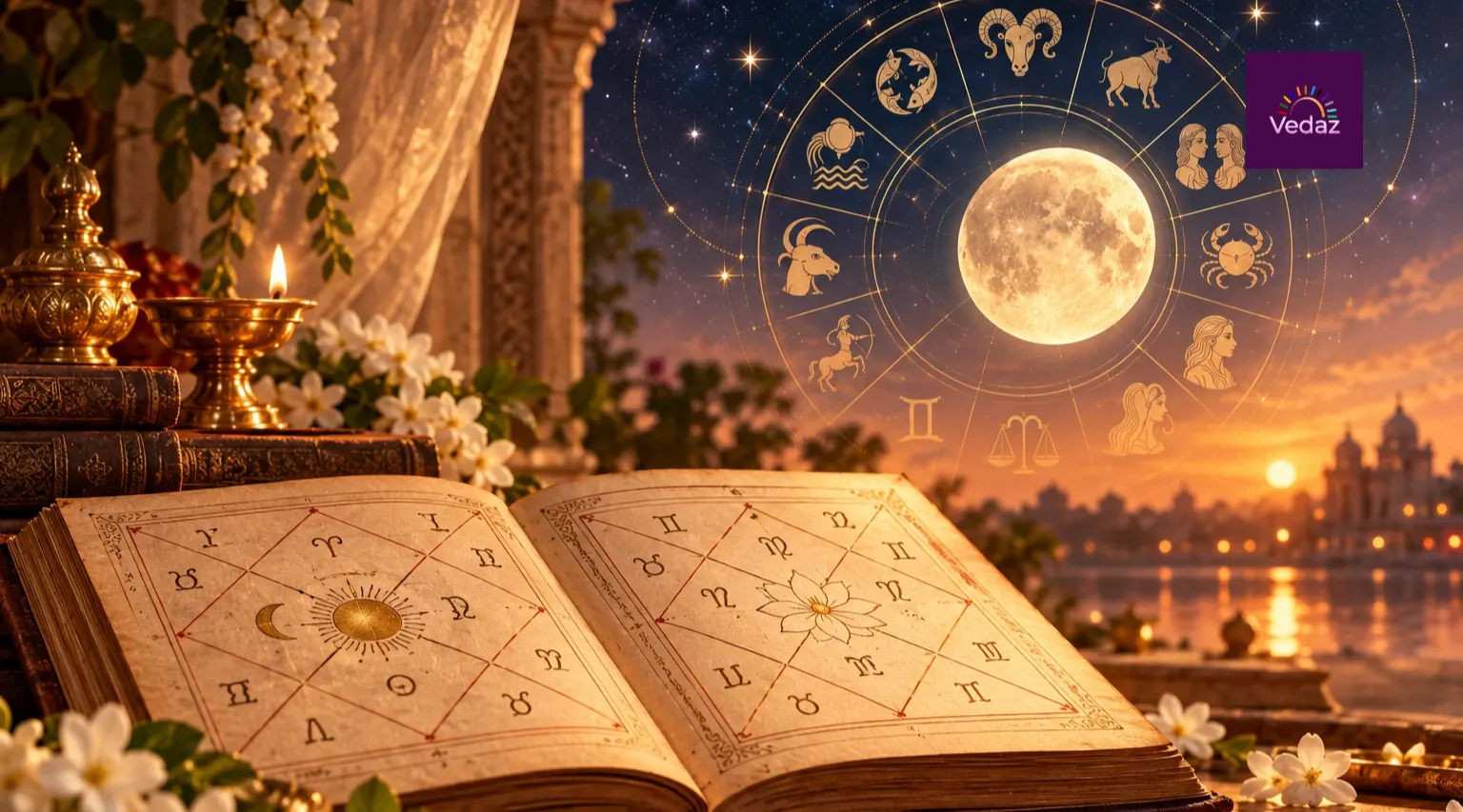
The Navamsa (D9) chart splits each zodiac sign into nine parts of 3°20' and builds a second chart from them. It's the most important divisional chart in Vedic astrology. It's used to judge marriage, the spouse, dharma and the real inner strength of every planet. A planet that's strong in both the birth chart (D1) and the D9 gives reliable results. A planet in the same sign in both is called vargottama.
- ◦What Is the Navamsa Chart?
- ◦How the Navamsa Is Calculated
- ◦Vargottama: The Strongest Placement
- ◦Reading the Navamsa for Planetary Strength
- ◦Reading the Navamsa for Marriage
- ◦Karakamsa: Your Soul's Purpose in the Navamsa
- ◦The Family of Divisional Charts (Vargas)
- ◦How to Read Your D9 Chart: A 7-Step Method
- ◦A Sample D1 vs D9 Comparison (Hypothetical)
- ◦A Quick Guide to the D10 (Dashamsa) Career Chart
- ◦How the D9 Changes the Way Dashas Unfold
- ◦Pushkara Navamsa: A Special Refinement
- ◦D9 in Kundli Matching
- ◦Common D9 Misunderstandings
- ◦Before You Read Your D9: A Quick Checklist
- ◦The Bottom Line
Experienced Vedic astrologers rarely read a birth chart without its Navamsa. A planet that looks weak in the main chart can be powerful in the D9, and the other way round.
That's why searches like "D9 chart calculator" and "Navamsa chart" keep growing as more people move beyond Sun-sign astrology. If you're used to checking your daily horoscope, the D9 is the next level up.
This guide explains what the Navamsa is, how it's calculated, how to read it for marriage and planetary strength, what vargottama means, and where the D9 fits among the other divisional charts (vargas).
What Is the Navamsa Chart?
Navamsa (नवांश) means "ninth part." Each 30° sign is split into nine navamsas of 3°20' each, which gives 108 navamsas across the zodiac. Each navamsa is given a sign. When you place every planet (and the lagna) in its navamsa sign, you get the D9 chart.
Here's a neat link: each navamsa equals one nakshatra pada. There are 27 nakshatras × 4 padas = 108 padas = 108 navamsas. So the pada of your Moon's nakshatra tells you the Moon's navamsa sign directly. You can find your Moon's nakshatra and pada with the nakshatra calculator.
Classical texts describe the Navamsa as the chart of:
- Marriage and the spouse.
- Dharma: your values, purpose and inner life.
- The "fruit" of the birth chart: how planets truly deliver results, especially in the second half of life.
- Planetary strength: the real dignity of each planet.
How the Navamsa Is Calculated
The rule depends on the element of the sign:
| Sign element | Signs | First navamsa begins from |
|---|---|---|
| Fire | Aries, Leo, Sagittarius | Aries |
| Earth | Taurus, Virgo, Capricorn | Capricorn |
| Air | Gemini, Libra, Aquarius | Libra |
| Water | Cancer, Scorpio, Pisces | Cancer |
The nine navamsas then follow in zodiac order.
Worked example: a planet at 15° Taurus
- Taurus is an earth sign, so its navamsas start from Capricorn.
- 15° ÷ 3°20' = 4.5, so it falls in the 5th navamsa.
- Counting from Capricorn: Capricorn (1), Aquarius (2), Pisces (3), Aries (4), Taurus (5).
- So the planet is in Taurus navamsa. That's the same sign as in D1, which makes it vargottama.
Many textbooks use another rule that works out the same: movable signs start from themselves, fixed signs from the 9th sign, and dual signs from the 5th sign. Both rules give identical results.
Why birth time matters so much: The D9 lagna changes about every 13 minutes (two hours ÷ nine). A small mistake in birth time can change your whole Navamsa. That's why an accurate birth time, or rectification, is a must for D9 analysis. Use a D9 chart calculator with exact birth details.
Vargottama: The Strongest Placement
A planet is vargottama when it sits in the same sign in D1 and D9. Classical texts see this as a sign of strength and consistency. The planet's outer expression matches its inner nature.
The vargottama navamsas are:
- 1st navamsa of movable signs (Aries, Cancer, Libra, Capricorn).
- 5th navamsa of fixed signs (Taurus, Leo, Scorpio, Aquarius).
- 9th navamsa of dual signs (Gemini, Virgo, Sagittarius, Pisces).
A vargottama lagna is seen as especially strong. It gives a clear, steady sense of self.
Reading the Navamsa for Planetary Strength
The D9 fine-tunes how each planet will perform:
| D1 status | D9 status | Typical interpretation |
|---|---|---|
| Strong (own/exalted) | Strong | Highly reliable results |
| Strong | Debilitated | Promise may not fully deliver; results weaken with time |
| Debilitated | Exalted / own sign | Weakness often overcome; results improve over time (a form of neecha bhanga) |
| Debilitated | Debilitated | Needs care; other supports in the chart matter |
| Any | Vargottama | Consistent, dependable expression |
This is why astrologers often say: "D1 is the tree, D9 is the fruit." The birth chart shows the promise. The Navamsa shows what that promise gives you.
Reading the Navamsa for Marriage
This is the D9's most famous use. Astrologers look at:
- The D9 lagna and its lord: your nature within marriage and partnership.
- The 7th house of the D9: the nature of the spouse and the marriage.
- The D1 7th lord in the D9: is the marriage indicator strong at the inner level?
- Venus in the D9: the natural significator of love and marriage. Venus in its own sign, exalted, or in a friend's sign supports harmony.
- Jupiter in the D9: traditionally also important in a woman's chart.
- Benefics and malefics in the D9 kendras (1, 4, 7, 10).
- The Darakaraka (the Jaimini spouse significator) in the D9.
A marriage that looks tough in D1 but is supported in D9 often gets better after the first few years. On the other hand, D1 promise without D9 support may need more conscious effort. For the full marriage-timing method, see our marriage prediction guide.
If you want a quick read on how two people connect, you can also try the love calculator or the compatibility tool before going deeper into the D9.
Editorial note: The D9 describes tendencies in partnership. It never "proves" a marriage will fail or succeed. Effort, communication and respect shape real relationships.
Karakamsa: Your Soul's Purpose in the Navamsa
In Jaimini astrology, the Atmakaraka is the planet with the highest degree in your chart (ignoring the sign), and it's the soul's significator. Its sign in the Navamsa is called the Karakamsa. Planets in the Karakamsa, and planets aspecting it, describe your deeper purpose, spiritual path and natural talents. Vedaz has an Atmakaraka and Darakaraka calculator to help you find yours.
The Family of Divisional Charts (Vargas)
The Navamsa is one of 16 classical divisional charts (Shodashavarga) described by Parashara. Each one zooms in on one area of life:
| Chart | Name | Division | Area of life |
|---|---|---|---|
| D1 | Rashi | 1 | The whole life, the main birth chart |
| D2 | Hora | 2 | Wealth |
| D3 | Drekkana | 3 | Siblings, courage |
| D4 | Chaturthamsa | 4 | Property, home, fortune |
| D7 | Saptamsa | 7 | Children |
| D9 | Navamsa | 9 | Marriage, dharma, planetary strength |
| D10 | Dashamsa | 10 | Career and profession |
| D12 | Dwadashamsa | 12 | Parents |
| D16 | Shodashamsa | 16 | Vehicles, comforts |
| D20 | Vimshamsa | 20 | Spiritual practice |
| D24 | Chaturvimshamsa | 24 | Education and learning |
| D27 | Bhamsa | 27 | Strengths and weaknesses |
| D30 | Trimshamsa | 30 | Challenges and misfortunes |
| D40 | Khavedamsa | 40 | Maternal lineage effects |
| D45 | Akshavedamsa | 45 | Paternal lineage, character |
| D60 | Shashtiamsa | 60 | Past karma; considered very important, but extremely time-sensitive |
Practical tip: The higher the division, the more it depends on birth time. D9 and D10 are widely used. D60 needs a time that's right to within a minute or two, so be careful with it unless your time is verified or rectified.
Dashamsa (D10) deserves a special mention. It's the second most-used divisional chart and it focuses on career. The 10th house and its lord in the D10, along with the D10 lagna, sharpen career predictions from the D1.
How to Read Your D9 Chart: A 7-Step Method
- Confirm your birth time. The D9 depends on it.
- Generate D1 and D9 together with a reliable calculator.
- Check for vargottama planets and the D9 lagna.
- Compare each planet's dignity in D1 and D9.
- Read the D9 7th house, its lord and Venus for marriage.
- Find the D9 sign of your Atmakaraka (Karakamsa) for purpose.
- Combine it with dashas. A planet's dasha gives results based on both its D1 and D9 strength.
If you'd like help, ask KundliGPT - kundligpt to compare your D1 and D9 in plain language.
A Sample D1 vs D9 Comparison (Hypothetical)
Imagine a chart where:
| Planet | D1 (birth chart) | D9 (Navamsa) | Reading |
|---|---|---|---|
| Venus | Kanya - virgo (debilitated) | Meen (exalted) | Debilitation overcome internally; love life improves with maturity |
| Jupiter | Kark - cancer (exalted) | Makar - capricorn (debilitated) | Strong outer promise; wisdom must be earned; results may feel less than expected |
| Moon | Vrishabh - taurus (exalted) | Vrishabh | Vargottama: steady, reliable mind |
| Saturn | Tula (exalted) | Tula | Vargottama and exalted: strong discipline and career endurance |
| Mars | Mesh - aries (own sign) | Kark (debilitated) | Energy strong outwardly; inner anger management needed |
Interpretation: Venus is weak in D1 but gains great strength in D9. This is a common pattern in people whose relationships get happier over time. Jupiter's D9 debilitation suggests that its D1 exaltation won't deliver on its own. Honest effort and humility unlock it.
The vargottama Moon and Saturn are the chart's most dependable planets, so their dashas are likely to be steady and productive.
This kind of comparison is why astrologers say you can't judge a planet from the birth chart alone.
A Quick Guide to the D10 (Dashamsa) Career Chart
The D10 splits each sign into ten parts of 3° each. It's used to refine career analysis from the D1:
- D10 lagna and its lord: your professional identity and approach.
- 10th house of the D10: the nature of your work and status.
- The D1 10th lord's position in the D10: is the career promise strong at the inner level?
- Sun, Saturn and Mercury in the D10: authority, endurance and skills.
Like the D9, the D10 depends a lot on time (its lagna changes about every 12 minutes). Use it with dashas to time job changes and promotions.
How the D9 Changes the Way Dashas Unfold
When a planet's dasha begins, astrologers look at where it sits in both D1 and D9:
- Strong in both: the dasha tends to deliver its promised results smoothly.
- Strong in D1, weak in D9: the dasha may start well but feel less satisfying, or you may need extra effort to keep the results going.
- Weak in D1, strong in D9: the dasha may begin with challenges and get noticeably better as it goes on.
- Vargottama: the dasha's results tend to match the planet's nature from start to finish.
Astrologers also check the house the planet is in, in the D9. A planet in a D9 kendra or trikona is seen as well supported. One in the D9 6th, 8th or 12th may need more care.
Dashas show the long-term timeline. For the year ahead, you can pair them with the 2027 horoscope.
Pushkara Navamsa: A Special Refinement
Classical texts name certain navamsas as Pushkara navamsas. These are "nourishing" divisions that strengthen any planet placed in them, whatever the sign. They fall in navamsas ruled by benefics within each sign.
A planet in a Pushkara navamsa is often said to give better results than its sign alone would suggest. Some calculators flag these automatically. It's a useful extra layer once you're comfortable with the basics.
D9 in Kundli Matching
Basic Guna Milan uses only the Moon's nakshatra and sign. Experienced astrologers go further and compare both partners' Navamsa charts, including the D9 lagnas, 7th houses and Venus placements.
That's one reason two couples with the same Guna score can get very different guidance. Run a basic match with kundli matching, then ask an astrologer for a D9 comparison.
If one partner's birth time isn't known, you can still start with kundli matching without birth time, but remember the D9 itself needs an accurate time.
Common D9 Misunderstandings
- "A debilitated planet in D1 is ruined." Check its D9. An exalted or own-sign Navamsa placement often lifts it a lot.
- "My D9 shows a bad marriage." The D9 shows tendencies and areas to work on, not fate. Never make relationship decisions from one chart factor.
- "All D9 calculators agree." Different ayanamsas or birth-time errors can change the D9 lagna and the planets near navamsa boundaries.
- "Higher divisional charts are always more accurate." They have more detail, but they're also more fragile. They're only as good as your birth time.
Before You Read Your D9: A Quick Checklist
- Is your birth time verified to within a few minutes?
- Does your calculator state its ayanamsa (Lahiri is India's standard)?
- Are any planets within a degree of a navamsa boundary? If so, treat their D9 sign as uncertain.
- Have you read the D1 first? The D9 refines the birth chart. It never replaces it.
- Are you looking at the D9 alongside the current dasha? That's where its insights become practical.
The Bottom Line
The Navamsa is the second pillar of every Vedic chart. It's where planetary promises get tested and where marriage is understood in depth. Learn to compare D1 with D9, spot vargottama planets, and read the D9 7th house and Venus, and your understanding of any chart will grow a great deal.
Generate your D1 and D9 charts free through Vedaz calculators, find your Atmakaraka and Karakamsa, or ask Veda, the AI astrologer, to read your Navamsa with you.
Ishita Banerjee
Ascendants, Moon signs, Navamsa D9, chart interpretation. | 11 years
Ishita Banerjee specializes in making birth-chart concepts easier to navigate. Her writing introduces technical terms gradually, uses clear examples to explain chart components, and helps readers understand how Lagna, Moon signs, and divisional charts fit into traditional astrological interpretation.
Frequently Asked Questions
1. What is the D9 chart in astrology?
The D9 or Navamsa chart splits each sign into nine parts of 3°20' and maps the planets into a new chart. It's used to judge marriage, the spouse, dharma and the true strength of planets.
2. How is the Navamsa calculated?
The nine navamsas of each sign start from a fixed sign based on its element. Fire signs start from Aries, earth from Capricorn, air from Libra and water from Cancer. Divide the planet's degree by 3°20' to find which navamsa it's in, then count from the starting sign.
3. What is vargottama?
A planet is vargottama when it's in the same sign in the birth chart (D1) and the Navamsa (D9). It's seen as a strong, consistent placement.
4. Why is the D9 chart important for marriage?
Classical texts call the Navamsa the chart of marriage. Its 7th house, the placement of the D1 7th lord in the D9, and Venus in the D9 describe the spouse and the inner quality of the marriage.
5. Can a weak planet in D1 be strong in D9?
Yes. A planet that's debilitated in D1 but exalted or in its own sign in D9 is often seen as overcoming its weakness over time.
Related Blogs

Boost Your Health with Astrology
Boost your health with astrology using zodiac-based habits, wellness tips, and simple routines for better physical and mental balance.

The Socking Truth Behind Wearing A Black Thread
Uncover the mystery behind the black thread. From protection to spiritual energy—here’s why everyone’s suddenly wearing one.

Hidden Messages In Your Moles
What if that little mole on your cheek is more than just a mark? Explore the fascinating meanings behind mole placements and what they reveal about your future.
Who Is Your Ishta Devata?
Explore the concept of your personal God in Hinduism. Learn how to discover, connect with, and build a relationship with your Ishta Devata for inner peace and spiritual growth.