Panchang Today: A Simple Guide to Reading the Daily Hindu Calendar
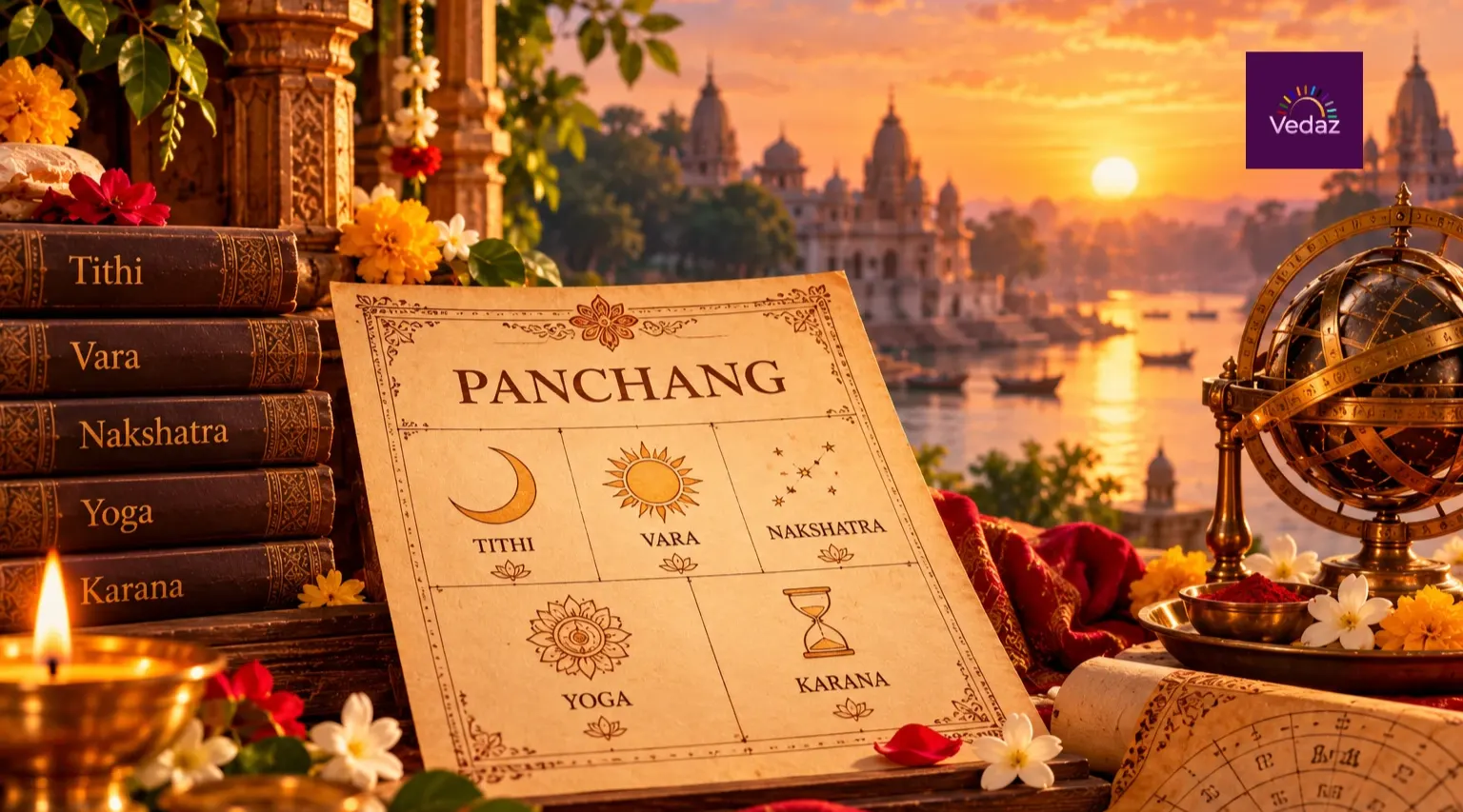
Today's panchang is the Hindu almanac for the day. It has five parts: tithi (lunar day), vara (weekday), nakshatra (the Moon's star), yoga (Sun and Moon combination) and karana (half a tithi). It also gives sunrise, sunset, Rahu Kaal and good timings (muhurats), so you can pick the right time for a puja, a trip or a fresh start.
- ◦What Is a Panchang?
- ◦Part 1: Tithi (The Lunar Day)
- ◦Part 2: Vara (The Weekday)
- ◦Part 3: Nakshatra (The Moon's Star)
- ◦Part 4: Yoga (The Sun and Moon Combination)
- ◦Part 5: Karana (Half a Tithi)
- ◦Beyond the Five Parts: Time Windows in Today's Panchang
- ◦Lunar Months: Amanta vs Purnimanta
- ◦How to Use Today's Panchang: Simple Examples
- ◦Today's Panchang vs Tomorrow's Panchang
- ◦A Word on Superstition and Balance
- ◦The Bottom Line
Every Hindu festival, every wedding date and every griha pravesh timing starts with one thing: the panchang. People search for it hundreds of thousands of times a month, as "panchang today," "aaj ka panchang" or "tomorrow panchang." Some are planning a puja. Some are about to launch a business. Some just want to know if today is Ekadashi.
But a panchang can look confusing at first glance. It is full of words most of us never learned. This guide breaks down today's panchang in plain language, whether you read it in English or look for today panchang hindi versions. You will learn what each part means, how it works, and how to use the daily panchang in real life.
What Is a Panchang?
Panchang (पंचांग) comes from two Sanskrit words: pancha (five) and anga (part). It is named this way because it rests on five main parts. You may also hear it called dainik panchang when it is the day-by-day version.
| Part | What it is | How many |
|---|---|---|
| Tithi | Lunar day, based on the gap between the Sun and Moon | 30 in a lunar month |
| Vara | Weekday, ruled by a planet | 7 |
| Nakshatra | The star group the Moon is in | 27 |
| Yoga | A combination of the Sun's and Moon's positions | 27 |
| Karana | Half of a tithi | 11 types (60 per month) |
A modern daily panchang adds more on top of these five. You will usually see sunrise and sunset, moonrise and moonset, the Sun and Moon signs, the lunar month and paksha, Rahu Kaal, Yamaganda, Gulika, Abhijit muhurat, Brahma muhurat, choghadiya and upcoming festivals.
Panchang today changes with your city. The day is counted from local sunrise, and tithis and nakshatras change at exact moments. So the panchang for Delhi and Chennai can be different on the same date. Always use one made for your own city.
Part 1: Tithi (The Lunar Day)
A tithi is the time the Moon takes to move 12 degrees ahead of the Sun. The Moon's speed keeps changing, so a tithi can last anywhere from about 19 to 26 hours. A lunar month has 30 tithis, split into two halves called paksha:
- Shukla Paksha (the bright, growing half): Pratipada up to Purnima (full moon)
- Krishna Paksha (the dark, shrinking half): Pratipada up to Amavasya (new moon)
| # | Tithi | # | Tithi |
|---|---|---|---|
| 1 | Pratipada | 9 | Navami |
| 2 | Dwitiya | 10 | Dashami |
| 3 | Tritiya | 11 | Ekadashi |
| 4 | Chaturthi | 12 | Dwadashi |
| 5 | Panchami | 13 | Trayodashi |
| 6 | Shashthi | 14 | Chaturdashi |
| 7 | Saptami | 15 | Purnima / Amavasya |
| 8 | Ashtami |
Tithi groups: Old texts sort tithis into five groups by their nature. Nanda (1, 6, 11) stands for joy. Bhadra (2, 7, 12) stands for health. Jaya (3, 8, 13) stands for victory. Rikta (4, 9, 14) means "empty" and is avoided for new beginnings. Purna (5, 10, 15) stands for fullness.
Which tithi counts for the day? For most religious purposes, the tithi running at sunrise is the tithi of the day. This is why a festival can fall on different dates in different cities. It is also why you sometimes see a tithi "skipped" (kshaya) or "repeated" (adhika). Your todays panchang will show the exact start and end time of each tithi, so you can see this for yourself.
Well-known tithis: Ekadashi (fasting, Lord Vishnu), Chaturthi (Ganesha), Ashtami (Durga and Krishna), Trayodashi (Pradosh, Shiva), Purnima (full moon rituals) and Amavasya (remembering ancestors).
Part 2: Vara (The Weekday)
Each day of the week belongs to a planet. In the Vedic way, the day starts at sunrise, not at midnight.
| Vara | Day | Ruling planet | Traditionally good for |
|---|---|---|---|
| Ravivar | Sunday | Sun | Authority, health, government work |
| Somvar | Monday | Moon | Travel, family, emotional matters |
| Mangalvar | Tuesday | Mars | Courage, property, surgery, sport |
| Budhvar | Wednesday | Mercury | Study, trade, communication |
| Guruvar | Thursday | Jupiter | Learning, rituals, money, teachers |
| Shukravar | Friday | Venus | Art, romance, shopping, beauty |
| Shanivar | Saturday | Saturn | Discipline, service, long-term work |
Part 3: Nakshatra (The Moon's Star)
The sky is divided into 27 nakshatras, each 13°20' wide. The Moon stays in each one for about a day. Today's nakshatra is one of the most important details in the daily panchang. It helps in choosing muhurats, naming ceremonies and daily plans. Your own birth nakshatra is the base for your dasha, your naam akshar and kundali matching.
Here is the full nakshatra chart, which also works as a nakshatra rashi chart because it shows the ruling planet and the rashi for each one.
| # | Nakshatra | Ruling planet | Rashi |
|---|---|---|---|
| 1 | Ashwini | Ketu | Mesh |
| 2 | Bharani | Venus | Mesh |
| 3 | Krittika | Sun | Mesh / Vrishabh |
| 4 | Rohini | Moon | Vrishabh |
| 5 | Mrigashira | Mars | Vrishabh / Mithun |
| 6 | Ardra | Rahu | Mithun |
| 7 | Punarvasu | Jupiter | Mithun / Kark |
| 8 | Pushya | Saturn | Kark |
| 9 | Ashlesha | Mercury | Kark |
| 10 | Magha | Ketu | Simha |
| 11 | Purva Phalguni | Venus | Simha |
| 12 | Uttara Phalguni | Sun | Simha / Kanya |
| 13 | Hasta | Moon | Kanya |
| 14 | Chitra | Mars | Kanya / Tula |
| 15 | Swati | Rahu | Tula |
| 16 | Vishakha | Jupiter | Tula / Vrishchik |
| 17 | Anuradha | Saturn | Vrishchik |
| 18 | Jyeshtha | Mercury | Vrishchik |
| 19 | Mula | Ketu | Dhanu |
| 20 | Purva Ashadha | Venus | Dhanu |
| 21 | Uttara Ashadha | Sun | Dhanu / Makar |
| 22 | Shravana | Moon | Makar |
| 23 | Dhanishta | Mars | Makar / Kumbh |
| 24 | Shatabhisha | Rahu | Kumbh |
| 25 | Purva Bhadrapada | Jupiter | Kumbh / Meen |
| 26 | Uttara Bhadrapada | Saturn | Meen |
| 27 | Revati | Mercury | Meen |
Look closely and you will see the planets follow the same order three times: Ketu, Venus, Sun, Moon, Mars, Rahu, Jupiter, Saturn, Mercury. This is the same order used in the Vimshottari dasha system.
Nakshatra types and what they suit
Old muhurat texts sort the nakshatras into groups by nature:
- Dhruva (fixed): Rohini, Uttara Phalguni, Uttara Ashadha, Uttara Bhadrapada. Good for foundations, griha pravesh and long-term commitments.
- Chara (moving): Swati, Punarvasu, Shravana, Dhanishta, Shatabhisha. Good for travel and buying vehicles.
- Kshipra (quick): Ashwini, Pushya, Hasta. Good for trade, medicine and learning. Pushya is especially popular for buying things.
- Mridu (gentle): Mrigashira, Chitra, Anuradha, Revati. Good for art, friendship and romance.
- Ugra (fierce): Bharani, Magha, Purva Phalguni, Purva Ashadha, Purva Bhadrapada. Traditionally used for bold or tough tasks.
- Tikshna (sharp): Ardra, Ashlesha, Jyeshtha, Mula. Traditionally used for firm endings.
- Mishra (mixed): Krittika, Vishakha. Fine for everyday work.
Gandmool nakshatras
Ashwini, Ashlesha, Magha, Jyeshtha, Mula and Revati sit at the meeting points of water and fire signs. They are called Gandmool. A baby born in one of these is traditionally given a simple shanti puja. It is a custom, not a sign of bad luck.
Part 4: Yoga (The Sun and Moon Combination)
Panchang yoga is worked out by adding the positions of the Sun and Moon and dividing the total into 27 equal parts of 13°20'. (This is not the same as the yogas in a birth chart, like Raja Yoga.)
The 27 yogas are: Vishkambha, Priti, Ayushman, Saubhagya, Shobhana, Atiganda, Sukarma, Dhriti, Shula, Ganda, Vriddhi, Dhruva, Vyaghata, Harshana, Vajra, Siddhi, Vyatipata, Variyan, Parigha, Shiva, Siddha, Sadhya, Shubha, Shukla, Brahma, Indra and Vaidhriti.
Most of them are seen as good. Vyatipata and Vaidhriti are usually avoided for auspicious starts. Vishkambha, Atiganda, Shula, Ganda, Vyaghata, Vajra and Parigha call for some care when choosing a muhurat.
Part 5: Karana (Half a Tithi)
Every tithi has two karanas, so a lunar month has 60. There are 11 types:
- Seven moving (chara) karanas that repeat in a cycle: Bava, Balava, Kaulava, Taitila, Gara, Vanija and Vishti.
- Four fixed (sthira) karanas that come once a month, close to Amavasya: Shakuni, Chatushpada, Naga and Kimstughna.
Vishti karana, also called Bhadra, is the one people watch most. Good events like weddings, griha pravesh and even tying rakhi on Raksha Bandhan are traditionally avoided during Bhadra. Most people spot it by checking their daily panchang each morning.
Beyond the Five Parts: Time Windows in Today's Panchang
Rahu Kaal
Rahu Kaal is a window of about 90 minutes every day that is seen as poor for starting something new. The time between sunrise and sunset is cut into eight equal parts, and Rahu Kaal sits in a fixed part for each weekday.
| Day | Part of the day | Approx. time (if sunrise is 6 am) |
|---|---|---|
| Monday | 2nd | 7:30 – 9:00 am |
| Tuesday | 7th | 3:00 – 4:30 pm |
| Wednesday | 5th | 12:00 – 1:30 pm |
| Thursday | 6th | 1:30 – 3:00 pm |
| Friday | 4th | 10:30 am – 12:00 pm |
| Saturday | 3rd | 9:00 – 10:30 am |
| Sunday | 8th | 4:30 – 6:00 pm |
The real timings move with your city's sunrise and sunset, which is one more reason to use a local panchang today. Also, you do not need to stop work that has already begun. The rule is only about starting new things.
Yamaganda and Gulika Kaal
These are two more daily windows of about 90 minutes each. Gulika (also called Mandi) is said to be the son of Saturn. Yamaganda is avoided for new starts. Gulika is believed to make things repeat, so people avoid it for things like funerals, but sometimes use it for things they want repeated, like investments.
Abhijit Muhurat
This is the eighth of fifteen daytime muhurtas. It sits around local noon and lasts about 48 minutes. It is said to be strong enough to cancel many other doshas. Many traditions make an exception for Wednesdays.
Brahma Muhurat
This starts about 96 minutes before sunrise and lasts 48 minutes. It is the traditional best time for meditation, prayer and study.
Choghadiya
Choghadiya splits the day and the night into eight parts each. Amrit, Shubh, Labh and Char are the good ones. Udveg, Kaal and Rog are the bad ones. It is popular in western India for quick calls on travel and business.
Lunar Months: Amanta vs Purnimanta
Different regions count the lunar month in different ways:
- Amanta (month ends on Amavasya): followed in Gujarat, Maharashtra, Karnataka, Andhra Pradesh, Telangana and Tamil Nadu (with solar versions too).
- Purnimanta (month ends on Purnima): followed in most of North India, including Uttar Pradesh, Bihar, Madhya Pradesh, Rajasthan, Punjab and Himachal.
So the same festival can fall in "Bhadrapada" in one region and "Shravana" in another. The day of the festival stays the same. Only the month name changes.
How to Use Today's Panchang: Simple Examples
- Starting something new (a job, a project, a purchase): Make sure the tithi is not Rikta (4, 9, 14). Stay away from Rahu Kaal and Bhadra. If you can, pick a friendly nakshatra like Pushya, Rohini, Hasta or Revati. Abhijit muhurat is a safe backup.
- Travel: Choose a chara nakshatra and avoid leaving during Rahu Kaal. If your family follows it, also check the disha shool, the direction to avoid on that weekday.
- Fasting and rituals: Go by the sunrise tithi. Dates for Ekadashi, Pradosh and Sankashti Chaturthi come straight from the daily panchang.
- Your own timing: Try Tara Bala. Count from your birth nakshatra to today's nakshatra, then divide by 9 and look at the remainder. A remainder of 2, 4, 6, 8 or 9 is seen as good. A remainder of 3, 5 or 7 asks for care. You can also check if the Moon is in the 8th sign from your Moon sign (Chandrashtama). Your aaj ka rashifal works on the same idea.
- Big events (wedding, griha pravesh, mundan): These need a muhurat made for the exact people involved, not just the general panchang. An astrologer looks at the panchang together with both charts.
Today's Panchang vs Tomorrow's Panchang
Many people search for tomorrow's panchang when they plan ahead, for a puja, a trip or a purchase. All five parts are worked out from the sky, so tomorrow's panchang is just as accurate as today's panchang.
A good habit is to check it the evening before. Note the sunrise tithi, the nakshatra, whether Bhadra falls during the day, and the Rahu Kaal time for your city. That gives you a clear plan before the day starts.
For a week or a month ahead, start with the key dates: Ekadashi, Purnima, Amavasya, Sankranti and Pradosh. Then fit your other plans around them.
A Word on Superstition and Balance
The panchang is a timing tool. It grew out of careful study of the sky over many centuries. It is there to help you work with natural rhythms, not to scare you. Missing Rahu Kaal by a few minutes will not ruin your plans. Starting exam prep on a "Rikta" tithi will not decide your result. Hard work, good preparation and a good heart count for far more. Use the panchang to pick better moments when you can, and don't worry when you can't.
The Bottom Line
The panchang is India's living calendar. It has five parts that describe the mood of each day, plus handy windows like Rahu Kaal and Abhijit muhurat. Once you know tithi, vara, nakshatra, yoga and karana, today's panchang stops feeling like a puzzle and becomes an easy planning tool.
Find your birth nakshatra free, try the Vedaz calculators for muhurat and dosha tools, or ask Vedaz if today's panchang suits your plans.
Siddharth Rao
Panchang, Tithi, Hindu calendar concepts, traditional observances. | 15 years
Siddharth Rao approaches traditional calendar topics with an emphasis on accuracy, clear definitions, and cultural context. He explains unfamiliar terms in a practical sequence, helping readers understand Panchang components and the customary significance of dates and timings in Hindu traditions.
Frequently Asked Questions
1. What is panchang today?
Today's panchang is the daily Vedic almanac. It lists the tithi, vara, nakshatra, yoga and karana, along with sunrise, sunset, Rahu Kaal and good muhurats for your location. People use it to pick favourable times for rituals and important tasks.
2. What are the five parts of panchang?
The five parts (anga) are tithi (lunar day), vara (weekday), nakshatra (the Moon's star), yoga (Sun and Moon combination) and karana (half of a tithi). Together they show the quality of time on a given day.
3. Why is panchang different for different cities?
Panchang depends on local sunrise and on the exact moments when tithis and nakshatras change. Since sunrise is different in each place, the same date can have a different tithi or timing in different cities.
4. How many nakshatras are there?
There are 27 nakshatras, each 13°20' wide. Some traditions add a 28th one, Abhijit, for muhurat work. The Moon stays in each nakshatra for about a day.
5. What is Rahu Kaal?
Rahu Kaal is a daily window of about 90 minutes. It falls in a fixed part of the daytime for each weekday. People avoid starting new ventures in it, but work already in progress can carry on.
Related Blogs
Boost Your Health with Astrology
Boost your health with astrology using zodiac-based habits, wellness tips, and simple routines for better physical and mental balance.

The Socking Truth Behind Wearing A Black Thread
Uncover the mystery behind the black thread. From protection to spiritual energy—here’s why everyone’s suddenly wearing one.
Hidden Messages In Your Moles
What if that little mole on your cheek is more than just a mark? Explore the fascinating meanings behind mole placements and what they reveal about your future.
Who Is Your Ishta Devata?
Explore the concept of your personal God in Hinduism. Learn how to discover, connect with, and build a relationship with your Ishta Devata for inner peace and spiritual growth.