Complete Guide to Rahu and Ketu: Meaning, Dosha, Dasha & Remedies
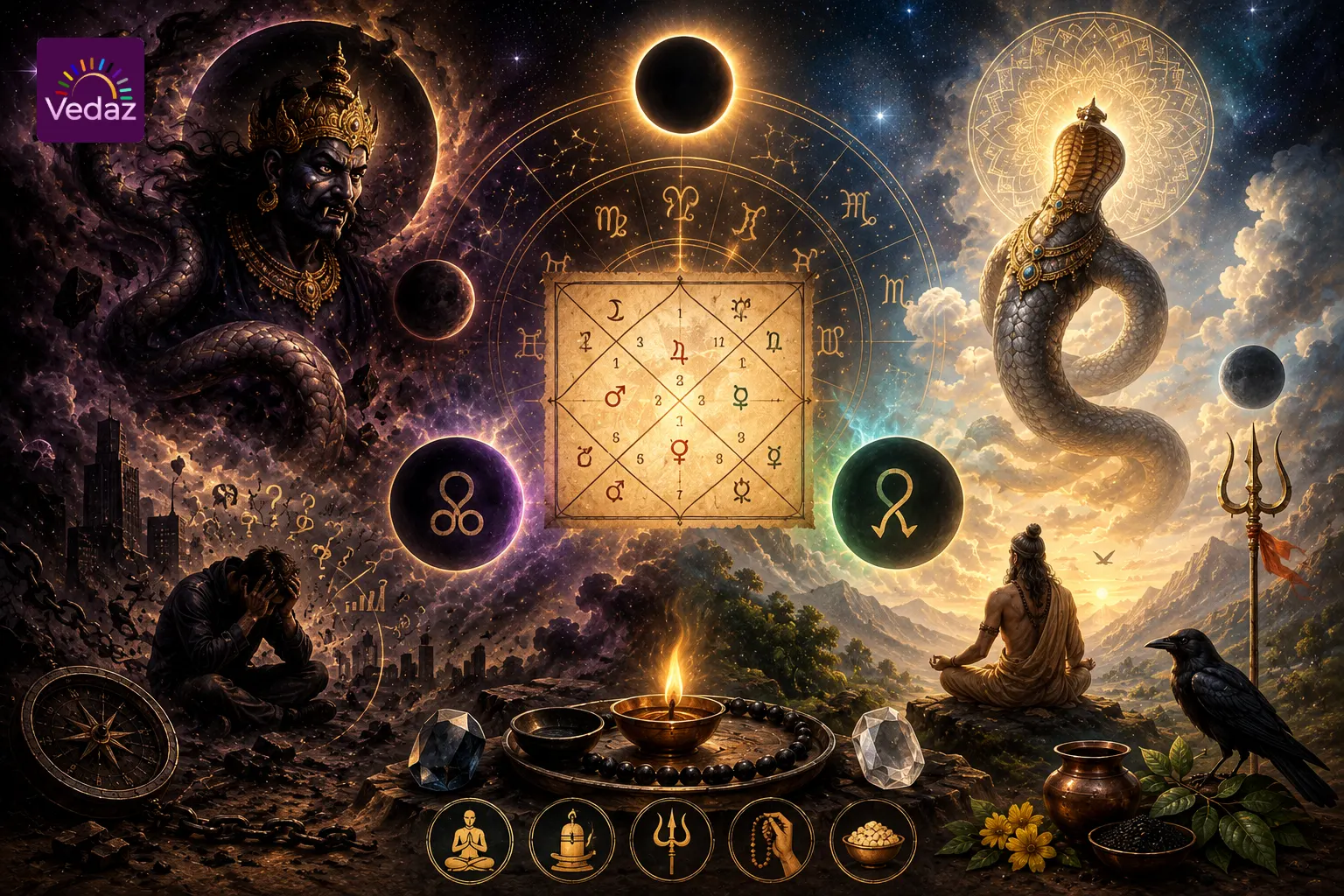
Rahu and Ketu are the North and South Lunar Nodes in Vedic astrology — mathematical points where the Moon's orbit crosses the Sun's path. They cause eclipses, govern karma, and shape desire and detachment in a birth chart. They are always exactly 180° apart.
- ◦What Are Rahu and Ketu in Vedic Astrology?
- ◦The Mythology Behind Rahu and Ketu: Why They Behave Like They Do
- ◦What Does Rahu Represent in a Horoscope?
- ◦What Does Ketu Represent in a Horoscope?
- ◦The Rahu-Ketu Axis: How the Karmic Spine Works in Your Chart
- ◦Rahu in the 12 Houses: Quick Reference Guide
- ◦Ketu in the 12 Houses: Quick Reference Guide
- ◦Rahu and Ketu Mahadashas: The Periods That Define Decades
- ◦Kal Sarpa Dosha, Guru Chandal Yoga, and Other Famous Rahu-Ketu Combinations
- ◦The 6 Nakshatras Ruled by Rahu and Ketu
- ◦Classical Remedies for Rahu and Ketu Affliction
- ◦See Where Rahu and Ketu Sit in Your Chart — Free on Vedaz
- ◦Final Thought
Rahu and Ketu are not planets. They don't even have physical form.
They are two points in the sky — mathematical intersections where the Moon's orbit crosses the Sun's apparent path. No mass, no light, no surface. Just geometry.
And yet they are responsible for some of the most intense, disorienting, and consequential experiences a Vedic chart can produce. They cause eclipses. They create obsessions. They strip things away without warning. Classical Vedic literature returns to them constantly — and Western astrology barely mentions them at all.
This is the complete guide: what Rahu and Ketu actually are, the mythology that gives them their character, what they represent, what they do in each house, the famous Kal Sarpa Dosha, the long mahadasha periods that can define entire decades, and the classical remedies. Bookmark this one — it's the page you'll return to whenever a chart, an eclipse, or a particularly strange life period sends you looking for answers on the karmic axis.
Quick Answers: Rahu and Ketu in Vedic Astrology
- What are they? Mathematical points — North and South Lunar Nodes — not physical planets
- How far apart? Always exactly 180° from each other in your chart
- What does Rahu rule? Desire, ambition, foreign things, technology, illusion, obsession
- What does Ketu rule? Detachment, past-life mastery, spirituality, sudden losses, moksha
- How long are their mahadashas? Rahu = 18 years; Ketu = 7 years
- What is Kal Sarpa Dosha? All seven traditional planets hemmed between the two nodes
- Do they move forward? No — they move in retrograde, shifting signs roughly every 18 months
What Are Rahu and Ketu in Vedic Astrology?
Astronomically, Rahu (the North Lunar Node) and Ketu (the South Lunar Node) are the two points where the Moon's orbit intersects the ecliptic — the Sun's path across the sky as seen from Earth. They're not objects. They're positions. And whenever the Sun and Moon align near these points, an eclipse happens.
In Vedic astrology, they are treated as full "shadow planets" — chhaya grahas — given mahadasha periods, house-by-house effects, and karmic significance on par with the visible planets. They always sit exactly 180° apart. Wherever Rahu is in your chart, Ketu is in the opposite house and sign. Together they form what classical astrology calls the karmic axis of your chart — the spine around which your life's deeper story is organized.
To understand how this axis sits within the full structure of your birth chart, see the complete guide to 12 houses in Vedic astrology explained.
The Mythology Behind Rahu and Ketu: Why They Behave Like They Do
Vedic astrology is unusual in how tightly its mythology maps onto actual astrological behavior. The story of Rahu and Ketu comes from one of the most famous episodes in Hindu cosmology — the churning of the cosmic ocean, the Samudra Manthan.
When the gods and asuras churned the ocean to draw out amrita, the nectar of immortality, an asura named Svarbhanu disguised himself among the gods and quietly took a sip. The Sun and Moon recognized him and reported him immediately to Vishnu, who beheaded the asura with his Sudarshana Chakra.
But it was too late — the nectar had already reached his throat. The head became immortal. So did the body. The head became Rahu. The body became Ketu. And both have been chasing revenge on the Sun and Moon ever since — which is why they "swallow" them during eclipses.
The astrological character of each flows directly from this story:
- Rahu — the head with no body. All desire, no satiation. He consumes, obsesses, hungers — but can never feel full, because without a body, nothing lands anywhere. Rahu is the part of your chart that wants what it's never had, and keeps wanting it even after it gets it.
- Ketu — the body with no head. All action, no conscious direction. He moves on deep, past-life instinct, does things brilliantly without knowing why, then loses interest and wanders off. Ketu is the part of your chart that has already mastered something — and now finds it quietly meaningless.
What Does Rahu Represent in a Horoscope?
Rahu governs everything foreign, novel, hidden, ambitious, technological, illusory, and obsessive. He is associated with:
- Worldly desire and material ambition
- Foreign lands and foreign partners
- Modernity, technology, social media, cryptocurrency, and anything cutting-edge
- Obsession, addiction, intoxication, and maya — illusion
- Outsiders, rebels, and people who break taboos and somehow pull it off
- Sudden unexpected gains, viral fame, overnight success
- Manipulation, deception, and the underworld
- Photography, cinema, anything that projects or captures images
A strong, well-placed Rahu can produce remarkable worldly success — founders of disruptive companies, foreign-born celebrities, technologists, masters of unconventional fields. A weak or afflicted Rahu produces obsession without satisfaction — a persistent hunger that no achievement quite quenches.
For a deeper look at how Rahu behaves across all twelve house placements, the dedicated guide to Rahu placement in different houses explained covers each position in full. The specific dynamics of Rahu in 12th house meaning and remedies are worth reading if that placement appears in your chart.
What Does Ketu Represent in a Horoscope?
Ketu governs everything that points away from the material world:
- Spirituality, mysticism, occult knowledge, past-life mastery
- Things you're inexplicably good at without having studied them
- Detachment, renunciation, monastic tendencies
- Deep research and narrow expertise
- The healing arts — anything precise and inward-facing
- Isolation, loneliness, sudden losses, accidents, and separations
- At the deepest level — moksha, liberation from the cycle of birth and death itself
A strong Ketu produces depth, wisdom, and sometimes a kind of genius in very specific areas — the "old soul" who arrived already knowing things. A weak or afflicted Ketu produces confusion, sudden losses, and a pervasive feeling that nothing in the visible world is quite enough.
For house-by-house detail, see Ketu placement in different houses explained. If Ketu sits with Saturn in your chart, the Saturn and Ketu conjunction meaning and its effect is a particularly significant combination to study.
The Rahu-Ketu Axis: How the Karmic Spine Works in Your Chart
Because they're always 180° apart, Rahu and Ketu form a single axis running through your chart. Whatever house Rahu occupies, Ketu is in the opposite house. This isn't just a positional fact — it describes a fundamental tension that runs through your whole life.
- Ketu sits on the area you've already mastered — karmically speaking — and now find quietly unsatisfying.
- Rahu sits on the area you're obsessively pulled toward but have no native instinct for.
Most people spend their lives reluctantly leaving the comfort of Ketu and lurching toward the unfamiliar pull of Rahu, making a mess of it repeatedly before they find their footing.
The Ketu side is what you can't stop being good at. The Rahu side is what you can't stop wanting. Between them is the karmic plot of your life.
To understand what the rest of your chart says about this karmic story, how to read kundli for beginners is an excellent starting point.
Rahu in the 12 Houses: Quick Reference Guide
Rahu's house placement shows where you're relentlessly hungry, ambitious, and willing to bend the rules to get what you want. The opposite house is where Ketu sits.
| Rahu in House | Core Theme |
|---|---|
| 1st | Obsession with self-image, identity reinvention, magnetic but unsettled persona |
| 2nd | Hunger for wealth and status, unusual speech, foreign-influenced family |
| 3rd | Ambitious in communication and media, courage with risk, writing pull |
| 4th | Restlessness at home, foreign property, unconventional mother, real-estate ambition |
| 5th | Unconventional creativity, unusual or late children, speculative gains, foreign romance |
| 6th | Powerful in conflict and competition — often a success story, victory over enemies |
| 7th | Foreign or unconventional spouse, intense partnerships, public-facing obsession |
| 8th | Occult interests, sudden transformations, hidden wealth, intensity around mortality |
| 9th | Rebellion against tradition, foreign higher education, unconventional guru |
| 10th | Strong career ambition, public success often abroad, willingness to break norms |
| 11th | Powerful network and gains, obsessive ambitions fulfilled, unconventional friend circle |
| 12th | Foreign settlement, spiritual obsession, hidden expenses, dream-rich inner life |
Ketu in the 12 Houses: Quick Reference Guide
Ketu's house placement shows where you carry past-life mastery, where you feel quietly competent without effort, and where detachment — sometimes painful detachment — tends to appear.
| Ketu in House | Core Theme |
|---|---|
| 1st | Detached personality, spiritual seeking from a young age, identity feels less urgent |
| 2nd | Distance from family, careful or sparse speech, money matters feel unimportant |
| 3rd | Spiritual courage, fewer or distant siblings, communication that goes deep not wide |
| 4th | Detachment from home and homeland, mystical mother figure, restless emotional core |
| 5th | Innate creativity or intelligence, complications around children, unconventional romance |
| 6th | Victory through detachment, strong healing capacities, immunity at the soul level |
| 7th | Detached in marriage, partner is often spiritual or distant, partnerships end cleanly |
| 8th | Strong intuition, occult talent, deep transformative experiences |
| 9th | Spontaneous spiritual understanding, past-life dharma, detachment from formal religion |
| 10th | Career feels secondary or mystical, public role held with detachment, sudden status shifts |
| 11th | Few but deep friendships, gains feel hollow, unusual or distant elder siblings |
| 12th | Strong moksha potential, spiritual longing, foreign isolation, rich inner dream life |
Rahu and Ketu Mahadashas: The Periods That Define Decades
In the Vimshottari Dasha system, the periods of Rahu and Ketu stand out as the most distinctive — and the most unequal. Rahu mahadasha lasts 18 years. Ketu mahadasha lasts 7.
Rahu Mahadasha (18 Years)
Often the most professionally consequential period in a person's life. Rahu mahadasha tends to bring:
- Foreign exposure and technological involvement
- Fame or notoriety
- Unconventional achievements
- A kind of relentless ambition that surprises even the person living it
Many founders, foreign-settled professionals, and breakthrough artists trace their most pivotal years directly to this dasha.
The catch: even when it produces real external success, Rahu mahadasha rarely feels satisfying from the inside. The hunger doesn't stop just because you got what you wanted. That's the nature of Rahu — the head with no body to rest in.
For a full breakdown of what to expect period by period, see Rahu mahadasha effects and practical remedies.
Ketu Mahadasha (7 Years)
Often the most spiritually formative period in a person's life. Ketu mahadasha tends to bring:
- Detachment from things that previously felt essential
- Sudden losses of jobs, relationships, or identity
- Spiritual awakening
- Deep specialization in unexpected areas
- At its most extreme — a pull toward withdrawal that can feel monastic
Many people come out of Ketu mahadasha genuinely unrecognizable from who they were going in — quieter, deeper, and often completely reoriented about what matters. The catch: it's one of the harder periods to be inside while it's actually happening.
If you're navigating a Ketu period and looking for spiritual clarity, Moksha — Vedaz's AI astrologer for mental peace can help you work through the detachment and spiritual themes that define this dasha.
Kal Sarpa Dosha, Guru Chandal Yoga, and Other Famous Rahu-Ketu Combinations
A few combinations involving Rahu and Ketu have become famous in popular Vedic astrology. They deserve the attention — but most are considerably less catastrophic than the internet would have you believe.
What Is Kal Sarpa Dosha and Is It Really Dangerous?
When all seven traditional planets (Sun, Moon, Mars, Mercury, Jupiter, Venus, Saturn) are placed on one side of the Rahu-Ketu axis — hemmed between the two nodes — the chart has Kal Sarpa Dosha. Literally: "the time-serpent flaw." Traditionally associated with delays, mysterious obstacles, and a feeling of running headlong into invisible karmic walls.
The honest take: it's real, but heavily overstated in casual readings. Many extraordinarily successful people have it. It correlates more with karmic intensity than with failure. There are also classical exemptions and partial configurations that meaningfully change the impact.
Kal Sarpa Yoga (the Auspicious Variant)
When the same all-on-one-side configuration is supplemented by specific benefic placements, classical texts call it Kal Sarpa Yoga — not a dosha but an asset, associated with unusually high achievement, fame, or spiritual realization. Whether you're looking at a dosha or a yoga depends on the surrounding chart conditions. Same configuration, very different story.
Guru Chandal Yoga: Rahu with Jupiter
When Rahu sits with Jupiter in the same house. Classical association: distortion of wisdom, unconventional or unreliable teachers, a guru figure who turns out to be different than expected, or spiritual ambition that tilts toward manipulation.
Modern interpretations vary widely — many people with Guru Chandal Yoga become unconventional but entirely legitimate teachers and original thinkers. The dedicated guide to Rahu Jupiter conjunction and major changes in destiny explores this combination in full.
Eclipse Points in the Natal Chart
When natal Rahu or Ketu sits conjunct the Sun or Moon in your chart, you carry an eclipse point. This often produces an intense, unusual, or mystical relationship with the parent that planet represents (Sun = father, Moon = mother), and a deep undercurrent throughout life that can swing between obscured and brilliantly illuminated.
For the specific dynamics of Rahu alongside the Sun, effects of Sun Rahu conjunction on personality and life events is essential reading. And when Rahu aligns with the Moon, Rahu Moon conjunction and its influence on mind and emotions covers the emotional and psychological dimensions in depth.
The 6 Nakshatras Ruled by Rahu and Ketu
Rahu and Ketu don't just influence houses and signs — they govern six nakshatras directly, each carrying the raw karmic signature of the node that rules it. These six nakshatras are among the most intense, transformative, and spiritually charged in the entire Vedic system. If your Moon, Ascendant, or key planets fall in any of these, the Rahu-Ketu axis is not background noise in your chart — it is the main story.
| Nakshatra | Ruling Node | Pada Range | Core Energy | Key Themes |
|---|---|---|---|---|
| Ashwini Nakshatra | Ketu | Aries 0°–13°20' | Swift, instinctive, healing | New beginnings, speed, past-life gifts, raw courage |
| Ardra Nakshatra | Rahu | Gemini 6°40'–20° | Stormy, intellectual, hungry | Destruction before renewal, obsessive brilliance, grief |
| Magha Nakshatra | Ketu | Leo 0°–13°20' | Ancestral, regal, karmic | Past-life royalty, lineage karma, authority and pride |
| Swati Nakshatra | Rahu | Libra 6°40'–20° | Independent, restless, ambitious | Worldly desire, flexibility, foreign connections, trade |
| Mula Nakshatra | Ketu | Sagittarius 0°–13°20' | Destructive, rooted, truth-seeking | Uprooting, moksha, spiritual investigation, karmic endings |
| Shatabhisha Nakshatra | Rahu | Aquarius 6°40'–20° | Secretive, scientific, solitary | Hidden knowledge, healing mysteries, unconventional paths |
Classical Remedies for Rahu and Ketu Affliction
Classical Vedic astrology offers detailed remedies for both nodes. We're reporting what the tradition prescribes. Whether you take these literally, symbolically, or as a form of meditative discipline is entirely your call.
Rahu Remedies
- Mantra — "Om Bhram Bhreem Bhroum Sah Rahave Namah" or the simpler "Om Raam Rahave Namah." Traditionally chanted on Saturdays.
- Donations — black sesame, blue or black cloth, blankets, mustard oil. Given to those on the margins of society, since Rahu governs outsiders.
- Service — to the elderly, the disabled, or any group classical texts associate with karmic purification through service.
- Worship — of Goddess Durga or Lord Bhairava, both traditionally invoked for Rahu pacification.
- Gemstone — hessonite garnet (gomedh), only after a full individual chart analysis. Rahu gemstones can amplify the very obsession you're trying to manage — don't do this casually.
Ketu Remedies
- Mantra — "Om Sraam Sreem Sroum Sah Ketave Namah" or "Om Kem Ketave Namah." Traditionally chanted on Tuesdays.
- Donations — striped or multi-colored cloth, blankets. Given to wandering ascetics, stray animals, or dogs (dogs are strongly associated with Ketu).
- Service — to spiritual teachers, monasteries, the homeless, and animals — especially strays.
- Worship — of Lord Ganesha, traditionally said to clear Ketu-related obstacles.
- Gemstone — cat's eye (lehsunia), again only after a proper chart analysis. Ketu gemstones can deepen detachment and isolation if used for the wrong chart.
For personalized remedy guidance based on your specific chart, Atri — Vedaz's AI astrologer for astrological remedies can identify which classical prescriptions apply to your Rahu-Ketu placement and current dasha period.
See Where Rahu and Ketu Sit in Your Chart — Free on Vedaz
Vedaz tells you exactly which houses Rahu and Ketu occupy, what they mean for your specific chart, whether you have Kal Sarpa Dosha (and which variant), and — if you're currently running Rahu or Ketu mahadasha — what to expect over the rest of the period. All explained at vedaz.io - today.
Final Thought
Rahu and Ketu are probably the most fascinating points in any Vedic chart — and the most honest. They're the parts of you that don't quite fit the rest. The unusual ambitions. The sudden detachments. The pull toward foreign things. The strange expertise you never formally developed. The thing you keep chasing and the thing you keep abandoning.
Where the visible planets describe who you are by birth, the nodes describe who you're in the process of becoming — often in spite of your own preferences.
Find them in your chart. Look at the axis they form across the houses. Then sit with the question honestly: what is Ketu showing you that you've already mastered and grown quietly tired of — and what is Rahu showing you that you're about to spend the next decade chasing?
The answer is rarely comfortable. But it's almost always the truest thing in the chart.

Acharya Gopalji
Vedic, Numerology | 15 years
Acharya Gopalji is a practitioner of Vedic Astrology and Numerology. He specializes in helping people understand their life path, inner strengths, and personal growth, offering thoughtful guidance during important phases of life.
Frequently Asked Questions
1. Are Rahu and Ketu real planets?
Not in the astronomical sense. They're mathematical points where the Moon's orbit crosses the ecliptic — the North and South Lunar Nodes. Western astronomy uses the same terminology. Vedic astrology gives them the full status of planets (chhaya grahas, or shadow planets) because of how profoundly they influence a chart.
2. What is the difference between Rahu and Ketu?
Rahu represents desire, ambition, and the things you don't yet have but obsessively want. Ketu represents detachment, past-life mastery, and the things you already have but find quietly unsatisfying. They sit 180° apart and form the karmic axis of your chart.
3. Is Rahu always bad and Ketu always spiritual?
No. Rahu can produce extraordinary worldly success when well-placed and well-supported by the chart. Ketu can produce painful isolation and confusion when poorly placed. The character of each depends entirely on house, sign, aspects, and dasha context. The "Rahu = bad, Ketu = good" framing is a simplification that classical texts don't endorse.
4. What is Kal Sarpa Dosha and is it really dangerous?
It occurs when all seven traditional planets are hemmed between Rahu and Ketu. Traditional readings associate it with delays and karmic obstacles — but modern practice is more measured. Many high achievers have it, partial variants exist, and the auspicious Kal Sarpa Yoga form significantly changes the story. It's rarely the catastrophe that popular content makes it out to be.
5. How long do Rahu and Ketu stay in one sign?
About 18 months each. Rahu and Ketu move in retrograde — against the order of signs — and shift signs roughly every year and a half. A full cycle through the zodiac takes about 18 to 19 years.
6. What happens when Rahu and Ketu transit my natal Moon or Sun?
You essentially undergo a personal eclipse — of identity (Sun) or emotion (Moon). These periods often coincide with major life pivots, unexpected gains or losses, and identity reassessments. They're also when actual eclipse seasons hit you most directly and personally.
7. How do I know if I am in Rahu or Ketu mahadasha?
Generate your Vimshottari Dasha sequence — any reputable Vedic calculator will show this. It displays which mahadasha you're currently in, when it started, and when it ends. Rahu lasts 18 years, Ketu lasts 7. You can also experience strong Rahu or Ketu effects during their antardasha (sub-period) within another planet's mahadasha.
8. Can Rahu and Ketu be cancelled or pacified?
Their effects can be modified through chart conditions — benefic aspects, a strong Jupiter, a well-placed dispositor — and through the classical remedies above. They're never fully "cancelled" the way some doshas can be, because they aren't flaws. They're karmic positions. The traditional view is that you learn to work with them, not against them.
More by this writer
888 Angel Number Meaning: A Sign of Abundance and Flow
Angel number 888 is more than a coincidence — it’s a signal that abundance, purpose, and a major career breakthrough are on the horizon. Here’s what to do when you see it.

Sun and Mercury Conjunction and Its Impact on Intelligence and Career
Budh Aditya Yoga meaning and benefits. See how this conjunction strengthens mind, speech, and leadership ability.

Ashadhi Ekadashi 2026 Date and Puja Vidhi
Ashadhi Ekadashi 2026 complete guide: date, vrat, fasting rules, puja vidhi, bhajans, nama japa & pandharpur yatra dedicated to lord vitthal.
707 Angel Number: A Divine Sign That You're Exactly Where You Need to Be
The 707 angel number signals spiritual awakening, inner wisdom, and alignment with your true path. If you keep seeing 707, it’s a sign to trust your intuition and embrace your inner growth.
Related Blogs
How Your Ruling Planet Affects You?
The impact of your ruling planet upon yourself and your course of action in life. Find the hidden meaning behind your zodiac sign’s star guide.

How the Moon Phases Impacts Body & Mind
Can the Moon’s phases impact your sleep, mood, and health? Explore the fascinating connection between lunar cycles and wellness and how to harness their energy for personal growth
What Are The Hidden Connection Between Planets and Emotions
Do planets influence your emotions? Explore how astrology connects to mental health, from Mercury retrograde effects to Saturn return life changes—and what science says about it!

Mercury Retrograde Survival Guide: Mental Health Tips for Every Sign
Turn Mercury Retrograde chaos into clarity with actionable mental health hacks for every zodiac sign.