Vastu for Home Explained: Best Directions, Room Placement & Easy Fixes
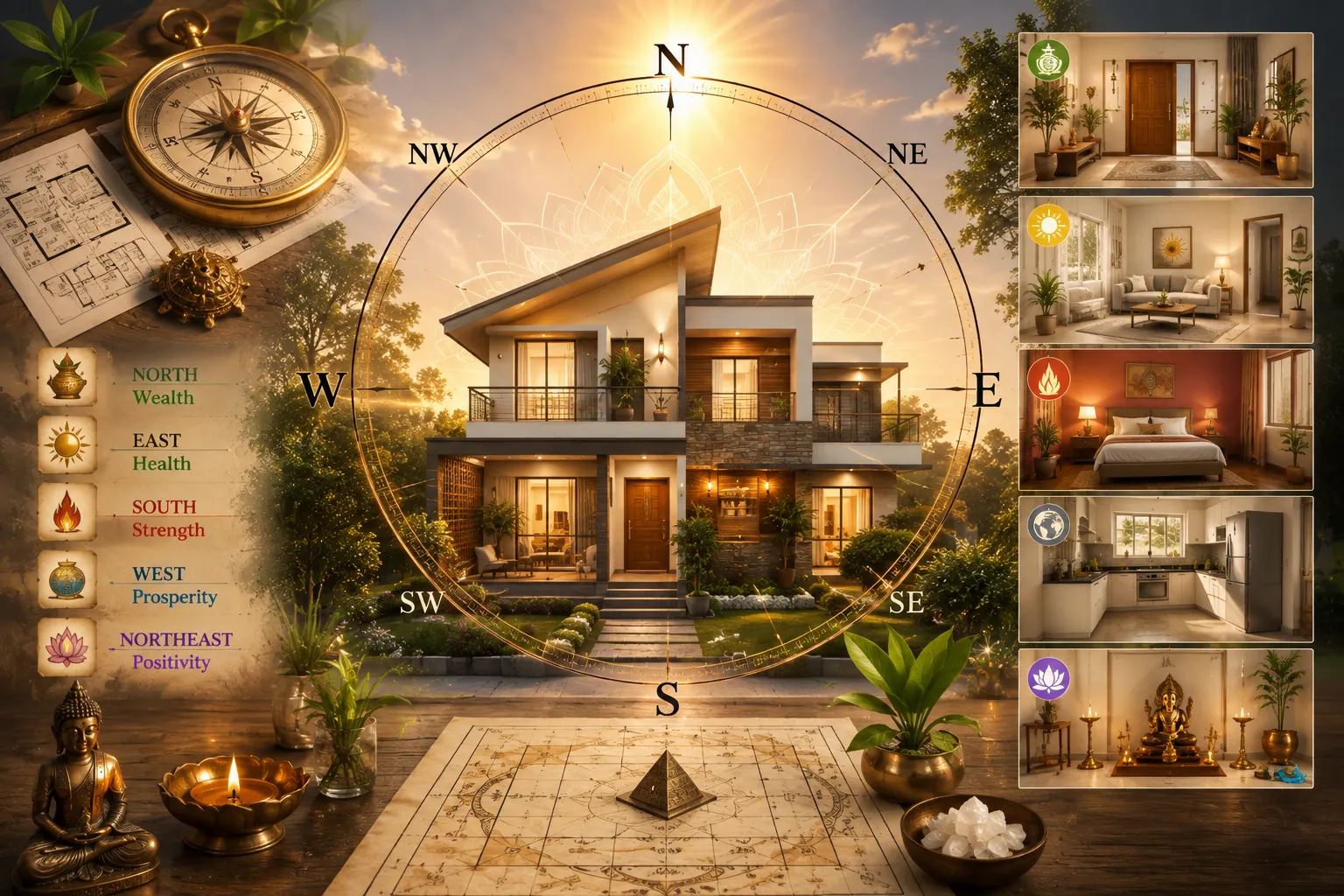
Vastu Shastra is one of the Vedic upavedas — supplementary sciences — with surviving texts like the Manasara Shilpa Shastra dating back over 3,000 years. It governs three things in any structure: which direction it faces, how its proportions relate, and where each activity happens relative to the five classical elements. The northeast and southwest are its two most weight-bearing directions.
- ◦What is Vastu Shastra? The Vedic Science of Dwelling Explained
- ◦The 8 Directions in Vastu Shastra: Rulers, Elements, and Domains
- ◦Vastu Shastra vs Feng Shui: Key Differences You Should Know
- ◦Room-by-Room Vastu Shastra Guide: Placement, Direction, and Rules
- ◦The Five Elements (Pancha Bhuta) in Vastu Shastra and Their Balance
- ◦The Most Common Vastu Defects and What to Actually Do About Them
- ◦Vastu Shastra for Renters: What You Can Actually Do Without Touching a Wall
- ◦What Vastu Shastra Will Not Fix: An Honest Assessment
- ◦Get a Vastu Reading for Your Home on Vedaz
- ◦Final Thought
- ◦Frequently Asked Questions: Vastu Shastra Explained
Most Indian families consult Vastu before buying or renovating a home. And most of them, if you ask honestly, can only explain it in fragments — something about which way the kitchen should face, a grandmother who refused to let anyone put the bed against the north wall, an uncle who turned down an otherwise perfect flat because the main door opened south.
Those fragments come from somewhere real. Vastu Shastra is the architectural discipline behind them — a system that has been shaping Indian homes for at least three thousand years. Like astrology, it is one of the Vedic sciences. Unlike astrology, it works with space rather than time. Not when you were born, but where you live.
This guide is the whole thing: what Vastu actually is, what each of the eight directions governs, how the rules play out room by room, which defects matter most (and what you can actually do about them), and a practical section for renters who cannot touch a single wall.
Quick Vastu Reference
- Vastu Shastra is a Vedic system of architecture concerned with direction, room placement, and elemental balance in a home
- Northeast is the most sacred direction — keep it light, clean, and open
- Southwest should be the heaviest part of the home — master bedroom, storage, weight-bearing walls
- Main entrance ideally faces north, east, or northeast
- Master bedroom works best in the southwest; kitchen in the southeast
- Head while sleeping should point south or east — never north
- Cook should face east while at the stove
- The center of the home (Brahmasthan) should remain open and uncluttered
- Toilets in the northeast and kitchens in the northeast are the most serious defects
- Most Vastu remedies are practical adjustments that even renters can make
What is Vastu Shastra? The Vedic Science of Dwelling Explained
Vastu Shastra translates roughly as "the science of dwelling." It is the traditional Indian system that governs how buildings should be oriented, proportioned, and arranged to work with natural forces rather than against them.
It is one of the upavedas — the supplementary Vedic disciplines — and the oldest surviving texts on it, like the Manasara Shilpa Shastra and the Mayamatam, predate most of the temple architecture we associate with classical India. Traditional architects still reference those same texts today.
At its core, Vastu cares about three things:
- Which way a structure faces
- How its proportions relate to each other
- Where each activity happens relative to the five elements
When those three things are in alignment, the classical texts say the home supports the people living in it. When they are not, certain kinds of friction — financial, physical, relational — tend to build up over time.
That framing probably sounds abstract. It gets concrete quickly once you start looking at specific directions and rooms.
Just as Vedic astrology uses the birth chart to understand how planetary positions shape a person's life, Vastu uses the directional map of a home to understand how spatial arrangement shapes the energy of those living in it. If you're curious how these two Vedic sciences interconnect — and how your birth chart's planetary placements interact with the directions relevant to your specific life path — how to read kundli for beginners gives the chart-reading foundation that makes that cross-reference possible.
The 8 Directions in Vastu Shastra: Rulers, Elements, and Domains
Every Vastu reading starts with a compass. The eight directions — four cardinal, four inter-cardinal — each have a ruling deity, a governing element, and a domain of life they influence.
| Direction | Ruler / Element / Domain |
|---|---|
| North (Uttara) | Kubera (god of wealth) — water — wealth, career, opportunity |
| Northeast (Ishanya) | Ishana / Shiva — water — the most sacred direction; spiritual practice, clarity, divine connection |
| East (Purva) | Indra (king of gods) — air — vitality, social standing, growth |
| Southeast (Agneya) | Agni (fire) — fire — energy, transformation, digestion |
| South (Dakshina) | Yama (god of dharma) — earth — strength, longevity, karma |
| Southwest (Nairutya) | Nirriti — earth — stability, ancestry, relationships, weight |
| West (Paschima) | Varuna (god of waters) — water — gains, prosperity, the future |
| Northwest (Vayavya) | Vayu (wind) — air — movement, social connections, change |
Once you understand this table, two principles jump out — and almost every specific Vastu rule flows from one of them:
- The northeast is sacred and should stay light. Pooja rooms, meditation areas, and water sources belong here. A toilet or heavy furniture in the northeast is considered the most consequential Vastu defect in most classical readings.
- The southwest is heavy and should anchor the home. The master bedroom, bulky storage, safes, and weight-bearing structures belong here. Open balconies or voids in the southwest are said to weaken the home's foundation in every sense of the word.
Interestingly, the north direction in Vastu is governed by Kubera — the same deity of wealth referenced in Vedic astrology's Kubera Yoga. The north is consistently the direction of financial energy and opportunity across both systems.
Vastu Shastra vs Feng Shui: Key Differences You Should Know
People mix these up constantly, and it is worth spending a moment on why they are not the same thing.
Both systems start from the same premise — that how you arrange a dwelling affects the people living in it. But they use completely different maps:
- Feng Shui works from the bagua — an octagonal reference grid oriented to the entrance — and uses the five Chinese elements: wood, fire, earth, metal, water
- Vastu uses the eight cardinal and inter-cardinal directions and the Vedic five elements: space, air, fire, water, earth
Sometimes the two systems agree. Both like the southeast for kitchens. But they disagree on bedroom placement and several other key points — and mixing advice from both in the same home produces contradictions.
Pick one system per home and stick with it.
Room-by-Room Vastu Shastra Guide: Placement, Direction, and Rules
Main Entrance Vastu: The Most Important Element in Any Home
The main door is the most important single element in any Vastu reading. This is where energy enters the home, and its direction shapes everything else.
- Best directions: north, east, northeast, or west
- Avoid: south or southwest unless you have compensating elements in place
- The door should open inward — energy should be welcomed, not pushed away
- It should be the largest and most prominent door in the home
Living Room Vastu: Direction and Furniture Placement
Best in the north, east, or northeast. The living room is where the household connects and social energy flows, and these directions support exactly that. When you arrange furniture:
- Heavier pieces belong toward the south or southwest of the room
- Lighter seating belongs toward the north or east
Master Bedroom Vastu: Best Direction for the Head of Household
Best in the southwest — the direction of stability, anchoring, and weight. This is the right place for whoever is the primary earner or head of household. For the bed specifically:
- Position so your head points south or east while sleeping
- Never sleep with your head pointing north — this is one of the most consistently avoided arrangements in Vastu
- Avoid mirrors directly facing the bed
Children's Bedroom Vastu: Direction for Study and Sleep
Best in the west or northwest — directions associated with growth, movement, and learning.
- Study areas for children work best in the east or northeast, where light and clarity are strongest
- Head pointing east while sleeping supports concentration
- Head pointing south supports deep sleep
Kitchen Vastu: The Correct Direction and Fire-Water Rule
Best in the southeast — the direction of fire, governed by Agni. Key rules:
- The cook should face east while cooking
- Keep the stove and the water source (sink, fridge) on different sides of the kitchen — fire and water elements sitting adjacent to each other is a specific thing Vastu tries to avoid
- Kitchens in the northeast or southwest are the most problematic placements
Pooja Room Vastu: Placement and Deity Facing Direction
Best in the northeast — the most sacred direction. Placement rules:
- Deities should face east or west; the person praying should face east or north
- Avoid pooja rooms located beneath a staircase
- Avoid rooms sharing a wall with a bathroom
- Do not place the pooja room inside the bedroom
Bathroom and Toilet Vastu: Placements to Avoid
Best in the northwest, west, or south. The three placements to strictly avoid:
- Northeast — most sacred direction; this is the most serious defect
- Southeast — water and fire in direct conflict
- The center of the home — blocks the Brahmasthan
Northeast toilets are the defect that comes up most often in consultations — and the one with the most urgent remedies.
Study and Home Office Vastu: Facing Direction and Desk Placement
Best in the east, north, or northeast. Sit facing east or north while working. Placement rules:
- Bookshelves should go on the south or west walls
- Heavy filing cabinets work best in the southwest
- Electronics and computers do well in the southeast — the fire direction is considered compatible with electrical equipment
Storage Room Vastu: Safes, Lockers, and Heavy Items
Best in the southwest. Heavy storage naturally anchors the heaviest direction.
- Safes and lockers should be placed so the door opens northward — toward Kubera, the god of wealth — when accessed
Staircase Vastu: Direction and Design Rules
Best in the south, southwest, or west. Rules to follow:
- Never start or end at the northeast
- Should ascend clockwise (associated with positive directional flow)
- Should not be positioned directly at the entrance to the home
Brahmasthan Vastu: The Sacred Center of the Home
The exact center of a home is called the Brahmasthan — the spiritual core. In classical Indian architecture, this was often an open courtyard, deliberately kept light and free. Modern apartments cannot do that literally, but the principle holds:
- Keep the center open, well-lit, and free of heavy furniture or fixed columns
- A congested Brahmasthan is associated with stagnation — things feeling stuck across multiple areas of life simultaneously
The Five Elements (Pancha Bhuta) in Vastu Shastra and Their Balance
Vastu works to balance all five elements across the structure of a home. Too much or too little of any element creates a specific kind of imbalance.
- Akasha (Space) — the Brahmasthan, open areas, room to breathe. Heavily cluttered homes lose the space element.
- Vayu (Air) — cross-ventilation, windows, airflow. Stale homes where air does not move are lacking this element. Associated with the northwest.
- Agni (Fire) — the kitchen, lighting, electronics, the southeast. Cold, dim, or poorly lit homes lack the fire element.
- Jala (Water) — taps, sinks, fountains, the northeast. Homes without flowing water anywhere feel stagnant in a way that goes beyond the physical.
- Prithvi (Earth) — floors, weight, anchoring, the southwest. Homes without a solid, grounded quality to them feel unstable — and often are.
The Most Common Vastu Defects and What to Actually Do About Them
Almost every home has at least one Vastu defect. The question is how significant it is and what can actually be done about it. Most have two categories of remedy: structural (if you own and can renovate) and practical or symbolic (if you cannot).
If you're dealing with a serious defect and want personalized remedial guidance — including which mantras, placements, and adjustments apply to your specific situation — Atri — Vedaz's AI remedial astrologer combines Vastu defect analysis with your birth chart to recommend classical remedies that fit your specific energy and circumstances, free.
Toilet in the Northeast — The Most Serious Vastu Defect
The most cited serious defect. Structural fix is to move the toilet — rarely realistic. Practical mitigation:
- Keep the door closed at all times
- Place a bowl of sea salt inside (replace it weekly)
- Keep this room cleaner than any other in the house
- Hang a small mirror outside the bathroom door facing away from it
Kitchen in the Northeast — Fire in the Sacred Direction
Same structural option applies. Mitigation:
- Maintain the kitchen meticulously
- Keep the flame covered when not actively cooking
- Place a water element — a small fountain or salt-water bowl — in the actual northeast corner of the home outside the kitchen
Main Door Facing Southwest — Least Favorable Energy Entry
Mitigation:
- Place a swastika or Om symbol on the door
- Install bright lighting around the entrance
- Ensure this door is the largest in the home
- Add a solid threshold
Heavy Structures in the Northeast — Blocking the Sacred Direction
Mitigation:
- Declutter that area aggressively
- Use light colors on those walls
- Install reflective elements — mirrors or water bowls — to keep the energy there moving
Voids in the Southwest — Weakening the Home's Anchor
Mitigation:
- Place your heaviest furniture in the southwest interior
- Hang a substantial painting or framed piece on the southwest wall
- Avoid spending extended time sitting and facing southwest
Bedroom Doors Facing Each Other — Energy Conflict Between Rooms
Mitigation:
- Keep both doors closed
- Hang a curtain or screen between them
- Place a piece of furniture in the corridor that breaks the direct line of sight
Mirror Facing the Bed — Consistently Avoided in Both Vastu and Feng Shui
Mitigation:
- Cover the mirror when sleeping
- Reposition the bed so it is not reflected
- Move the mirror to a different wall entirely
Vastu Shastra for Renters: What You Can Actually Do Without Touching a Wall
You cannot move walls. You cannot change the direction the main door faces. You almost certainly cannot relocate the kitchen. But a surprising amount of the practical impact of Vastu comes from adjustments that have nothing to do with the structure.
Here is what renters can do:
- Choose your bedroom wisely. Within the apartment, use whichever room sits closest to the southwest as the master bedroom.
- Position your bed carefully. Head pointing south or east. Not north.
- Protect the northeast. Keep the northeast corner of every room clean, uncluttered, and light. This one is free.
- Anchor the southwest. Heavier furniture, darker tones in the southwest corners of rooms.
- Face the right direction while working. Desk positioned so you face east or north.
- Add water to the northeast. A small fountain or even a clean bowl of water in the northeast of the living room works.
- Salt-water bowls. A small bowl of sea salt mixed with water, placed in problem corners and replaced every week, is among the most traditional and renter-friendly remedies in Vastu. Simple, inexpensive, and reversible.
- Lighting. Brighten dim corners, particularly in the north and east. Avoid letting the northeast of any room become a shadowy, underused area.
The north direction — governed by Kubera, the Vedic deity of wealth — being kept bright and active is a principle that aligns directly with what Vedic astrology says about the relationship between the north direction and financial prosperity. The 12 houses in Vedic astrology explained guide shows how the same elemental principles that govern Vastu directions also govern the astrological houses associated with wealth and gains.
What Vastu Shastra Will Not Fix: An Honest Assessment
This is worth saying plainly.
Vastu shapes how a home supports the lives being lived inside it. It does not replace those lives. It can create favorable conditions — for financial flow, for clarity, for harmonious relationships, for restful sleep. It cannot rescue a troubled marriage, substitute for medical attention, or shortcut the actual work of living well.
The classical position is actually quite measured on this: Vastu creates conditions. What the people inside the home do with those conditions is entirely their own.
Get a Vastu Reading for Your Home on Vedaz
Vedaz analyzes your home's direction, room placement, and key Vastu defects — and gives you specific, practical remedies including the renter-friendly ones. Combine it with your birth chart for personalized direction guidance based on your specific energy.
Chat with an AI astrologer on Vedaz for your personalized Vastu and birth chart reading →
Final Thought
Vastu, like astrology, works best when you treat it as a frame for thoughtful decisions rather than a rulebook to follow mechanically.
The principle underneath every specific instruction — keep the sacred direction light, anchor the heavy direction, separate fire and water, let energy move rather than stagnate — is something most people find intuitive once they encounter it, regardless of what they believe about the metaphysics. These rules are the accumulated thinking of a culture that took very seriously how spaces shape the people inside them.
Walk through your home with this guide once. Notice the rooms that already feel right — the corners you naturally gravitate to — and the ones that have always felt slightly off. The Vastu reading is often surprisingly close to the intuition you already had. It just gives you vocabulary for it, and a remedy to try.
Get personalized Vastu and astrology guidance on Vedaz — free →
—
Frequently Asked Questions: Vastu Shastra Explained
What is Vastu Shastra in simple terms? Vastu Shastra is the traditional Indian science of architecture and interior design. The core idea is that the direction a home faces, where each room sits, and how the five elements are distributed through the structure all affect the people who live there. It is older than most surviving Indian temple architecture, and its core principles have not changed much in three thousand years.
Which direction should the main door face according to Vastu? North, east, and northeast are the most favorable. West is acceptable. South and southwest are best avoided as primary entrances unless specific compensating measures are in place. The door should open inward and be the most prominent door in the home.
Which direction is best for the bedroom according to Vastu? The master bedroom should ideally be in the southwest — the direction of stability and weight. Children's rooms work best in the west or northwest. For the bed itself, position it so your head points south or east. Sleeping with the head pointing north is consistently avoided in Vastu.
Where should the kitchen be in Vastu Shastra? In the southeast — the direction of fire (Agni). The cook should face east. The stove and the water source should be on opposite sides of the kitchen, since fire and water are opposing elements and placing them adjacent creates elemental conflict.
Is Vastu Shastra scientifically proven? Vastu is a traditional discipline, not a scientifically validated one in the modern empirical sense. That said, a lot of what it recommends overlaps naturally with what modern architecture also considers good design: cross-ventilation, natural light in active spaces, separation of sleep and work areas, and clean, functional kitchens. Whether the metaphysical framework behind it holds up is a separate question from whether homes designed to Vastu principles tend to function well — which, for many people, they do.
Can Vastu be applied to apartments and rented homes? Yes. Renters cannot make structural changes, but most of the practically impactful Vastu adjustments — choosing the right room as a bedroom, positioning the bed correctly, keeping the northeast clean, anchoring the southwest, facing the right direction while working, mirror placement — are entirely within a renter's control. Salt-water bowls and lighting adjustments work in any home.
What are the most serious Vastu defects? The most consequential in classical literature: a toilet in the northeast, a kitchen in the northeast, heavy structures blocking the northeast, voids or open spaces in the southwest, a main entrance facing southwest without compensation, and heavy construction at the Brahmasthan (the center of the home). Each has both structural and practical remedies.
Should I follow Vastu or Feng Shui? Pick one. The two systems use different reference maps and different elemental frameworks, and mixing them produces conflicting instructions. Vastu is the Indian system and generally the more natural fit for homes in an Indian context. Feng Shui is the Chinese system. Both are internally coherent — the problem is applying both simultaneously to the same space.
What is Brahmasthan in Vastu Shastra? The Brahmasthan is the exact center of the home — considered its spiritual core. Classical Indian architecture often left it as an open courtyard. Modern apartments cannot do that literally, but the principle remains: the center of the home should be as open, light, and uncluttered as possible. A heavily built-up or congested center is associated with stagnation — things feeling stuck across multiple areas of life at once.

Astro Parvati
Vedic Astrology, Numerology, Face reading | 5 years
Astro Parvati is a practitioner of Vedic Astrology, Numerology, and Face Reading. She specializes in helping people understand their personal path, home and family harmony, and important life decisions through simple and practical guidance.
Frequently Asked Questions
1. What is Vastu Shastra in simple terms?
Vastu Shastra is the traditional Indian science of architecture and interior design that aligns direction, room placement, and elements to support well-being.
2. Which direction should the main door face according to Vastu?
North, east, and northeast are most favorable. West is acceptable, while south and southwest are generally avoided.
3. Which direction is best for the bedroom according to Vastu?
The southwest is best for the master bedroom. Sleep with your head facing south or east.
4. Where should the kitchen be in Vastu Shastra?
The southeast is ideal for the kitchen. The cook should face east while cooking.
5. Can Vastu be applied to rented homes?
Yes. You can adjust bed direction, declutter northeast, place heavy items southwest, and use simple remedies like lighting and salt bowls.
More by this writer

Left Eye Blinking for a Female: Good News or Warning
Left eye blinking in women can indicate luck, caution, or emotional shifts. Explore its meaning, causes, and when to stay calm.

Venus in 9th House Fortune and Luck: Marriage, Spouse & Destiny Secrets
Explore Venus in 9th house effects on luck, marriage life, spouse profession, appearance, meeting timing, and Navamsa chart influence.

Find Your Nakshatra: Full Guide to Meaning & Compatibility
Explore Nakshatras — the 27 lunar constellations of Vedic astrology that reveal personality traits, life patterns, strengths, challenges, and spiritual influences.
Related Blogs

Feng Shui Chinese Art of Finding Love
Simple, down-to-earth Feng Shui love hacks to help you shift your space, clear emotional blocks, and invite real, meaningful love into your life.
Effortless Feng Shui Tips to Boost Romance
Unlock the magic of love with astrology-backed rituals to attract your soulmate using candles, moon phases, and vision boards.
Why Every Home Needs Vastu Shanti?
Find out the 10 strong Vastu Shanti advantages that can make your house more energy level, eliminate the negativity, and bring abundance, bliss and well-being.
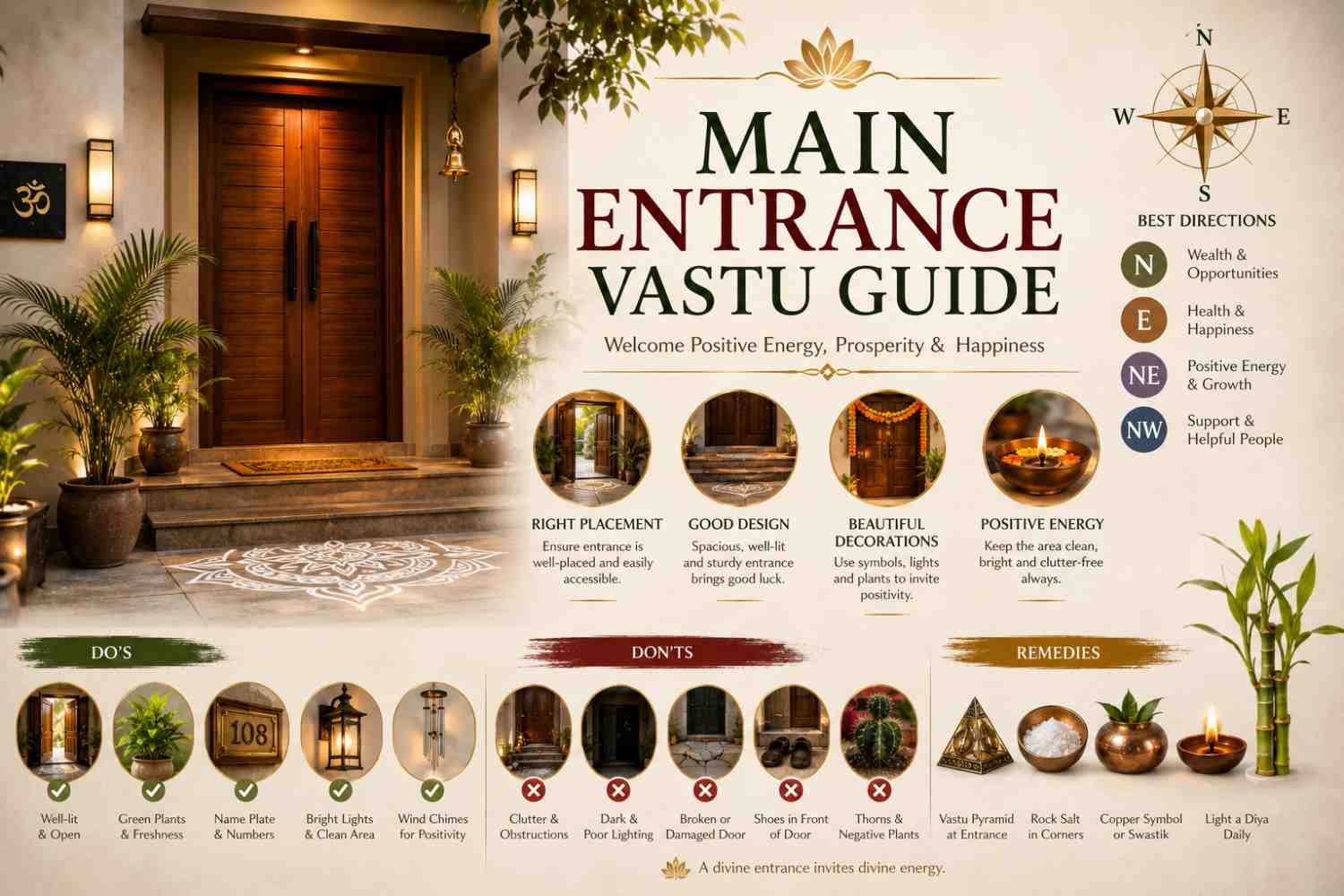
Main Entrance Vastu Guide: Placement, Design, Decorations, and Remedies
Most entrance Vastu mistakes are easy to fix. Start with this guide.