Vedic Astrology (Hindu Astrology): How Jyotish Really Works
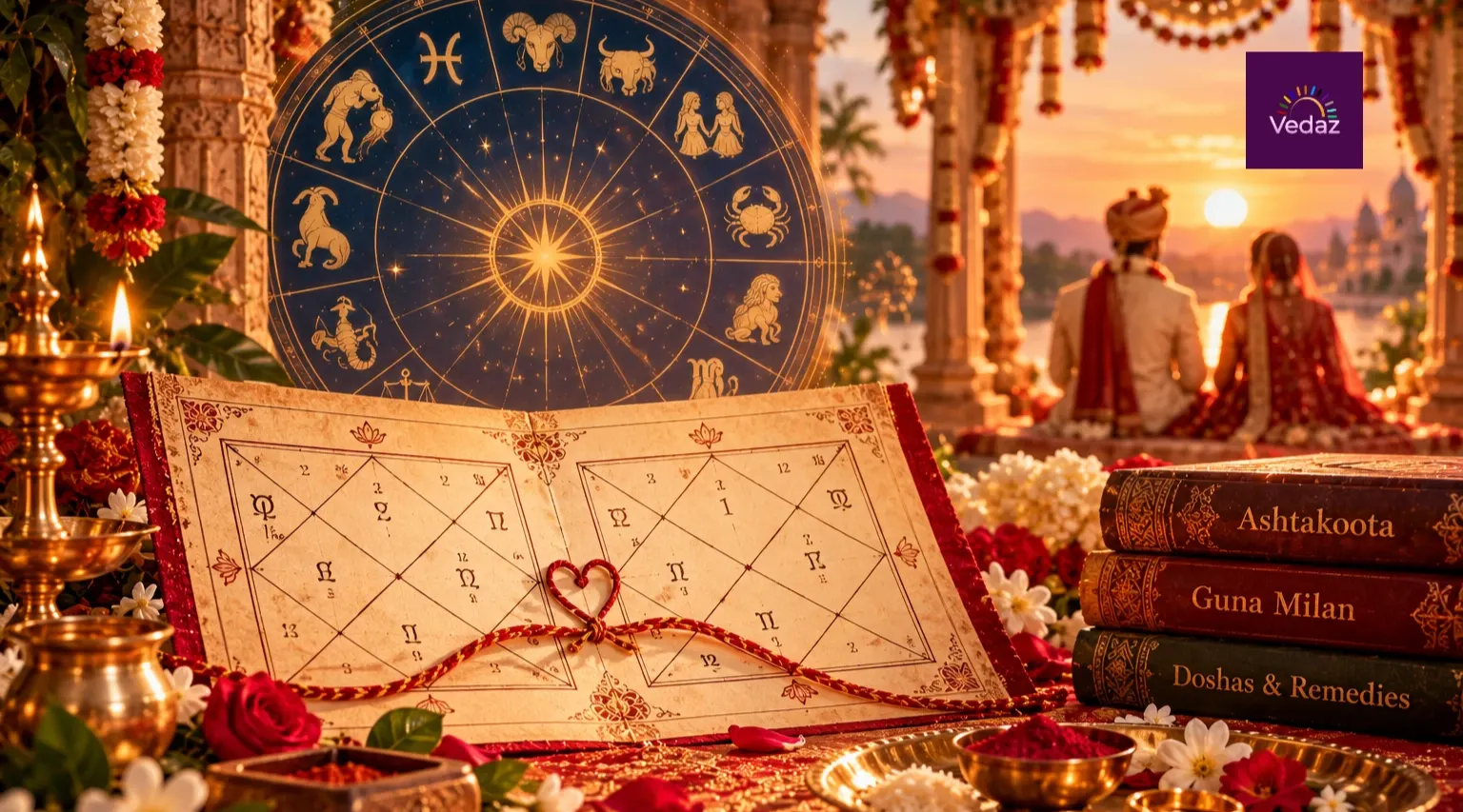
Vedic astrology, also called Hindu astrology, Indian astrology or Jyotish, is India's traditional system of astrology. It uses the sidereal (star-based) zodiac, nine planets including Rahu and Ketu, 27 nakshatras, divisional charts and the Vimshottari dasha system. Its philosophy links the birth chart to karma: the chart shows tendencies and timing, while present action and choice shape outcomes.
- ◦What Makes Astrology "Vedic"?
- ◦Five Features That Define Vedic Astrology
- ◦The Philosophy: Karma, Free Will and the Chart
- ◦The Four Goals of Life in Your Chart
- ◦The Nine Grahas as Karmic Agents
- ◦The Major Schools of Indian Astrology
- ◦Hindu Astrology Across the Life Cycle
- ◦Remedies (Upaya): The Vedic Approach
- ◦Vedic Astrology vs Western Astrology: A Fair Comparison
- ◦Why Vedic Astrology Is Growing
- ◦Learning Vedic Astrology: A Roadmap
- ◦Essential Vedic Astrology Terms
- ◦Myths About Vedic Astrology
- ◦How Vedaz Applies Vedic Principles
- ◦Where to Start Today
- ◦Vedic Astrology in the Modern World
- ◦The Bottom Line
Searches for "Vedic astrology," "Hindu astrology" and "Jyotish chart" have grown sharply, by more than 170% in a year, with Vedic calculator searches up over five times. More people, in India and abroad, are moving beyond Sun-sign horoscopes toward the deeper Indian system.
If you've been reading your daily horoscope for a while, this is the system working behind it.
Our beginner's guide to astrology covers the building blocks: planets, signs, houses and dashas. This guide goes a level deeper: the philosophy behind Vedic astrology, how it maps life goals onto the chart, its major schools, its approach to remedies, and how it's used in Hindu life from birth to marriage.
What Makes Astrology "Vedic"?
The word Jyotish (ज्योतिष) means "science of light." It's one of the six Vedangas, auxiliary disciplines for understanding and practising the Vedas, alongside phonetics, grammar, etymology, metre and ritual. Its original purpose was practical: to calculate the right times for Vedic rituals.
Over centuries, it grew into a full system of individual astrology. Key texts include:
- Brihat Parashara Hora Shastra: attributed to sage Parashara; the foundation of modern Vedic astrology.
- Brihat Jataka and Brihat Samhita: by Varahamihira (6th century CE).
- Jaimini Sutras: a distinct system attributed to sage Jaimini.
- Saravali, Phaladeepika, Jataka Parijata, Uttara Kalamrita: later classics refining interpretation.
"Vedic astrology" and "Hindu astrology" are used interchangeably. "Indian astrology" is a broader umbrella that also includes regional systems like KP and Lal Kitab.
Five Features That Define Vedic Astrology
| Feature | What it means |
|---|---|
| Sidereal zodiac | Signs aligned to the fixed stars, using an ayanamsa (Lahiri is India's standard) |
| Moon and lagna focus | The Moon sign (rashi) and ascendant (lagna) are central, more than the Sun sign |
| 27 nakshatras | Lunar mansions that refine personality, timing and matching |
| Dasha systems | Planetary periods (especially Vimshottari) that time life events |
| Divisional charts | Derived charts (D9, D10, etc.) that zoom into specific life areas |
You can see all five in a single Vedic birth chart.
The Philosophy: Karma, Free Will and the Chart
Vedic astrology sits inside a broader Hindu view of karma, the principle that actions have consequences across time. Classical thought describes three kinds of karma:
- Sanchita karma: the total store of accumulated past actions.
- Prarabdha karma: the portion that has "ripened" to be experienced in this life.
- Kriyamana (agami) karma: the actions you're creating now, which shape the future.
Many teachers describe the birth chart as a map of prarabdha: the tendencies, circumstances and timing you were born into. But kriyamana (present effort, choice and conduct) remains in your hands.
That's why responsible Vedic astrology is never fatalistic. The chart shows the terrain; you still choose how to walk it.
A common traditional image: the chart is like a weather forecast. You can't stop the monsoon, but you can carry an umbrella, plan your travel, and plant at the right time.
The Four Goals of Life in Your Chart
Hindu philosophy describes four aims of life, the purusharthas, and Vedic astrology maps each onto three houses:
| Purushartha | Meaning | Houses |
|---|---|---|
| Dharma | Purpose, duty, values | 1st, 5th, 9th |
| Artha | Wealth, career, resources | 2nd, 6th, 10th |
| Kama | Desire, relationships, enjoyment | 3rd, 7th, 11th |
| Moksha | Liberation, spirituality, letting go | 4th, 8th, 12th |
A chart with many planets in dharma houses often points to a life shaped by purpose and learning; artha houses, by work and resources; kama houses, by relationships and ambition; moksha houses, by inner life and spirituality. Every chart has all four. The balance is what differs.
The Nine Grahas as Karmic Agents
In Jyotish, planets are grahas, "those that grasp": forces that deliver the results of karma at the right time:
- Sun (Surya): soul, father, authority; the self's light.
- Moon (Chandra): mind and emotions; how life is felt.
- Mars (Mangal): energy, courage, conflict.
- Mercury (Budh): intellect, speech, skill.
- Jupiter (Guru): wisdom, grace, teachers, children.
- Venus (Shukra): love, beauty, comfort, marriage.
- Saturn (Shani): discipline, delay, endurance, justice; the karmic teacher.
- Rahu: desire, ambition, the unconventional; what the soul hungers for.
- Ketu: detachment, past mastery, spirituality; what the soul is releasing.
Each graha has deities, colours, days, mantras and remedies associated with it, which is how astrology connects to daily Hindu practice.
The Major Schools of Indian Astrology
| School | Key features | Typical use |
|---|---|---|
| Parashari | Houses, lordships, yogas, Vimshottari dasha, 16 divisional charts | The mainstream system; overall life reading |
| Jaimini | Chara karakas (Atmakaraka, Darakaraka), sign aspects, Chara dasha | Soul purpose, career, relationships |
| Tajik / Varshphal | Annual solar-return chart with Persian-influenced techniques | Year-ahead predictions |
| KP (Krishnamurti Paddhati) | Nakshatra sub-lords, Placidus houses | Precise timing, yes/no questions |
| Nadi | Palm-leaf manuscripts; also planetary Nadi techniques | Story-like life readings |
| Lal Kitab | Fixed-house chart, simple practical remedies | Remedy-focused guidance |
| Prashna | Chart of the moment a question is asked | Questions without birth data |
| Muhurta | Election of auspicious times | Weddings, griha pravesh, launches |
Learn more in our guides to KP and Nadi astrology, Lal Kitab and mahadasha.
If you like the year-ahead approach of Tajik, the yearly horoscope is a good place to start.
Hindu Astrology Across the Life Cycle
Jyotish is woven into Hindu life through the samskaras (rites of passage):
- Jatakarma and Namakarana: the birth chart is cast and the name chosen from the nakshatra syllable.
- Annaprashana: the first solid food, often on a chosen muhurta.
- Mundan / Chudakarana: first haircut, timed by the panchang - panchang.
- Vidyarambha / Aksharabhyasam: beginning education, often on Vijayadashami.
- Upanayana: the sacred thread ceremony in some communities.
- Vivaha: marriage, with kundli matching and muhurta.
- Griha pravesh: entering a new home.
- Annual observances: janma nakshatra birthdays, Sankrantis, eclipses and festivals timed by the panchang.
Remedies (Upaya): The Vedic Approach
Remedies are one of the most misunderstood parts of Hindu astrology. In the classical view, a remedy is a way to work with a planetary period, not to buy a different fate. Traditional remedies, from simplest to most specialised:
- Conduct (achara): honesty, discipline, respect for parents and teachers; the foundation.
- Seva (service): helping those in need, especially people signified by the planet (e.g., workers and elderly for Saturn).
- Dana (charity): giving items associated with a planet on its day.
- Mantra and prayer: planetary mantras, stotras like the Hanuman Chalisa or Aditya Hridayam.
- Vrata (fasting/observance): e.g., Monday for the Moon, Saturday for Saturn.
- Puja and homa: rituals, ideally performed with understanding, not fear.
- Ratna (gemstones): the most powerful and the most risky; only after full chart analysis.
Vedaz's principle: no remedy should be sold through fear. A good astrologer starts with conduct, service and prayer, and treats expensive rituals and gemstones as optional, chart-specific choices.
Vedic Astrology vs Western Astrology: A Fair Comparison
Neither system is "the real one." They answer somewhat different questions:
- Western astrology is strong on psychology and personality, using the tropical zodiac tied to the seasons.
- Vedic astrology is strong on timing (dashas), detail (nakshatras, divisional charts) and life events, using the sidereal zodiac tied to the stars.
Many people find their Vedic chart describes life events more precisely, while their Western chart describes inner experience vividly. You can explore both on Vedaz.
Why Vedic Astrology Is Growing
Several trends explain the surge in searches:
- Accurate free calculators make Vedic charts accessible in seconds.
- Interest in timing: people want to know when, not just who they are.
- Cultural reconnection: younger Indians, in India and abroad, exploring traditional knowledge.
- AI tools that explain complex charts in plain language, like KundliGPT.
Vedaz brings these together: Swiss Ephemeris precision with Lahiri ayanamsa, free kundli and calculators, and Vedaz, the AI astrologer, who explains your chart conversationally, with verified human astrologers for deeper consultations.
Learning Vedic Astrology: A Roadmap
- Start with your own chart: lagna, Moon, Sun.
- Learn the nine grahas and their significations.
- Learn the 12 houses and the purushartha triads.
- Learn planetary dignity: exaltation, debilitation, own sign.
- Study nakshatras, beginning with your own. Find it with the nakshatra calculator, then see our nakshatras guide.
- Learn Vimshottari dasha and track your current period.
- Add the Navamsa. See our D9 guide.
- Read one classic slowly, such as an English translation of BPHS or Phaladeepika.
- Practise on known charts (with permission), matching events to dashas.
Essential Vedic Astrology Terms
| Term | Meaning |
|---|---|
| Jyotish | The science of light; Vedic astrology |
| Graha | Planet; one of nine celestial influences |
| Rashi | Zodiac sign; in personal use, your Moon sign |
| Bhava | House; one of 12 areas of life |
| Lagna | Ascendant; the rising sign at birth |
| Nakshatra | One of 27 lunar mansions |
| Dasha | Planetary period (e.g., Vimshottari) |
| Gochar | Transit; the planets' current movement |
| Yoga | A meaningful planetary combination |
| Dosha | An affliction or challenging combination; always read with cancellations |
| Varga | Divisional chart (D9, D10, etc.) |
| Muhurta | An auspicious time chosen for an action |
| Prashna | Horary chart for a question |
| Upaya | Remedy |
| Ayanamsa | Correction between tropical and sidereal zodiacs |
Myths About Vedic Astrology
- "Vedic astrology is fatalistic." Its own philosophy separates prarabdha (what you're born with) from kriyamana (what you do now). Responsible Jyotish emphasises effort and choice.
- "Doshas are curses." Every classical dosha comes with cancellation conditions. Many are extremely common and mild in effect.
- "Remedies must be expensive." The classical foundation (conduct, service, charity, prayer) costs little or nothing.
- "Vedic and Western astrology contradict each other." They measure from different starting points and emphasise different factors. Many people find both meaningful in different ways.
- "Only Brahmins or initiated scholars can understand it." Jyotish has always been taught through study and practice. Today, accurate calculations and clear explanations make it accessible to anyone curious.
- "Astrology replaces professional advice." Responsible astrologers always refer health, legal, financial and mental-health matters to qualified professionals.
How Vedaz Applies Vedic Principles
Vedaz was built to make authentic Vedic astrology accessible and honest:
- Accurate calculation: Swiss Ephemeris with Lahiri ayanamsa for every chart.
- Classical methods: Parashari houses and yogas, Vimshottari dasha, nakshatras, Navamsa and other vargas, and Ashtakoota - ashtakoota matching with cancellations.
- Plain-language explanation: Vedaz, the AI astrologer, explains your chart conversationally.
- Non-fatalistic tone: astrology points to timing; outcomes come from effort.
- No fear-based selling: remedies start with conduct, service and prayer.
Where to Start Today
If you're new to Vedic astrology, start small: generate your chart, learn your lagna, Moon sign and nakshatra, and find your current mahadasha. Those four facts alone will make every horoscope, transit and consultation more meaningful.
Not sure of your nakshatra? The nakshatra calculator gives it in seconds.
Vedic Astrology in the Modern World
Jyotish has adapted to modern life while keeping its foundations:
- Calculation has moved from hand-computed tables to precise software. Vedaz, for example, uses the Swiss Ephemeris, accurate to a fraction of an arcsecond.
- Access has moved from family astrologers to apps and online consultations, letting people compare astrologers and ask questions privately.
- Questions have evolved (career pivots, startups, relocation abroad, relationships outside traditional matchmaking) and Vedic principles are applied to them.
- AI tools now explain charts in plain language, though interpretation still benefits from human wisdom for complex or emotional situations.
- Ethics are more important than ever: clear disclaimers, no fear-based selling, respect for professional advice in health, law and finance.
What hasn't changed is the core idea: the sky at birth offers a map of tendencies and timing, and how we walk that map is up to us.
The Bottom Line
Vedic astrology is more than a horoscope. It's a complete framework connecting the sky at birth to karma, life goals and timing. Its sidereal zodiac, nakshatras, dashas and divisional charts give remarkable detail, and its philosophy keeps choice and effort at the centre.
Approached with curiosity rather than fear, Jyotish is a lifelong companion for understanding yourself and your timing.
Generate your free Vedic birth chart, explore your nakshatra - nakshatra calculator, or ask Vedaz to walk you through your chart.
Aarav Sharma
Vedic astrology, Kundli interpretation, planetary placements | 12 years
Aarav Sharma specializes in Vedic astrology and birth-chart interpretation, explaining planetary placements, houses, and traditional astrological principles in accessible language.
Frequently Asked Questions
1. What is Vedic astrology?
Vedic astrology, or Jyotish, is India's traditional astrology system. It uses the sidereal zodiac, nine planets including Rahu and Ketu, 27 nakshatras, divisional charts and dasha periods to describe personality, life themes and timing.
2. Is Hindu astrology the same as Vedic astrology?
Yes. Hindu astrology, Vedic astrology and Jyotish are used interchangeably for the same traditional Indian system. Indian astrology is a broader term that also includes systems like KP and Lal Kitab.
3. What is the difference between Vedic and Western astrology?
Vedic astrology uses the star-based sidereal zodiac and emphasises the Moon sign, ascendant, nakshatras and dashas. Western astrology uses the season-based tropical zodiac and emphasises the Sun sign and aspects.
4. Does Vedic astrology believe in fate?
Classical Vedic philosophy describes the chart as reflecting prarabdha karma — tendencies and timing — while present action (kriyamana karma) shapes outcomes. Responsible Vedic astrology is not fatalistic.
5. What are the main schools of Indian astrology?
The main schools are Parashari (mainstream), Jaimini, Tajik (annual charts), KP (Krishnamurti Paddhati), Nadi, Lal Kitab, Prashna (horary) and Muhurta (electional astrology).
Related Blogs
Boost Your Health with Astrology
Boost your health with astrology using zodiac-based habits, wellness tips, and simple routines for better physical and mental balance.
The Socking Truth Behind Wearing A Black Thread
Uncover the mystery behind the black thread. From protection to spiritual energy—here’s why everyone’s suddenly wearing one.
Hidden Messages In Your Moles
What if that little mole on your cheek is more than just a mark? Explore the fascinating meanings behind mole placements and what they reveal about your future.
Who Is Your Ishta Devata?
Explore the concept of your personal God in Hinduism. Learn how to discover, connect with, and build a relationship with your Ishta Devata for inner peace and spiritual growth.