Vedic vs Western Astrology
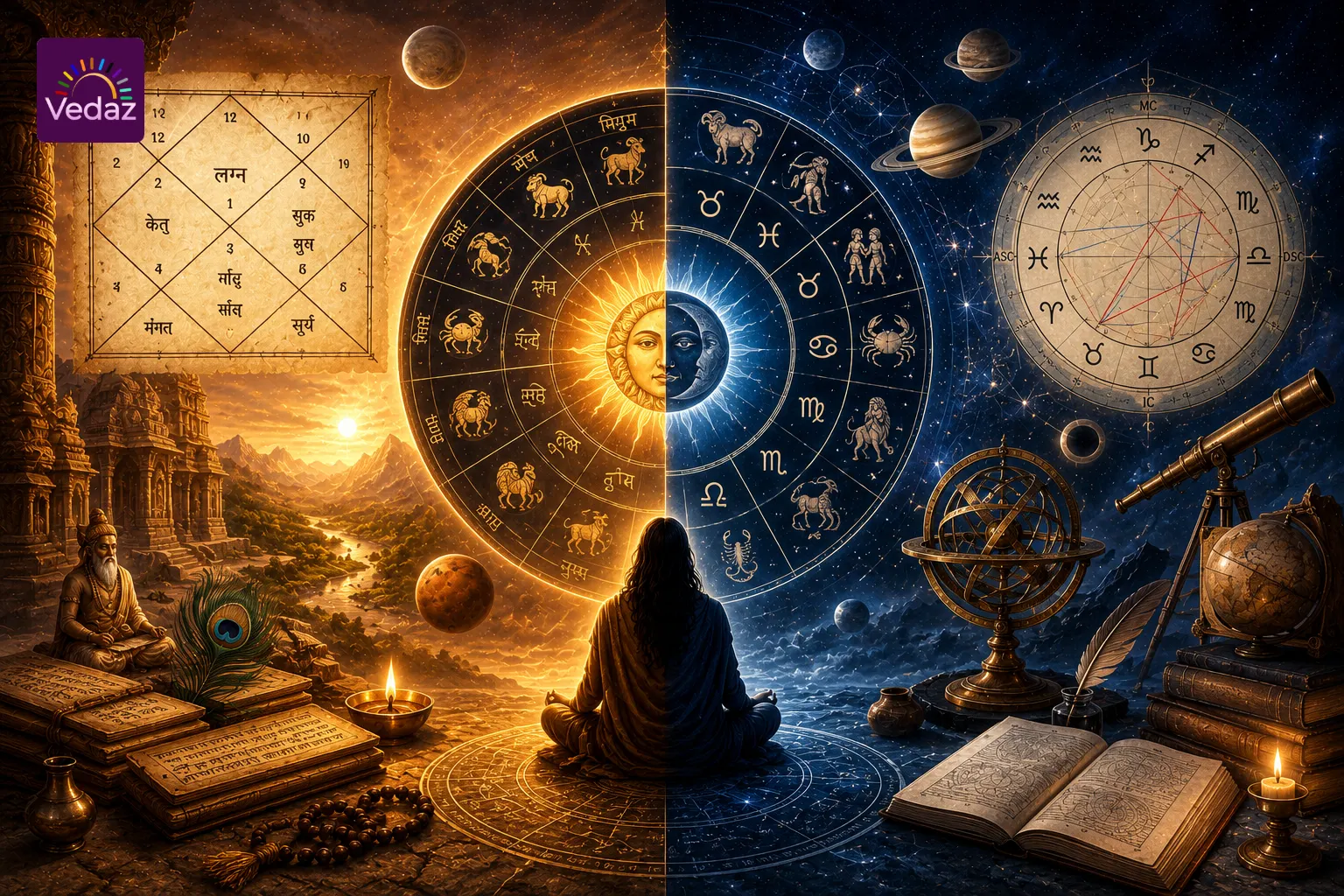
Vedic and Western astrology use different zodiacs — sidereal (real-sky star positions) vs tropical (season-based). The two systems have drifted approximately 24 degrees apart due to Earth's axial precession. This gap, called the ayanamsa, is large enough to shift roughly 80% of people into a completely different sun sign in the Vedic system.
- ◦Vedic Astrology vs Western Astrology: The Short Answer
- ◦The 7 Differences Between Vedic and Western Astrology That Actually Change How You Read a Chart
- ◦Side-by-Side: Vedic vs Western Astrology at a Glance
- ◦Is Vedic Astrology More Accurate Than Western Astrology?
- ◦How to Find Your Real Vedic Birth Chart in 3 Steps
- ◦Generate Your Free Vedic Chart on Vedaz
- ◦Final Thought
If you've spent years identifying as a Leo, this might sting a little.
In Vedic astrology, you're almost certainly a Cancer or a Virgo or something you've never once thought of yourself as. Around 80% of people have a completely different sun sign in the Vedic system than the Western one they grew up reading. Not a slightly different sign. A different one entirely.
That's not a glitch. It's the result of two systems that look at the sky in fundamentally different ways — and understanding that difference is the single most important thing to know if you're exploring Vedic astrology for the first time.
Quick Answer: Vedic Astrology vs Western Astrology — The Core Differences
- Zodiac system: Vedic uses the sidereal zodiac (actual star positions); Western uses the tropical zodiac (fixed to the spring equinox and seasons)
- Primary sign: Vedic astrology centres the Moon sign (Rashi); Western astrology centres the Sun sign
- Lunar system: Vedic uses 27 Nakshatras (lunar mansions); Western has no equivalent
- Timing tool: Vedic uses the Vimshottari Dasha system — calendar-based planetary periods; Western uses transits and progressions
- House system: Vedic uses whole-sign houses by default; Western typically uses Placidus or other quadrant systems
- Outer planets: Western uses Uranus, Neptune, and Pluto; classical Vedic astrology uses only the 7 visible planets plus Rahu and Ketu
- Prescriptive layer: Vedic astrology offers remedies (mantras, gemstones, fasting); Western astrology is mostly diagnostic
Vedic Astrology vs Western Astrology: The Short Answer
Vedic astrology tracks the actual position of constellations in the sky. It uses what's called the sidereal zodiac. Western astrology uses the tropical zodiac, which is fixed to the seasons and the spring equinox — not to where the stars actually are.
The Earth wobbles slowly on its axis. It completes one full wobble every 26,000 years, a phenomenon called precession. Because of this, the two zodiacs have drifted about 24 degrees apart over the last two millennia. That's enough to push most people's sun sign back by one full position.
Beyond the zodiac difference, Vedic astrology also:
- Centres the Moon sign rather than the Sun
- Works with a system of 27 nakshatras (lunar mansions)
- Uses a predictive timing tool called Vimshottari Dasha that has no real equivalent in Western practice
More on all of that below.
The 7 Differences Between Vedic and Western Astrology That Actually Change How You Read a Chart
1. Sidereal vs Tropical Zodiac: Why Your Vedic Sun Sign Is Different
Western astrology defines 0° Aries as the spring equinox — always, regardless of where the constellation Aries actually sits in the sky today. Vedic astrology defines 0° Aries as the actual stellar position. Two thousand years ago, these two starting points were aligned. Today they're about 24 degrees apart. That gap has a name: the ayanamsa.
What this means practically: someone born on August 20th is a Leo in the Western system but a Cancer in the Vedic one. The personality description you've been reading in magazines and apps for years is likely describing a sign that isn't actually yours anymore.
2. Why Vedic Astrology Uses Moon Sign — Not Sun Sign — as Your Primary Identity
Ask a Western astrologer your sign and they'll say "Sun in Sagittarius." Ask a Vedic astrologer the same question and they'll say "Moon in Anuradha" or "Rashi is Vrishchika." In Vedic astrology, your Moon sign is your primary identity — not your Sun sign.
The reasoning behind this makes sense once you hear it. The Sun moves slowly and represents the soul and deeper self. The Moon governs the mind, emotions, and day-to-day inner life — which is what most people are actually asking about when they turn to astrology. The Moon, in Jyotish, is the one that describes how you feel and think and react. That's why it leads.
If you want to understand what your Moon sign and its nakshatra reveal about your emotional wiring, how to read kundli for beginners walks through exactly where to locate these in your chart and what each position means.
3. The 27 Nakshatras: The Layer of Vedic Astrology That Has No Western Equivalent
Vedic astrology divides the sky twice. The 12 rashis are familiar — Aries, Taurus, Gemini, and so on. But laid over them is a second, parallel system of 27 nakshatras, each covering exactly 13°20′ of the zodiac. Each nakshatra has its own:
- Ruling deity — the divine principle governing its energy
- Animal symbol — its instinctive, embodied nature
- Gunas (qualities) — its constitutional makeup
- Life themes — the particular motivations and karmic patterns it carries
In practice, your Moon nakshatra often tells you more about yourself than your Moon sign alone. A few examples:
- Ashwini — initiation, healing, and speed
- Rohini — sensuality, fertility, and beauty
- Pushya — traditionally considered the most auspicious nakshatra; associated with nurturing and deep-rooted tradition
There's no equivalent layer in Western astrology at all. If you want to go deeper on which nakshatras are most favourable for specific life outcomes, best nakshatra combinations for marriage covers nakshatra compatibility scoring in the context of the matchmaking system — a good illustration of how practically this layer is applied.
Read more on Nakshatra Complete guide
4. Vimshottari Dasha: Vedic Astrology's Calendar-Based Predictive Timing System
This is arguably where Vedic astrology pulls ahead most clearly.
The Vimshottari Dasha system divides your life into planetary periods of fixed lengths:
- Sun — 6 years
- Moon — 10 years
- Mars — 7 years
- Rahu — 18 years
- Jupiter — 16 years
- Saturn — 19 years
- Mercury — 17 years
- Ketu — 7 years
- Venus — 20 years
Total: 120 years. Each of those main periods (mahadashas) breaks further into sub-periods called antardashas.
What this makes possible is remarkable: you can predict not just what life themes are likely to surface, but roughly when. Western astrology uses transits and progressions, which work — but they're less calendar-based. The Dasha system gives Vedic astrology a forecasting backbone that most Western practitioners simply don't have access to. The Rahu Mahadasha effects and practical remedies guide is a strong example of how this system is applied to a single 18-year period in concrete, predictive terms.
5. Whole-Sign Houses vs Placidus: How Vedic Astrology Divides the Chart
Western charts typically use Placidus or other quadrant-based house systems where the house cusps fall at specific degree angles. Vedic astrology uses whole-sign houses almost universally — your entire rising sign becomes the 1st house, the next sign is the 2nd house, and so on, all the way around.
It's a cleaner, older approach. It also doesn't break down at high latitudes the way Placidus famously does, which is one reason many Western astrologers have quietly started adopting it too. To understand how each of the twelve houses functions in this whole-sign framework, 12 houses in Vedic astrology explained covers every house in the sidereal context.
6. Rahu and Ketu vs Outer Planets: How Vedic Astrology Handles Generational Influence
Western astrology works with Uranus, Neptune, and Pluto as full chart planets. Classical Vedic astrology doesn't use them. It sticks to the seven visible planets plus Rahu and Ketu — the lunar nodes, which mark where the Moon's orbit crosses the ecliptic.
Rahu and Ketu carry much of the karmic and generational weight that Western astrology assigns to Pluto and Uranus — but they operate quite differently, with their own logic and significations built up over thousands of years of classical study. Rahu placement in different houses explained and Ketu placement in different houses explained show exactly how these two shadow planets function across the chart and why they carry so much karmic significance in Vedic readings.
7. Remedial Astrology: Why Vedic Astrology Is Both Diagnostic and Prescriptive
Western astrology is largely diagnostic. It tells you what the chart says about you and your life. Vedic astrology goes a step further — it's also prescriptive. If your chart shows a difficult Mars period, a Vedic astrologer won't just note it. They'll suggest specific:
- Mantras aligned to the afflicted planet
- Gemstones that strengthen weak or beneficial planets
- Charitable acts linked to the relevant deity or planetary archetype
- Fasting practices on the planet's assigned day of the week
Whether you take these remedies literally or treat them as symbolic rituals is entirely your call. Either way, this prescriptive layer is a defining feature of Jyotish — and it's something Western practice largely doesn't offer.
If you're navigating a difficult period and want guidance tailored to what your chart is actually running right now, Atri — Vedaz's AI remedial astrologer identifies the active dasha, reads the chart's pressure points, and recommends classical remedies — free.
Side-by-Side: Vedic vs Western Astrology at a Glance
| Dimension | Vedic Astrology | Western Astrology |
|---|---|---|
| Zodiac | Sidereal (actual stars) | Tropical (seasonal) |
| Primary Sign | Moon sign (Rashi) | Sun sign |
| Lunar System | 27 Nakshatras | None (lunar nodes only) |
| Houses | Whole-sign by default | Placidus / quadrant |
| Outer Planets | Rarely used | Uranus, Neptune, Pluto used |
| Timing | Vimshottari Dasha (calendar-based) | Transits / progressions |
| Goal | Diagnostic + prescriptive | Mostly diagnostic |
| Origin | ~3,500–5,000 years (Vedas) | ~2,000 years (Hellenistic Greece) |
Is Vedic Astrology More Accurate Than Western Astrology?
This is the question that comes up most often — and the honest answer is that they're not really competing. They're answering different questions.
The same pattern shows up in relationship astrology too. Different traditions often measure compatibility differently — compare synastry vs kundli matching to see how Western and Vedic systems approach relationships from completely different angles.
Western astrology, tied to the seasons, works beautifully for psychological archetypes. The energy of early spring feels genuinely different from late autumn, and the tropical zodiac captures that feeling with real precision. If you want to understand your personality or emotional patterns, Western astrology has a lot to offer.
Vedic astrology, anchored to the actual stars and built around the Dasha system, is generally stronger for prediction and timing — not just what kind of person you are, but when things are likely to happen. Career shifts. Relationship windows. Periods of difficulty or expansion. The Vedic toolkit for that kind of question is more developed.
If you've always felt like your Western sun sign was almost right but slightly off, there's a good chance your Vedic chart is the missing piece.
How to Find Your Real Vedic Birth Chart in 3 Steps
You need three things: your date of birth, your exact time of birth (as close to five minutes as possible), and your place of birth. Birth time matters because the rising sign changes every two hours and is the foundation everything else is built on.
-
Pull your birth time from your birth certificate, or ask a parent if you can.
-
Generate a free Vedic kundli using a sidereal calculator — Lahiri ayanamsa is the standard most commonly used in India.
-
Note three things: your Lagna (rising sign), your Rashi (Moon sign), and your Nakshatra. Those are your three core Vedic identifiers.
Finally, look up which Dasha period you're currently running. It tends to explain quite a lot about why the last two or three years have felt the way they have.
Generate Your Free Vedic Chart on Vedaz
Vedaz uses Lahiri ayanamsa, whole-sign houses, full Vimshottari Dasha, and an AI interpretation layer that explains your chart in plain English — not Sanskrit you'll need to Google separately. Find your real Moon sign, nakshatra, Lagna, and current Dasha in under a minute.
Generate your free Vedic Kundali on Vedaz — find your real Moon sign and nakshatra →
Final Thought
This isn't really about which system wins. It's about the fact that thousands of years of Indian astronomical observation produced something with a completely different centre of gravity — Moon-led, nakshatra-rich, Dasha-timed — and most English-speaking readers have simply never had access to it in their own language.
That's the gap Vedaz exists to close.
Pull your chart. Read your real Moon sign. The story it tells will probably feel more familiar than the one you've been reading.
Get your free Vedic Kundali — Lagna, Moon sign, nakshatra, and Dasha in plain English →

Acharya Gopalji
Vedic, Numerology | 15 years
Acharya Gopalji is a highly respected astrologer with over 15 years of experience in the fields of Vedic Astrology and Numerology. His deep understanding of ancient astrological principles, combined with years of practical application, has made him a trusted guide for thousands seeking direction and clarity in life.
Frequently Asked Questions
1. Is Vedic astrology more accurate than Western astrology?
Neither is universally more accurate — they're built for different things. Vedic astrology is generally stronger for predicting the timing of life events, thanks to its Dasha system. Western astrology tends to be preferred for psychological self-understanding, because of how its seasonal zodiac maps onto personality. Many serious practitioners today use both.
2. Why is my Vedic sun sign different from my Western sun sign?
Because the two systems use different zodiacs. Vedic uses sidereal (real-sky positions) and Western uses tropical (season-based). The drift between them is currently about 24 degrees — enough to push most people's sun sign back by one full position.
3. Can I use both Vedic and Western astrology together?
Yes, and many astrologers do. Western charts often give you a clear personality narrative; Vedic charts give you better timing and a karmic framework. They contradict each other less than people expect, once you understand that each system is really answering a different kind of question.
4. What is more important in Vedic astrology — the sun sign or the moon sign?
The Moon sign. It governs your mind, emotional patterns, and instincts — which is what most people are actually asking about when they turn to astrology. Your Sun sign matters, but in Jyotish it's not the headline.
5. What is a nakshatra and why do I need to know mine?
A nakshatra is one of 27 lunar mansions in the Vedic system. Your Moon nakshatra often describes your personality and instincts more precisely than your Moon sign alone. Traditional matchmaking systems, Dasha calculations, and many predictive techniques are built on nakshatras rather than rashis.
6. Should I switch from Western to Vedic astrology?
You don't have to switch — you can use both. But if your Western sun sign has always felt like it almost fits, your Vedic chart is probably where the remaining 20% lives.
More by this writer

888 Angel Number Meaning: A Sign of Abundance and Flow
Angel number 888 is more than a coincidence — it’s a signal that abundance, purpose, and a major career breakthrough are on the horizon. Here’s what to do when you see it.

Sun and Mercury Conjunction and Its Impact on Intelligence and Career
Budh Aditya Yoga meaning and benefits. See how this conjunction strengthens mind, speech, and leadership ability.

Ashadhi Ekadashi 2026 Date and Puja Vidhi
Ashadhi Ekadashi 2026 complete guide: date, vrat, fasting rules, puja vidhi, bhajans, nama japa & pandharpur yatra dedicated to lord vitthal.
707 Angel Number: A Divine Sign That You're Exactly Where You Need to Be
The 707 angel number signals spiritual awakening, inner wisdom, and alignment with your true path. If you keep seeing 707, it’s a sign to trust your intuition and embrace your inner growth.
Related Blogs

Boost Your Health with Astrology
Boost your health with astrology using zodiac-based habits, wellness tips, and simple routines for better physical and mental balance.
The Socking Truth Behind Wearing A Black Thread
Uncover the mystery behind the black thread. From protection to spiritual energy—here’s why everyone’s suddenly wearing one.

Hidden Messages In Your Moles
What if that little mole on your cheek is more than just a mark? Explore the fascinating meanings behind mole placements and what they reveal about your future.
Who Is Your Ishta Devata?
Explore the concept of your personal God in Hinduism. Learn how to discover, connect with, and build a relationship with your Ishta Devata for inner peace and spiritual growth.