What Is Astrology? A Clear Beginner's Guide to Vedic Astrology
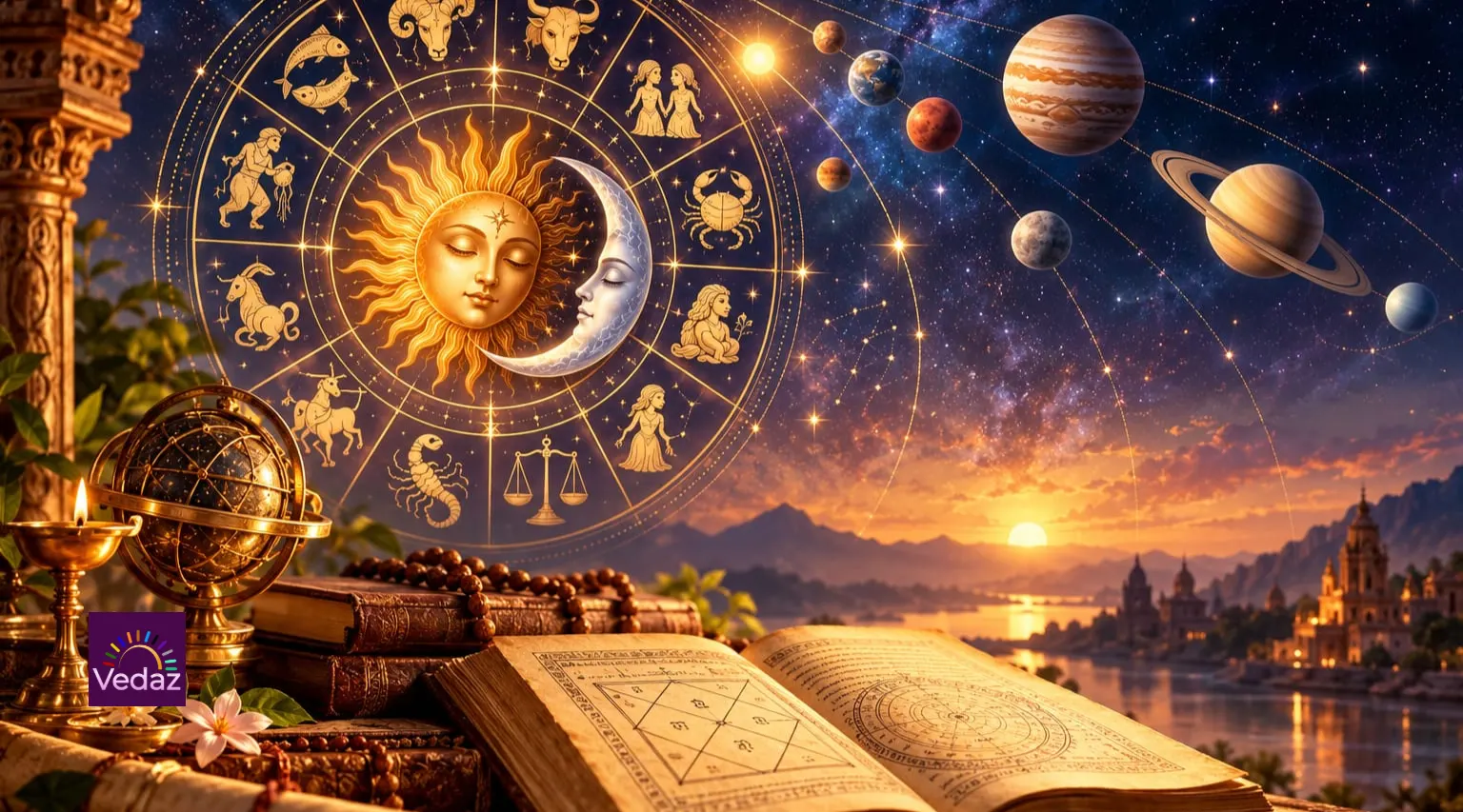
Astrology is the study of how the positions of the Sun, Moon, and planets at a given moment are read as symbols for human life and timing. Vedic astrology (Jyotish) is India's traditional system: it maps your birth moment into a chart of 9 planets, 12 signs, 12 houses, and 27 nakshatras, then uses planetary periods (dashas) and transits to describe tendencies and timing.
- ◦A Simple Definition
- ◦A Short History of Vedic Astrology
- ◦Vedic vs. Western Astrology
- ◦The Building Blocks of a Vedic Birth Chart
- ◦How "Astrology by Date of Birth" Works
- ◦Yogas: Combinations That Shape a Chart
- ◦Transits (Gochar): The Sky Right Now
- ◦What Astrology Can and Cannot Do
- ◦Different Ways Astrology Is Used in India
- ◦How to Start Learning Astrology
- ◦Choosing an Astrologer (or an AI Astrologer)
- ◦The Bottom Line
Astrology is one of the oldest knowledge systems in the world. It's also one of the most searched words on the Indian internet. Still, most people only meet it through a two-line daily horoscope. Behind that horoscope sits a detailed system of calculation that astrologers have been refining for more than two thousand years.
This guide explains astrology from the ground up, especially Vedic astrology, or Jyotish, the system used across India. By the end, you'll know what a birth chart is made of, how astrology by date of birth really works, how Vedic astrology is different from Western astrology, and how to use it sensibly in your own life.
A Simple Definition
Astrology rests on one simple idea: the sky at a given moment can be read as a map of that moment. When you are born, the Sun, Moon, and planets sit in specific positions relative to the Earth and the horizon. Astrologers note down those positions in a birth chart and read them using a symbolic language built over many centuries.
The Sanskrit name for Vedic astrology is Jyotish (ज्योतिष), from jyoti, which means light. It's often called the "eye of the Vedas" because it was used to pick the right time for rituals, festivals, and big life events.
A Short History of Vedic Astrology
- Vedanga Jyotisha: One of the six limbs of Vedic study, it is among the oldest Indian texts on keeping time. It focused on calendars and the timing of rituals.
- Brihat Parashara Hora Shastra: Credited to the sage Parashara, this is a foundational text for birth-chart astrology in India. Its methods, like houses, yogas, and Vimshottari dasha, are still used today.
- Varahamihira: This 6th-century CE scholar wrote Brihat Jataka and Brihat Samhita. They cover natal astrology and mundane astrology, including weather, nations, and omens.
- Later classics: Texts such as Phaladeepika, Saravali, and Jataka Parijata refined the rules of interpretation.
Traditionally, Jyotish has three branches:
| Branch | What it covers |
|---|---|
| Siddhanta | Astronomy and mathematics — calculating planetary positions |
| Samhita | Mundane astrology — nations, weather, collective events, and omens |
| Hora | Individual astrology — birth charts, prashna (horary), and muhurta (timing) |
Most of what people call "astrology" today falls under the Hora branch.
Vedic vs. Western Astrology
Both systems share the same twelve signs and many of the same planet meanings. But they differ in some big ways.
| Feature | Vedic (Jyotish) | Western |
|---|---|---|
| Zodiac | Sidereal — aligned to fixed stars | Tropical — aligned to the seasons |
| Most important sign | Moon sign (rashi) and Ascendant (lagna) | Sun sign |
| Planets used | 7 visible planets + Rahu and Ketu | 7 visible planets + Uranus, Neptune, and Pluto |
| Lunar mansions | 27 nakshatras, central to interpretation | Rarely used |
| Timing method | Dasha system (e.g., Vimshottari) + transits | Progressions + transits |
| Divisional charts | Yes — D9 (Navamsa), D10, etc. | Not traditionally used |
| Matching for marriage | Ashtakoota Guna Milan | Synastry |
The gap between the two zodiacs is about 24 degrees today. This gap is called the ayanamsa. It's the reason many people's Vedic Sun sign differs from their Western Sun sign. Vedaz uses the Lahiri (Chitrapaksha) ayanamsa, a standard associated with India's calendar reform committee.
The Building Blocks of a Vedic Birth Chart
A Vedic chart (kundli) has five main layers. Once you understand them, every horoscope you read will make a lot more sense.
1. The Nine Grahas (Planets)
Jyotish uses nine grahas. The word means "that which seizes." These are forces that grab hold of our attention and our experience.
| Graha | English | Core significations |
|---|---|---|
| Surya | Sun | Self, father, authority, vitality, government |
| Chandra | Moon | Mind, mother, emotions, public, comfort |
| Mangal | Mars | Energy, courage, siblings, property, conflict |
| Budh | Mercury | Intellect, speech, trade, learning, skills |
| Guru / Brihaspati | Jupiter | Wisdom, teachers, children, wealth, dharma |
| Shukra | Venus | Love, marriage, beauty, art, luxury |
| Shani | Saturn | Discipline, delay, work, endurance, justice |
| Rahu | North Node of the Moon | Ambition, obsession, foreign connections, unconventional pursuits |
| Ketu | South Node of the Moon | Detachment, spirituality, past skills, loss |
Rahu and Ketu are not physical bodies. They are the two points where the Moon's path crosses the Sun's apparent path, which is where eclipses happen. They always sit exactly opposite each other.
2. The Twelve Rashis (Signs)
The zodiac is a 360-degree band split into twelve signs of 30 degrees each. Every rashi has a ruling planet, an element (fire, earth, air, or water), and a quality (movable, fixed, or dual).
| Rashi | Western name | Ruler | Element |
|---|---|---|---|
| Mesh | Aries | Mars | Fire |
| Vrishabh | Taurus | Venus | Earth |
| Mithun | Gemini | Mercury | Air |
| Kark | Cancer | Moon | Water |
| Simha | Leo | Sun | Fire |
| Kanya | Virgo | Mercury | Earth |
| Tula | Libra | Venus | Air |
| Vrishchik | Scorpio | Mars | Water |
| Dhanu | Sagittarius | Jupiter | Fire |
| Makar | Capricorn | Saturn | Earth |
| Kumbh | Aquarius | Saturn | Air |
| Meen | Pisces | Jupiter | Water |
Want more detail on each sign? Read our guide to zodiac signs and their dates.
3. The Twelve Bhavas (Houses)
Signs describe how a planet's energy shows up, while houses in astrology tell you which area of life it affects. The first house begins with your Ascendant (Lagna), the sign that was rising in the east when you were born. Since the Earth keeps rotating, this sign changes roughly every two hours. That's why knowing your exact birth time is so important when making your kundli.
| House | Main areas of life |
|---|---|
| 1st (Lagna) | Body, personality, overall direction |
| 2nd | Wealth, family, speech, food |
| 3rd | Courage, siblings, communication, short travel |
| 4th | Mother, home, property, vehicles, inner peace |
| 5th | Children, intelligence, education, romance, past merit |
| 6th | Enemies, debts, disease, service, competition |
| 7th | Marriage, partnerships, business dealings |
| 8th | Longevity, sudden events, inheritance, research, the hidden |
| 9th | Luck, father, guru, dharma, long journeys |
| 10th | Career, status, action in the world |
| 11th | Gains, income, friends, fulfilment of desires |
| 12th | Expenses, losses, foreign lands, sleep, liberation |
4. The Twenty-Seven Nakshatras
In Vedic astrology, each zodiac sign is divided into smaller sections called nakshatras, or lunar mansions. There are 27 nakshatras, and each one is further divided into four parts called padas.
Your birth nakshatra is the one the Moon was in when you were born. It plays an important role in Vedic astrology, as it's believed to influence your personality, helps determine the starting point of your dasha cycle, and is used for kundali matching before marriage.
To learn more, check out our panchang and nakshatra guide.
5. Dashas — Vedic Astrology's Timeline
This is where Vedic astrology stands apart. The Vimshottari dasha system splits a 120-year life cycle into planetary periods (mahadashas). Each one is ruled by a single graha.
| Mahadasha | Length |
|---|---|
| Ketu | 7 years |
| Venus | 20 years |
| Sun | 6 years |
| Moon | 10 years |
| Mars | 7 years |
| Rahu | 18 years |
| Jupiter | 16 years |
| Saturn | 19 years |
| Mercury | 17 years |
The dasha you begin life in depends on your birth nakshatra. Each mahadasha is split into smaller antardashas (sub-periods). Astrologers read the dasha together with transits to answer the "when" questions. When is a career shift likely? When is marriage supported? When should you be patient?
How "Astrology by Date of Birth" Works
Astrology by date of birth is one of the most common searches in India. Here's what each detail adds:
- Date of birth: Helps establish the positions of the slow planets (Saturn, Jupiter, Rahu, and Ketu) and the Sun's sign.
- Time of birth: Helps determine the Ascendant and house positions. Along with the date, it also gives the exact Moon degree and nakshatra.
- Place of birth: Gives the latitude, longitude, and time zone needed to work out the Ascendant correctly.
With just a date of birth, an astrologer can tell you your Sun sign, usually your Moon sign, and the general planetary picture. Add the time and place, and they can build a full birth chart with houses, divisional charts, and an exact dasha timeline. That's why a serious reading always asks for all three.
You can generate a free birth chart with date, time, and place on Vedaz in under a minute.
Yogas: Combinations That Shape a Chart
A yoga in astrology is a specific combination of planets that gives a clear, recognisable result. The classical texts list hundreds of them. Here are a few well-known ones:
- Gaja Kesari Yoga: Jupiter in a kendra (1st, 4th, 7th, or 10th house) from the Moon. It's linked to wisdom and respect.
- Raja Yoga: A link between the lords of the kendra and trikona (1st, 5th, and 9th) houses. It's linked to status and success.
- Dhana Yoga: Links between the lords of the wealth houses (2nd, 5th, 9th, and 11th). It's linked to financial growth.
- Budhaditya Yoga: The Sun and Mercury together. It's linked to intelligence and communication.
Yogas don't work alone. They "switch on" during the dashas of the planets that form them. That's why two people with the same yoga can see its results at different ages.
Transits (Gochar): The Sky Right Now
Your birth chart never changes, but the planets keep moving. Their current positions compared to your chart are called gochar (transits). Daily horoscopes are mostly based on the Moon's transit. The bigger life themes come from the slow planets:
- Saturn spends about 2.5 years in each sign. When it passes over the 12th, 1st, and 2nd houses from your Moon, that's the famous Sade Sati.
- Jupiter spends about a year in each sign. It's traditionally seen as a planet of growth and protection.
- Rahu and Ketu spend about 18 months in each sign, and they move backwards through the zodiac.
What Astrology Can and Cannot Do
Being honest about this is what separates responsible astrology from fear-selling.
Astrology can:
- Give you a language to understand your nature, your strengths, and the patterns that keep repeating.
- Suggest good and not-so-good timing for actions (muhurta).
- Offer a way to reflect during big changes, like a new career, a relationship, or a move.
- Help couples talk about compatibility using structured methods like Guna Milan.
Astrology cannot:
- Replace a doctor, lawyer, financial advisor, or therapist.
- Guarantee that you'll clear an exam, get a visa, land a job, or have a certain marriage outcome.
- Override your effort. In Jyotish's own philosophy, karma includes what you do now, not just what happened in the past.
At Vedaz, our editorial principle is simple: astrology points to timing; outcomes come from effort. No chart is "bad," and no planet is your enemy.
Different Ways Astrology Is Used in India
- Janam kundli (birth chart): The base of every personal reading. See our kundli guide.
- Kundali matching: Checking compatibility for marriage with the 36-point Guna Milan. See our kundali matching guide.
- Muhurta: Picking auspicious times for weddings, griha pravesh, and business launches.
- Prashna: Answering a question using the chart of the moment it's asked. This helps when birth details aren't known.
- Rashifal: Daily, weekly, and yearly predictions by Moon sign. See our aaj ka rashifal guide.
- Panchang - panchang: The daily almanac of tithi, nakshatra, yoga, karana, and vara.
- Varshphal: The yearly solar return chart, used to plan the year.
How to Start Learning Astrology
- Get your own chart. It's easiest to learn on a chart you know well, and you know yours best.
- Learn the planets first, then the signs, then the houses. Nakshatras and dashas come next.
- Watch your current dasha. Notice how its themes show up in your life.
- Track the Moon for a month. Each day, note your mood and what happened against the Moon's sign.
- Read one classical text slowly. Many beginners start with an English translation of Brihat Parashara Hora Shastra or Phaladeepika.
- Practise on family charts (with permission). Compare known life events with dashas and transits.
Choosing an Astrologer (or an AI Astrologer)
Whether you go to a person or use an AI astrologer, look for these things:
- Accurate calculations: Ask which ayanamsa and ephemeris they use. Vedaz uses the Swiss Ephemeris for astronomical positions.
- Explanation, not just verdicts: A good astrologer tells you why, such as which house or which dasha is behind a statement.
- No fear tactics: Be careful with anyone who says your life is ruined unless you buy an expensive puja or gemstone.
- Respect for boundaries: Responsible astrologers send health, legal, and money questions to the right professionals.
You can chat with Vedaz, the Vedaz AI astrologer, which reads your chart using planetary positions. You can also connect with a verified human astrologer for a deeper consultation.
The Bottom Line
Astrology, and Vedic astrology in particular, is far richer than a daily horoscope. It's a structured system of planets, signs, houses, nakshatras, and dashas that describes tendencies and timing in a person's life. Used with care, it works like a mirror and a planning aid. Used with fear, it becomes a burden. What makes the difference is accurate calculation and honest interpretation.
The best place to begin is your own chart. Generate your free kundli, then ask Vedaz to explain your Ascendant, Moon sign, and current dasha in plain language.
Aarav Sharma
Vedic astrology, Kundli interpretation, planetary placements | 12 years
Aarav Sharma specializes in Vedic astrology and birth-chart interpretation, explaining planetary placements, houses, and traditional astrological principles in accessible language.
Frequently Asked Questions
1. What is astrology in simple words?
Astrology is the practice of reading the positions of the Sun, Moon,n and planets at a particular moment, usually your birth, as symbols. These symbols describe your personality, your life themes,s and your timing. Vedic astrology is India's traditional form.
2. What is the difference between Vedic astrology and Western astrology?
Vedic astrology uses the sidereal zodiac, which is aligned to the stars. It focuses on the Moon sign and Ascendant, and uses nakshatras and dashas for timing. Western astrology uses the tropical zodiac and focuses mainly on the Sun sign.
3. Can astrology predict my future by date of birth?
Your date of birth gives the broad planetary picture. With your time and place of birth added, an astrologer can build a full chart and dasha timeline to describe tendencies and good periods. Astrology shows timing and potential, not fixed outcomes.
4. How many houses are there in astrology?
There are twelve houses (bhavas). Each one covers areas of life like self, wealth, home, children, marriage, career, and gains. The first house starts at your Ascendant, which depends on your birth time.
5. Is birth time necessary for astrology?
You need it for an accurate Ascendant, house positions, and dasha timing. Without it, astrologers can still read your Moon sign and planetary positions, or use prashna (horary) astrology.
Related Blogs
Boost Your Health with Astrology
Boost your health with astrology using zodiac-based habits, wellness tips, and simple routines for better physical and mental balance.
The Socking Truth Behind Wearing A Black Thread
Uncover the mystery behind the black thread. From protection to spiritual energy—here’s why everyone’s suddenly wearing one.
Hidden Messages In Your Moles
What if that little mole on your cheek is more than just a mark? Explore the fascinating meanings behind mole placements and what they reveal about your future.
Who Is Your Ishta Devata?
Explore the concept of your personal God in Hinduism. Learn how to discover, connect with, and build a relationship with your Ishta Devata for inner peace and spiritual growth.