What to Ask an Astrologer: The Specific Questions That Reveal Whether They Are Genuine
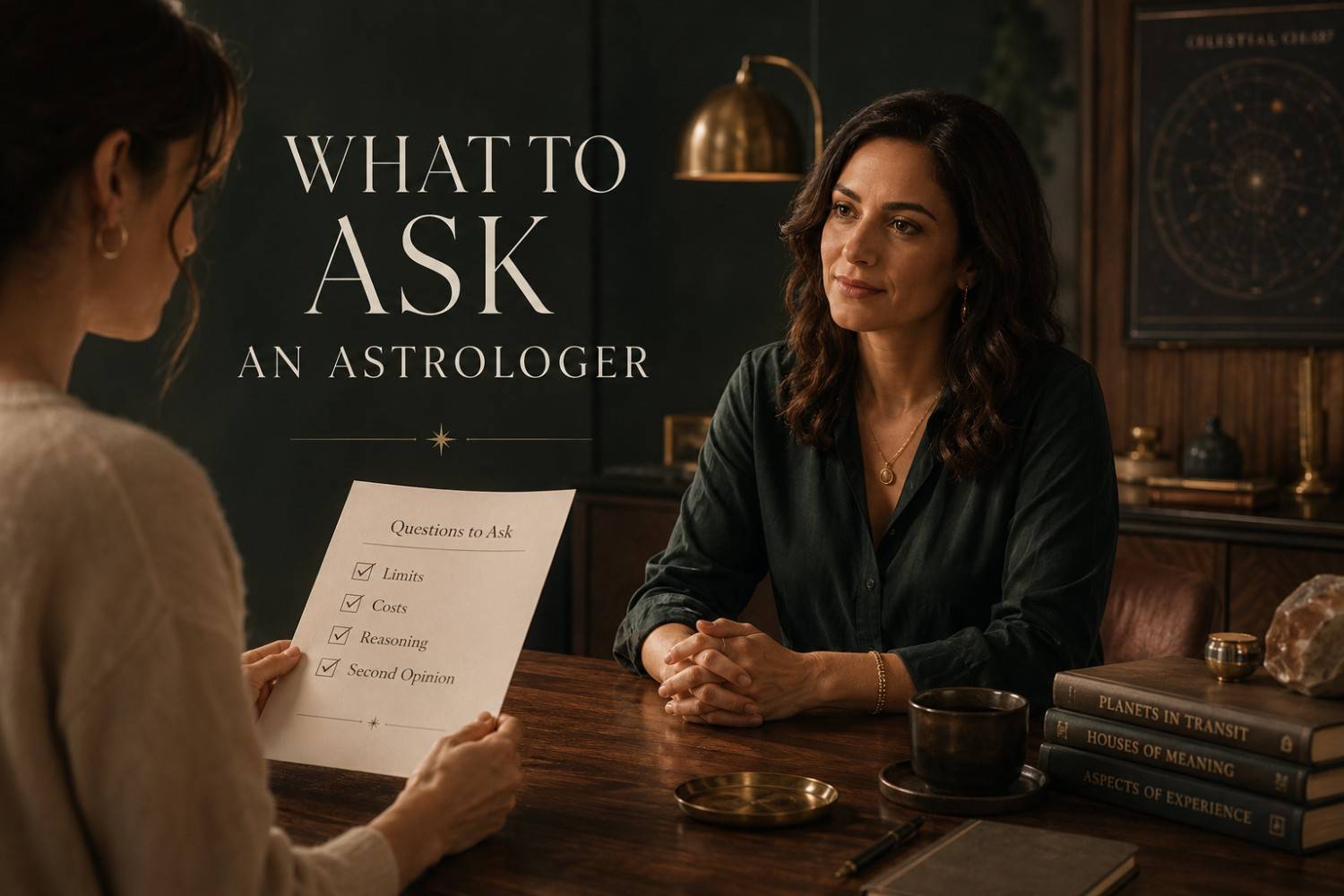
Questions to ask a genuine astrologer

Many people search for what to ask an astrologer but end up hearing vague advice about red flags. In reality, a few simple questions can reveal much more. Asking about limits, reasoning, remedies, costs, and second opinions often gives a clearer picture of whether you are receiving genuine guidance or pressure-driven answers.

Most people worry about asking the wrong questions during an astrology consultation.

But honestly, the bigger risk is often not asking enough questions at all.

A consultation can sound impressive even when the advice is weak. Someone can appear knowledgeable, confident, and convincing while quietly relying on fear, urgency, or expensive remedies. And if you do not know much about astrology yourself, it can be difficult to tell the difference.

The good news is that you do not need to understand houses, doshas, planetary combinations, divisional charts, or technical astrology to evaluate an astrologer.

A few simple questions are often enough.

This guide covers the questions that reveal the most, the answers worth paying attention to, and the warning signs that often matter more than ratings, credentials, or years of experience.

Because in many cases, the way someone answers tells you far more than the answer itself.


Quick Facts

TopicHonest Reality
How this worksGenuine practitioners answer these questions comfortably and specifically. Exploitative ones often avoid, deflect, or shift the conversation.
You needNo astrology expertise. Just pay attention to how the answers are given.
Best single question"What can my chart NOT tell me?"
Biggest tellWhether they openly acknowledge limits, uncertainty, or exceptions.
When to use theseBefore paying and early in the consultation.
Honest framingThe answers often reveal more about ethics and quality than credentials do.

Question 1: What Can My Chart NOT Tell Me?

This is probably the single most revealing question you can ask.

A genuine astrologer is usually comfortable discussing limits. They may explain that astrology points toward tendencies, patterns, timing windows, and possibilities rather than guaranteed outcomes.

They may also tell you that charts cannot reliably predict exact events, exact dates, or replace professional expertise in areas like health, law, finance, or mental health.

That willingness to admit limits is important.

Someone relying heavily on fear-based astrology often struggles with this question because their entire approach depends on astrology sounding all-powerful. They may avoid the question, dismiss it, or act as though a chart can reveal almost everything.

Ironically, the astrologers most comfortable discussing limitations are often the ones worth listening to.


Question 2: Can You Walk Me Through the Reasoning, Not Just the Conclusion?

Astrology consultation warning signs guide

If someone makes an important statement about your life, it is completely reasonable to ask how they arrived there.

You are not asking for a full astrology lesson. You are simply asking for the logic behind the conclusion.

A genuine practitioner can usually explain:

  • Which planets they looked at

  • Which houses were important

  • Which planetary periods influenced the interpretation

  • Why they reached the conclusion they did

You may not understand every technical detail, and that is perfectly fine.

What matters is whether a clear chain of reasoning exists.

Someone relying more on authority than analysis often gives strong conclusions without showing how they got there. The message becomes "trust me" rather than "here is why."

That difference is often very revealing.


Question 3: Have You Checked the Cancellation or Mitigating Conditions?

This question becomes especially important if someone tells you that you have a dosha or difficult chart combination.

Whether it is Manglik Dosha, Nadi Dosha, Kaal Sarp Dosha, Bhakoot Dosha, or something else, ask whether cancellation conditions or balancing factors have been checked.

Many traditional astrological combinations come with exceptions, mitigating influences, or cancellation rules.

A careful astrologer usually knows this and often checks automatically before making strong statements.

Someone whose approach depends on making a problem sound frightening may not mention these factors at all.

The goal here is not to challenge the astrologer.

The goal is simply to understand whether you are receiving a complete analysis or only hearing the most dramatic part of the story.


Question 4: What Is the Total Cost, Including Any Remedies?

Many people only ask about consultation fees.

That is understandable, but it is often not enough.

If remedies are likely to be recommended, it is reasonable to ask about those costs too.

A transparent practitioner is usually comfortable discussing:

  • Consultation fees

  • Follow-up costs

  • Remedy costs

  • Additional services

  • Whether remedies are optional

Someone who becomes vague about pricing may be revealing something important.

Fear-based sales models often work best when the full cost appears gradually rather than upfront.

Clarity around money is not rude.

It is simply part of making an informed decision.


Question 5: Would You Be Comfortable If I Got a Second Opinion?

This question is surprisingly powerful.

Ethical practitioners are usually comfortable with it because they understand that astrology involves interpretation and that different astrologers may approach the same chart differently.

They generally do not fear comparison.

Someone relying on urgency, however, may discourage second opinions directly or indirectly.

Pay attention if you hear things like:

  • "You need to act immediately."

  • "There is no time to wait."

  • "You should not delay."

  • "You must do this before a certain date."

Urgency is not always wrong.

But unnecessary urgency often deserves closer attention.

A second opinion should not feel threatening to someone who genuinely believes in their work.


Question 6: Is Astrology Even the Main Thing I Should Be Using for This Problem?

Spot fear based astrology tactics

This may be the most important ethics question of all.

For serious issues involving health, legal matters, finances, relationships involving abuse, or mental health concerns, ask directly whether astrology should actually be the primary source of guidance.

A responsible astrologer may say astrology can provide perspective, timing, or reflection.

But they will usually also acknowledge when a doctor, therapist, lawyer, financial planner, or another qualified professional should be involved.

That answer often reveals a great deal about someone's integrity.

Because knowing where astrology ends can be just as important as knowing where it begins.


How to Read the Answers

Do not judge someone based on one answer alone.

Instead, look for the overall pattern that emerges across the conversation.

  • Good Signs

  • They openly discuss limits and uncertainty.

  • They explain how they reached conclusions.

  • They check balancing factors before making something sound serious.

  • They are comfortable with questions.

  • They are transparent about costs.

  • They welcome second opinions.

  • They encourage professional help when appropriate.

These answers usually suggest someone who values understanding over persuasion.

  • Warning Signs

  • They avoid discussing limits.

  • They make dramatic claims without explanation.

  • They ignore cancellation conditions.

  • They move quickly toward remedies.

  • They stay vague about costs.

  • They discourage second opinions.

  • They present astrology as the answer to every problem.

One warning sign alone does not always mean someone is dishonest. But several appearing together should make you pause.

  • The Biggest Thing to Notice

Across all six questions, ask yourself one simple question:

Do they seem comfortable with honesty, questions, and scrutiny?

Or does everything feel dependent on mystery, pressure, urgency, and fear?

That distinction often matters more than credentials, titles, or years of experience.

  • Trust the Pattern, Not the Personality

Someone can sound charismatic, confident, and impressive while still giving answers that deserve caution.

At the same time, someone who speaks simply and without drama may actually be offering better guidance.

Personality can be persuasive.

Patterns are usually more reliable.


Engage With a Platform That Answers These Openly — Vedaz

Vedaz is built around these same principles: being transparent about limitations, explaining reasoning, acknowledging cancellation conditions, remaining clear about costs, and encouraging professional help where appropriate.

But the most important point is this:

Use these questions everywhere.

Ask them on Vedaz.

Ask them with any astrologer.

Ask them on any platform.

The goal is not to blindly trust a name.

The goal is to ask better questions.


Final Thought

The most useful protection in astrology is probably not a list of famous names, social media followers, or ratings.

It is knowing which questions to ask.

Ask what your chart cannot tell you. Ask how conclusions were reached. Ask whether cancellation conditions were checked. Ask about total costs. Ask about second opinions. Ask whether astrology should even be the main guide for the situation.

None of these questions require astrology expertise.

They simply require curiosity and attention.

Because beneath all six questions, the same pattern keeps appearing.

Genuine practitioners are usually comfortable with questions, transparency, and limitations.

Manipulative approaches often depend on urgency, mystery, and the idea that you should stop asking questions and simply trust.

So ask the questions.

Listen carefully.

And trust the pattern more than the polish.

It usually tells you far more.

Meera Venkataraman

Astrology Literacy, Spiritual Counseling & Consultation Practices | 9+ Years

Meera Venkataraman is a researcher and writer focusing on astrology literacy, spiritual guidance, and consultation practices. She explores how people engage with astrology in modern contexts and helps readers identify ethical practitioners, set realistic expectations, and approach astrological guidance thoughtfully.

Published on: June 25, 2026|Last Updated on: June 25, 2026

Frequently Asked Questions

1. What is the single best question to ask an astrologer?

"What can my chart NOT tell me?" is probably the most revealing question because it immediately shows whether someone is comfortable discussing limitations. Honest practitioners usually answer it clearly and specifically.

2. How can I tell if an astrologer is genuine without knowing astrology?

You do not need technical knowledge. Pay attention to whether they explain reasoning, acknowledge limits, answer questions comfortably, and remain transparent about costs and remedies.

3. What should I ask if an astrologer tells me I have a dosha?

Ask whether cancellation conditions or mitigating factors were checked. Many traditional doshas have balancing influences that should be considered before strong conclusions are made.

4. Why does asking about second opinions reveal quality?

Because ethical practitioners are generally comfortable with comparison. Someone relying heavily on urgency or pressure may be much less comfortable with the idea.

5. How do I know if an astrologer is overreaching?

Ask whether astrology should even be the primary input for your situation. Responsible practitioners usually understand when professional expertise is more important.

6. Should a confident personality reassure me?

Not by itself. Confidence can be persuasive, but clear reasoning, transparency, and honesty about limitations are often much better indicators of quality.