Why Astrology Predictions Go Wrong — and How to Tell What Is Actually Worth Trusting
Astrology predictions accuracy and trust guide

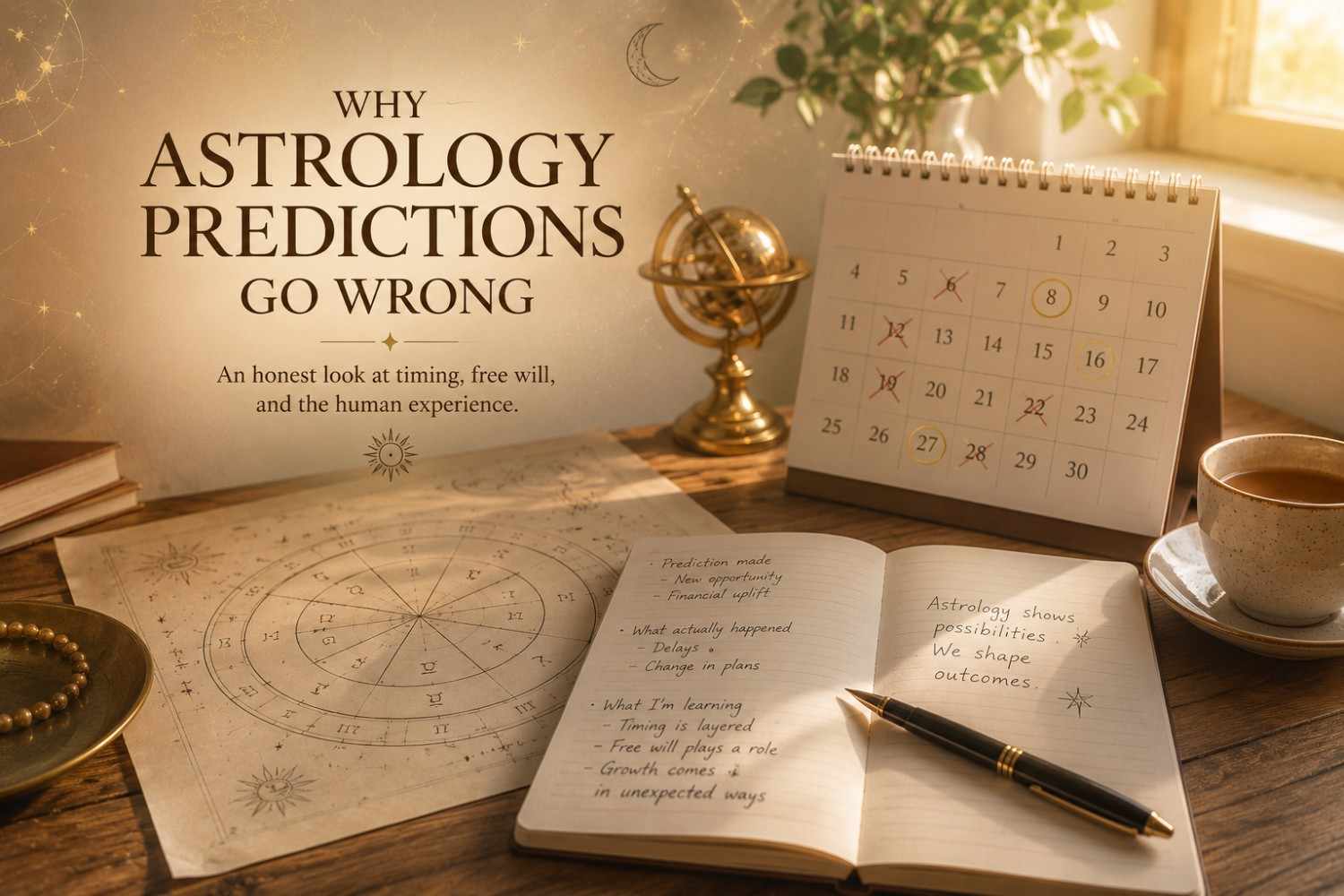
If you have followed astrology long enough, you have probably seen predictions fail. This guide explores why astrology predictions go wrong, why certainty can become misleading, what kinds of guidance tend to hold up better, and how to approach astrology in a way where failed predictions create reflection and perspective instead of fear.

Introduction

Most people do not remember astrology because of the chart.

They remember it because of a prediction.

A date that was supposed to bring marriage. A month that was supposed to bring a new job. A warning that sounded serious but never actually happened.

And if you stay around astrology long enough, you will eventually experience this yourself. A prediction feels convincing, the date arrives, and then... nothing.

That moment often creates a much bigger question. If predictions can be wrong, what exactly should we trust?

The honest answer is more nuanced than many people expect. Failed predictions do not automatically prove astrology is useless. But they do reveal something important about the difference between thoughtful guidance and false certainty.

People interested in understanding where prediction frameworks genuinely help — and where they reach their limits — may also appreciate a deeper discussion of what astrology can't predict.

Understanding why predictions go wrong is one of the most useful things anyone interested in astrology can learn. Because very often, failed predictions reveal what astrology does reasonably well, what it struggles with, and where people sometimes promise far more than the system can honestly deliver.


Quick Facts

TopicHonest Reality
Biggest reason predictions failExact guaranteed claims astrology cannot honestly support
Another major reasonFalse certainty and practitioner overreach
A third reasonHuman choices and real-life circumstances matter too
What tends to be more reliableTendencies, timing windows, and reflection
What deserves cautionExact dates, guarantees, and catastrophic certainty
Honest truthFailed predictions often reveal overpromising, not bad luck

Reason 1 — The Prediction Was Never Honest in That Form

Why astrology forecasts sometimes go wrong

The most common reason predictions fail is surprisingly simple: the prediction was often presented with more certainty than the astrology could realistically support.

Many people encounter astrology through statements like:

"You will definitely get this job by March."

"Marriage will happen this year."

"A major life event is guaranteed during this period."

These predictions sound impressive because they are specific. Specificity creates confidence. Confidence creates the feeling of accuracy.

But astrology traditionally works much better as a framework for understanding tendencies, themes, opportunities, challenges, and periods of emphasis than as a system of guaranteed future events.

A chart may suggest that relationships become more important during a certain period. It may suggest that career matters move into focus. It may indicate a supportive phase for growth or a period requiring patience.

Periods like these are often discussed through your current Mahadasha, which is generally more useful for understanding themes and timing windows than guaranteeing specific events.

What it often cannot honestly do is guarantee that one exact outcome will occur by one exact date.

That distinction matters because many failed predictions are not failures of astrology as much as failures of certainty.

The prediction became more precise than the framework could reasonably support.


Reason 2 — Confidence Often Sounds More Convincing Than Honesty

Human beings naturally prefer certainty.

If one astrologer says, "There appears to be a supportive period coming, but I cannot guarantee the outcome," and another says, "This will definitely happen," many people will instinctively trust the second person more.

The irony is that the first answer may actually be the more responsible one.

Certainty feels reassuring. It feels authoritative. It feels like expertise. People often assume that the person who sounds most confident must also know the most.

But confidence and accuracy are not the same thing.

This creates a strange incentive within astrology. Predictions that sound bold, dramatic, and definitive often attract more attention than predictions that acknowledge uncertainty. A guaranteed marriage date sounds more exciting than a discussion about relationship trends. A precise prediction sounds more impressive than a probability.

The problem is that reality rarely unfolds with that level of precision.

Life is messy. Opportunities appear unexpectedly. Plans change. People change. Circumstances shift.

An astrologer willing to admit uncertainty may sound less impressive in the moment, but that willingness often reflects a more realistic understanding of what astrology can and cannot do.

Learning more about evaluating an astrologer can also make it easier to distinguish thoughtful guidance from false certainty.


Reason 3 — Human Choices Still Matter

One of the biggest weaknesses in many predictions is that they quietly assume people are passive participants in their own lives.

Real life does not work that way.

Even if astrology identifies a genuinely supportive period, outcomes still depend on action, effort, awareness, and decision-making.

A person can move through an excellent career period and never apply for a new opportunity.

Someone else can move through a challenging period and still create meaningful progress through persistence, preparation, and good choices.

This is why many experienced astrologers prefer speaking about potentials rather than certainties.

The chart may describe conditions. It may describe opportunities. It may describe challenges.

For readers interested in understanding these patterns more independently, learning about reading your birth chart and divisional charts can provide useful context for interpreting predictions more realistically.

But it does not completely replace human agency.

Life unfolds through the interaction between circumstances and choices. Ignoring either side of that equation often leads to unrealistic expectations.

And honestly, this may be one of the healthiest things to remember whenever a prediction feels overwhelming.

Your chart matters.

Your decisions matter too.


Reason 4 — Sometimes Predictions Feel Accurate for Reasons Beyond Astrology

Honest approach to astrology predictions

Honest evaluation requires looking at successful predictions with the same curiosity we apply to failed ones.

Some predictions feel remarkably accurate because they are broad enough to fit many situations.

Statements such as:

"A new opportunity may appear."

"You may experience challenges in communication."

"Someone close to you may disappoint you."

can apply to a surprisingly large number of ordinary life experiences.

Human psychology also plays a role. People naturally look for patterns and connections. When a prediction loosely matches something that happens, the mind often fills in the gaps and strengthens the feeling of accuracy.

Memory contributes as well.

Most people remember the predictions that seemed astonishingly accurate and forget the many that were vague, irrelevant, or completely wrong.

This does not automatically make astrology meaningless. It simply means that evaluating predictions honestly requires examining both the hits and the misses rather than focusing only on one side.

Because sometimes what feels accurate is not always as precise as it appears.


What Is Actually More Defensible to Trust

If exact predictions often struggle, what makes more sense to trust?

A few forms of guidance tend to hold up much better over time.

  • Trust tendencies more than exact events — astrology generally works more realistically when describing patterns, themes, and areas of focus than when promising a specific event on a specific date. A tendency allows room for life to unfold naturally.

  • Trust broader timing windows more than precise dates — supportive periods lasting several months are often more believable than predictions tied to one exact day. Real life rarely operates according to a perfectly scheduled calendar.

  • Trust reflection more than prophecy — some of astrology's greatest value comes from helping people understand themselves better. Insights about habits, motivations, strengths, and blind spots often prove more useful than dramatic forecasts.

  • Trust conditional guidance over guarantees — "this period supports career growth if you actively pursue opportunities" is usually more honest than "you will definitely get promoted."

  • Trust people who acknowledge uncertainty — an astrologer willing to admit limitations is often demonstrating more integrity than someone who claims complete certainty about everything.

A simple rule works surprisingly well here.

The more specific, absolute, and guaranteed a prediction becomes, the more carefully it deserves to be evaluated.


How to Engage So a Failed Prediction Is Neither Crisis Nor Surprise

One of the healthiest ways to approach astrology is to hold predictions more lightly from the beginning.

  • Mentally soften extremely specific predictions — if someone predicts an exact event by an exact date, treat it as a possibility rather than a promise. This creates healthier expectations and reduces disappointment if things unfold differently.

  • Be cautious around catastrophic certainty — dramatic warnings about disasters, curses, or unavoidable suffering often deserve extra scrutiny. The stronger the fear, the more important it becomes to slow down and evaluate the claim carefully.

  • Treat positive predictions as opportunities rather than guarantees — supportive periods may create favorable conditions, but they still require effort, decisions, and participation from you.

  • Notice incentives carefully — if a frightening prediction quickly leads to urgency, expensive remedies, or pressure to act immediately, it is worth asking whether fear is being used as a sales tool.

  • Keep your own choices central — astrology should never make you feel powerless. Your actions continue shaping outcomes in ways no chart can completely replace.

  • Apply the same thinking to successful predictions — one accurate prediction does not automatically prove every future prediction will be equally reliable. Healthy skepticism should work in both directions.

Approached this way, failed predictions become less emotionally disruptive and more informative.

Instead of creating a crisis of faith, they become opportunities to understand where certainty may have gone too far.


Engage With Tendencies and Windows, Not Guarantees — Vedaz

Vedaz presents astrology as tendencies, timing windows, and reflective guidance rather than exact guarantees or catastrophic certainty.

The goal is simple: astrology should help people feel more informed and thoughtful, not frightened or trapped by rigid predictions.

People who prefer exploring astrology through supportive windows, recurring themes, and reflective conversations rather than exact-event predictions may also find Shubha AI helpful as a gentle companion designed around perspective instead of certainty.

Those interested in understanding dashas, planetary periods, and timing techniques in a more educational way may also enjoy learning with Vidya AI, which explains astrology concepts step by step without relying on fixed-date guarantees.

Free at vedaz.io.


Final Thought

Failed astrology predictions are often treated as proof that astrology is completely wrong.

But they can also teach something valuable.

Very often, failed predictions reveal where certainty became stronger than the evidence supporting it. They expose the difference between guidance and guarantees. They remind us that life remains larger and more complicated than any chart, forecast, or predictive system.

Sometimes predictions fail because they became too specific.

Sometimes they fail because certainty sounded more impressive than honesty.

And sometimes they fail because people are still people. Choices matter. Effort matters. Circumstances change. Opportunities appear unexpectedly. Life continues moving in ways that no system can fully predict.

That is why a healthier relationship with astrology may be simpler than it sounds.

Trust tendencies more than guarantees.

Trust broader windows more than exact dates.

Trust thoughtful reflection more than prophecy.

Because once you stop expecting astrology to provide absolute certainty, you can begin appreciating the things it may genuinely offer: perspective, self-understanding, timing awareness, and a deeper way of thinking about life's recurring patterns.

And unlike exact predictions, those things rarely disappear when a date passes quietly.

Dr. Anirudh Sen

Astrology Education, Digital Astrology & Contemporary Jyotish Studies | 10+ Years

Dr. Anirudh Sen is an astrology educator and researcher who explores how traditional Jyotish is understood and practiced in modern contexts. His work focuses on astrology literacy, predictive methodologies, and helping readers develop realistic expectations about what Vedic astrology can and cannot reliably indicate. He is particularly interested in bridging classical astrological principles with contemporary discussions around technology, consultation practices, and personal decision-making.

Published on: June 23, 2026|Last Updated on: June 23, 2026

Frequently Asked Questions

1. How accurate is Vedic astrology, honestly?

The honest answer is that Vedic astrology is generally better at describing tendencies, themes, and life patterns than predicting specific events or dates. Its strongest value lies in reflection and perspective rather than guaranteed forecasts.

2. Why does astrology often feel accurate?

The feeling of accuracy often comes from a combination of genuine self-reflection, pattern recognition, confirmation bias, selective memory, and occasionally meaningful resonance with broader life themes.

3. Can Vedic astrology predict specific events?

Not reliably. Exact predictions about specific dates, events, or guaranteed outcomes usually involve more certainty than astrology can honestly support.

4. If astrology cannot predict everything, does it still have value?

Yes. Many people find value in astrology as a framework for self-understanding, personal reflection, meaning-making, and thinking about recurring patterns in life.

5. Is the honest answer about astrology disappointing?

For many people, it is actually liberating. The fact that astrology does not determine everything leaves room for choice, effort, growth, and personal agency.

6. How should I approach astrology responsibly?

Treat it as a reflective framework rather than a source of certainty. Stay aware of psychological influences, avoid guaranteed claims, keep your own judgment central, and rely on qualified professionals for serious health, legal, financial, and mental health matters.