21 Most Powerful Yogas in Kundli & Their Meaning
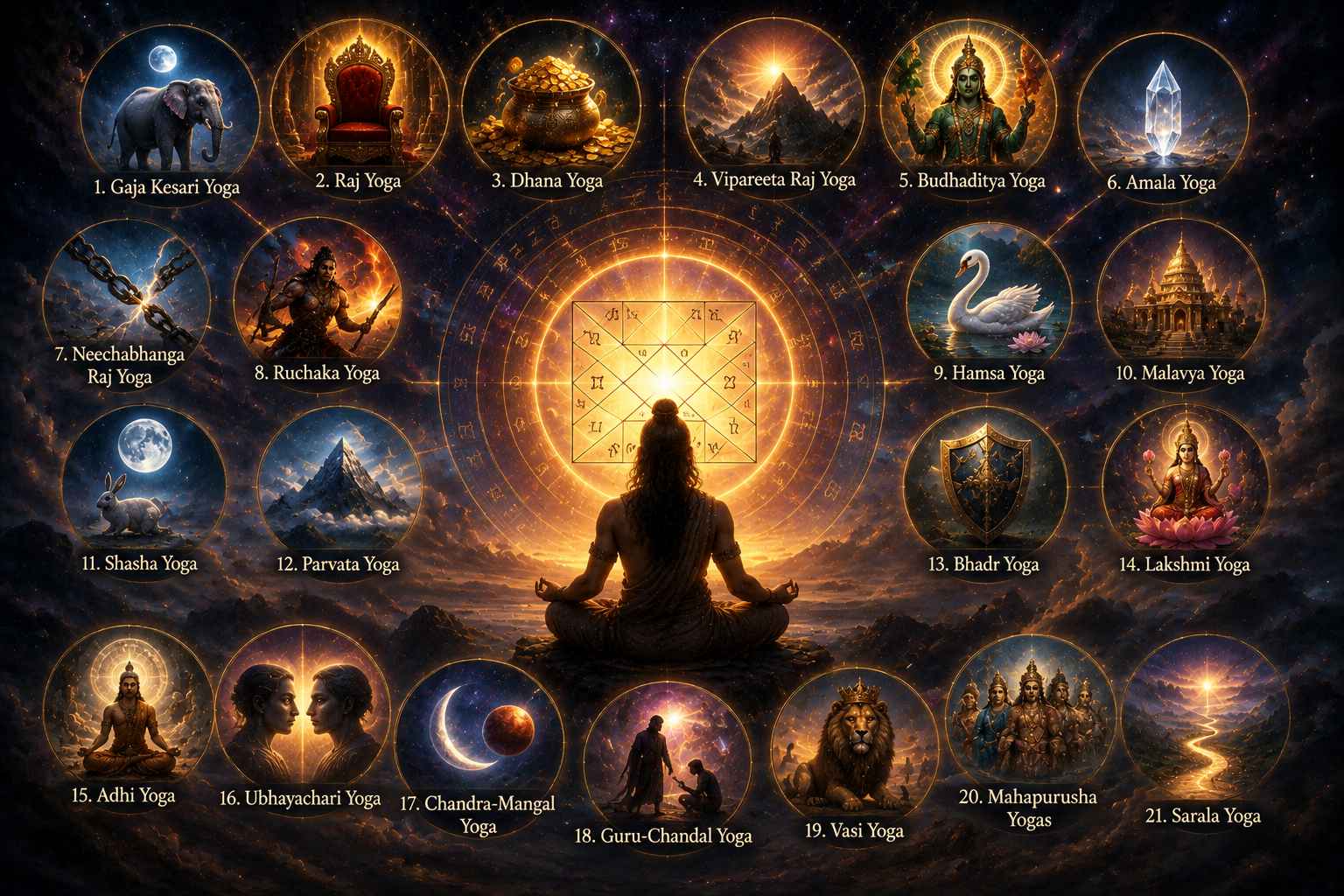
A yoga in Vedic astrology is a specific planetary combination in your birth chart that classical texts link to a predictable life outcome — wealth, power, fame, struggle, or spiritual depth. There are over 1,000 named yogas. Most charts carry three to eight strong ones. This guide covers the 21 that matter most.
- ◦What is Yoga in Vedic Astrology — and Why It Matters More Than Individual Placements
- ◦The Major Categories of Yogas in Vedic Astrology
- ◦The 21 Most Important Yogas in Vedic Astrology
- ◦How to Find Your Yogas in Your Vedic Birth Chart
- ◦Yoga Cancellations: When a Vedic Astrology Yoga Does Not Activate
- ◦Why Yogas in Vedic Astrology Matter More Than Single Planet Placements
- ◦See Your Active Yogas Free on Vedaz
- ◦Final Thought
Quick Answer: What is a Yoga in Vedic Astrology?
- A yoga is a structural planetary combination — of planets, signs, houses, or house lords — that classical Vedic texts say produces a specific, predictable life outcome
- Yogas are more powerful than individual planet placements because they describe architectural patterns, not isolated traits
- Classical literature catalogues over 1,000 yogas across categories: Raja (power), Dhana (wealth), Panch Mahapurusha (great person), Spiritual, and Difficult yogas
- Most charts carry 3 to 8 strong yogas; very few carry more than 20
- A yoga in your chart is potential, not a guarantee — it activates during the dasha period of the planets that form it
- To identify yours: generate a sidereal Vedic chart, locate kendra (1st, 4th, 7th, 10th) and trikona (1st, 5th, 9th) houses, and trace connections between their lords
What is Yoga in Vedic Astrology — and Why It Matters More Than Individual Placements
Here's something most people get wrong about Vedic astrology: they spend all their time looking at where their planets are sitting. Sun in the 5th. Mars in the 7th. Saturn in the 10th. That's like reading individual words but never looking at the sentence.
Yogas are the sentences.
The word "yoga" literally means "union" in Sanskrit. In chart reading, it refers to a specific combination — of planets, signs, houses, or house lords — that classical texts say will produce a particular outcome in your life. Not a tendency. Not a possibility. An architectural pattern your chart either has or doesn't.
What makes yogas more powerful than individual placements is exactly this: they're structural. Two people can both have Mars in the 7th house and lead completely different lives — because one has a Raja Yoga activating that Mars and the other doesn't. The yoga is the lever. The planet is just where the lever is attached.
Yogas can be formed in several ways:
- Planets sitting in the same house (conjunction)
- Planets aspecting each other across the chart
- A planet in its own or exalted sign in a specific location
- The lords of key houses being connected through conjunction, aspect, or sign exchange
Classical Vedic literature catalogues over a thousand of them. Most people have somewhere between three and eight strong yogas in their chart. Very few people have more than twenty. And almost no one knows which ones they're carrying. If you're new to reading your chart and want to understand the framework before identifying yogas, how to read kundli for beginners is the right starting point.
The Major Categories of Yogas in Vedic Astrology
Before we get into the list, here's a quick map. All thousand-plus yogas in classical literature fall into a handful of broad buckets:
- Raja Yogas — the "power" combinations. These are about status, authority, recognition, and rising in the world. Historically, the name literally meant kingship.
- Dhana Yogas — the wealth combinations. These are about accumulation, material success, and financial ease. A chart can have Raja Yogas without Dhana Yogas and produce a powerful but not particularly rich person — think scholars, monks, or certain politicians.
- Panch Mahapurusha Yogas — the "five great person" yogas. Five specific planets, each with their own version, formed when the planet sits in a kendra (angular house) in its own or exalted sign. Each produces a very distinct personality type.
- Spiritual Yogas — combinations the classical texts associate with renunciation, mysticism, and dharmic life paths. These are rare and often misread as "bad" charts when they're really just different ones.
- Difficult Yogas — combinations that classical texts flag as bringing specific hardships. Important note: almost all of these have cancellation conditions. Reading a difficult yoga without checking for cancellation is how wrong predictions happen.
The 21 Most Important Yogas in Vedic Astrology
Raja Yogas in Vedic Astrology (Power and Status)
1. Gajakesari Yoga
Formed when Jupiter sits in a kendra — the 1st, 4th, 7th, or 10th house — from the Moon.
This is the most frequently cited yoga in classical Vedic literature, and it earns that reputation. People with strong Gajakesari Yoga tend to be articulate, ethically grounded, and quietly commanding. They're the person in the room everyone turns to when something actually needs to be figured out. Not loud. Not flashy. Just respected.
Classical texts associate it with:
- Intelligence and sharp articulation
- Strong reputation and lasting influence
- Ethical leadership — the kind that outlives the person
A strong Jupiter in the horoscope is the foundational requirement — weak or afflicted Jupiter considerably reduces this yoga's delivery even when the positional condition is met.
2. Kendra-Trikona Raja Yoga
Formed when the lord of a kendra (1st, 4th, 7th, or 10th house) and the lord of a trikona (1st, 5th, or 9th house) are connected — either conjunct in the same house, in a sign exchange, or aspecting each other.
This is the core engine behind most "rising in life" charts. Founders, politicians, and high-status professionals often have multiple versions of this yoga overlapping. One instance gives you upward momentum. Multiple instances, stacked together, can produce a chart that just keeps rising.
The lord of ascendant in different houses guide shows how the Lagna lord's placement — the starting point for most Kendra-Trikona yoga identification — shapes the entire trajectory of a chart.
3. Vipreet Raja Yoga
Formed when the lord of the 6th, 8th, or 12th house sits in another of those same three houses. For example: the 6th lord in the 8th, or the 8th lord in the 12th.
The name translates roughly to "reversed royalty." And that's exactly what it is. Classically, this yoga is associated with rising through adversity — the chart has a specific structure that converts hardship into eventual achievement. People who came up the hard way, who were pushed into corners and figured out how to push back, often have strong Vipreet Raja Yoga. The planets in 8th house and hidden life transformations context is relevant here — the 8th house is a key axis for this yoga's formation.
4. Neechabhanga Raja Yoga
This one has a longer setup. A planet is in its debilitation sign — its weakest position. But specific conditions apply: either the lord of that debilitation sign, or the planet that gets exalted in the same sign, sits in a kendra from the Lagna or Moon. When this happens, the debilitation is cancelled — and the planet that should have been weak becomes quietly powerful instead.
Classical literature considers this one of the most potent yogas precisely because it's unexpected. Self-made figures — people who built something significant from difficult starting points — often have this yoga in their charts. The nuances of when Neechabhanga genuinely delivers versus when it remains theoretical are covered thoroughly in is Neech Bhang Raj Yoga always powerful and Neech Bhang Raj Yoga benefits in kundli.
Panch Mahapurusha Yogas: The Five Great Person Yogas in Vedic Astrology
Each of these is formed by one of five planets sitting in a kendra (angular house) in its own sign or sign of exaltation. The Sun and Moon don't participate — only Mars, Mercury, Jupiter, Venus, and Saturn. Each produces a very distinct person.
5. Ruchaka Yoga (Mars)
Mars in a kendra in Aries, Scorpio, or Capricorn.
Produces courage, physical vitality, leadership, military or athletic capability, and a willingness to confront difficulty head-on. People with Ruchaka Yoga tend to be the ones who go first. They're not reckless — they're decisive. There's a difference. The house-by-house expression of this yoga is detailed in Ruchaka Yoga effects in all houses.
6. Bhadra Yoga (Mercury)
Mercury in a kendra in Gemini or Virgo.
Produces sharp intelligence, articulate communication, commercial acumen, and longevity. You'll find this yoga often in the charts of successful writers, traders, communicators, and people who make their living through language or analysis. Mercury strength in kundli and career growth is worth reading alongside this — a strong Mercury is also what determines how fully Bhadra Yoga delivers.
7. Hamsa Yoga (Jupiter)
Jupiter in a kendra in Sagittarius, Pisces, or Cancer.
Produces wisdom, ethical authority, spiritual depth, refined character, and — classically — physical attractiveness as well. This is the most graceful of the five Mahapurusha yogas. People who carry it tend to be widely respected and genuinely good-natured rather than just good-seeming.
8. Malavya Yoga (Venus)
Venus in a kendra in Taurus, Libra, or Pisces.
Produces artistic talent, aesthetic refinement, beauty, a comfortable life, and often a charming or attractive partner. Common in the charts of successful designers, performers, and people who have built careers largely from warmth, style, or presence.
9. Sasa Yoga (Saturn)
Saturn in a kendra in Capricorn, Aquarius, or Libra.
The slowest-burning of the five, and in many ways the most durable. Produces discipline, longevity, institutional authority, and mastery earned over long timelines. The success this yoga produces tends to be the kind that lasts — built patiently, held firmly, not easily undone. The Atmakaraka Saturn and life path influence guide gives deeper context on how Saturn's structural role in the chart amplifies yogas like Sasa when it is also the soul's significator.
Dhana Yogas in Vedic Astrology (Wealth Combinations)
10. Lakshmi Yoga
Formed when the 9th lord — the lord of fortune — is in its own sign or exalted, and Venus is also strong in the chart.
This yoga is associated with wealth, beauty, and material comfort — but the classical texts describe it as a "natural blessing" yoga. The wealth doesn't come through hustle so much as through luck and alignment. Fortune tends to find these people.
11. Chandra Mangal Yoga
Formed by the conjunction of Moon and Mars in the same house.
Associated with the ability to make money — specifically through commerce, real estate, or aggressive entrepreneurship. The combination produces a sharp financial instinct and a willingness to act on it without overthinking. You see this often in self-made business people.
For the complete picture of how this Moon-Mars combination plays out across the emotional and material dimensions of a chart, Moon and Mars combination in kundli: emotional fire or fiery emotions covers it in full. The Shashi Mangal Yoga meaning and results in horoscope guide also gives the classical variant of this combination.
12. Dhana Yoga (Classical Form)
Formed when the lords of the 2nd house (wealth, family assets) and the 11th house (gains, income) are connected through conjunction, exchange, or mutual aspect.
This is the textbook wealth yoga. The 2nd house is where money lives; the 11th is where it comes in. When their lords are directly linked, money flows more easily from effort to accumulation. The stronger the connection, the stronger the effect.
13. Kubera Yoga
A more specific wealth yoga formed when the lords of the 2nd, 9th, or 11th houses are in their own houses and receive an aspect from Jupiter.
Named after Kubera, the deity of wealth in Hindu mythology. Associated less with sudden windfalls and more with sustained, durable prosperity — the kind that compounds over decades.
14. Adhi Yoga
Formed when benefic planets — Jupiter, Mercury, and Venus — occupy the 6th, 7th, and 8th houses from the Moon.
Associated with leadership, comfort, a large following, and genuine authority. One of the more reliable indicators of a life well-supported by others — people with Adhi Yoga tend to attract good allies, good help, and good circumstances. The Durdhara Yoga and wealth indications in horoscope is a closely related Moon-based wealth yoga worth reading alongside this one.
Spiritual Yogas in Vedic Astrology
15. Pravrajya Yoga
Formed when four or more planets are conjunct in a single house, particularly the 4th, 9th, or 12th.
Associated with renunciation, spiritual seeking, and monastic tendencies. Strong Pravrajya Yoga sometimes appears in the charts of people who eventually walk away from conventional life for a spiritual path. It's not a "bad" yoga — it's just a different direction.
16. Saraswati Yoga
Formed when Mercury, Jupiter, and Venus are together in a kendra or trikona, with Jupiter in its own or exalted sign.
Named after the goddess of learning and the arts. Associated with deep scholarship, mastery of arts and sciences, and articulate, elegant wisdom. You find this yoga often in classical musicians, rigorous academics, and traditional teachers who've spent decades genuinely mastering something.
Specific Powerful Yogas to Know in Vedic Astrology
17. Budha-Aditya Yoga
Formed by the conjunction of Sun and Mercury in the same house.
Associated with sharp intelligence, quick thinking, and success in communication-heavy fields. The sign it falls in matters: the combination is strongest in Gemini, Virgo, or Leo — and relatively weaker in signs where either planet is debilitated. The full effects of this conjunction across all houses are examined in Sun and Mercury conjunction and its impact on intelligence and career.
18. Akhanda Samrajya Yoga
A rare and specific Raja Yoga formed when the lords of the 2nd, 9th, and 11th houses, along with Jupiter, are interconnected and well-placed.
The name translates as "unbroken sovereignty." Associated with large-scale leadership, lasting authority, and the kind of influence that extends across time and geography. This one is genuinely rare — finding it in a chart is significant.
19. Parijaata Yoga
Formed through a chain of dispositorship — one planet sits in another planet's sign, which sits in another's, and the chain ends in a planet placed in its own or exalted sign.
Associated with progressive rise. Unlike yogas that deliver early or suddenly, Parijaata Yoga tends to unfold over time — the native's position, reputation, and material situation keeps improving the further into life they go. This is closely related to the mechanism behind Parivartan Rajyog and sudden success, a sign-exchange version of the same dispositorship principle.
20. Shubha Kartari Yoga
Formed when benefic planets sit in the houses immediately on both sides of a particular house — essentially "bracketing" it with positive influence. Most significant when it brackets the Moon or the 10th house.
Associated with protection and quiet good fortune in whatever area is being bracketed. Think of it as a buffer zone — the house in the middle is shielded from difficulty by benefics on either side.
21. Sunaphaa / Anaphaa / Durudhara Yoga
Three related Moon yogas formed by planets sitting in:
- The 2nd from the Moon — Sunaphaa Yoga
- The 12th from the Moon — Anaphaa Yoga
- Both the 2nd and 12th from the Moon — Durudhara Yoga
Each produces a distinct psychological and material profile — generally favourable, with specific themes depending on which planets are involved. Sunaphaa brings resources and initiative; Anaphaa brings refinement and recognition; Durudhara brings a fuller, more well-rounded life profile. The Durudhara variant specifically is detailed in Durdhara Yoga and wealth indications in horoscope.
How to Find Your Yogas in Your Vedic Birth Chart
Yoga identification sounds complex, but it follows clear structural logic. Here's the process:
-
Generate your full Vedic chart — Lagna chart with all nine planets and their sign placements.
-
Identify your kendra houses (1st, 4th, 7th, 10th) and your trikona houses (1st, 5th, 9th).
-
Check each kendra and trikona for planets in their own sign or exalted sign — these are likely yoga triggers.
-
Check the relationship between your kendra lords and trikona lords. Conjunctions, sign exchanges, or mutual aspects produce Kendra-Trikona Raja Yogas.
-
Check Jupiter's position relative to your Moon — a kendra relationship gives you Gajakesari Yoga.
-
Check the 6th, 8th, and 12th lords for Vipreet Raja Yoga.
-
Note any debilitated planet, then check for Neechabhanga cancellation conditions.
With intermediate Vedic astrology knowledge, most people can identify their main yogas in about fifteen to twenty minutes using just their chart printout. The 12 houses in Vedic astrology explained is the reference to have open while doing this — knowing which houses are kendra and trikona, and what each house governs, is the prerequisite for all yoga identification.
Want to know which of your yogas are currently active in your running dasha? Kuber — Vedaz's AI wealth astrologer reads your Dhana and Raja Yogas, identifies which are running in your current dasha period, and explains in plain English what that means for your life right now — free.
Yoga Cancellations: When a Vedic Astrology Yoga Does Not Activate
A yoga in your chart is a structural promise — but not an automatic delivery. Yogas can be neutralised in several ways:
- A key planet in the yoga is debilitated without a Neechabhanga cancellation
- The yoga involves lords of the 6th, 8th, or 12th house in ways that disqualify the combination
- A malefic planet aspects the yoga formation and weakens it significantly
- The native is not running a dasha period that activates the yoga — dormant yogas often sit quiet for decades before their moment comes
- The yoga appears in a divisional chart but not the main Rashi chart, or vice versa
That last point is worth dwelling on. A yoga that shows up strongly in your Navamsa (D9 chart) but not in your main chart will tend to deliver in marriage and inner life — not worldly status. A yoga strong in the Dashamsa (D10 chart) specifically supports career outcomes. Experienced astrologers use divisional charts to separate the active yogas from the theoretical ones. Also worth noting: why business success yogas do not work for everyone addresses precisely this problem — the gap between a yoga existing on paper and it actually delivering results.
Why Yogas in Vedic Astrology Matter More Than Single Planet Placements
A single planet tells you something about a trait. A yoga tells you something about a destiny.
Most people who get interested in astrology focus on individual placements. Sun in the 5th. Mars in the 7th. Saturn in the 10th. These are useful. But they're fingerprints — partial information. They don't capture the structural relationships that actually generate life outcomes.
Two charts can share half their planet placements and still produce two wildly different lives, because the yoga structure differs. One chart has overlapping Raja Yogas linking the kendra and trikona lords. The other doesn't. Same planets. Different architecture.
This is why classical Vedic literature devotes so much more attention to yogas than to individual planets. The yoga is the pattern. The planet is just one element in it. And the pattern, when strong, is more reliable than any single placement you'll find in your chart.
See Your Active Yogas Free on Vedaz
Vedaz scans your full chart — Rashi, Navamsa, and Dashamsa — for the 50+ most consequential yogas, flags which are active in your current dasha, and explains each one in plain English. Find out which Raja Yogas, Dhana Yogas, and Mahapurusha Yogas are working in your life right now.
Generate your free Kundali and discover your active yogas on Vedaz →
Final Thought
Yogas are the part of your chart that most rewards careful reading.
Your sun sign is a label. Your moon sign is a temperament. Your nakshatra is a texture. But your yogas are the structural inheritance — the patterns your chart actually has the architecture to produce.
Most people are surprised to discover how many yogas they carry. Most are even more surprised to learn which dasha periods will finally activate them.
Pull your chart. Find the yogas. Note which dashas will run them. The next decade of your life is partly written in those activations — and partly written in whether you show up in a way that lets them deliver.
Find your active yogas, dashas, and full birth chart free on Vedaz →

Acharya Pratap
Vedic Astrology, Vastu Shastra, Numerology, Palmistry | 10 years
Acharya Pratap is a practitioner of Vedic Astrology, Vastu Shastra, and Numerology. He specializes in helping people understand the planetary combinations in their birth chart and gain clarity about wealth, career, personal growth, and important life phases through practical guidance.
Frequently Asked Questions
1. How many yogas are there in Vedic astrology?
There are over a thousand yogas described in classical texts, though most charts contain 3 to 8 strong ones.
2. What is the most powerful yoga in Vedic astrology?
There is no single most powerful yoga, but Akhanda Samrajya Yoga and strong Raja Yogas are considered highly influential.
3. Can I find yogas in my kundli myself?
Yes, by identifying house lords, checking kendra and trikona houses, and looking for planetary connections.
4. Do all yogas in a chart give results?
No, yogas activate during relevant dasha periods and may not deliver if weakened or cancelled.
5. What is the difference between Raja Yoga and Dhana Yoga?
Raja Yoga gives power and status, while Dhana Yoga focuses on wealth and financial gains.
Related Blogs

Dreaming of moving abroad? Check Foreign Travel Astrology
Is your destiny written in the stars? Discover if the universe is guiding you toward a life abroad!

The Best Places to Travel Abroad Foreign Travel Astrology
Is foreign travel written in your stars? Explore how astrology influences your journeys and uncover the best destinations for your zodiac sign!

Can Your Birth Chart Predict Depression Symptoms?
This article examines whether astrological birth charts can predict depression symptoms, contrasting astrological beliefs with psychological research on personality traits and mental health.

The Manifestation Secrets Hidden in Celebrity Birth Charts
Find out what makes fame unique and special. This guide lets you know how some of the biggest celebrities use planetary help to become successful—and how you can do the same.