Anant Kaal Sarp Dosha — Effects & Remedies
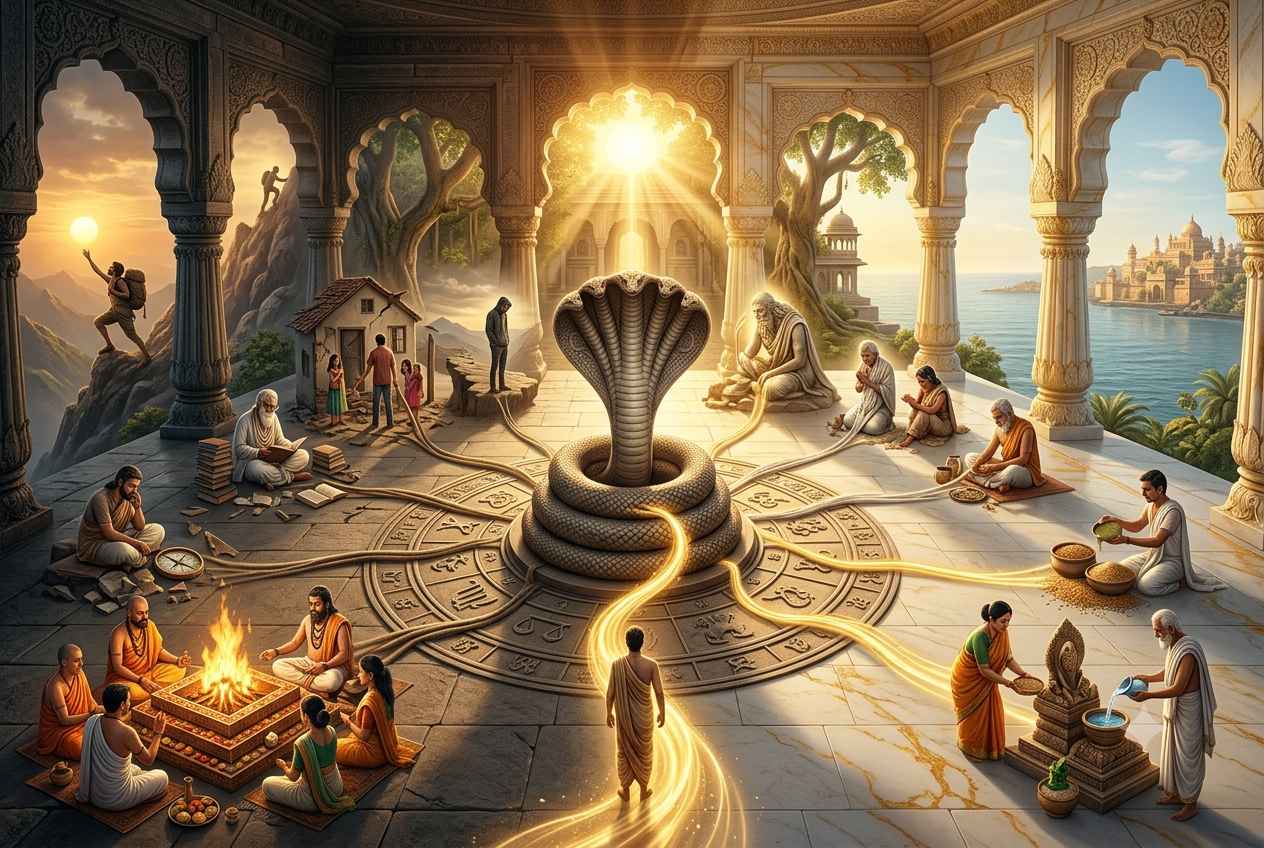 Anant Kaal Sarp Dosha forms when Rahu sits in the 1st house and Ketu sits in the 7th, shaping personality, health, confidence, and married life. Its intensity depends on the rest of the chart, and many with this dosha live stable lives. Remedies focus on Shiva worship and strengthening the 1st and 7th houses.
Anant Kaal Sarp Dosha is the first of the twelve types, and it forms when Rahu sits in the 1st house and Ketu sits in the 7th.
This axis runs straight through the houses of self and partnership, so it mostly shows up in personality, health, confidence, and married life.
Like every type of Kaal Sarp Dosha, how strongly it plays out depends on the rest of the chart too, and plenty of people with Anant dosha go on to live perfectly stable lives.
If you want to know whether you actually have it, you can check using the Kaal Sarp Dosha calculator.
Quick Summary
- Forms when Rahu is in the 1st house and Ketu is in the 7th
- Mainly affects self-identity, health, confidence, and marriage/partnerships
- Gives a restless, intense personality with swinging confidence
- Brings delays or instability in marriage and business partnerships
- Also carries a positive side — magnetic presence, independence, unconventional success
- Best suited to self-driven, independent careers rather than rigid hierarchies
- Can support a spiritual or solitary path due to Ketu's detachment
- Effects vary with dasha periods and chart strength; not everyone feels it strongly
- Core remedies include Shiva worship, Mahamrityunjaya mantra, and Naga puja
Which Houses It Involves
Anant is built around the axis running through the 1st and 7th houses, so understanding both is really the key to understanding this type.
The 1st house, or lagna, is the self in the fullest sense. It covers the body, physical health, vitality, temperament, personality, and appearance, and the way a person approaches and initiates things in life. In a lot of ways, it's the lens through which everything else in the chart gets experienced.
The 7th house sits directly opposite and rules marriage and the spouse, business partnerships, contracts, negotiations, and how a person deals with the wider world.
Since Rahu lands in the 1st and Ketu in the 7th, the dosha's energy gets pulled toward the self, while the partnership side of life is left under Ketu's detaching, dissolving influence. What comes out of this is a life theme built around identity, independence, and the ongoing challenge of forming lasting one-to-one bonds.
How This Type Forms
Anant Kaal Sarp Dosha forms specifically when Rahu, the serpent's head, sits in the 1st house, with Ketu directly across in the 7th, and all seven remaining planets fall between them on one side.
Being the first of the twelve types, it puts Rahu right on the ascendant, which is exactly why its effects tend to show up so clearly in the personality itself.
That said, it's worth remembering that if even one planet slips outside this axis, the yoga becomes partial and its effects turn a lot milder. So the placement is just the starting point here, not the final word.
The next type in the series is Kulik Kaal Sarp Dosha, where Rahu moves into the 2nd house and the focus shifts toward wealth, family, and speech.
Effects on the Self, Health, and Personality (Rahu in the 1st)
When Rahu sits on the ascendant, it tends to create a restless, intense, and somewhat unconventional personality.
Where this dosha is actively expressing itself, people might notice their self-confidence going up and down, swinging between bold ambition one moment and self-doubt the next.
There can also be a tendency to overthink, a kind of inner restlessness, and trouble feeling settled or at home in one's own skin.
Since the 1st house governs the body, stress often shows up physically too, whether that's tension, disturbed sleep, headaches, or vague health issues that come and go along with life's pressures.
Some people describe feeling misunderstood, or sensing that how others see them doesn't quite match who they actually are inside.
On the flip side, this same Rahu placement also gives a magnetic, memorable presence and a real drive to define oneself on one's own terms rather than following the crowd.
Effects on Marriage and Partnerships (Ketu in the 7th)
With Ketu sitting in the 7th house of marriage and partnership, this part of life often feels harder to pin down.
Where the dosha is active, it can bring delays in getting married, a sense of emotional distance within the marriage itself, or recurring misunderstandings with a spouse or business partner.
Since Ketu's whole nature is to detach and dissolve, relationships in this area can feel karmic, on-again-off-again, or like they never fully settle into something solid.
Business partnerships tend to run into similar instability, and working independently often turns out better than sharing a venture. None of this means it's set in stone though.
Plenty of people with Anant dosha go on to have happy marriages and successful partnerships. It really just means this is the area of life that rewards patience, honesty, and a bit of conscious effort the most.
Signs This Type May Be Active
A few common signs, none of which confirm anything on their own, include a recurring feeling of standing apart or being misunderstood, confidence that rises and falls for no clear reason, a pattern where partnerships (whether personal or professional) start off well but struggle to find stability, and a strong, restless pull toward independence and an unconventional path.
Most of these can just as easily come down to ordinary life and personality, so the only real way to confirm this dosha is by looking at the actual chart.
The Positive and Constructive Side
Rahu in the 1st house isn't only a challenge, it's a genuine source of drive too. It can give someone a magnetic, distinctive personality, fearless ambition, and the push to step outside ordinary expectations.
A lot of self-made, independent people who've carved their own unconventional path carry this exact placement, and they rise up precisely because of the restless energy that others might see as a problem.
When channelled with a bit of self-awareness, the intensity that comes with Anant turns into striking individuality and the courage to build life on one's own terms.
Meanwhile, Ketu's detachment in the 7th house can actually work in favour of people drawn to spiritual, advisory, or solitary work, where deep partnership isn't the main focus anyway.
Career and Finances
Since Rahu sits on the house of self rather than a house tied to wealth, Anant's career theme tends to revolve around self-driven, often unconventional achievement.
These individuals usually do best when they get to shape their own role, work independently, or move into original, boundary-crossing fields instead of getting boxed into rigid hierarchies.
The Ketu in the 7th house is a signal to be a little cautious with business partnerships, since solo ventures or clearly defined agreements generally work out better than loosely shared setups.
Handled the right way, the ambition that Rahu in the 1st brings can genuinely become a driving force behind success.
Marriage, Family, and Relationships
This is really the area of life that Anant touches most directly, and the honest advice here is to lead with patience and stay open.
Delays in marriage or a stretch of unsettled relationships are common themes for this placement, but they're tendencies rather than guarantees.
A strong Venus and Jupiter, benefic influence on the 7th house, and making a conscious effort to communicate can all soften this pattern quite a bit.
Getting a proper kundli matching done before marriage is especially useful for this type, since it looks at the whole 7th-house picture instead of just the dosha on its own.
If you're interested in how the 7th house is influenced when Rahu itself occupies it, read our guide to Takshak Kaal Sarp Dosha.
An Honest Note on Intensity
Like every type of Kaal Sarp Dosha, Anant is something to read in degrees rather than treat as an all-or-nothing verdict.
If the yoga turns out to be partial, meaning any planet sits outside the axis, or if the 1st and 7th houses carry benefic strength, the effect tends to be mild or barely noticeable at all. It's really the whole chart that decides this, never just the label.
Approached calmly and confirmed the right way, Anant becomes a pattern worth working with rather than something to fear. Reading it through fear doesn't help anyone.
What actually helps is clear, chart-based understanding that turns a worrying-sounding label into something practical and usable.
Key Remedies
The core Kaal Sarp remedies, worship of Lord Shiva, chanting the Mahamrityunjaya mantra, and performing Naga puja, form the foundation for every type of this dosha, and you'll find them covered in full detail on the main Kaal Sarp Dosha page.
For Anant specifically, the focus shifts toward strengthening the 1st house of self and bringing more harmony to the 7th house of partnership.
That usually means devotion to Shiva to steady the self and build confidence, along with steps aimed at keeping the 7th house peaceful and well-supported, both before and within marriage.
Since the right emphasis really depends on which planets are enclosed in the yoga and how strong they are, it's worth confirming your exact placement before starting any remedy. You can talk to a Vedaz astrologer to get that clarity.
FAQ
What is Anant Kaal Sarp Dosha? It's the first of the twelve types, and it forms when Rahu sits in the 1st house and Ketu in the 7th, with all the other planets enclosed between them. It mainly affects the self, health, personality, and married life.
Is Anant Kaal Sarp Dosha bad for marriage? It can bring delays or a bit of friction since Ketu sits in the 7th house of marriage, but this is a tendency rather than a guarantee. A strong chart, benefic support to the 7th house, and the right remedies can soften this quite a lot, and plenty of people with Anant dosha end up happily married.
How does Anant Kaal Sarp Dosha affect health? Since Rahu sits in the 1st house, which governs the body, stress can end up showing physically, whether that's tension, disturbed sleep, or vague complaints that come and go. These are traditional associations rather than a diagnosis, so any real health concern is best taken to a doctor.
What is the positive side of Anant Kaal Sarp Dosha? Rahu in the 1st house gives a magnetic, distinctive personality along with strong, unconventional ambition. A lot of self-made, independent achievers carry this placement, and they tend to rise because of their restless drive, not despite it.
What is the remedy for Anant Kaal Sarp Dosha? The core Kaal Sarp remedies, Shiva worship, the Mahamrityunjaya mantra, and Naga puja, apply here too, with a particular focus on steadying the 1st house of self and bringing harmony to the 7th house of partnership. Remedies should always be matched to your full chart rather than applied generically.
Does everyone with Anant Kaal Sarp Dosha experience these effects? No, not necessarily. If the yoga turns out partial, or if the 1st and 7th houses are strong, the effect tends to be mild or may not show up at all. It's read in degrees, and the whole chart decides how much it actually operates, if at all.
Is Anant Kaal Sarp Dosha the most serious type? Not really, no. Being the first type listed doesn't automatically make it the strongest one. How serious it is depends on the strength of the enclosed planets and whether the yoga is complete, not on where the type falls in the list. A proper reading is what actually weighs this accurately.
When is Anant Kaal Sarp Dosha felt most strongly? Its effects tend to rise and fall along with the dasha, or planetary period, and the transits of Rahu and Ketu, so it's felt more strongly during some periods and barely noticeable during others. Remedies are usually given extra emphasis during the Rahu or Ketu periods, since that's when the pattern tends to be most active. Looking at your dasha sequence can reveal the timing that applies specifically to your chart.
Does Anant Kaal Sarp Dosha affect business partnerships? It can, since Ketu sits in the 7th house, which governs partnerships as well as marriage. Loosely structured joint ventures can end up unstable, so clearly defined agreements or working independently often serve better. Think of this as guidance to plan around rather than a reason to avoid doing business altogether.
Can Anant Kaal Sarp Dosha be cancelled? In a practical sense, yes. A partial yoga, where even one planet sits outside the axis, or strong 1st and 7th houses can reduce the effect quite significantly. The pattern itself stays present in the chart, but its intensity can end up low or barely noticeable, which is exactly why a proper reading matters far more than a simple calculator flag.
Should I do a puja for Anant Kaal Sarp Dosha? Only if a proper reading confirms the yoga is complete, active, and genuinely affecting you. A lot of cases turn out to be partial or mild, and those really just need simple Shiva worship along with calm awareness. A dedicated Nivaran puja is one option among several, and it's best done on an astrologer's guidance rather than out of fear.
Does Anant Kaal Sarp Dosha affect confidence? It can, since Rahu sits in the 1st house, which shapes self-image and temperament. Where it's active, confidence might swing between bold ambition and self-doubt. Grounding practices, Shiva worship, and a bit of self-awareness can help even this out, and this same placement, when handled well, can produce remarkable self-belief instead.
Is Anant Kaal Sarp Dosha good for a spiritual path? It can be, yes. Ketu in the 7th house loosens attachment to conventional partnership and worldly ties, and a lot of people find this naturally pulls them toward a more inward, spiritual life. Many people with this placement end up channelling that restless, detached energy into real spiritual depth rather than chasing purely material goals.