AI Astrology vs a Human Astrologer: An Honest Comparison of What Each Actually Does Well
The debate around AI astrology vs a human astrologer is often framed like a competition, but both approaches have different strengths and weaknesses. This guide explores where AI genuinely helps, where skilled human astrologers still add value, and why honesty, nuance, and non-fatalistic guidance matter more than the medium itself.
- ◦Quick Facts
- ◦The Comparison Most People Get Wrong
- ◦What AI Astrology Genuinely Does Well
- ◦What a Skilled Human Astrologer Still Does Better
- ◦Where AI Astrology Can Fall Short
- ◦Where Human Astrologers Can Fall Short
- ◦Where Both Can Go Wrong
- ◦The Honest Comparison Summary
- ◦A Practical Decision Guide
- ◦Try Honestly-Framed AI Astrology — Vedaz
- ◦Final Thought
AI astrology is everywhere now.
You can generate a birth chart in seconds, ask detailed questions about your horoscope, and receive explanations that would have required a consultation just a few years ago. Naturally, this has led to a question many people are asking: can AI do what a human astrologer does?
The answer is not as simple as many people think.
AI has some genuine advantages. Human astrologers have some genuine advantages too. And both can become unhelpful when fear, certainty, or manipulation replace honest guidance.
The real question is not which one wins. It is understanding what each does well, where each falls short, and which is actually better suited to the kind of help you are looking for.
Quick Facts
| Topic | Honest Reality |
|---|---|
| AI astrology strength | Fast access, consistent calculations, lower cost, no personal remedy-selling incentive |
| Human astrologer strength | Dialogue, emotional nuance, contextual judgment |
| AI weakness | Can sound confident without genuine understanding |
| Human weakness | Quality varies enormously; fear-based selling remains common |
| Shared risk | Both become harmful when astrology becomes fear-based or fatalistic |
| Most honest takeaway | Honesty matters more than the medium itself |
The Comparison Most People Get Wrong
Most discussions about AI astrology start from the wrong place.
People often compare the best possible astrologer with average AI, or compare the best AI experience with the worst astrologers. That creates a debate that sounds interesting but is not very useful in real life.
Most people are not choosing between a legendary astrologer and cutting-edge technology. They are deciding whether an AI tool is enough for their needs or whether a human consultation would genuinely add value.
That is a much better question.
Because AI and human astrologers are not necessarily competing. In many situations, they are solving different problems.
What AI Astrology Genuinely Does Well
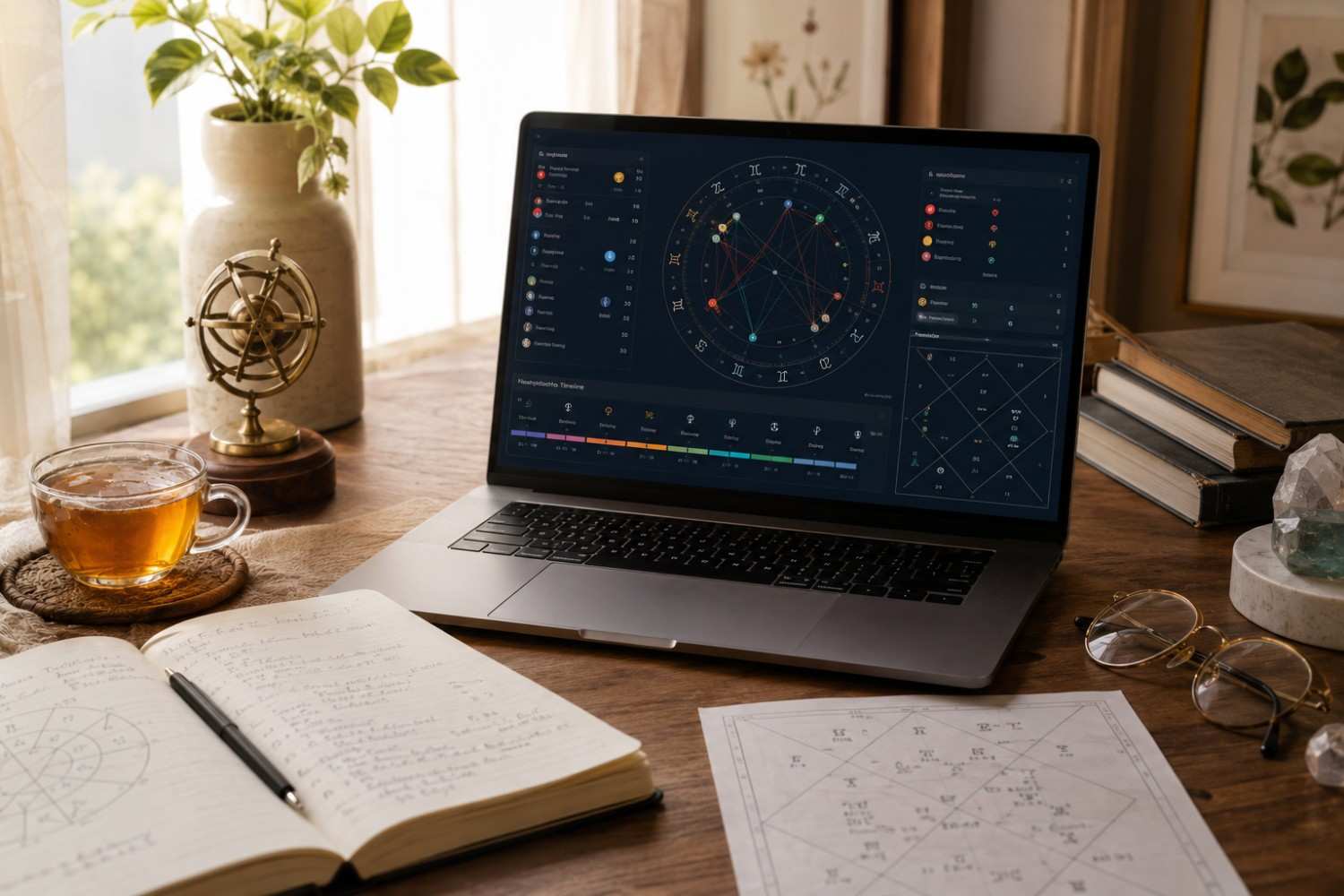
AI astrology has several advantages that come directly from being technology. Some of these advantages are bigger than many people realize.
-
It handles calculations extremely well. Birth charts, divisional charts, planetary positions, dashas, and transits are fundamentally computational tasks. A well-built system can calculate them accurately and consistently every single time without fatigue, distraction, or arithmetic mistakes.
-
It makes astrology more accessible. Many people simply want to understand their chart, learn the basics, or explore a question without booking a consultation. AI tools make that possible instantly, often at a much lower cost.
-
Privacy can be a genuine benefit. Questions about relationships, family issues, insecurities, career worries, or personal struggles often feel easier to explore privately. Some people are simply more comfortable asking sensitive questions when there is no other person involved.
-
It provides consistent explanations. Human interpretations can vary based on mood, style, or personal beliefs. A thoughtfully designed AI system can maintain a consistent tone and approach across thousands of interactions.
-
It removes one common incentive behind fear-based astrology. A well-designed AI platform does not personally benefit from frightening someone into buying gemstones, rituals, or expensive remedies. That does not guarantee honesty, but it removes one of the industry's most common pressure tactics.
-
It is an excellent learning tool. For understanding your Lagna, Moon sign, houses, yogas, Mahadasha, and other foundations, AI can provide a clear and approachable starting point before someone decides whether deeper guidance is necessary. Having a basic understanding of the chart they're reading also makes it easier to judge whether an interpretation feels educational, nuanced, and internally consistent.
For many everyday astrology questions, those strengths are genuinely enough.
What a Skilled Human Astrologer Still Does Better
The strongest argument for human astrologers is not calculation.
It is conversation.
Astrology is often sought during emotionally complicated periods of life, and that is where skilled practitioners can still offer something technology struggles to replicate.
-
They can understand the question behind the question. Someone asking about marriage may actually be struggling with trust. Someone asking about career timing may really be dealing with uncertainty or burnout. Good astrologers often recognize the deeper concern underneath the surface question.
-
They can ask meaningful follow-up questions. Real conversations create opportunities for clarification, nuance, and context. A chart may show possibilities, but understanding how those possibilities fit into someone's actual life often requires dialogue.
-
They can synthesize competing chart factors. Many charts contain contradictory indications. A skilled astrologer can prioritize what matters most instead of treating every placement as equally important.
-
They can adapt their communication. Different people need different kinds of explanations. Some want technical detail. Others want practical guidance. Human interaction allows for that flexibility.
-
They can provide long-term context. A trusted astrologer who has known someone for years may understand recurring life patterns, family dynamics, and personal history in ways a tool cannot fully replicate.
-
They know when astrology is not the answer. The best practitioners understand the limits of astrology. Sometimes the most valuable thing an astrologer can say is, "This is something you should discuss with a therapist, doctor, lawyer, or financial advisor."
This ability to combine interpretation with human understanding remains the strongest case for skilled astrology consultations.
Where AI Astrology Can Fall Short
AI has real strengths, but it is not magic.
Like any tool, it has limitations that become more obvious in complex situations.
-
Confidence can sometimes exceed understanding. AI is designed to generate fluent answers. That means it can occasionally sound more certain than the situation actually warrants.
-
Complex charts require judgment, not just interpretation. Some charts contain competing indications that need prioritization. AI can help analyze them, but it may not always weigh those factors the same way an experienced practitioner would.
-
It lacks lived human experience. AI can discuss grief, relationships, disappointment, and uncertainty, but it does not experience those things itself. For some people, that difference matters.
-
Emotional nuance remains difficult. Technology has improved enormously, but some situations require a level of empathy, intuition, and relational understanding that is still difficult to replicate fully.
-
The quality depends on the platform itself. Not all AI astrology systems are built with the user's interests in mind. Some are designed primarily to drive spending, upsells, or dependency rather than genuine understanding.
Technology can be powerful, but it is only as honest as the people building it.
Where Human Astrologers Can Fall Short
Human astrologers bring strengths that AI does not have, but they also come with risks that technology largely avoids.
-
Quality varies enormously. Two astrologers can look at the same chart and produce very different interpretations. Some practitioners are thoughtful and rigorous. Others are not.
-
Personal biases can influence readings. Every human being has assumptions, preferences, and blind spots. Sometimes those influence interpretations in ways that are not immediately obvious.
-
Fear-based selling remains a serious problem. Many people have experienced frightening predictions followed by expensive remedies, rituals, gemstones, or consultation packages. This remains one of the biggest concerns within the astrology industry.
-
Some practitioners become overly deterministic. Astrology is often most useful as a framework for reflection. Problems arise when interpretations are presented as fixed destiny rather than possibilities and tendencies.
-
Dependency can develop. Some clients become reluctant to make decisions without consulting their astrologer first. That kind of dependence is rarely healthy, regardless of how skilled the practitioner may be.
-
Not everyone acknowledges professional limits. Ethical astrologers know when a situation belongs with a doctor, lawyer, therapist, or financial professional. Unfortunately, not everyone respects those boundaries.
These weaknesses do not apply to every astrologer, but they are common enough to deserve attention.
Where Both Can Go Wrong
One of the most important points in this entire discussion is that neither AI nor human astrologers are automatically trustworthy.
Both can fail.
-
Fear replaces perspective. Astrology becomes harmful when it is used primarily to create anxiety rather than understanding.
-
Astrology becomes fixed destiny. Problems begin when possibilities and tendencies are presented as guaranteed outcomes.
-
Dependency replaces understanding. The healthiest astrology encourages learning and reflection. Unhealthy astrology creates emotional dependence.
-
Professional boundaries disappear. Neither AI nor astrologers should replace medical, legal, financial, or mental health professionals.
-
Uncertainty is hidden behind confidence. Sometimes the most honest answer is uncertainty. Both AI and humans can be tempted to sound more certain than they should.
-
The goal becomes control instead of guidance. Astrology should help people think more clearly, not surrender their judgment to someone else.
The medium is not the real integrity test. Many of these concerns ultimately come back to the broader limits that apply to both, regardless of whether guidance comes from an AI system or a human practitioner.
Honesty is.
The Honest Comparison Summary
AI astrology has some genuine structural advantages. It offers fast access, accurate calculations, lower costs, and freedom from many of the commercial pressures that have damaged parts of the astrology industry.
Human astrologers have different strengths. The best practitioners bring emotional nuance, dialogue, contextual understanding, and the ability to adapt interpretations to a person's unique situation.
But neither side automatically wins.
AI only helps when it is thoughtfully designed. Human astrologers only help when they are ethical, skilled, and honest about the limits of astrology.
That is why the healthiest comparison is not really AI versus human.
It is honestly designed guidance versus poorly designed guidance.
And that distinction matters far more than the medium itself.
A Practical Decision Guide
Use AI Astrology When:
-
You want to understand your chart.
-
You are learning astrology.
-
You need quick explanations.
-
You value privacy and convenience.
-
You want affordable access to information.
Use a Human Astrologer When:
-
You want deeper discussion.
-
The situation is emotionally complex.
-
Context matters heavily.
-
You value dialogue and follow-up questions.
-
A more personalized interpretation would genuinely help.
Use Neither When:
-
The issue is medical.
-
The issue is legal.
-
The issue is financial.
-
The issue involves mental health treatment.
-
Professional expertise is clearly required.
Regardless of which option you choose, ask the same questions:
-
Does this create understanding or dependency?
-
Does it respect uncertainty?
-
Does it avoid fear-based tactics?
-
Does it acknowledge limits honestly?
Those questions matter far more than whether the answer comes from a person or a machine.
Try Honestly-Framed AI Astrology — Vedaz
Vedaz is designed around the strengths AI astrology genuinely offers: accurate calculations, clear explanations, honest framing, and freedom from fear-based remedy pressure.
The goal is not to create dependency or certainty. It is to help people understand their charts more clearly and approach astrology with greater confidence and perspective.
People who primarily want educational explanations, chart walkthroughs, and approachable astrology discussions may also enjoy exploring Buddhi AI, which focuses on astrology concepts, chart interpretation fundamentals, and broader astrological learning.
For readers who prefer a more traditional astrology-style conversation while still valuing honest framing and non-fatalistic guidance, Shubha AI offers a space to discuss chart questions in a reflective and supportive way.
Free at vedaz.io.
Final Thought
The debate between AI astrology and human astrologers is often treated as if one side must eventually replace the other.
But that may be the wrong way to think about it.
Both approaches bring something valuable. Both have limitations. And both can be helpful or harmful depending on how they are used.
AI is excellent at accessibility, consistency, education, and calculation. Human astrologers remain strongest in dialogue, emotional nuance, and contextual understanding.
But none of those strengths matter if honesty disappears.
The healthiest astrology—whether it comes from a person or a platform—is the kind that helps you understand yourself more clearly without taking away your judgment, agency, or peace of mind.
Because in the end, that matters far more than the medium delivering the message.
Dr. Anirudh Sen
Digital Astrology, Consultation Practices & Astrology Education | 10+ Years
Dr. Anirudh Sen is an astrology educator and researcher specializing in digital astrology platforms, consultation methodologies, and contemporary applications of Jyotish. His work focuses on helping readers understand how traditional astrological practices are evolving in the age of artificial intelligence, making informed choices between self-service tools, AI-based insights, and human consultations.
Frequently Asked Questions
1. Is AI astrology as good as a human astrologer?
It depends on what you need. AI astrology is very strong at accurate calculations, instant access, lower cost, and consistent explanations. A skilled human astrologer is stronger at dialogue, emotional understanding, contextual judgment, and handling complex life situations with nuance. The honest comparison is not simply AI versus human. It is honestly-designed AI versus genuinely skilled and ethical human guidance.
2. What does AI astrology do better than a human?
AI astrology is excellent at chart calculations, divisional charts, planetary positions, and dasha sequences because these are computational tasks. It also gives instant access, lower-cost guidance, and consistent explanations without personal mood or pressure influencing the reading. Most importantly, a well-designed AI system does not personally profit from frightening users into expensive remedies, which removes one of the biggest exploitation patterns in astrology.
3. What does a human astrologer do that AI still struggles with?
A skilled human astrologer can synthesize many competing chart factors more naturally, ask follow-up questions, understand emotional context, and respond to the deeper meaning behind what someone is really asking. Humans can also exercise ethical judgment in sensitive situations, including knowing when astrology should not be the main tool for a problem and when someone should speak to a doctor, therapist, lawyer, or financial expert instead.
4. When should I use neither AI nor a human astrologer?
For serious medical, legal, financial, or mental health matters. Astrology of any kind should never replace qualified professional expertise in those areas. Both AI and human astrology become harmful when they are treated as substitutes for real professional care or when they create fear and dependency around serious life situations.
5. Does AI astrology completely avoid exploitation problems?
Not automatically. AI astrology has a structural advantage because it does not personally benefit from selling expensive remedies or creating fear. But an AI system is still only as honest as the people designing it. Some tools may still be built mainly to create anxiety, dependency, or upsells. That is why the same honesty test still matters: no fear-based framing, no manipulation, no dependency-building, and clear respect for limits.
6. What is the healthiest practical approach for most people?
For most people, the healthiest approach is usually to start with a good honestly-framed AI astrology tool to understand the basics of their chart and answer everyday questions. Then, if deeper synthesis, emotional nuance, or detailed discussion genuinely feels useful, a carefully chosen ethical human astrologer can add value. And for serious professional matters, the right path is always a qualified professional, not astrology.
Related Blogs
Boost Your Health with Astrology
Boost your health with astrology using zodiac-based habits, wellness tips, and simple routines for better physical and mental balance.
The Socking Truth Behind Wearing A Black Thread
Uncover the mystery behind the black thread. From protection to spiritual energy—here’s why everyone’s suddenly wearing one.
Hidden Messages In Your Moles
What if that little mole on your cheek is more than just a mark? Explore the fascinating meanings behind mole placements and what they reveal about your future.
Who Is Your Ishta Devata?
Explore the concept of your personal God in Hinduism. Learn how to discover, connect with, and build a relationship with your Ishta Devata for inner peace and spiritual growth.