Kundli Reading for Beginners: Signs, Houses, Planets & Lagna Explained
A Vedic birth chart (kundli) is an astronomical map of planetary positions at your exact birth moment. It uses three building blocks — 12 signs (Rashis), 12 houses (Bhavas), and 9 planets (Grahas) — with the Lagna (Ascendant) as its foundation. Requires exact birth date, time, and place.
- ◦What Is a Vedic Birth Chart (Kundli), Really?
- ◦Building Block 1 — The Twelve Signs (Rashis): The "What Flavor" Layer
- ◦Building Block 2 — The Twelve Houses (Bhavas): The "Which Area of Life" Layer
- ◦Building Block 3 — The Nine Planets (Grahas): The "Which Energy" Layer
- ◦How the Three Layers Combine — Reading the Chart's Logic
- ◦Why the Lagna (Ascendant) Is the Most Important Point in Your Chart
- ◦Vedic vs Western Astrology — Key Differences Explained Simply
- ◦How to Begin Reading Your Own Vedic Birth Chart — Step by Step
- ◦What a Birth Chart Can — and Cannot — Tell You
- ◦Final Thought
If you've ever stared at a kundli and thought, "what on earth am I looking at?" — you're not alone. The grid of symbols, abbreviations, and degrees can feel like a secret language you were never taught.
But here's the thing: the logic behind it is actually learnable. And once you get it, astrology stops being something a practitioner does to you and becomes something you can engage with thoughtfully yourself. That shift is genuinely powerful.
This is the beginner's complete guide to the Vedic birth chart — what it is, how it works, and how you can actually start reading your own.
Quick Answers
- What is a kundli? A snapshot of the sky at your exact birth moment, mapped to your birth location
- Three building blocks: 12 signs (Rashis), 12 houses (Bhavas), 9 planets (Grahas)
- Vedic vs Western: Vedic uses the sidereal zodiac (fixed stars), not the tropical/seasonal zodiac
- Most important point: The Lagna (Ascendant) — it frames your entire chart
- What you need: Exact date, exact time, and place of birth
- Honest truth: A chart is a tool for reflection and perspective — not deterministic prediction
What Is a Vedic Birth Chart (Kundli), Really?
Here's the simplest way to understand it: a Vedic birth chart is a precise map of the sky at the exact moment you were born, from the exact location you were born.
That's it. At its core, it's astronomy. The chart records:
- Which zodiac sign was rising on the eastern horizon at your birth moment (this is called the Lagna or Ascendant)
- Where each of the nine classical planets was positioned — the Sun, Moon, Mars, Mercury, Jupiter, Venus, Saturn, and the lunar nodes Rahu and Ketu
Because the sky is always moving, even a 15-minute difference in birth time can shift placements. The Lagna changes roughly every two hours — which is why your birth time matters so much.
What astrology does with this map is interpretive. It treats planetary positions as a symbolic framework for reflecting on your personality, tendencies, life themes, and timing. So: astronomy in construction, symbolic framework in interpretation. Both parts of that sentence are important.
Building Block 1 — The Twelve Signs (Rashis): The "What Flavor" Layer
The zodiac is split into twelve signs of 30 degrees each: Aries, Taurus, Gemini, Cancer, Leo, Virgo, Libra, Scorpio, Sagittarius, Capricorn, Aquarius, and Pisces. Each sign carries its own nature — a quality, an element, and a ruling planet — that colors any planet sitting within it.
Think of signs as the flavor or tone. The same planet in different signs behaves quite differently.
One crucial thing for newcomers: Vedic astrology uses the sidereal zodiac (aligned to the fixed stars), while Western astrology uses the tropical zodiac (aligned to the seasons and equinoxes).
Because of a slow astronomical drift called precession, these two systems now differ by roughly 24 degrees. That's why your Vedic sign is often one sign earlier than your Western sign.
This is also why Vedic astrology emphasizes the Moon sign (Rashi) — not the Sun sign — as the primary reference point. Your Moon sign reflects your emotional mind, your inner experience, and how you instinctively respond to life.
Building Block 2 — The Twelve Houses (Bhavas): The "Which Area of Life" Layer
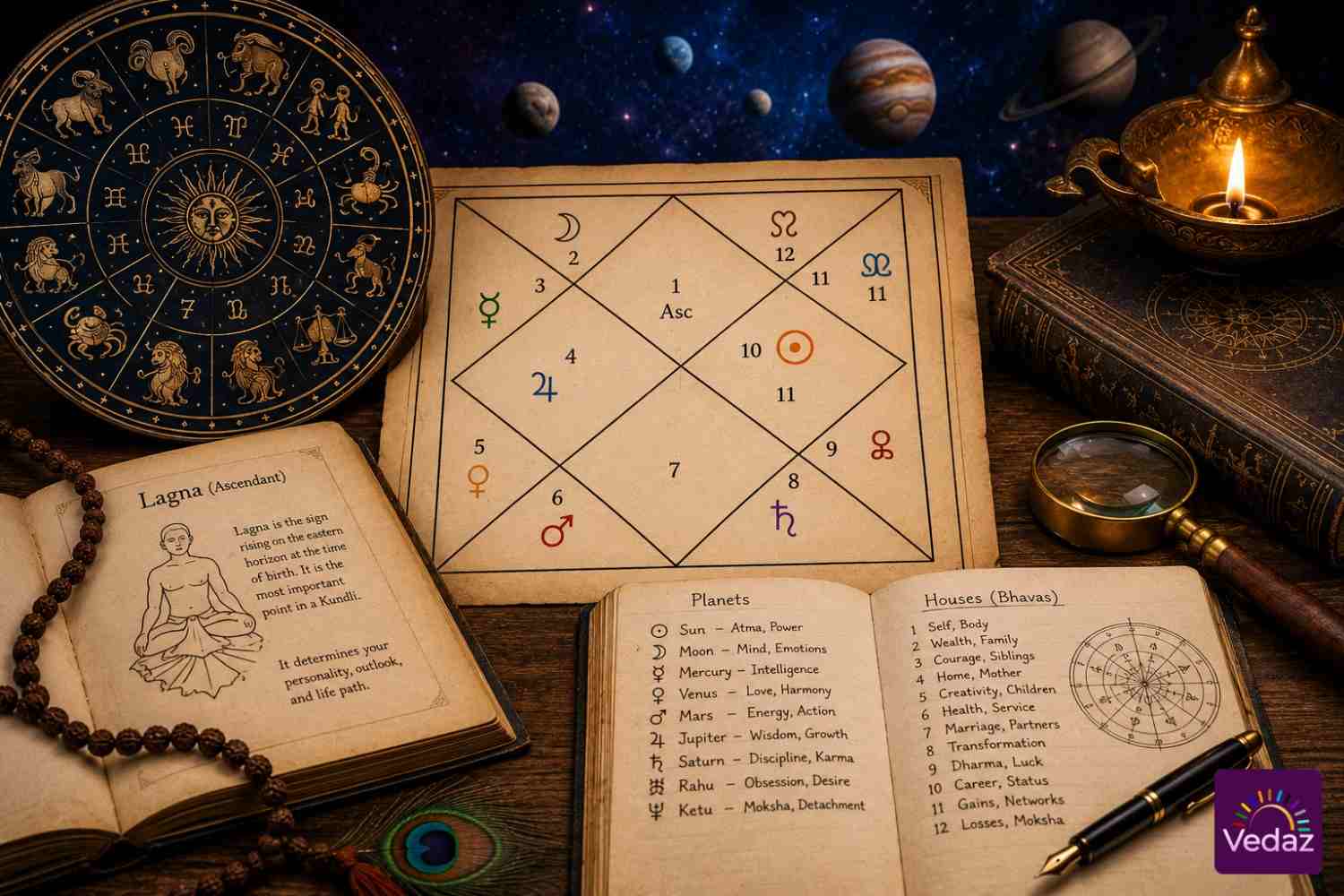
If signs are the flavor, houses are the stage — the twelve different domains of life where planetary energy plays out. Every specific topic in astrology (career, marriage, children, health, finances) maps back to one or more houses.
Here's a quick reference:
- 1st House (Lagna) — Self, body, personality; the foundation of the entire chart
- 2nd House — Wealth, family, speech, accumulated resources
- 3rd House — Courage, siblings, communication, short journeys
- 4th House — Home, mother, emotional foundation, property
- 5th House — Intelligence, children, creativity, romance
- 6th House — Health challenges, enemies, debt, daily work
- 7th House — Marriage, partnerships, business dealings
- 8th House — Transformation, sudden events, the hidden, inheritance
- 9th House — Fortune, dharma, higher learning, the guru
- 10th House — Career, profession, public reputation, authority
- 11th House — Gains, income, fulfillment of desires, networks
- 12th House — Loss, expenditure, foreign lands, liberation, the inner life
Every specific-topic guide in this library is, at root, exploring one or more of these houses — and the planets and timing cycles that activate them.
Building Block 3 — The Nine Planets (Grahas): The "Which Energy" Layer

In Vedic astrology, the nine classical grahas each carry a core energy and signification. These aren't just the physical planets — they are symbolic archetypes:
- Sun — Soul, authority, father, leadership, vitality
- Moon — Mind, emotions, mother, the inner experience (the primary reference point in Vedic astrology)
- Mars — Energy, courage, conflict, drive, siblings
- Mercury — Intelligence, communication, commerce, analysis
- Jupiter — Wisdom, dharma, expansion, the great benefic
- Venus — Love, beauty, refinement, relationships
- Saturn — Discipline, structure, limitation, the great teacher
- Rahu (north node) — Ambition, the unconventional, worldly desire
- Ketu (south node) — Detachment, spirituality, the past, liberation
Each planet influences the house it sits in and the houses it aspects — which is where chart reading gets layered and interesting.
How the Three Layers Combine — Reading the Chart's Logic
Chart reading is really just synthesizing these three layers: planet + sign + house, and then looking at the relationships they form.
A simple beginner reading might look like this: Mars in Aries in the 10th house → Mars (drive, courage) + Aries (its own bold sign, strong placement) + 10th house (career, reputation) → energetic, decisive engagement with career and public life. That's the basic logic.
Beyond single placements, charts are read through:
- House lordships — which planet rules each house for your specific Lagna
- Aspects — how planets influence each other across the chart
- Conjunctions — planets placed together, blending their energies
- Yogas — specific significant combinations that indicate notable themes or outcomes
And all of this static potential gets timed through the Mahadasha system — the planetary period cycles unique to Vedic astrology. Curious how your current planetary period is shaping your life? Understanding Your Mahadasha goes deep on exactly this.
The full picture is layered, which is why mastery takes study. But the foundation is always this: signs, houses, planets, and how they relate. Start there and everything else builds naturally.
Why the Lagna (Ascendant) Is the Most Important Point in Your Chart
Of everything in a Vedic birth chart, the Lagna — the sign rising on the eastern horizon at your birth — is the single most important factor. Here's why:
- It determines which sign occupies your 1st house
- And therefore, which signs occupy all the other houses
- Which means it determines which planets rule which life areas — for you specifically
Two people born on the same day can have dramatically different charts if born even a few hours apart, because their Lagnas differ and the entire house framework shifts.
This is also why generic sun-sign astrology is only the shallowest layer of what a full chart contains. Your Lagna is the lens through which everything else is read. Get this right, and the whole chart opens up.
Vedic vs Western Astrology — Key Differences Explained Simply
People often wonder why their Vedic chart looks so different from their Western chart. Here's the honest summary:
- Zodiac system: Vedic = sidereal (fixed stars); Western = tropical (seasons/equinoxes). They differ by ~24 degrees due to precession
- Primary reference: Vedic emphasizes the Moon sign and Lagna; Western emphasizes the Sun sign
- Timing system: Vedic uses the Mahadasha (planetary period) system; Western primarily uses transits and progressions
- Neither is "correct" in an absolute sense — they are different symbolic systems with different internal logic, each with their own depth
This library presents the Vedic system on its own terms, without constantly comparing or ranking it against Western approaches.
How to Begin Reading Your Own Vedic Birth Chart — Step by Step
You don't need to be a professional astrologer to start engaging with your chart. Here's a grounded approach:
- Get an accurate chart — using your exact birth date, time, and place. Use a sidereal/Vedic calculator (like the free chart tool at Vedaz). Tropical calculators will give you the wrong sign positions
- Identify your Lagna and Moon sign — these are your two foundational reference points. Read your Rashi's Moon-sign guide for the full picture
- Note where your Sun, Moon, and Lagna lord are placed — by sign and house. These three alone give you a meaningful first sketch of the chart
- Look for major yogas — specific combinations that indicate significant themes in your life
- Understand your current Mahadasha — the timing layer that shows which planetary energy is most active right now
- Read specific-topic guides for your live questions — career, marriage, finances, health — each has its own dedicated guide in this library
- Hold it all as reflective perspective, not fixed prediction — this framing is the foundation of honest astrology
If you're just starting and want to understand your personality through the lens of Vedic astrology, Gargi - gargi — Vedaz's AI advisor specializing in personality and self-growth — is a natural first conversation.
What a Birth Chart Can — and Cannot — Tell You

This one matters, so it's worth being direct:
- A birth chart is astronomically precise in construction and symbolically interpretive in meaning — both halves of that sentence matter
- It is a framework for reflection and perspective, not a fortune-telling machine or a deterministic verdict on your life
- Accurate birth time is essential — the Lagna, and therefore the entire chart structure, depends on it
- Generic sun-sign content is the shallowest layer; the real depth is in the full chart, which is learnable with study
- Be wary of any practitioner who delivers absolute, fear-based, or guarantee-laden readings — How to Evaluate an Astrologer covers the red flags in detail, and it's worth reading before you pay anyone for a consultation
Astrology is most healthily approached as a tool for self-reflection you participate in — not a verdict handed down to you. That's the framing this entire library maintains.
Final Thought
The kundli can look impenetrable at first. But once you see the logic — twelve signs giving flavor, twelve houses naming the areas of life, nine planets carrying the energies, the Lagna framing it all — it stops being a mystery and becomes a framework you can actually use.
That shift changes your whole relationship with astrology. It stops being something pronounced over you and becomes something you engage with thoughtfully yourself. And if you want to go deeper on how your chart's timing cycles are playing out right now, Divisional Charts (Vargas) Explained is the natural next step from this foundation.
Start here. Build from here. Engage with your chart as a participant in your own self-understanding — not as a recipient of a verdict. That's both the most accurate way to read a chart and the most meaningful.
Generate your free Vedic birth chart and start exploring — at vedaz.io - www.vedaz.io
Frequently Asked Questions
1. What is a Vedic birth chart (kundli)?
A Vedic birth chart is a precise astronomical map of where the planets were — relative to the sidereal zodiac and the horizon at your birth location — at the exact moment of your birth. It records the rising sign (Lagna) and positions of the nine classical grahas. The construction is astronomy; the interpretation is a symbolic framework for reflecting on character, tendencies, life themes, and timing.
2. What are the building blocks of a birth chart?
Three layers: the twelve signs/Rashis (the "what flavor" layer), the twelve houses/Bhavas (the "which life area" layer — self, wealth, home, career, marriage, and so on), and the nine planets/Grahas (the "which energy" layer — Sun, Moon, Mars, Mercury, Jupiter, Venus, Saturn, Rahu, Ketu). A reading synthesizes these: a planet, in a sign, in a house, and the relationships it forms.
3. Why is my Vedic sign different from my Western sign?
Vedic astrology uses the sidereal zodiac (aligned to the fixed stars), while Western astrology uses the tropical zodiac (aligned to the seasons and equinoxes). Because of a slow astronomical drift called precession, these now differ by roughly 24 degrees — so your Vedic sign is often one sign earlier than your familiar Western sun sign. Vedic astrology also emphasizes the Moon sign and Lagna rather than the Sun sign as primary reference points.
4. Why is birth time so important?
The Lagna (Ascendant) changes roughly every two hours, and it determines the entire house framework — including which planet rules which house for you specifically. Two people born the same day at different times can have substantially different charts. Because the Lagna is the lens through which everything else is read, accurate birth time is essential for an accurate chart.
5. How do I start reading my own chart?
Get an accurate sidereal chart from exact birth data; identify your Lagna and Moon sign; note where the Sun, Moon, and Lagna lord are placed by sign and house; check for major yogas; understand your current Mahadasha; read the specific-topic guides for your live questions; and hold it all as reflective perspective rather than fixed prediction.
6. Is a birth chart fortune-telling?
No — and this distinction matters. A birth chart is astronomically precise in construction and symbolically interpretive in meaning. It is a framework for reflection and perspective, not deterministic fortune-telling. Be wary of any practitioner who delivers absolute, fear-based, or guarantee-laden readings — these misrepresent what a chart honestly is.
Related Blogs

How to Read Your Kundli
Beginner’s guide to how to read kundli, covering lagna, 12 zodiac signs, 12 houses in Vedic astrology, navagraha, and doshas in kundli.

Nadi Dosha in Kundli and Its Solutions
Learn what Nadi Dosha means in horoscope matching, when it gets cancelled, and the best remedies to ensure a happy married life.

Bhakoot Dosha Effects and Marriage Remedies
Learn about Bhakoot Dosha, its impact on relationships, and effective astrological remedies for a happy, balanced, and compatible marriage.

Best Nakshatra Combinations for Marriage
Explore Nakshatra compatibility, guna milan rules, and powerful star pairings that create happy and stable marriages.
Our AI Astrologers
Connect with our expert AI astrologers for instant guidance.