D9 Navamsha, D10 & D7 Explained: A Beginner’s Guide to Vargas
beginner guide to divisional charts

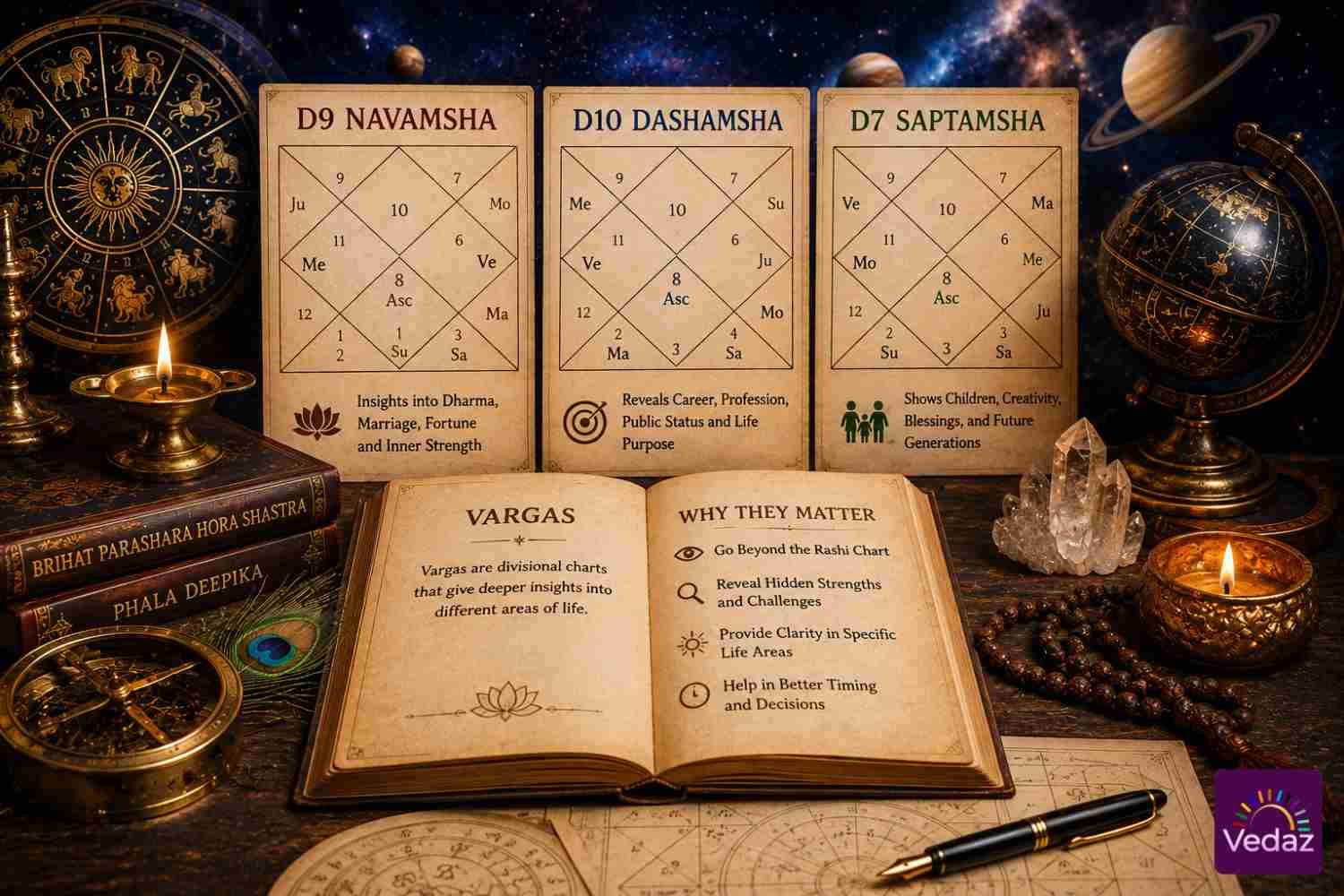
Divisional charts (vargas) are derived by subdividing each zodiac sign to magnify specific life areas. The D-9 (Navamsha) examines marriage and dharma, the D-10 (Dashamsha) examines career, and the D-7 (Saptamsha) examines children. A planet must be strong in both the main chart and the relevant divisional chart to fully deliver results in that area.

If you've ever had a Vedic astrology reading and walked away thinking "that was surprisingly detailed" — divisional charts are a big part of why.

Most people are familiar with the main birth chart. Twelve houses, nine planets, signs, lordships — that's the foundation. But here's what many beginners don't realise: the main chart is actually just the starting point.

Vedic astrology takes each sign and subdivides it further, producing a whole set of additional charts — each one a magnifying lens focused on a specific dimension of life.

Marriage. Career. Children. Property. Education. Each has its own chart. And a planet that looks strong in the main chart can look very different in the divisional chart — which is precisely why readings that rely only on the main chart often miss the full picture.

This is the guide that explains how divisional charts work, which ones matter most, and why their presence in a reading is one of the clearest signs you're getting a genuinely rigorous analysis.


Quick Answers

  • What they are: Charts derived by subdividing each zodiac sign, each magnifying a specific life area
  • The core principle: Finer subdivision reveals detail the main chart's 30° resolution simply cannot
  • Most important: D-1 (main chart), D-9 (Navamsha — marriage, dharma), D-10 (Dashamsha — career)
  • Also widely used: D-7 (children), D-2 (wealth), D-4 (property), D-12 (parents), D-24 (education)
  • Why they matter: A strong main-chart placement can be weak in the divisional chart — and vice versa
  • Honest truth: They add depth and nuance, not certainty — still a framework for reflection, not prediction

What Is a Divisional Chart, Actually?

Let's start with the basic mechanism, because it's simpler than it sounds.

The main birth chart — the D-1, or Rashi chart — places each planet in one of twelve signs of 30 degrees each. That's the foundation. A divisional chart takes it further: it subdivides each sign into a set of equal parts, and maps each part onto a full zodiac of its own, producing a brand new twelve-house chart.

The number of subdivisions names the chart. The Navamsha subdivides each sign into 9 parts — so it's the D-9. The Dashamsha divides into 10 parts — the D-10. The Saptamsha into 7 — the D-7. And so on.

Here's the key insight: two planets sitting in the same sign of the main chart can fall into entirely different divisions — and therefore land in completely different signs and houses of a divisional chart.

This is how Vedic astrology distinguishes between charts that look similar on the surface. The divisional charts reveal differences that the 30-degree resolution of the main chart simply can't show.

If you're still building your foundation with the main chart itself, How to Read Your Vedic Birth Chart is the right place to start before going deeper here.


Why Divisional Charts Actually Matter — The Core Principle

d9 navamsha and d10 explained

Here's the classical principle at the heart of this whole system: a planet must be strong in both the main chart and the relevant divisional chart to give its full results in that life area.

Not just one. Both.

A planet that looks powerful in the main chart but weak in the D-9? Its results in marriage will be more complicated than the main chart alone suggests. A planet that looks ordinary in the main chart but lands in a strong position in the D-10? Career outcomes may be considerably better than a main-chart-only reading would predict.

This plays out across every specific life area:

  • Marriage analysis that ignores the D-9 (Navamsha) is incomplete. A difficult 7th house in the main chart may be significantly softened by a strong D-9 — or a promising 7th house may be undermined by a weak one
  • Career analysis that ignores the D-10 (Dashamsha) is incomplete. The D-10 can substantially refine or even contradict what the main chart suggests about profession and achievement
  • Children analysis that ignores the D-7 (Saptamsha) is incomplete. Strong claims based only on the main chart here are not following the classical method

This is why the note appears throughout this library — in the marriage guide, the career guide, the children guide — that rigorous analysis examines the relevant divisional chart. It's not a technicality. It's the difference between a surface reading and a complete one.


The Most Important Divisional Charts and What They're Used For

Here's the practical reference for the key vargas:

ChartNamePrimary Use
D-1RashiMain birth chart — overall life, foundation for all others
D-9NavamshaMarriage, partnership, dharma; general check on planetary strength
D-10DashamshaCareer, profession, public life, achievement
D-7SaptamshaChildren and progeny
D-2HoraWealth and financial resources
D-3DrekkanaSiblings, courage, effort
D-4ChaturthamshaProperty, fixed assets, home
D-12DwadashamshaParents and ancestry
D-24ChaturvimshamshaEducation and learning
D-30TrimshamshaChallenges, difficulties, resilience

For most practical questions, the D-1, D-9, and D-10 carry the most weight — with the topic-specific divisional chart added for whatever question is being examined.

The D-9 is particularly special: it's consulted not just for marriage but as a general check on planetary strength for almost any question. A planet that is "vargottama" — sitting in the same sign in both the D-1 and the D-9 — is considered especially strong.

Finer charts (D-16, D-20, D-27, D-60, and more) are used in advanced specialised practice. The classical D-60 (Shashtiamsha) is held in particularly high regard in some traditions — but it requires extremely accurate birth time to be meaningful.


The Birth-Time Sensitivity Issue — An Honest Caveat

This is important and often glossed over, so it's worth being direct about.

The finer the divisional chart, the more sensitive it is to birth-time accuracy. The main chart's Lagna changes roughly every two hours. A high divisional chart can shift its Lagna within minutes of birth time. Which means even a small birth-time inaccuracy — 10 or 15 minutes off — can produce a materially different divisional chart at the finer levels.

The practical implication:

  • With accurate, confirmed birth time, divisional analysis is reliable and genuinely illuminating
  • With uncertain birth time, heavy reliance on fine vargas is much less dependable
  • An honest practitioner acknowledges this rather than reading fine divisional charts with false confidence on uncertain data

If your birth time is approximate rather than exact, focus on the D-1 and D-9, which are more forgiving — and treat fine varga analysis with appropriate caution until birth time can be verified.


How Divisional Charts Are Used in Practice — Step by Step

Working with divisional charts isn't complicated once you know the sequence:

  • Step 1 — Read the main chart (D-1) first. Get the overall picture: relevant houses, their lords, the planets placed in them, key yogas
  • Step 2 — Examine the D-9 (Navamsha). Both for marriage questions specifically and as a general check on the underlying strength of any planet you're examining
  • Step 3 — Examine the topic-specific chart. D-10 for career, D-7 for children, D-4 for property, D-24 for education — whichever matches your live question
  • Step 4 — Compare the two pictures. Does the planet that looked strong in the D-1 hold up in the divisional chart? Agreement strengthens the reading. Disagreement signals nuance — and a main-chart-only reading would have missed it entirely
  • Step 5 — Synthesise honestly. Weight the divisional chart appropriately for its life area, and acknowledge where birth-time uncertainty limits confidence in fine vargas

And if you want to understand how divisional chart analysis intersects with timing — which dasha period activates a placement that's strong in both the D-1 and D-10, for example — Understanding Your Mahadasha is where that layer lives.


Divisional Charts as a Rigor Marker — What to Actually Look For

understanding vargas in vedic astrology

Here's a genuinely practical takeaway you can use right now: the presence or absence of divisional-chart analysis is one of the clearest, most checkable markers of whether a reading is rigorous or superficial.

A career reading that never mentions the D-10 is operating at main-chart level only. A marriage reading that never examines the D-9 is missing the chart the tradition considers most important for that question. A children reading that ignores the D-7 is not following the classical method.

This doesn't mean a reading has to be technically exhausting to be useful. But if you're paying for a detailed analysis of a specific life area and divisional charts don't come up, that's a concrete signal worth noticing.

How to Evaluate an Astrologer covers the broader red flags in detail — the divisional-chart question fits naturally into the checklist of things worth asking before you commit to a consultation.


Final Thought

Once you understand divisional charts, a lot of things in this library start to make more sense — particularly why the marriage, career, and children guides keep returning to the same point: a rigorous analysis doesn't stop at the main chart.

The principle is elegant. Subdivide each sign finely enough, and you reveal detail the 30-degree main chart simply can't show.

Two planets in the same sign look identical at the main-chart level — but in the D-9, they may land in entirely different signs, entirely different houses, with entirely different implications. That's not a technicality. That's the difference between a surface reading and a genuinely complete one.

Hold it with the right caveats — birth-time sensitivity for fine vargas, and the consistent reminder that depth is not the same as certainty. Divisional charts are an instrument of precision and nuance within a framework that remains, at its honest core, a tool for reflection and perspective.

But within that framing? They're one of the things that make Vedic astrology worth taking seriously.

See your key divisional charts (D-9, D-10, D-7) — free at vedaz.io - www.vedaz.io

Published on: May 25, 2026|Last Updated on: May 25, 2026

Frequently Asked Questions

1. What are divisional charts (vargas) in Vedic astrology?

Divisional charts are derived by subdividing each 30-degree sign of the main birth chart into equal parts, mapping each part onto a full zodiac to produce a new twelve-house chart. Each divisional chart magnifies a specific life area — the D-9 for marriage, the D-10 for career, the D-7 for children, and so on. They are one of the primary sources of analytical depth in Vedic astrology, revealing distinctions the main chart's resolution cannot.

2. Why do divisional charts matter?

A planet that appears strong in the main chart can appear weak in the relevant divisional chart — and vice versa. The classical principle is that a planet must be strong in both to deliver its full results in a given life area. This is why rigorous marriage analysis uses the D-9, career analysis uses the D-10, and children analysis uses the D-7. Main-chart-only readings of these areas are incomplete by the classical standard.

3. What are the most important divisional charts?

The D-1 (main chart), D-9 (Navamsha — marriage, dharma, and a general check on planetary strength), and D-10 (Dashamsha — career) carry the most weight for most questions. Topic-specific charts are added as relevant: D-7 (children), D-2 (wealth), D-3 (siblings), D-4 (property), D-12 (parents), D-24 (education), D-30 (challenges). Finer charts like the D-60 are used in advanced specialised analysis.

4. Why is birth-time accuracy especially important for divisional charts?

The finer the divisional chart, the more sensitive it is to birth-time accuracy. The main chart's Lagna changes roughly every two hours, but a high divisional chart can shift its Lagna within minutes. Small birth-time inaccuracies can therefore produce a materially different divisional chart at fine levels. Divisional analysis is most reliable with a confirmed, accurate birth time — on uncertain data, heavy reliance on fine vargas is less dependable, and an honest practitioner acknowledges this.

5. How can divisional charts help me judge if a reading is rigorous?

The use of relevant divisional charts is one of the clearest markers distinguishing rigorous Vedic analysis from superficial reading. A career reading with no mention of the D-10, a marriage reading that never examines the D-9, or a children reading that ignores the D-7 is operating only at the main-chart level — incomplete by the classical standard. It's a concrete, checkable signal worth looking for when evaluating any reading or astrologer.

6. How can divisional charts help me judge if a reading is rigorous?

The use of relevant divisional charts is one of the clearest markers distinguishing rigorous Vedic analysis from superficial reading. A career reading with no mention of the D-10, a marriage reading that never examines the D-9, or a children reading that ignores the D-7 is operating only at the main-chart level — incomplete by the classical standard. It's a concrete, checkable signal worth looking for when evaluating any reading or astrologer.

7. Do divisional charts make astrology more certain?

No — they add depth and nuance, not certainty. They reveal distinctions the main chart cannot, making analysis more rigorous and complete. But they remain part of a symbolic framework for reflection and perspective, held within the same honest framing as the rest of the tradition. More depth is not the same as deterministic prediction. What Vedic Astrology Can and Cannot Do addresses this distinction directly.