Mahadasha by Birth Chart: Meaning, Effects, Timeline & All 9 Dashas
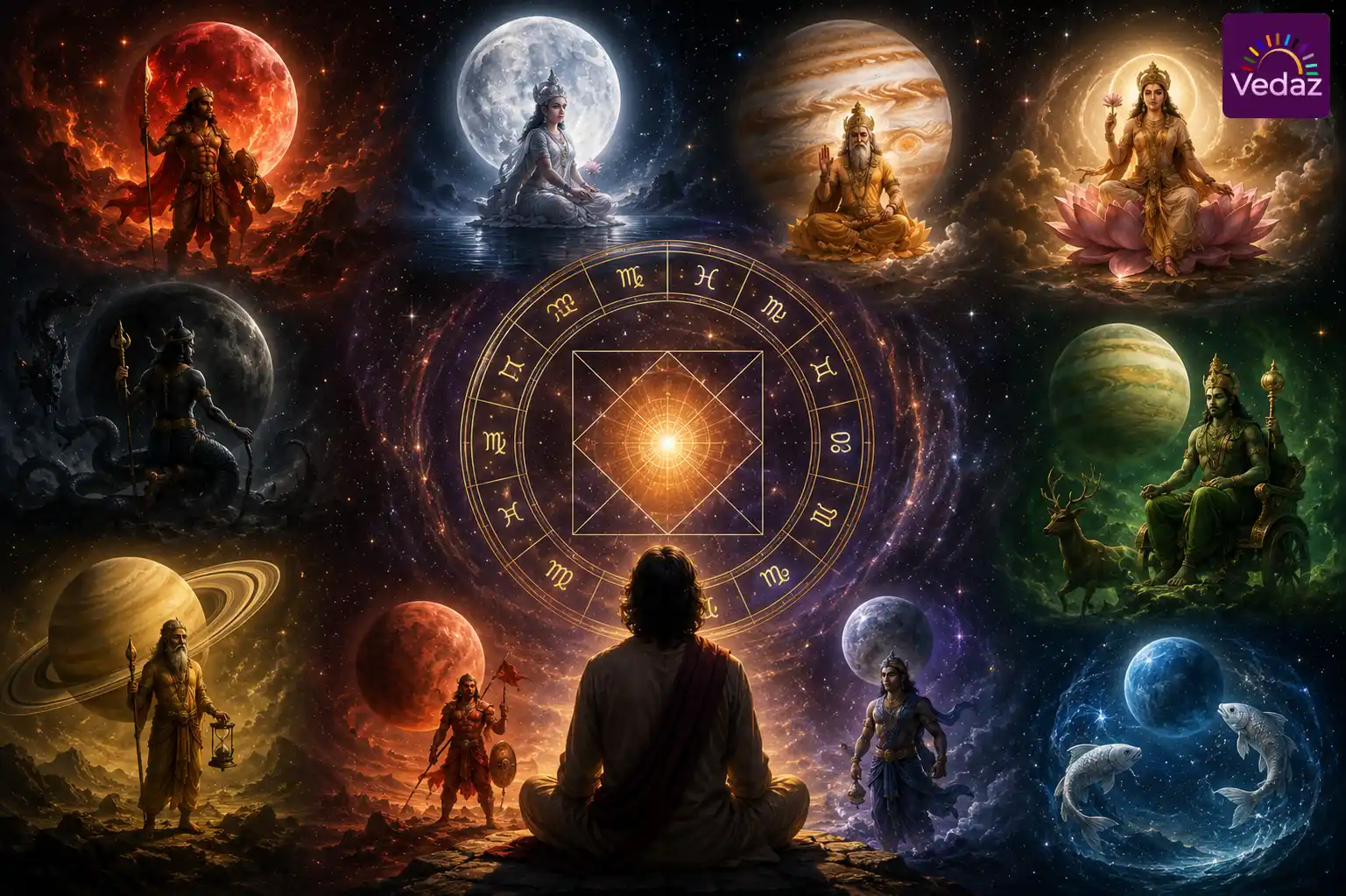
Mahadasha is Vedic astrology's 120-year planetary timing system, called Vimshottari Dasha. Nine planets each rule a fixed period — from 6 to 20 years — cycling in sequence from birth. The ruling planet of the period you are in shapes the dominant themes, events, and energies of that chapter of your life.
- ◦What Is Mahadasha in Vedic Astrology?
- ◦The 9 Planetary Mahadashas and Their Durations
- ◦How to Find Your Current Mahadasha
- ◦What Each Mahadasha Brings: The 9 Planetary Periods
- ◦Antardashas: The Sub-Periods That Give Each Mahadasha Its Texture
- ◦How the Mahadasha Sequence Reveals the Shape of Your Life
- ◦Strong vs. Weak Mahadasha: What Actually Determines Your Experience
- ◦How to Use Mahadasha Timing for Major Life Decisions
- ◦The 9 Mahadashas in Brief: What to Read Next
- ◦Final Thought
Western astrology tells you who you are. Vedic astrology tells you when.
That one word — when — is what makes the Mahadasha system one of the most remarkable tools in all of astrology.
It is a 120-year planetary calendar, calculated from the exact moment you were born, that maps which planet is running your life right now and what is structurally coming next. No Western system does this, transits show you the current sky. Progressions show you slow symbolic movement.
But neither gives you what the dasha calendar gives you: a personalized planetary timeline of your life, already written at birth.
Once people discover their Mahadasha sequence, two things tend to happen. First, the past suddenly makes sense — "oh, that's why those three years were so relentless." Second, the future becomes more navigable — not predicted down to the day, but legible in a way it was not before.
This is the complete guide. What Mahadasha is, how the Vimshottari Dasha system works, how to find which period you are in, what each of the 9 planetary periods actually feels like, how the sub-periods (antardashas) modify the experience, and how to use this knowledge to make better-timed decisions.
What Is Mahadasha in Vedic Astrology?
A Mahadasha (literally "great period") is one of nine planetary periods that together form a 120-year cycle in your life. At any given moment, exactly one Mahadasha is active in your chart — and the planet ruling that period exerts a disproportionate influence on the events, opportunities, and challenges you experience during it.
The full system is called Vimshottari Dasha — a Sanskrit term meaning "120 years," because the complete cycle spans exactly that. What makes it uniquely valuable is that it gives Vedic astrology its predictive backbone. A natal chart tells you about the architecture of your personality and karma. The dasha calendar tells you when those features become active.
Think of your birth chart as the script of a play. The Mahadasha is the staging schedule — it tells you which act is currently running, how long it lasts, and what comes next. You can read your chart without understanding dashas, but you will not know what the current chapter of your life is about.
To understand the chart that feeds this system, see the full guide on How to Read Your Kundli — it covers the foundational chart reading before dasha timing begins. The nakshatra your Moon occupies is the critical entry point; a complete overview is in the Nakshatra Complete Guide.
The 9 Planetary Mahadashas and Their Durations
Each of the nine traditional Vedic planets has a fixed Mahadasha length. Together, they add up to exactly 120 years. Here is the complete sequence:
| Planet (Mahadasha) | Duration |
|---|---|
| Ketu | 7 years |
| Venus (Shukra) | 20 years |
| Sun (Surya) | 6 years |
| Moon (Chandra) | 10 years |
| Mars (Mangal) | 7 years |
| Rahu | 18 years |
| Jupiter (Guru) | 16 years |
| Saturn (Shani) | 19 years |
| Mercury (Budha) | 17 years |
One thing to notice: the cycle does not always start with Ketu. Where you enter the sequence depends entirely on your Moon's nakshatra at birth.
Each nakshatra is assigned one of these nine planets as its ruler, and that planet's Mahadasha is where your life's dasha calendar begins — usually partway through that period, depending on how much of the nakshatra had been traversed at the moment of your birth.
How to Find Your Current Mahadasha
You need three things: your exact date of birth, your exact time of birth, and your place of birth.
From these, a Vedic chart calculator finds your Moon's precise position, identifies the nakshatra it occupies, and uses the percentage of that nakshatra already completed at birth to determine both which Mahadasha you started life in and how far into it you were.
A simple example: If you were born when the Moon was exactly halfway through Magha nakshatra (which is ruled by Ketu), you began life with roughly 3.5 years of Ketu Mahadasha remaining — half of Ketu's full 7-year period. After that, the cycle continues in fixed order: Ketu → Venus → Sun → Moon → Mars → Rahu → Jupiter → Saturn → Mercury — then back to Ketu, repeating across the full 120 years.
The easiest way to see your full sequence — with start and end dates for every period — is through the free kundali tool on Vedaz. It maps your complete Vimshottari Dasha calendar and shows you exactly where you are right now.
What Each Mahadasha Brings: The 9 Planetary Periods
Each planet's Mahadasha tends to emphasize the themes that planet rules in classical Vedic astrology. These are general patterns — your specific natal placement of each planet (which house, which sign, which aspects it receives) modifies the themes substantially.
Two people in the same Mahadasha can have completely different experiences.
| Mahadasha | Typical Themes |
|---|---|
| Sun (6 years) | Authority, government roles, paternal relationships, vitality, public recognition, ego challenges |
| Moon (10 years) | Emotional life, mother, the public, home and family, mental health, nurturing |
| Mars (7 years) | Drive, courage, real estate, conflicts, sibling matters, surgery or accidents possible, entrepreneurship |
| Mercury (17 years) | Communication, commerce, intellectual work, technology, education, business growth, networks |
| Jupiter (16 years) | Wisdom, expansion, children, marriage (often), advisory roles, religious or philosophical deepening |
| Venus (20 years) | Love, marriage, art, luxury, partnerships, comforts, vehicles, financial accumulation |
| Saturn (19 years) | Discipline, delays, career formalization, hardship that builds character, longevity |
| Rahu (18 years) | Foreign exposure, technology, sudden gains, obsessions, unconventional rises, breakthrough or breakdown |
| Ketu (7 years) | Detachment, spiritual seeking, sudden losses, specialization, isolation, moksha |
Antardashas: The Sub-Periods That Give Each Mahadasha Its Texture
A 17-year Mercury Mahadasha or 20-year Venus Mahadasha is far too long to feel like a single continuous experience. This is where antardashas — sub-periods — come in.
Within each Mahadasha, the same nine planets cycle through as sub-lords, in the same Vimshottari order, scaled to the main period's duration. The antardasha sequence always starts with the Mahadasha planet itself.
Example — Saturn Mahadasha (19 years total):
- Saturn–Saturn antardasha (~3 years)
- Saturn–Mercury antardasha (~2.7 years)
- Saturn–Ketu antardasha (~1.1 years)
- Saturn–Venus antardasha (~3.2 years)
- Saturn–Sun antardasha (~11 months)
- Saturn–Moon antardasha (~1.6 years)
- Saturn–Mars antardasha (~1.1 years)
- Saturn–Rahu antardasha (~2.9 years)
- Saturn–Jupiter antardasha (~2.5 years)
The combination of Mahadasha planet + antardasha planet is what produces the actual texture of the period. A Saturn Mahadasha with a Jupiter antardasha feels very different from a Saturn Mahadasha with a Rahu antardasha — even though both are technically "Saturn periods."
Below the antardasha, there is a third level called pratyantardasha (sub-sub-periods), and even finer divisions called sookshma and prana dashas. For most practical purposes, Mahadasha + antardasha gives you 90% of the useful picture.
If you want to track your current antardasha cycle in real time, Muhurta, Vedaz's timing AI, can help you match upcoming sub-periods to auspicious windows for decisions.
How the Mahadasha Sequence Reveals the Shape of Your Life
Your Mahadasha sequence is the rhythm section of your life story. The melody changes constantly — new jobs, new relationships, new cities — but the underlying planetary beat was set the moment you were born.
Once you know your full Vimshottari sequence, you can see your life as a planned 120-year arc. Some sequences are structurally fortunate — someone who enters career-building years during a strong Jupiter Mahadasha, then runs Saturn for discipline, then Mercury for intellectual expansion.
Some sequences explain long-standing patterns that otherwise feel mysterious. Some people ask: "Why did everything suddenly shift at 28?" Then they check their chart and discover a Mahadasha boundary right there.
This is the predictive insight that Western astrology does not offer in the same way. A natal chart is a snapshot of who you are. The dasha calendar is the unfolding of when you become it.
Understanding what your chart says about your personality before reading the dashas makes the timing work much better — Gargi, Vedaz's personality astrology AI, is a good starting point for that foundational reading.
Strong vs. Weak Mahadasha: What Actually Determines Your Experience
Two people running the exact same Mahadasha can have completely different experiences. The variables that determine whether a period delivers blessings or hardship include:
- House placement of the Mahadasha planet — Saturn in the 6th produces a very different period than Saturn in the 8th
- Sign placement — a planet in its own sign or exaltation delivers strong results; debilitated delivers weak or distorted ones
- Aspects received — benefic aspects from Jupiter, Venus, or Mercury strengthen; malefic aspects from Mars, Saturn, Rahu, or Ketu can complicate
- Conjunctions — sitting with a benefic sweetens the Mahadasha; sitting with a malefic sharpens it
- Functional nature for your Lagna — Saturn is a yogakaraka for Libra Lagna but a malefic for Aries Lagna; the same planet plays different roles for different ascendants
- Antardasha planet's relationship with the Mahadasha planet — friendly, neutral, or hostile
- Yogas activated — the Mahadasha planet may be part of a Raja Yoga, Dhana Yoga, or other combination that only fires when that planet's period runs
This is exactly why generic predictions almost always disappoint. "Saturn Mahadasha is bad" is not astrology — it is noise. A well-placed Saturn can produce the most professionally consequential and rewarding period of a person's life. A debilitated Jupiter can deliver expansion in the wrong areas. The textbook themes are the starting point. Your chart is the determining factor.
How to Use Mahadasha Timing for Major Life Decisions
This is where the system becomes genuinely practical. A few principles that experienced astrologers consistently apply:
- Time major launches — business ventures, marriages, significant moves — for periods when both your Mahadasha and antardasha rulers are well-placed in your chart
- Be cautious during the antardasha of any planet that is debilitated, retrograde, or heavily afflicted in your natal chart
- Allow 1–2 years of adjustment at the start of any new Mahadasha; transitions tend to feel disorienting before the new energy stabilizes
- Sandhi periods — the transitions between two Mahadashas — are traditionally low-vitality, uncertain phases; the last 6–12 months of one period and the first 6–12 of the next deserve extra care and patience
- Career amplification tends to arrive during the Mahadasha of the planet ruling your 10th or 2nd house; this is when professional opportunities structurally open up. For a deeper read on this, Niti, Vedaz's career astrology AI, can map your dasha timeline against your career houses directly
- Marriage and partnership themes intensify during the Mahadasha of the planet ruling your 7th house — favorable or otherwise
- Repeat periods (Mahadasha-antardasha of the same planet, e.g., Mercury-Mercury) often produce the most concentrated, pure expression of that planet — the most intense version of its themes, for better or for worse
The 9 Mahadashas in Brief: What to Read Next
Each of the nine Mahadashas deserves its own deep-dive. Below is a quick orientation to each — pick the one most relevant to where you are in life right now, or read them in sequence to understand your full 120-year arc:
- Sun Mahadasha (6 years) — the period of authority, recognition, and ego development
- Moon Mahadasha (10 years) — the period of emotional life, mother, home, and the inner world
- Mars Mahadasha (7 years) — the period of drive, conflict, physical energy, and entrepreneurship
- Mercury Mahadasha (17 years) — the long period of intellectual work, business-building, and communication
- Jupiter Mahadasha (16 years) — the period of wisdom, expansion, and life's most blessed years for many
- Venus Mahadasha (20 years) — the longest Mahadasha; the period of love, art, relationships, and material accumulation
- Saturn Mahadasha (19 years) — the second-longest; the period of discipline, delay, and durable building
- Rahu Mahadasha (18 years) — the period of obsession, foreign exposure, and unconventional rises
- Ketu Mahadasha (7 years) — the period of detachment, sudden change, and spiritual deepening
Ready to see your full Vimshottari Dasha calendar? Vedaz calculates your complete 120-year dasha sequence, identifies your current Mahadasha and antardasha, shows you when they end and what is coming next, and explains how your specific natal placements modify each period — all in plain English. Start with your free kundali on Vedaz, or get a personalised horoscope reading that includes your active dasha interpretation.
Final Thought
The Mahadasha system is Vedic astrology's most practical gift. It is the closest thing any astrological tradition has to a personalized life calendar — and unlike most astrological tools, it works even for skeptics. The themes it describes tend to arrive whether you are watching for them or not. Knowing what is structurally active in your chart right now is, at minimum, a genuinely useful orientation.
Pull your chart. Find your current Mahadasha and antardasha. Then read the dedicated guide for whichever planet is running your life right now. Most people discover that the themes of the past two or three years suddenly make sense — and that the next chapter, already written in their dasha calendar, is more knowledgeable than they had assumed.
The map was always there. You just needed to find it.
Harit Bhargava
Dasha Systems, Predictive Astrology & Life Event Analysis | 17+ Years
Harit Bhargava is a Vedic astrologer specializing in Vimshottari Dasha, planetary periods, and predictive techniques. He writes extensively about timing methods used in classical Jyotish to understand major life transitions.
Frequently Asked Questions
1. What is the Mahadasha system in Vedic astrology?
Mahadasha is the system of nine planetary periods — each ruled by one of the nine traditional Vedic planets — that together span 120 years. At any moment, one of these "great periods" is running in your life and exerting a disproportionate influence on your dominant themes. The full system is called Vimshottari Dasha, and it is the central predictive tool of Vedic astrology.
2. How do I calculate my current Mahadasha?
You need your exact date, time, and place of birth. The calculation finds your Moon's precise position at birth, identifies which nakshatra it occupied, and uses the percentage of that nakshatra completed to determine which Mahadasha you started life in. From there, the cycle proceeds in fixed order: Ketu �� Venus → Sun → Moon → Mars → Rahu → Jupiter → Saturn → Mercury, then repeats. Any reputable Vedic chart calculator will give you the full sequence with start and end dates.
3. Which Mahadasha is the best?
There is no universally "best" Mahadasha — it depends entirely on your chart. For most people, Jupiter Mahadasha is among the most consistently favorable, since Jupiter is the great benefic. Venus Mahadasha brings comfort and beauty but can produce indulgence. Saturn and Rahu Mahadashas are often the most professionally consequential but can be emotionally demanding. The "best" Mahadasha for any individual is the one whose ruling planet is most powerfully placed in their natal chart.
4. Which Mahadasha is considered the most difficult?
Saturn and Rahu Mahadashas carry the strongest reputation for difficulty in popular Vedic astrology — but this is heavily dependent on natal placement. A well-placed Saturn or Rahu can produce extraordinary success during its Mahadasha. Ketu Mahadasha is often the most spiritually demanding, and Mars Mahadasha can be physically intense. Generic "X Mahadasha is bad" predictions are unreliable; the actual natal placement determines the real experience.
5. How long does each Mahadasha last?
The fixed durations are: Ketu 7 years, Venus 20, Sun 6, Moon 10, Mars 7, Rahu 18, Jupiter 16, Saturn 19, Mercury 17. The full cycle totals exactly 120 years. The starting Mahadasha at birth is rarely experienced in full — you begin partway through it, depending on how much of your Moon's nakshatra had already been completed at the moment of birth.
6. What are antardashas?
Antardashas are sub-periods within each Mahadasha. The same nine planets cycle through as antardashas, in the same Vimshottari order, scaled to the duration of the main Mahadasha. A Saturn Mahadasha (19 years) contains a full sequence of antardashas — each lasting anywhere from 11 months to over three years. The combination of Mahadasha + antardasha is what produces the actual texture and lived experience of any given period.
7. Can Mahadasha effects be predicted accurately?
General themes can be predicted with reasonable accuracy. Specific events are much harder. The Mahadasha tells you which energies are structurally amplified — it does not tell you that "you will get a promotion on this date." Used responsibly, dasha analysis is excellent for understanding why certain themes are surfacing now and roughly when major life chapters will shift. Used carelessly, it can create false certainty about specific outcomes.
8. Can remedies reduce the bad effects of a difficult Mahadasha?
Classical Vedic astrology says yes, and prescribes specific mantras, gemstones, donations, and observances for each planetary period. Whether you take these literally or symbolically depends on your worldview. The most universally useful "remedy" during any difficult Mahadasha is awareness itself — understanding that the difficulty is structural and time-bound, rather than evidence of personal failure, makes most periods significantly easier to navigate. For specific planetary remedies, Atri, Vedaz's remedies AI, provides tailored guidance for whichever Mahadasha planet is currently active in your chart.
9. What happens during the transition between two Mahadashas?
Mahadasha transitions — sometimes called "sandhi" — are traditionally periods of low vitality and uncertain timing. The energy of the old Mahadasha is fading; the new one is not yet established. Life can feel genuinely "between worlds." Many people describe these transitions as quiet periods of reorganization where major decisions feel hard to make. Most astrologers recommend patience during the 6–12 months on either side of a Mahadasha change before committing to significant new directions.
Related Blogs

How Your Ruling Planet Affects You?
The impact of your ruling planet upon yourself and your course of action in life. Find the hidden meaning behind your zodiac sign’s star guide.

How the Moon Phases Impacts Body & Mind
Can the Moon’s phases impact your sleep, mood, and health? Explore the fascinating connection between lunar cycles and wellness and how to harness their energy for personal growth

What Are The Hidden Connection Between Planets and Emotions
Do planets influence your emotions? Explore how astrology connects to mental health, from Mercury retrograde effects to Saturn return life changes—and what science says about it!

Mercury Retrograde Survival Guide: Mental Health Tips for Every Sign
Turn Mercury Retrograde chaos into clarity with actionable mental health hacks for every zodiac sign.