Mahadasha and Antardasha: How Vimshottari Dasha Times Your Life
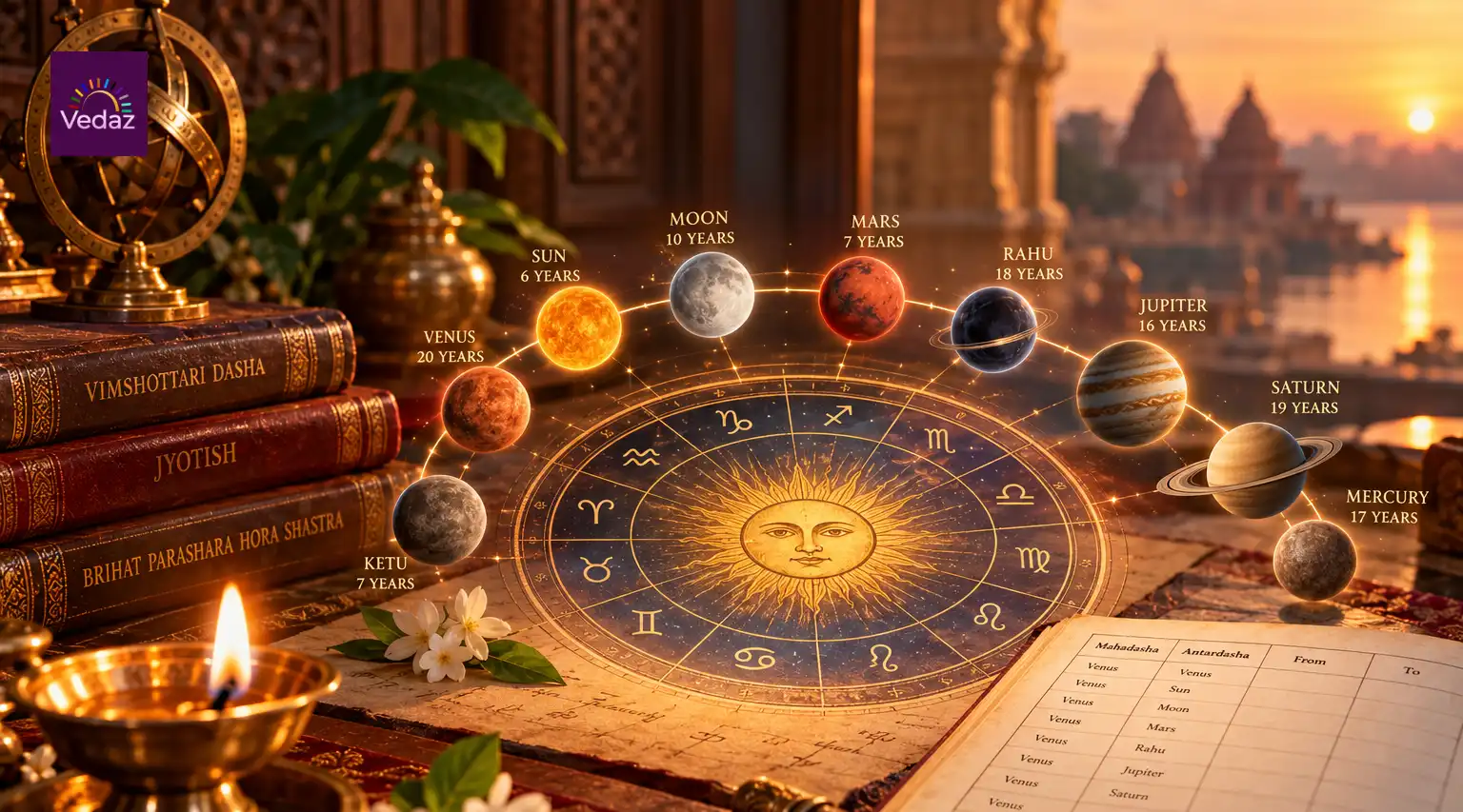
A mahadasha is a major planetary period in Vedic astrology. An antardasha is a sub-period inside it. The Vimshottari system shares a 120-year cycle among nine planets, from Ketu's 7 years to Venus's 20 years, and it starts with the lord of your birth nakshatra. The planet whose mahadasha and antardasha you're running shapes the main themes of that stretch of your life.
- ◦What Is a Dasha?
- ◦The Nine Mahadashas and Their Lengths
- ◦How Your Dasha Sequence Starts
- ◦How Antardashas Are Calculated
- ◦What Each Mahadasha Typically Brings
- ◦How to Read Your Current Dasha: A Step-by-Step Method
- ◦Example: Antardashas Within Venus Mahadasha
- ◦Dasha + Transit: How Events Get Triggered
- ◦Mahadasha and Your Moon Sign Transits
- ◦Dasha Sandhi: The Junction Between Mahadashas
- ◦Other Dasha Systems
- ◦Common Misunderstandings About Mahadasha
- ◦Simple Practices for Each Mahadasha
- ◦How to Track Your Dasha Through the Year
- ◦Rahu and Ketu Mahadashas: A Closer Look
- ◦The Bottom Line
If one tool makes Vedic astrology stand out, it's the dasha system. Western astrology describes who you are. Vedic dashas add when, meaning which planet's themes will lead each chapter of your life. That's why "mahadasha calculator," "dasha antardasha calculator" and "dasa bhukti calculator" are searched steadily.
This guide explains how Vimshottari dasha works, how to work out your dasha balance and antardashas, what each mahadasha usually brings, and how to read your current period sensibly. You can calculate your mahadasha free from your birth details.
What Is a Dasha?
Dasha (दशा) means "state" or "condition." In Vedic astrology, it's a period when one planet's meanings become especially active. The most widely used system is Vimshottari ("120") dasha, described by Parashara.
The levels of periods are:
- Mahadasha: the major period (6 to 20 years).
- Antardasha / Bhukti: a sub-period inside a mahadasha.
- Pratyantardasha: a sub-sub-period inside an antardasha.
- Sookshma and prana: even finer levels, used by advanced practitioners.
In Tamil, the mahadasha–antardasha table is called dasa puthi. In Telugu and Kannada, it's dasa bhukti. See our jathagam guide for regional terms.
The Nine Mahadashas and Their Lengths
| Order | Planet | Mahadasha length | Nakshatras ruled |
|---|---|---|---|
| 1 | Ketu | 7 years | Ashwini, Magha, Mula |
| 2 | Venus | 20 years | Bharani, Purva Phalguni, Purva Ashadha |
| 3 | Sun | 6 years | Krittika, Uttara Phalguni, Uttara Ashadha |
| 4 | Moon | 10 years | Rohini, Hasta, Shravana |
| 5 | Mars | 7 years | Mrigashira, Chitra, Dhanishta |
| 6 | Rahu | 18 years | Ardra, Swati, Shatabhisha |
| 7 | Jupiter | 16 years | Punarvasu, Vishakha, Purva Bhadrapada |
| 8 | Saturn | 19 years | Pushya, Anuradha, Uttara Bhadrapada |
| 9 | Mercury | 17 years | Ashlesha, Jyeshtha, Revati |
| Total | 120 years |
The order never changes. After Mercury, Ketu comes round again.
How Your Dasha Sequence Starts
Your first mahadasha belongs to the lord of your birth nakshatra (the Moon's nakshatra at birth). Born in Rohini? You start in Moon mahadasha. Born in Pushya? You start in Saturn mahadasha. Find your nakshatra in our nakshatras guide or with the nakshatra calculator.
Dasha balance at birth
You don't start at the beginning of that mahadasha. You start partway through, depending on how far the Moon had travelled through its nakshatra.
Formula:
Dasha balance = (portion of nakshatra remaining ÷ 13°20') × mahadasha length
Worked example:
- Moon at 16°40' Taurus. Rohini spans 10°00' to 23°20' Taurus.
- The Moon has travelled 6°40' into Rohini, so 6°40' remains (exactly half).
- Rohini's lord is the Moon (a 10-year mahadasha).
- Balance = ½ × 10 = 5 years of Moon mahadasha left at birth.
- The sequence then carries on: Mars (7), Rahu (18), Jupiter (16), Saturn (19)…
This is why an accurate Moon degree, and so an accurate birth time, matters for exact dasha dates.
How Antardashas Are Calculated
Each mahadasha is split into nine antardashas. They start with the mahadasha lord's own antardasha and follow the same order.
Formula:
Antardasha length (years) = (Mahadasha years × Antardasha planet's years) ÷ 120
Examples:
- Venus mahadasha, Venus antardasha: 20 × 20 ÷ 120 = 3 years 4 months.
- Jupiter mahadasha, Saturn antardasha: 16 × 19 ÷ 120 = 2.533 years = 2 years 6 months 12 days.
- Sun mahadasha, Moon antardasha: 6 × 10 ÷ 120 = 6 months.
Pratyantardashas are worked out the same way inside each antardasha. A mahadasha calculator does all of this instantly from your birth details.
What Each Mahadasha Typically Brings
The results of any dasha depend on the planet's sign, house, lordship, strength (including in the Navamsa) and aspects in your chart. The descriptions below are general themes, not fixed predictions.
Ketu mahadasha (7 years)
Detachment, spirituality, research, sudden changes, and letting go of what no longer fits. It can feel confusing, but it often brings deep insight.
Venus mahadasha (20 years)
Relationships, marriage, comfort, the arts, vehicles, beauty, pleasures and wealth. It's the longest dasha, and often a major chapter of life.
Sun mahadasha (6 years)
Authority, recognition at work, government matters, father, health and confidence. Lessons about ego are common.
Moon mahadasha (10 years)
Emotions, mother, home, public life, travel, nurturing and mental wellbeing. It's strongly coloured by the Moon's strength and phase.
Mars mahadasha (7 years)
Energy, courage, property, siblings, competition and technical work. If Mars is afflicted, there's also a chance of conflict or accidents, so care and patience help.
Rahu mahadasha (18 years)
Ambition, unconventional paths, foreign connections, technology and sudden rises. If Rahu is poorly placed, there can also be confusion or restlessness.
Jupiter mahadasha (16 years)
Wisdom, education, children, teachers, finance, dharma and growth. It's often seen as one of the most supportive dashas when Jupiter is well placed.
Saturn mahadasha (19 years)
Discipline, hard work, responsibility, endurance, and results that come late but last. It's especially rewarding for Taurus, Libra, Capricorn and Aquarius lagnas.
Mercury mahadasha (17 years)
Intellect, communication, business, learning, writing and skills. It's often good for education and trade.
Important: A "difficult" planet can give excellent results in your chart (for example, Saturn as yogakaraka), and a "benefic" can be hard (for example, Jupiter ruling the 6th and 8th). Always read the dasha lord's role in your own chart. See our lagna guide for functional benefics and yogakarakas.
How to Read Your Current Dasha: A Step-by-Step Method
- Find your current mahadasha and antardasha with a dasha calculator.
- Locate both planets in your chart. Note their sign, house and dignity.
- Note which houses they rule from your lagna.
- Check how they relate. Are they friends? Are they in good houses from each other (for example, 1/5/9 or kendras), or in difficult positions (6/8, 2/12)?
- Check both in the Navamsa. See our D9 guide.
- Overlay current transits. Jupiter and Saturn activating the dasha lords' houses trigger events.
- Sum up the themes, then plan around them.
Example: Saturn mahadasha, Venus antardasha, for a Tula (Libra) lagna. Saturn is the yogakaraka (4th and 5th lord). Venus is the lagna lord (and 8th lord). The two are friends. This period often brings career growth, property, creativity and personal recognition, especially if both planets are strong.
Example: Antardashas Within Venus Mahadasha
Venus mahadasha lasts 20 years. Its nine antardashas run in the fixed order, starting with Venus itself:
| Antardasha | Length | Calculation (20 × AD years ÷ 120) |
|---|---|---|
| Venus | 3 years 4 months | 20 × 20 ÷ 120 = 3.33 |
| Sun | 1 year | 20 × 6 ÷ 120 = 1.00 |
| Moon | 1 year 8 months | 20 × 10 ÷ 120 = 1.67 |
| Mars | 1 year 2 months | 20 × 7 ÷ 120 = 1.17 |
| Rahu | 3 years | 20 × 18 ÷ 120 = 3.00 |
| Jupiter | 2 years 8 months | 20 × 16 ÷ 120 = 2.67 |
| Saturn | 3 years 2 months | 20 × 19 ÷ 120 = 3.17 |
| Mercury | 2 years 10 months | 20 × 17 ÷ 120 = 2.83 |
| Ketu | 1 year 2 months | 20 × 7 ÷ 120 = 1.17 |
| Total | 20 years |
Each antardasha mixes the mahadasha lord's themes with the sub-period lord's. Venus–Saturn, for example, often combines Venus's comforts and relationships with Saturn's responsibilities and long-term commitments.
Dasha + Transit: How Events Get Triggered
A dasha shows which themes are active. Transits show when they peak. Astrologers watch for:
- Jupiter transiting over, or aspecting, the mahadasha or antardasha lord's natal position or the houses it rules. This often brings growth in those areas.
- Saturn transiting the same places. This often brings responsibility, effort and consolidation.
- The double transit, where Jupiter and Saturn both influence a house or its lord during a supportive dasha. It's a classic timing marker for big events like marriage, job changes or buying property.
Example: You're in Jupiter mahadasha, Mercury antardasha, and Mercury is your 10th lord. When transiting Jupiter aspects your 10th house and Saturn is at the same time passing through your 11th, a career step forward is strongly indicated during that window.
This is why two people in the same mahadasha can have very different experiences. Their natal placements and current transits are different. You can read more in our marriage prediction guide, which uses the same logic.
Mahadasha and Your Moon Sign Transits
Long transits like Sade Sati run separately from your dasha. When a supportive dasha overlaps with Sade Sati, Saturn's pressure often feels lighter. When a challenging dasha overlaps with it, patience and routine matter more. Knowing both helps you plan realistically.
Dasha Sandhi: The Junction Between Mahadashas
The months around the change from one mahadasha to the next are called dasha sandhi (junction). People often go through a transition then, with shifts in priorities, moves, career changes or a feeling of endings and beginnings. Traditional advice is not to rush big, irreversible decisions right at the junction, and to give yourself time to settle into the new period's themes.
Other Dasha Systems
Vimshottari is the most widely used, but Vedic astrology has others:
- Yogini dasha: a 36-year cycle of eight Yoginis, popular as a cross-check.
- Ashtottari dasha: a 108-year cycle used under certain chart conditions.
- Chara dasha: a Jaimini sign-based dasha.
- Kalachakra dasha: a complex system based on nakshatra padas.
Most astrologers use Vimshottari as the main timeline and the others for confirmation.
Common Misunderstandings About Mahadasha
"Rahu or Saturn mahadasha means disaster." Their results depend on placement and lordship. Many people do their best work in these dashas.
"Venus or Jupiter mahadasha guarantees good luck." Even benefic dashas can bring challenges if the planet rules difficult houses or is afflicted.
"I need expensive remedies for every dasha." Simple practices are the classical base: the planet's mantra, charity on its day, and conduct in line with its qualities.
"My dasha decides everything." The dasha sets the theme, transits trigger events, and your choices shape the outcome.
Simple Practices for Each Mahadasha
| Mahadasha | Simple, traditional practice |
|---|---|
| Sun | Surya arghya at sunrise; respect for father and authority |
| Moon | Monday Shiva worship; care for mother; regular sleep |
| Mars | Tuesday Hanuman Chalisa; physical exercise; patience |
| Mercury | Wednesday Ganesha worship; learning; kind speech |
| Jupiter | Thursday Vishnu worship; respect for teachers; charity |
| Venus | Friday Lakshmi worship; gratitude; harmony at home |
| Saturn | Saturday service to the elderly and workers; discipline |
| Rahu | Durga worship; honesty; avoiding shortcuts |
| Ketu | Ganesha worship; meditation; letting go gracefully |
Gemstones should only be considered after a full chart analysis, and never just because a dasha is running.
How to Track Your Dasha Through the Year
Write down your current mahadasha, antardasha and pratyantardasha with their end dates. Each time a sub-period changes, note which themes show up in your life over the next few weeks. Look at work, relationships, health routines and money. Over a year or two, you'll see clearly how each planet shows up in your chart. This simple dasha journal is one of the best ways to learn Vedic astrology from your own life. It also makes talks with an astrologer much more useful, because you can describe real experiences instead of guessing.
Rahu and Ketu Mahadashas: A Closer Look
Rahu (18 years) and Ketu (7 years) are shadow planets, so their dashas work differently from the others. They act mostly through:
- The sign lord of the sign they're in (their "dispositor").
- The house they sit in.
- Planets that are conjunct or aspecting them.
- Their nakshatra lord.
Rahu mahadasha often brings strong desire, ambition and change. That can mean foreign travel, new technologies, unconventional careers and rapid rises. If Rahu is poorly placed, it can also mean restlessness, confusion or reaching too far. Staying grounded and honest, and avoiding shortcuts, are the traditional keys.
Ketu mahadasha often brings detachment and a turn inward. That can mean interest in spirituality, research or healing, or letting go of old identities. If Ketu is poorly placed, it can feel confusing or lonely. Meditation, simplicity and patience are the traditional supports.
Both can be deeply transformative. Many people describe their Rahu dasha as the time they got the most worldly growth, and their Ketu dasha as the time they found the most inner clarity.
The Bottom Line
Mahadasha and antardasha turn a still birth chart into a living timeline. When you know your current periods and read the dasha lords' roles in your chart, it becomes clear why certain themes lead certain years. It also helps you plan with awareness instead of fear.
Calculate your mahadasha and antardasha free, learn your birth nakshatra, or ask Vedaz what your current dasha means for you.
Aditya Verma
Mahadasha, Antardasha, planetary periods, predictive chart interpretation | 10 years
Aditya Verma focuses on explaining the sequence and logic of traditional predictive astrology methods. He breaks down multi-step concepts into manageable explanations, helping readers understand planetary periods, related terminology, and the way Dasha systems are interpreted within a birth chart
Frequently Asked Questions
1. What is mahadasha in astrology?
Mahadasha is a major planetary period in Vedic astrology. In the Vimshottari system, nine planets rule periods of 6 to 20 years, adding up to 120 years. The active planet shapes the main themes of that phase of life.
2. How is mahadasha calculated?
Your first mahadasha is ruled by your birth nakshatra's lord. The balance left at birth depends on how much of the nakshatra the Moon still had to cross. The sequence then carries on in a fixed order.
3. What is antardasha?
Antardasha (or bhukti) is a sub-period inside a mahadasha. Its length is the mahadasha years multiplied by the antardasha planet's years, divided by 120.
4. Which mahadasha is the best?
No mahadasha is the best for everyone. A planet's dasha is most favourable when that planet is strong, well placed and rules good houses in your chart. The yogakaraka or the lagna lord are good examples.
5. What is dasa bhukti?
Dasa bhukti is the South Indian term for mahadasha and antardasha. In Tamil, it's called dasa puthi.
Related Blogs
How Your Ruling Planet Affects You?
The impact of your ruling planet upon yourself and your course of action in life. Find the hidden meaning behind your zodiac sign’s star guide.

How the Moon Phases Impacts Body & Mind
Can the Moon’s phases impact your sleep, mood, and health? Explore the fascinating connection between lunar cycles and wellness and how to harness their energy for personal growth
What Are The Hidden Connection Between Planets and Emotions
Do planets influence your emotions? Explore how astrology connects to mental health, from Mercury retrograde effects to Saturn return life changes—and what science says about it!

Mercury Retrograde Survival Guide: Mental Health Tips for Every Sign
Turn Mercury Retrograde chaos into clarity with actionable mental health hacks for every zodiac sign.