Shubh Muhurat January 2027: Auspicious Marriage Dates, Timings and Nakshatras
Updated 14 Nov 2026 · Verified by Aditya Vashisht
Planning a wedding, griha pravesh or a new car?
A general date list doesn't account for your own kundli. An astrologer can pick a date and time that does.
Why the January 2027 dates fall where they do
The short answer is Kharmas. Here's how it plays out:
- The pause: Most North Indian Panchangs stop weddings, griha pravesh and other samskaras while the Sun is in Dhanu rashi (Sagittarius). That runs from roughly mid-December to Makar Sankranti.
- The reopening: When the Sun enters Makar (Capricorn), the season opens again. The lunar month of Magha that follows is seen as one of the best months for marriage. That's why every January 2027 date sits after the 14th.
- The backdrop: January also carries Uttarayan, the Sun's northward journey, which tradition treats as a good time for new beginnings.
- The crunch: Families who missed the December 2026 dates and families who simply want a cooler wedding all end up chasing the same few late-January days.
Shubh muhurat January 2027 has 8 marriage windows on 8 dates, from 15 to 31 January, as per the Hindu Panchang. The longest runs on 19 January under Rohini and Mrigashira. Timings shift with local sunrise, so confirm them for your city.
Looking at the January calendar and wondering why the 1st has no wedding date? You're not missing anything. The first two weeks are blocked by Kharmas, and the wedding season only opens after Makar Sankranti.
Once it does, things move fast. All eight windows are packed into the second half of the month, which makes late January one of the most popular wedding stretches of the year. Cool evenings, warm shawls and outdoor mandaps are a big part of the charm.
Below you'll find every date with its start and end time, nakshatra and tithi. You'll also see which dates fall on weekends and how to turn this general list into a date that fits your family. One honest note first: a muhurat is about timing. It doesn't decide the fate of a marriage. Effort, understanding and family support matter just as much.
January 2027 marriage muhurat at a glance
| Fact | Detail |
|---|---|
| Total muhurat windows | 8 |
| Dates with a window | 8 (15, 18, 19, 20, 26, 27, 30, 31) |
| First window | 15 January, Friday, from 7:25 AM |
| Last window | 31 January, Sunday, until 7:31 PM |
| Longest window | 19 January (23 hr 29 min) |
| Shortest window | 18 January (2 min) |
| Weekend windows | 2 |
| Hindu lunar months | Pausha and Magha |
| Season | Peak winter in North India, mild and dry in the south |
Full list of shubh vivah muhurat dates in January 2027
| Date | Day | Muhurat window (start to end) | Nakshatra | Tithi |
|---|---|---|---|---|
| 15 January 2027 | Friday | 7:25 AM to 2:10 PM | Revati | Saptami |
| 18 January 2027 | Monday | 9:07 PM to 9:09 PM | Rohini, Krittika | Ekadashi |
| 19 January 2027 | Tuesday | 7:51 AM to 7:20 AM (20 Jan) | Rohini, Mrigashira | Dwadashi, Trayodashi |
| 20 January 2027 | Wednesday | 7:25 AM to 4:14 PM | Mrigashira | Trayodashi |
| 26 January 2027 | Tuesday | 8:20 PM to 7:18 AM (27 Jan) | Uttara Phalguni, Hasta | Panchami, Shashthi |
| 27 January 2027 | Wednesday | 7:23 AM to 11:53 PM | Hasta | Shashthi |
| 30 January 2027 | Saturday | 3:57 AM to 7:17 AM (pre-dawn of 31 Jan) | Anuradha | Navami |
| 31 January 2027 | Sunday | 7:22 AM to 7:31 PM | Anuradha | Dashami |
Timings are in IST for a reference location. Windows that cross midnight end on the date shown in brackets. Local timings can shift by a few minutes, so check the Vedaz Panchang for your city before you fix the date.
Date-by-date guide to January 2027 muhurats
The table gives you the facts. This part tells you what each window actually feels like in real life, so you can match it to the way your family likes to do a wedding.
15 January 2027, Friday: Revati, Saptami
- Timing: 7:25 AM to 2:10 PM, a daytime window of 6 hr 45 min.
- Best for: South Indian style morning muhurtham ceremonies, followed by a lunch reception.
- Nakshatra: Revati is the last of the 27 nakshatras. It's ruled by Mercury, and its deity is Pushan, linked with safe journeys and nourishment. Classical texts place it among the gentle (mridu) nakshatras, which is why people choose it for beginnings that need care and continuity.
18 January 2027, Monday: Rohini, Krittika, Ekadashi
- Timing: 9:07 PM to 9:09 PM. That's only 2 minutes.
- What to do: Tell your pandit early and decide which ritual falls inside the window. Usually that's the pheras or saptapadi. Keep every earlier function on schedule.
- Nakshatra: Rohini is the Moon's favourite nakshatra in Puranic stories, and the Moon rules it. Its deity is Prajapati, the creator. It's a fixed (dhruva) nakshatra, so it's seen as a good fit for lasting commitments. That's why it ranks so high for weddings.
19 January 2027, Tuesday: Rohini, Mrigashira, Dwadashi, Trayodashi
- Timing: 7:51 AM to 7:20 AM the next morning, a stretch of 23 hr 29 min.
- Why it's handy: It starts in the daytime and runs all night, so you can fix the main ritual at a time that's comfortable for everyone.
- Good to know: Rohini showed up on the 18th too. If your family likes this nakshatra, you get a second option here.
20 January 2027, Wednesday: Mrigashira, Trayodashi
- Timing: 7:25 AM to 4:14 PM, a daytime window of 8 hr 49 min.
- Best for: A morning ceremony with a relaxed afternoon.
- Nakshatra: Mrigashira is ruled by Mars, and its deity is Soma. It's a gentle nakshatra, linked with curiosity, courtship and the search for a companion. Not a bad theme for a wedding.
26 January 2027, Tuesday: Uttara Phalguni, Hasta, Panchami, Shashthi
- Timing: 8:20 PM to 7:18 AM the next morning, a night window of 10 hr 58 min.
- Best for: Families who follow the North Indian style, with an evening baraat and late-night pheras.
- Nakshatra: Uttara Phalguni is ruled by the Sun, and its deity is Aryaman, the Vedic god of contracts, hospitality and marriage alliances. It's a fixed nakshatra and often comes first in lists of wedding nakshatras because of that direct link to the marriage bond.
27 January 2027, Wednesday: Hasta, Shashthi
- Timing: 7:23 AM to 11:53 PM, a long daytime window of 16 hr 30 min.
- Why it's handy: You can have a morning muhurtham, an evening reception, or both, without worrying about running out of time.
- Nakshatra: Hasta is ruled by the Moon, and its deity is Savitr, the solar god of inspiration. Its symbol is an open hand. It's seen as a light, skilful nakshatra that suits ceremonies where hands are joined, like kanyadaan and panigrahan.
30 January 2027, Saturday: Anuradha, Navami
- Timing: 3:57 AM to 7:17 AM, which is 3 hr 20 min. It falls in the pre-dawn hours after midnight. The Panchang counts a day from sunrise to sunrise, so it's listed under the 30th.
- What to expect: Most families hold the main ritual in the brahma muhurta stretch, so plan the night's functions and guest rest around it.
- Heads up: It's a weekend, so venues and pandits will be in high demand.
- Nakshatra: Anuradha is ruled by Saturn, and its deity is Mitra, the god of friendship and agreements. It's valued for partnerships built on loyalty and counts as a gentle nakshatra.
31 January 2027, Sunday: Anuradha, Dashami
- Timing: 7:22 AM to 7:31 PM, a daytime window of 12 hr 9 min.
- Best for: A full-day wedding, with a morning ritual and an evening function.
- Heads up: It's a Sunday, so book early. Anuradha also appeared on the 30th, so you have two shots at this nakshatra.
The nakshatras behind January 2027 weddings
Six nakshatras carry the marriage windows this month: Revati, Rohini, Mrigashira, Uttara Phalguni, Hasta and Anuradha.
In Vedic tradition, the nakshatra describes the quality of the moment. Classical texts sort them by temperament, such as fixed (dhruva), gentle (mridu) and movable (chara). Weddings lean towards the fixed and gentle ones, because a marriage is meant to be steady and kind.
What about the couple's own birth nakshatra? Customs differ:
- Some families pick a matching or friendly nakshatra for the wedding.
- Others avoid the birth nakshatra completely.
Both are followed, so ask your family pandit which one is yours.
Weekend marriage dates in January 2027
Weekends are easiest for guests and hardest to book. Two windows fall on a Saturday or Sunday:
- 30 January (Saturday): 3:57 AM to 7:17 AM (pre-dawn of 31 Jan), Anuradha
- 31 January (Sunday): 7:22 AM to 7:31 PM, Anuradha
If a weekend date is already full, look at a window that starts on a Friday evening or ends on a Monday morning. Overnight windows often let you hold the reception on the weekend while the ritual itself stays inside the muhurat.
Regional traditions to know for January
- Punjab, Haryana and Delhi: Late January is a favourite, because Lohri and Makar Sankranti have just passed and everyone's still in a festive mood.
- Gujarat and Rajasthan: Uttarayan kite celebrations around 14 and 15 January keep venues and caterers busy that week. A date from the 26th onward is usually easier to book.
- Tamil Nadu: Pongal in mid-January coincides with the start of the Tamil month of Thai, which has its own wedding tradition, summed up in the saying that Thai opens new paths. Tamil families usually follow their own muhurtham lists, so cross-check with a Tamil Panchang.
- Bengal and Odisha: Magh is a classic wedding month here. Local almanacs like the Bengali Panjika have their own dates, which may differ from the list above.
How a vivah muhurat is calculated
A vivah muhurat isn't picked from the weekday alone. The Panchang runs several filters at once, and a date passes only when all of them line up.
- The five limbs: Tithi, vara, nakshatra, yoga and karana come first.
- Preferred nakshatras: Classical texts favour Rohini, Mrigashira, Magha, Uttara Phalguni, Hasta, Swati, Anuradha, Mula, Uttara Ashadha, Uttara Bhadrapada and Revati.
- Tithis to be careful with: Rikta tithis (Chaturthi, Navami and Chaturdashi) are often avoided, though some regional lists still include them when other factors are strong.
- Karana: Bhadra (Vishti karana) is avoided for the main ritual.
- Broader periods that are removed: Kharmas (the Sun in Sagittarius or Pisces), Chaturmas, and times when Venus or Jupiter are combust, meaning too close to the Sun to be seen. These two planets are the traditional significators of marriage.
- The lagna: Finally, the astrologer checks the rising sign at the moment of the ritual. That's why the windows in the table have exact start and end times and don't cover the whole day.
At Vedaz, these calculations run on Swiss Ephemeris with the Lahiri ayanamsa, the standard used by the Indian government's Rashtriya Panchang.
Planning a January 2027 wedding
All the dates sit within two weeks, so booking pressure is high. If you're aiming for 26, 27 or 31 January, treat October and November 2026 as your window to lock the venue and pandit.
A few practical things for winter weddings:
- North India: Arrange heaters and covered seating for older guests, and plan for morning fog. It can delay flights and road travel around Delhi, Lucknow and Patna.
- Outstation guests: Build in a buffer day.
- South and west: January is comfortable for open-air ceremonies, so a garden or beach venue is a realistic option.
A simple timeline helps:
- 9 to 12 months ahead: Shortlist dates.
- Next: Do your kundli matching and have the important family conversations.
- After that: Book the venue and the pandit together. A venue without a priest on the same window doesn't help much.
- About 3 months ahead: Send save-the-dates.
- 2 to 3 weeks before: Confirm the final muhurat time with the pandit, when local timings can be rechecked.
Before you lock the date: match the couple, not just the calendar
A general muhurat list tells you which dates are good for weddings in general. It can't tell you if a date suits your couple. Families usually take two more steps.
Step one is kundli matching. It compares the two charts through the Ashtakoota (36-point guna milan) system and checks things like Manglik dosha and its classical cancellation conditions. Treat the score as a starting point for a conversation, not a verdict. A low score is a reason to look closer, not a reason to call off a match.
Step two is a personal muhurat check. An astrologer looks at the couple's own charts, especially the Moon signs and the strength of Venus and Jupiter, against your shortlisted dates.
Want a second opinion? Keep your shortlist handy and chat with a Vedaz astrologer.
Common mistakes to avoid
- Booking the venue before checking the window. A date can be auspicious and still have a very short window, or one that falls at 3 AM. Check the exact time before you sign anything.
- Copying timings from a national list. Start and end times depend on sunrise and lagna at the venue. Use city-specific timings.
- Thinking weekends are always better. Weekday muhurats are just as valid and often cheaper to book. Tradition puts the muhurat first and convenience second, but you can usually balance both.
- Ignoring family customs. Some families avoid Mula nakshatra, the marriage of the eldest child in Jyeshtha, or certain tithis. Ask the elders early.
- Deciding out of fear. Astrology is a tool for timing and reflection. If a date doesn't work, picking another good one is a normal part of planning.
The bottom line
January 2027 gives you 8 muhurat windows to choose from. Start with the shortlist above, then filter it by your city's timings, your family's customs and what your guests can manage. Check the couple's charts before you commit. A good date supports a good beginning, but a happy marriage is built by the two people and the families around them.
Planning ahead for the next month? Take a look at Shubh Muhurat February 2027.
Muhurat & Vastu experts online
Acharya Raghuji
Muhurat, Vastu · हिंदी
Acharya Punit
Vivah muhurat · हिंदी, English
Shubh Muhurat January 2027: Auspicious Marriage Dates, Timings and Nakshatras
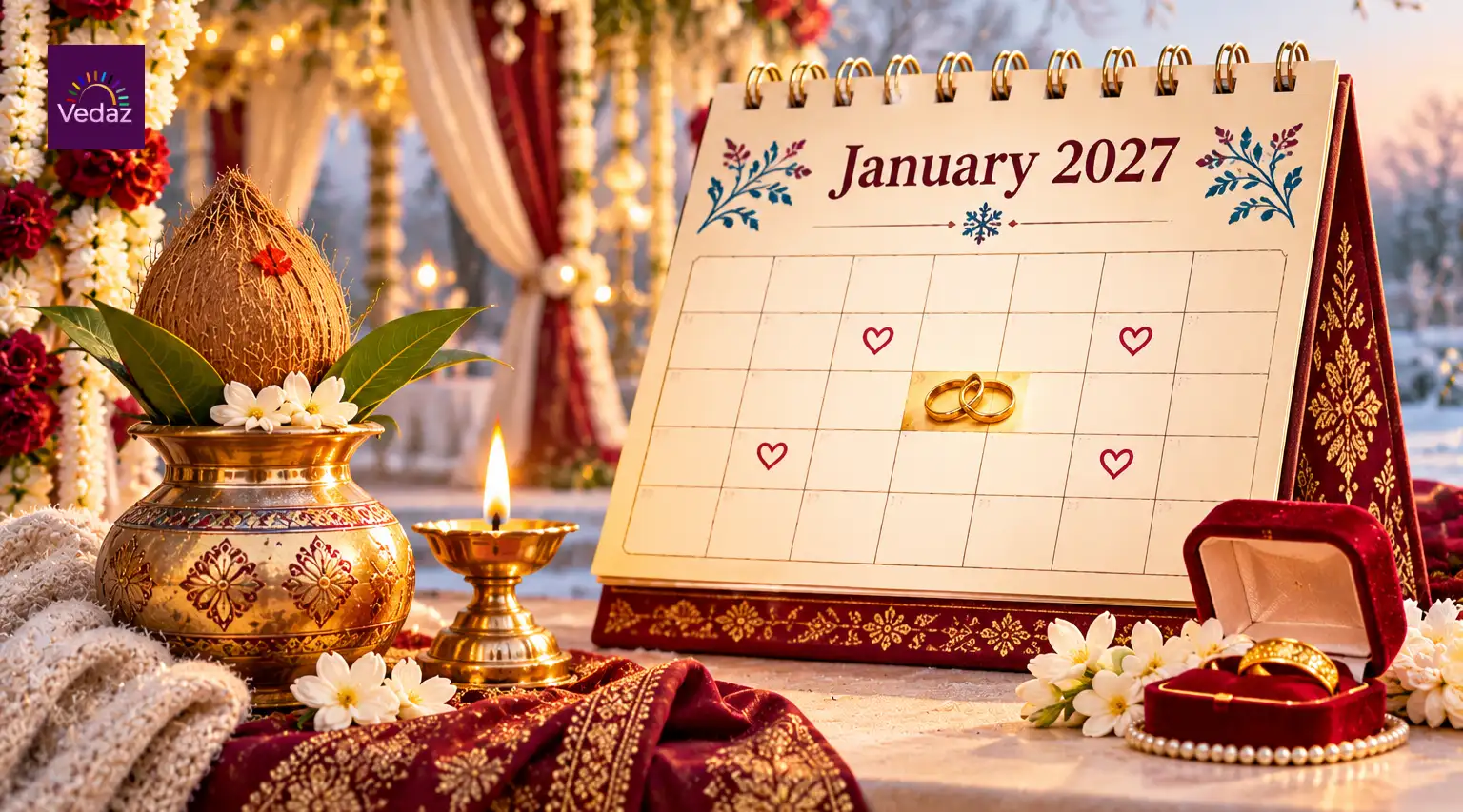
Shubh muhurat January 2027 has 8 marriage windows on 8 dates, from 15 to 31 January, as per the Hindu Panchang. The longest runs on 19 January under Rohini and Mrigashira. Timings shift with local sunrise, so confirm them for your city.
- ◦January 2027 marriage muhurat at a glance
- ◦Full list of shubh vivah muhurat dates in January 2027
- ◦Date-by-date guide to January 2027 muhurats
- ◦Why the January 2027 dates fall where they do
- ◦The nakshatras behind January 2027 weddings
- ◦Weekend marriage dates in January 2027
- ◦Regional traditions to know for January
- ◦How a vivah muhurat is calculated
- ◦Planning a January 2027 wedding
- ◦Before you lock the date: match the couple, not just the calendar
- ◦Common mistakes to avoid
- ◦The bottom line
Looking at the January calendar and wondering why the 1st has no wedding date? You're not missing anything. The first two weeks are blocked by Kharmas, and the wedding season only opens after Makar Sankranti.
Once it does, things move fast. All eight windows are packed into the second half of the month, which makes late January one of the most popular wedding stretches of the year. Cool evenings, warm shawls and outdoor mandaps are a big part of the charm.
Below you'll find every date with its start and end time, nakshatra and tithi. You'll also see which dates fall on weekends and how to turn this general list into a date that fits your family. One honest note first: a muhurat is about timing. It doesn't decide the fate of a marriage. Effort, understanding and family support matter just as much.
January 2027 marriage muhurat at a glance
| Fact | Detail |
|---|---|
| Total muhurat windows | 8 |
| Dates with a window | 8 (15, 18, 19, 20, 26, 27, 30, 31) |
| First window | 15 January, Friday, from 7:25 AM |
| Last window | 31 January, Sunday, until 7:31 PM |
| Longest window | 19 January (23 hr 29 min) |
| Shortest window | 18 January (2 min) |
| Weekend windows | 2 |
| Hindu lunar months | Pausha and Magha |
| Season | Peak winter in North India, mild and dry in the south |
Full list of shubh vivah muhurat dates in January 2027
| Date | Day | Muhurat window (start to end) | Nakshatra | Tithi |
|---|---|---|---|---|
| 15 January 2027 | Friday | 7:25 AM to 2:10 PM | Revati | Saptami |
| 18 January 2027 | Monday | 9:07 PM to 9:09 PM | Rohini, Krittika | Ekadashi |
| 19 January 2027 | Tuesday | 7:51 AM to 7:20 AM (20 Jan) | Rohini, Mrigashira | Dwadashi, Trayodashi |
| 20 January 2027 | Wednesday | 7:25 AM to 4:14 PM | Mrigashira | Trayodashi |
| 26 January 2027 | Tuesday | 8:20 PM to 7:18 AM (27 Jan) | Uttara Phalguni, Hasta | Panchami, Shashthi |
| 27 January 2027 | Wednesday | 7:23 AM to 11:53 PM | Hasta | Shashthi |
| 30 January 2027 | Saturday | 3:57 AM to 7:17 AM (pre-dawn of 31 Jan) | Anuradha | Navami |
| 31 January 2027 | Sunday | 7:22 AM to 7:31 PM | Anuradha | Dashami |
Timings are in IST for a reference location. Windows that cross midnight end on the date shown in brackets. Local timings can shift by a few minutes, so check the Vedaz Panchang for your city before you fix the date.
Date-by-date guide to January 2027 muhurats
The table gives you the facts. This part tells you what each window actually feels like in real life, so you can match it to the way your family likes to do a wedding.
15 January 2027, Friday: Revati, Saptami
- Timing: 7:25 AM to 2:10 PM, a daytime window of 6 hr 45 min.
- Best for: South Indian style morning muhurtham ceremonies, followed by a lunch reception.
- Nakshatra: Revati is the last of the 27 nakshatras. It's ruled by Mercury, and its deity is Pushan, linked with safe journeys and nourishment. Classical texts place it among the gentle (mridu) nakshatras, which is why people choose it for beginnings that need care and continuity.
18 January 2027, Monday: Rohini, Krittika, Ekadashi
- Timing: 9:07 PM to 9:09 PM. That's only 2 minutes.
- What to do: Tell your pandit early and decide which ritual falls inside the window. Usually that's the pheras or saptapadi. Keep every earlier function on schedule.
- Nakshatra: Rohini is the Moon's favourite nakshatra in Puranic stories, and the Moon rules it. Its deity is Prajapati, the creator. It's a fixed (dhruva) nakshatra, so it's seen as a good fit for lasting commitments. That's why it ranks so high for weddings.
19 January 2027, Tuesday: Rohini, Mrigashira, Dwadashi, Trayodashi
- Timing: 7:51 AM to 7:20 AM the next morning, a stretch of 23 hr 29 min.
- Why it's handy: It starts in the daytime and runs all night, so you can fix the main ritual at a time that's comfortable for everyone.
- Good to know: Rohini showed up on the 18th too. If your family likes this nakshatra, you get a second option here.
20 January 2027, Wednesday: Mrigashira, Trayodashi
- Timing: 7:25 AM to 4:14 PM, a daytime window of 8 hr 49 min.
- Best for: A morning ceremony with a relaxed afternoon.
- Nakshatra: Mrigashira is ruled by Mars, and its deity is Soma. It's a gentle nakshatra, linked with curiosity, courtship and the search for a companion. Not a bad theme for a wedding.
26 January 2027, Tuesday: Uttara Phalguni, Hasta, Panchami, Shashthi
- Timing: 8:20 PM to 7:18 AM the next morning, a night window of 10 hr 58 min.
- Best for: Families who follow the North Indian style, with an evening baraat and late-night pheras.
- Nakshatra: Uttara Phalguni is ruled by the Sun, and its deity is Aryaman, the Vedic god of contracts, hospitality and marriage alliances. It's a fixed nakshatra and often comes first in lists of wedding nakshatras because of that direct link to the marriage bond.
27 January 2027, Wednesday: Hasta, Shashthi
- Timing: 7:23 AM to 11:53 PM, a long daytime window of 16 hr 30 min.
- Why it's handy: You can have a morning muhurtham, an evening reception, or both, without worrying about running out of time.
- Nakshatra: Hasta is ruled by the Moon, and its deity is Savitr, the solar god of inspiration. Its symbol is an open hand. It's seen as a light, skilful nakshatra that suits ceremonies where hands are joined, like kanyadaan and panigrahan.
30 January 2027, Saturday: Anuradha, Navami
- Timing: 3:57 AM to 7:17 AM, which is 3 hr 20 min. It falls in the pre-dawn hours after midnight. The Panchang counts a day from sunrise to sunrise, so it's listed under the 30th.
- What to expect: Most families hold the main ritual in the brahma muhurta stretch, so plan the night's functions and guest rest around it.
- Heads up: It's a weekend, so venues and pandits will be in high demand.
- Nakshatra: Anuradha is ruled by Saturn, and its deity is Mitra, the god of friendship and agreements. It's valued for partnerships built on loyalty and counts as a gentle nakshatra.
31 January 2027, Sunday: Anuradha, Dashami
- Timing: 7:22 AM to 7:31 PM, a daytime window of 12 hr 9 min.
- Best for: A full-day wedding, with a morning ritual and an evening function.
- Heads up: It's a Sunday, so book early. Anuradha also appeared on the 30th, so you have two shots at this nakshatra.
Why the January 2027 dates fall where they do
The short answer is Kharmas. Here's how it plays out:
- The pause: Most North Indian Panchangs stop weddings, griha pravesh and other samskaras while the Sun is in Dhanu rashi (Sagittarius). That runs from roughly mid-December to Makar Sankranti.
- The reopening: When the Sun enters Makar (Capricorn), the season opens again. The lunar month of Magha that follows is seen as one of the best months for marriage. That's why every January 2027 date sits after the 14th.
- The backdrop: January also carries Uttarayan, the Sun's northward journey, which tradition treats as a good time for new beginnings.
- The crunch: Families who missed the December 2026 dates and families who simply want a cooler wedding all end up chasing the same few late-January days.
The nakshatras behind January 2027 weddings
Six nakshatras carry the marriage windows this month: Revati, Rohini, Mrigashira, Uttara Phalguni, Hasta and Anuradha.
In Vedic tradition, the nakshatra describes the quality of the moment. Classical texts sort them by temperament, such as fixed (dhruva), gentle (mridu) and movable (chara). Weddings lean towards the fixed and gentle ones, because a marriage is meant to be steady and kind.
What about the couple's own birth nakshatra? Customs differ:
- Some families pick a matching or friendly nakshatra for the wedding.
- Others avoid the birth nakshatra completely.
Both are followed, so ask your family pandit which one is yours.
Weekend marriage dates in January 2027
Weekends are easiest for guests and hardest to book. Two windows fall on a Saturday or Sunday:
- 30 January (Saturday): 3:57 AM to 7:17 AM (pre-dawn of 31 Jan), Anuradha
- 31 January (Sunday): 7:22 AM to 7:31 PM, Anuradha
If a weekend date is already full, look at a window that starts on a Friday evening or ends on a Monday morning. Overnight windows often let you hold the reception on the weekend while the ritual itself stays inside the muhurat.
Regional traditions to know for January
- Punjab, Haryana and Delhi: Late January is a favourite, because Lohri and Makar Sankranti have just passed and everyone's still in a festive mood.
- Gujarat and Rajasthan: Uttarayan kite celebrations around 14 and 15 January keep venues and caterers busy that week. A date from the 26th onward is usually easier to book.
- Tamil Nadu: Pongal in mid-January coincides with the start of the Tamil month of Thai, which has its own wedding tradition, summed up in the saying that Thai opens new paths. Tamil families usually follow their own muhurtham lists, so cross-check with a Tamil Panchang.
- Bengal and Odisha: Magh is a classic wedding month here. Local almanacs like the Bengali Panjika have their own dates, which may differ from the list above.
How a vivah muhurat is calculated
A vivah muhurat isn't picked from the weekday alone. The Panchang runs several filters at once, and a date passes only when all of them line up.
- The five limbs: Tithi, vara, nakshatra, yoga and karana come first.
- Preferred nakshatras: Classical texts favour Rohini, Mrigashira, Magha, Uttara Phalguni, Hasta, Swati, Anuradha, Mula, Uttara Ashadha, Uttara Bhadrapada and Revati.
- Tithis to be careful with: Rikta tithis (Chaturthi, Navami and Chaturdashi) are often avoided, though some regional lists still include them when other factors are strong.
- Karana: Bhadra (Vishti karana) is avoided for the main ritual.
- Broader periods that are removed: Kharmas (the Sun in Sagittarius or Pisces), Chaturmas, and times when Venus or Jupiter are combust, meaning too close to the Sun to be seen. These two planets are the traditional significators of marriage.
- The lagna: Finally, the astrologer checks the rising sign at the moment of the ritual. That's why the windows in the table have exact start and end times and don't cover the whole day.
At Vedaz, these calculations run on Swiss Ephemeris with the Lahiri ayanamsa, the standard used by the Indian government's Rashtriya Panchang.
Planning a January 2027 wedding
All the dates sit within two weeks, so booking pressure is high. If you're aiming for 26, 27 or 31 January, treat October and November 2026 as your window to lock the venue and pandit.
A few practical things for winter weddings:
- North India: Arrange heaters and covered seating for older guests, and plan for morning fog. It can delay flights and road travel around Delhi, Lucknow and Patna.
- Outstation guests: Build in a buffer day.
- South and west: January is comfortable for open-air ceremonies, so a garden or beach venue is a realistic option.
A simple timeline helps:
- 9 to 12 months ahead: Shortlist dates.
- Next: Do your kundli matching and have the important family conversations.
- After that: Book the venue and the pandit together. A venue without a priest on the same window doesn't help much.
- About 3 months ahead: Send save-the-dates.
- 2 to 3 weeks before: Confirm the final muhurat time with the pandit, when local timings can be rechecked.
Before you lock the date: match the couple, not just the calendar
A general muhurat list tells you which dates are good for weddings in general. It can't tell you if a date suits your couple. Families usually take two more steps.
Step one is kundli matching. It compares the two charts through the Ashtakoota (36-point guna milan) system and checks things like Manglik dosha and its classical cancellation conditions. Treat the score as a starting point for a conversation, not a verdict. A low score is a reason to look closer, not a reason to call off a match.
Step two is a personal muhurat check. An astrologer looks at the couple's own charts, especially the Moon signs and the strength of Venus and Jupiter, against your shortlisted dates.
Want a second opinion? Keep your shortlist handy and chat with a Vedaz astrologer.
Common mistakes to avoid
- Booking the venue before checking the window. A date can be auspicious and still have a very short window, or one that falls at 3 AM. Check the exact time before you sign anything.
- Copying timings from a national list. Start and end times depend on sunrise and lagna at the venue. Use city-specific timings.
- Thinking weekends are always better. Weekday muhurats are just as valid and often cheaper to book. Tradition puts the muhurat first and convenience second, but you can usually balance both.
- Ignoring family customs. Some families avoid Mula nakshatra, the marriage of the eldest child in Jyeshtha, or certain tithis. Ask the elders early.
- Deciding out of fear. Astrology is a tool for timing and reflection. If a date doesn't work, picking another good one is a normal part of planning.
The bottom line
January 2027 gives you 8 muhurat windows to choose from. Start with the shortlist above, then filter it by your city's timings, your family's customs and what your guests can manage. Check the couple's charts before you commit. A good date supports a good beginning, but a happy marriage is built by the two people and the families around them.
Planning ahead for the next month? Take a look at Shubh Muhurat February 2027.
Planning a wedding, griha pravesh or a new car?
Aditya Vashisht
Muhurat Astrology, Panchang, Vedic Rituals and Auspicious Timings | 15 Years
Aditya Vashisht explores traditional Vedic methods for determining auspicious timings and understanding periods when ceremonies are generally avoided. His work focuses on panchang principles, planetary combinations and the significance of religious observances.
Frequently Asked Questions
1. How many auspicious marriage dates are there in January 2027?
The reference Panchang list shows 8 muhurat windows across 8 dates in January 2027, from 15 January to 31 January.
2. Why are there no marriage dates before 15 January 2027?
Because of Kharmas. The Sun stays in Sagittarius until Makar Sankranti in mid-January, and most North Indian Panchangs pause weddings during that time. The season reopens once the Sun moves into Capricorn.
3. Which January 2027 date has the longest muhurat window?
The overnight window from 19 to 20 January, under Rohini and Mrigashira, runs for almost a full day. That gives families plenty of room to schedule the pheras at a comfortable hour.
4. Can we marry on a date that is not on this list?
Yes. Many families use a personalised muhurat drawn from the couple's charts. Some days, like Akshaya Tritiya and Vasant Panchami, are also treated as self-auspicious. An astrologer can help you check a specific date.
5. Are the muhurat timings the same for every city?
No. Start and end times depend on local sunrise and the rising sign at the venue. The timings here come from a reference list, so confirm them for your wedding city on the Vedaz Panchang.
Related Blogs

Boost Your Health with Astrology
Boost your health with astrology using zodiac-based habits, wellness tips, and simple routines for better physical and mental balance.

The Socking Truth Behind Wearing A Black Thread
Uncover the mystery behind the black thread. From protection to spiritual energy—here’s why everyone’s suddenly wearing one.

Hidden Messages In Your Moles
What if that little mole on your cheek is more than just a mark? Explore the fascinating meanings behind mole placements and what they reveal about your future.
Who Is Your Ishta Devata?
Explore the concept of your personal God in Hinduism. Learn how to discover, connect with, and build a relationship with your Ishta Devata for inner peace and spiritual growth.