Shubh Muhurat February 2027: Auspicious Marriage Dates, Timings and Nakshatras
Updated 15 Nov 2026 · Verified by Devansh Trivedi
Planning a wedding, griha pravesh or a new car?
A general date list doesn't account for your own kundli. An astrologer can pick a date and time that does.
Why the February 2027 dates fall where they do
February overlaps two lunar months, Magha and Phalguna, and both are rated highly for marriage.
- Magha: It's linked with purity and ritual bathing.
- Phalguna: It leads into spring and the festival of Holi.
- Vasant Panchami: The festival of Saraswati and the start of spring falls in this stretch in 2027 (confirm the exact day on the Panchang). Many families treat it as an abujh muhurat, a day considered auspicious in itself.
- Why so many dates: A favourable run of nakshatras, with Rohini, Uttara Phalguni, Swati, Anuradha, Magha, Mula, Uttara Bhadrapada and Revati all landing on suitable tithis.
The contrast with the month before is big. The January 2027 dates only open after Kharmas ends, so February feels like the season in full swing.
Shubh muhurat February 2027 has 14 marriage windows across 13 dates, from 2 to 28 February, as per the Hindu Panchang. The longest runs on 25 February under Swati. Timings shift with local sunrise, so confirm them for your city.
Most months make you hunt for a wedding date. February does the opposite. It gives you so many that the hard part is choosing one.
The weather helps too. The North Indian cold is easing, the South hasn't turned hot yet, and evening functions are comfortable outdoors almost everywhere. If you'd rather have options than a single forced date, February is hard to beat in 2027.
Below you'll find every window with its start and end time, nakshatra and tithi. You'll also see which dates land on weekends and how to turn this general list into a date that fits your family. One honest note first: a muhurat is about timing. It doesn't decide the fate of a marriage. Effort, understanding and family support matter just as much.
February 2027 marriage muhurat at a glance
| Fact | Detail |
|---|---|
| Total muhurat windows | 14 |
| Dates with a window | 13 (2, 3, 9, 10, 11, 14, 15, 21, 22, 25, 26, 27, 28) |
| First window | 2 February, Tuesday, from 5:49 PM |
| Last window | 28 February, Sunday, until 1:44 PM |
| Longest window | 25 February (21 hr 27 min) |
| Shortest window | 21 February (2 hr 18 min) |
| Weekend windows | 4 |
| Hindu lunar months | Magha and Phalguna |
| Season | Tail end of winter, with pleasant days across most of India |
Full list of shubh vivah muhurat dates in February 2027
| Date | Day | Muhurat window (start to end) | Nakshatra | Tithi |
|---|---|---|---|---|
| 2 February 2027 | Tuesday | 5:49 PM to 7:16 AM (3 Feb) | Mula | Dwadashi |
| 3 February 2027 | Wednesday | 7:21 AM to 12:23 PM | Mula | Dwadashi |
| 9 February 2027 | Tuesday | 3:42 AM to 7:12 AM (pre-dawn of 10 Feb) | Uttara Bhadrapada | Chaturthi |
| 10 February 2027 | Wednesday | 7:17 AM to 2:42 PM | Uttara Bhadrapada | Chaturthi |
| 10 February 2027 | Wednesday | 3:06 AM to 7:12 AM (pre-dawn of 11 Feb) | Uttara Bhadrapada, Revati | Panchami |
| 11 February 2027 | Thursday | 7:17 AM to 11:27 PM | Revati | Panchami |
| 14 February 2027 | Sunday | 4:48 AM to 7:09 AM (pre-dawn of 15 Feb) | Rohini | Navami |
| 15 February 2027 | Monday | 7:14 AM to 12:30 PM | Rohini | Navami |
| 21 February 2027 | Sunday | 11:29 AM to 1:47 PM | Magha | Pratipada |
| 22 February 2027 | Monday | 11:56 AM to 7:03 AM (23 Feb) | Uttara Phalguni | Dwitiya, Tritiya |
| 25 February 2027 | Thursday | 9:34 AM to 7:01 AM (26 Feb) | Swati | Panchami, Shashthi |
| 26 February 2027 | Friday | 7:06 AM to 10:10 AM | Swati | Shashthi |
| 27 February 2027 | Saturday | 10:10 PM to 6:59 AM (28 Feb) | Anuradha | Ashtami |
| 28 February 2027 | Sunday | 7:04 AM to 1:44 PM | Anuradha | Ashtami |
Timings are in IST for a reference location. Windows that cross midnight end on the date shown in brackets. Local timings can shift by a few minutes, so check the Vedaz Panchang for your city before you fix the date.
Date-by-date guide to February 2027 muhurats
The table gives you the facts. This part tells you what each window actually feels like in real life, so you can match it to the way your family likes to do a wedding.
2 February 2027, Tuesday: Mula, Dwadashi
- Timing: 5:49 PM to 7:16 AM the next morning, a stretch of 13 hr 27 min.
- Why it's handy: It starts in the evening and runs overnight, so you can fix the main ritual at a time that suits everyone.
- Nakshatra: Mula (also written Moola) is ruled by Ketu, and its deity is Nirriti. Many regional Panchangs still include it in the wedding list, as this calendar does. Some families avoid it by custom, so check your own family practice before you book.
3 February 2027, Wednesday: Mula, Dwadashi
- Timing: 7:21 AM to 12:23 PM, a daytime window of 5 hr 2 min.
- Best for: A short morning ceremony, followed by lunch.
- Good to know: Mula showed up on the 2nd too, so you get a second option if your family is fine with it.
9 February 2027, Tuesday: Uttara Bhadrapada, Chaturthi
- Timing: 3:57 is not the time here. It's 3:42 AM to 7:12 AM, which is 3 hr 30 min. It falls in the pre-dawn hours after midnight. The Panchang counts a day from sunrise to sunrise, so it's listed under the 9th.
- What to expect: Most families hold the main ritual in the brahma muhurta stretch, so plan the night's functions and guest rest around it.
- Nakshatra: Uttara Bhadrapada is ruled by Saturn, and its deity is Ahirbudhnya. It's a fixed nakshatra, linked with depth, patience and stability, which are exactly what families hope for in a long marriage.
10 February 2027, Wednesday: Uttara Bhadrapada, Chaturthi
- Timing: 7:17 AM to 2:42 PM, a daytime window of 7 hr 25 min.
- Best for: South Indian style morning muhurtham ceremonies and a lunch reception.
- Good to know: Uttara Bhadrapada also appeared on the 9th, so you have more than one shot at this nakshatra.
10 February 2027, Wednesday: Uttara Bhadrapada, Revati, Panchami
- Timing: 3:06 AM to 7:12 AM (pre-dawn of 11 Feb), which is 4 hr 6 min. Like the other early-morning windows, it's listed under the day the Panchang started counting from.
- What to expect: Plan the night's functions around a brahma muhurta ritual and make sure the family gets some rest.
- Good to know: Yes, the 10th has two separate windows, so double-check which one your pandit means.
11 February 2027, Thursday: Revati, Panchami
- Timing: 7:17 AM to 11:27 PM, a very long daytime window of 16 hr 10 min.
- Why it's handy: You can do a morning muhurtham, an evening reception, or both.
- Nakshatra: Revati is the last of the 27 nakshatras. It's ruled by Mercury, and its deity is Pushan, linked with safe journeys and nourishment. Classical texts place it among the gentle (mridu) nakshatras, which is why it's chosen for beginnings that need care and continuity.
14 February 2027, Sunday: Rohini, Navami
- Timing: 4:48 AM to 7:09 AM (pre-dawn of 15 Feb), which is 2 hr 21 min. The Panchang counts the day from sunrise to sunrise, so it's listed under the 14th.
- What to expect: The ritual usually happens in the brahma muhurta stretch, so plan the night's functions around it.
- Heads up: It's a weekend, so venues and pandits will be in high demand.
- Nakshatra: Rohini is the Moon's favourite nakshatra in Puranic stories, and the Moon rules it. Its deity is Prajapati, the creator. It's a fixed (dhruva) nakshatra, so it's seen as a good fit for lasting commitments. That's why it ranks so high for weddings.
15 February 2027, Monday: Rohini, Navami
- Timing: 7:14 AM to 12:30 PM, a daytime window of 5 hr 16 min.
- Best for: A morning ceremony with a lunch reception.
- Good to know: Rohini also appeared on the 14th. If your family likes this nakshatra, you get a second option.
21 February 2027, Sunday: Magha, Pratipada
- Timing: 11:29 AM to 1:47 PM, a short daytime window of 2 hr 18 min.
- Heads up: It's a weekend, and the window is tight, so the main ritual needs to be timed carefully.
- Nakshatra: Magha is ruled by Ketu, and its deity is the Pitris, the ancestors. Its link with lineage and family blessings is one reason it appears in wedding lists, since a marriage joins two family lines.
22 February 2027, Monday: Uttara Phalguni, Dwitiya, Tritiya
- Timing: 11:56 AM to 7:03 AM the next morning, a stretch of 19 hr 7 min.
- Why it's handy: It starts in the daytime and runs all night, so you can choose a comfortable hour for the main ritual.
- Nakshatra: Uttara Phalguni is ruled by the Sun, and its deity is Aryaman, the Vedic god of contracts, hospitality and marriage alliances. It's a fixed nakshatra and often comes first in lists of wedding nakshatras because of that direct link to the marriage bond.
25 February 2027, Thursday: Swati, Panchami, Shashthi
- Timing: 9:34 AM to 7:01 AM the next morning, which is 21 hr 27 min, the longest window of the month.
- Why it's handy: You have almost a full day to schedule the ritual, which makes planning much easier.
- Nakshatra: Swati is ruled by Rahu, and its deity is Vayu, the wind god. It's a movable (chara) nakshatra linked with independence and balance, and it's widely accepted for weddings in North Indian Panchangs.
26 February 2027, Friday: Swati, Shashthi
- Timing: 7:06 AM to 10:10 AM, a short daytime window of 3 hr 4 min.
- Best for: An early morning ceremony.
- Good to know: Swati also appeared on the 25th, so you have two chances at this nakshatra.
27 February 2027, Saturday: Anuradha, Ashtami
- Timing: 10:10 PM to 6:59 AM the next morning, a night window of 8 hr 49 min.
- Best for: Families who follow the North Indian style, with an evening baraat and late-night pheras.
- Heads up: It's a Saturday, so book early.
- Nakshatra: Anuradha is ruled by Saturn, and its deity is Mitra, the god of friendship and agreements. It's valued for partnerships built on loyalty and counts as a gentle nakshatra.
28 February 2027, Sunday: Anuradha, Ashtami
- Timing: 7:04 AM to 1:44 PM, a daytime window of 6 hr 40 min.
- Best for: A morning ritual followed by a lunch reception.
- Heads up: It's a Sunday, so expect strong demand. Anuradha also appeared on the 27th, so you have two shots at it.
The nakshatras behind February 2027 weddings
Eight nakshatras carry the marriage windows this month: Mula, Uttara Bhadrapada, Revati, Rohini, Magha, Uttara Phalguni, Swati and Anuradha.
In Vedic tradition, the nakshatra describes the quality of the moment. Classical texts sort them by temperament, such as fixed (dhruva), gentle (mridu) and movable (chara). Weddings lean towards the fixed and gentle ones, because a marriage is meant to be steady and kind.
What about the couple's own birth nakshatra? Customs differ:
- Some families pick a matching or friendly nakshatra for the wedding.
- Others avoid the birth nakshatra completely.
Both are followed, so ask your family pandit which one is yours.
Weekend marriage dates in February 2027
Weekends are easiest for guests and hardest to book. Four windows fall on a Saturday or Sunday:
- 14 February (Sunday): 4:48 AM to 7:09 AM (pre-dawn of 15 Feb), Rohini
- 21 February (Sunday): 11:29 AM to 1:47 PM, Magha
- 27 February (Saturday): 10:10 PM to 6:59 AM (28 Feb), Anuradha
- 28 February (Sunday): 7:04 AM to 1:44 PM, Anuradha
If a weekend date is already full, look at a window that starts on a Friday evening or ends on a Monday morning. Overnight windows often let you hold the reception on the weekend while the ritual itself stays inside the muhurat.
Regional traditions to know for February
February is a strong month in nearly every regional tradition. Here's how it looks in different parts of India:
- Uttar Pradesh and Bihar: The Magha and Phalguna dates get booked heavily. The 14th and 15th are especially popular because the Rohini window comes with a weekend.
- Urban couples: Some like the overlap with Valentine's Day, though most families care more about the muhurat than the Western calendar date.
- Maharashtra: The Marathi Panchang (Kalnirnay) usually shows its own list for Magh.
- Kerala: Malayalam calendar months follow a different system, and families often ask a local jyotsyan for the muhurtham.
- Bengal: Families who follow the Panjika often share several of the Magh dates listed here.
How a vivah muhurat is calculated
Every date in a vivah muhurat list is the result of a filtering process, not a guess.
- The five limbs: The Panchang starts with tithi (lunar day), vara (weekday), nakshatra (lunar mansion), yoga and karana.
- Preferred nakshatras: Marriage is favoured under a group the classical texts call fixed or gentle, such as Rohini, Uttara Phalguni, Uttara Ashadha, Uttara Bhadrapada, Mrigashira, Hasta, Anuradha and Revati. Magha, Swati and Mula are also accepted in many traditions.
- What gets removed: Bhadra (Vishti karana) and certain inauspicious yogas.
- Seasonal filters: Kharmas, when the Sun moves through Sagittarius or Pisces, removes about two months a year. Chaturmas removes the monsoon months. When Venus (Shukra) or Jupiter (Guru) is combust, dates can drop out too, because these planets stand for the bond of marriage in Vedic astrology.
- The lagna check: The last step picks the hours within a good day when the rising sign is suitable. This is why two families in different cities can get slightly different windows on the same date.
Vedaz computes all this with Swiss Ephemeris and the Lahiri ayanamsa.
Planning a February 2027 wedding
With fourteen windows, the challenge in February is choosing, not finding. Here's a simple way to narrow it down:
- Shortlist three dates. Then filter by venue availability, the couple's kundali review and the travel plans of key relatives.
- Book the weekend clusters early. The two busiest stretches are 14 to 15 February and 27 to 28 February.
- Look at midweek dates if budget matters. Dates like 3, 10 or 11 February can bring lower venue rates, and you lose nothing in muhurat terms.
A simple timeline helps:
- 9 to 12 months ahead: Shortlist dates.
- Next: Do your kundli matching and have the family conversations.
- After that: Book the venue and the pandit together. A venue without a priest on the same window doesn't help much.
- About 3 months ahead: Send save-the-dates.
- 2 to 3 weeks before: Confirm the final muhurat time with the pandit, when local timings can be rechecked.
Before you lock the date: match the couple, not just the calendar
Think of this calendar as a shortlist. The next step is to see how the couple's own charts sit against it.
Kundli matching is the usual starting point. Through guna milan, it compares eight factors across 36 points and flags doshas such as Manglik dosha, which classical texts pair with specific cancellation conditions. A modest score doesn't mean a marriage will struggle, and many happy marriages have average scores. It simply means an astrologer should look at the full charts.
After that comes a personalised muhurat check. It compares your shortlisted dates with the couple's Moon signs, nakshatras and dasha periods.
Stuck between three good dates? Chat with a Vedaz astrologer and narrow it down to the one that suits both families.
Common mistakes to avoid
- Forgetting that windows can cross midnight. Many windows run into the next morning, so the date on the invitation and the date of the pheras may differ. Tell your guests clearly.
- Mixing regional calendars. A Tamil, Malayalam or Bengali almanac can list different dates from the North Indian Panchang. Stick to the calendar your family follows.
- Booking the pandit too late. Experienced pandits fill up on popular dates just as fast as venues do.
- Letting one factor decide everything. A muhurat is one input. Compatibility, family readiness and practical logistics matter too.
- Not planning for the season. Heat, fog or rain can affect the day. Arrange cover, cooling or heating for the venue.
The bottom line
February 2027 gives you 14 muhurat windows to choose from. Start with the shortlist above, then filter it by your city's timings, your family's customs and what your guests can manage. Check the couple's charts before you commit. A good date supports a good beginning, but a happy marriage is built by the two people and the families around them.
Looking further ahead? Have a look at Shubh Muhurat March 2027.
Muhurat & Vastu experts online
Acharya Raghuji
Muhurat, Vastu · हिंदी
Acharya Punit
Vivah muhurat · हिंदी, English
Shubh Muhurat February 2027: Auspicious Marriage Dates, Timings and Nakshatras
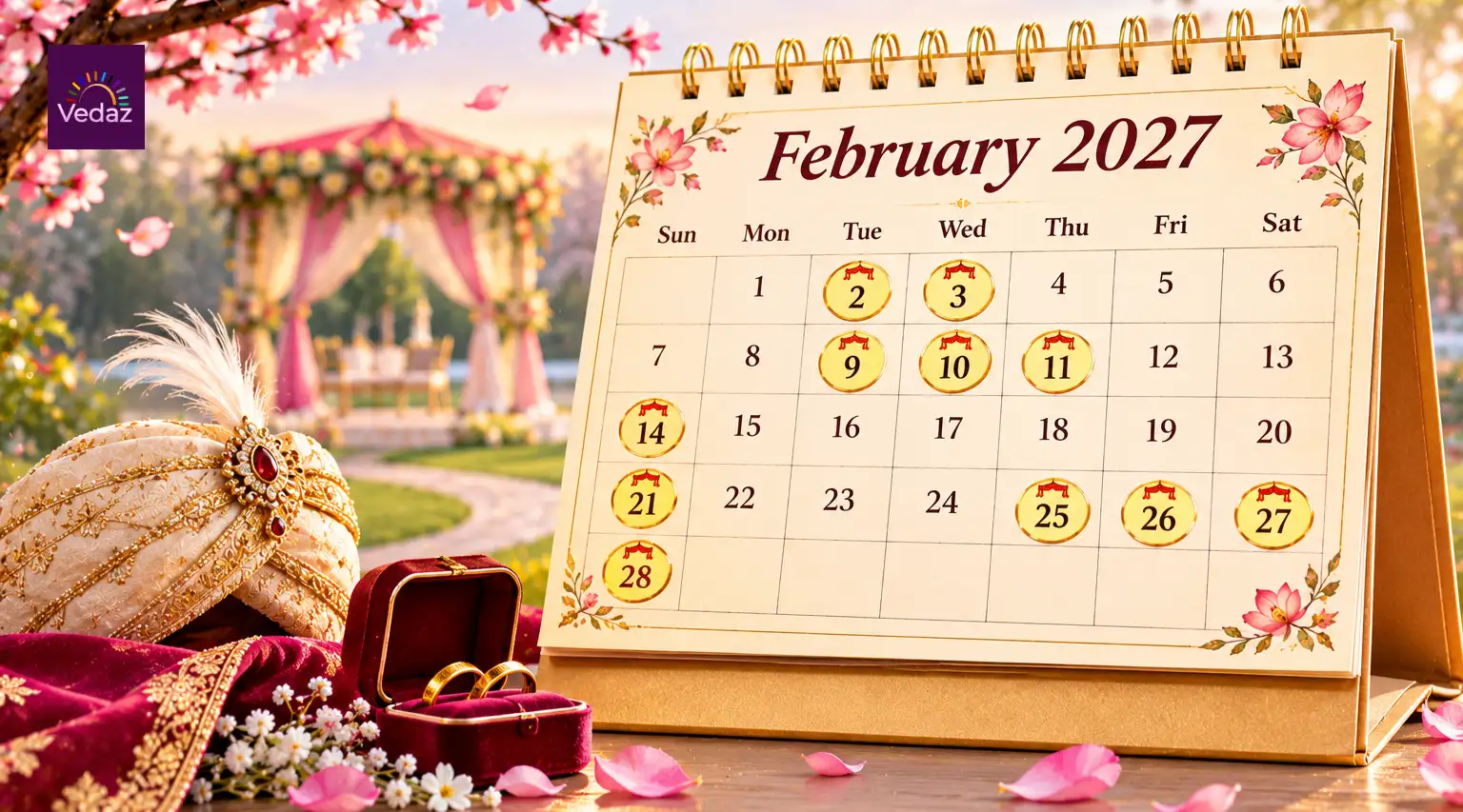
Shubh muhurat February 2027 has 14 marriage windows across 13 dates, from 2 to 28 February, as per the Hindu Panchang. The longest runs on 25 February under Swati. Timings shift with local sunrise, so confirm them for your city.
- ◦February 2027 marriage muhurat at a glance
- ◦Full list of shubh vivah muhurat dates in February 2027
- ◦Date-by-date guide to February 2027 muhurats
- ◦Why the February 2027 dates fall where they do
- ◦The nakshatras behind February 2027 weddings
- ◦Weekend marriage dates in February 2027
- ◦Regional traditions to know for February
- ◦How a vivah muhurat is calculated
- ◦Planning a February 2027 wedding
- ◦Before you lock the date: match the couple, not just the calendar
- ◦Common mistakes to avoid
- ◦The bottom line
Most months make you hunt for a wedding date. February does the opposite. It gives you so many that the hard part is choosing one.
The weather helps too. The North Indian cold is easing, the South hasn't turned hot yet, and evening functions are comfortable outdoors almost everywhere. If you'd rather have options than a single forced date, February is hard to beat in 2027.
Below you'll find every window with its start and end time, nakshatra and tithi. You'll also see which dates land on weekends and how to turn this general list into a date that fits your family. One honest note first: a muhurat is about timing. It doesn't decide the fate of a marriage. Effort, understanding and family support matter just as much.
February 2027 marriage muhurat at a glance
| Fact | Detail |
|---|---|
| Total muhurat windows | 14 |
| Dates with a window | 13 (2, 3, 9, 10, 11, 14, 15, 21, 22, 25, 26, 27, 28) |
| First window | 2 February, Tuesday, from 5:49 PM |
| Last window | 28 February, Sunday, until 1:44 PM |
| Longest window | 25 February (21 hr 27 min) |
| Shortest window | 21 February (2 hr 18 min) |
| Weekend windows | 4 |
| Hindu lunar months | Magha and Phalguna |
| Season | Tail end of winter, with pleasant days across most of India |
Full list of shubh vivah muhurat dates in February 2027
| Date | Day | Muhurat window (start to end) | Nakshatra | Tithi |
|---|---|---|---|---|
| 2 February 2027 | Tuesday | 5:49 PM to 7:16 AM (3 Feb) | Mula | Dwadashi |
| 3 February 2027 | Wednesday | 7:21 AM to 12:23 PM | Mula | Dwadashi |
| 9 February 2027 | Tuesday | 3:42 AM to 7:12 AM (pre-dawn of 10 Feb) | Uttara Bhadrapada | Chaturthi |
| 10 February 2027 | Wednesday | 7:17 AM to 2:42 PM | Uttara Bhadrapada | Chaturthi |
| 10 February 2027 | Wednesday | 3:06 AM to 7:12 AM (pre-dawn of 11 Feb) | Uttara Bhadrapada, Revati | Panchami |
| 11 February 2027 | Thursday | 7:17 AM to 11:27 PM | Revati | Panchami |
| 14 February 2027 | Sunday | 4:48 AM to 7:09 AM (pre-dawn of 15 Feb) | Rohini | Navami |
| 15 February 2027 | Monday | 7:14 AM to 12:30 PM | Rohini | Navami |
| 21 February 2027 | Sunday | 11:29 AM to 1:47 PM | Magha | Pratipada |
| 22 February 2027 | Monday | 11:56 AM to 7:03 AM (23 Feb) | Uttara Phalguni | Dwitiya, Tritiya |
| 25 February 2027 | Thursday | 9:34 AM to 7:01 AM (26 Feb) | Swati | Panchami, Shashthi |
| 26 February 2027 | Friday | 7:06 AM to 10:10 AM | Swati | Shashthi |
| 27 February 2027 | Saturday | 10:10 PM to 6:59 AM (28 Feb) | Anuradha | Ashtami |
| 28 February 2027 | Sunday | 7:04 AM to 1:44 PM | Anuradha | Ashtami |
Timings are in IST for a reference location. Windows that cross midnight end on the date shown in brackets. Local timings can shift by a few minutes, so check the Vedaz Panchang for your city before you fix the date.
Date-by-date guide to February 2027 muhurats
The table gives you the facts. This part tells you what each window actually feels like in real life, so you can match it to the way your family likes to do a wedding.
2 February 2027, Tuesday: Mula, Dwadashi
- Timing: 5:49 PM to 7:16 AM the next morning, a stretch of 13 hr 27 min.
- Why it's handy: It starts in the evening and runs overnight, so you can fix the main ritual at a time that suits everyone.
- Nakshatra: Mula (also written Moola) is ruled by Ketu, and its deity is Nirriti. Many regional Panchangs still include it in the wedding list, as this calendar does. Some families avoid it by custom, so check your own family practice before you book.
3 February 2027, Wednesday: Mula, Dwadashi
- Timing: 7:21 AM to 12:23 PM, a daytime window of 5 hr 2 min.
- Best for: A short morning ceremony, followed by lunch.
- Good to know: Mula showed up on the 2nd too, so you get a second option if your family is fine with it.
9 February 2027, Tuesday: Uttara Bhadrapada, Chaturthi
- Timing: 3:57 is not the time here. It's 3:42 AM to 7:12 AM, which is 3 hr 30 min. It falls in the pre-dawn hours after midnight. The Panchang counts a day from sunrise to sunrise, so it's listed under the 9th.
- What to expect: Most families hold the main ritual in the brahma muhurta stretch, so plan the night's functions and guest rest around it.
- Nakshatra: Uttara Bhadrapada is ruled by Saturn, and its deity is Ahirbudhnya. It's a fixed nakshatra, linked with depth, patience and stability, which are exactly what families hope for in a long marriage.
10 February 2027, Wednesday: Uttara Bhadrapada, Chaturthi
- Timing: 7:17 AM to 2:42 PM, a daytime window of 7 hr 25 min.
- Best for: South Indian style morning muhurtham ceremonies and a lunch reception.
- Good to know: Uttara Bhadrapada also appeared on the 9th, so you have more than one shot at this nakshatra.
10 February 2027, Wednesday: Uttara Bhadrapada, Revati, Panchami
- Timing: 3:06 AM to 7:12 AM (pre-dawn of 11 Feb), which is 4 hr 6 min. Like the other early-morning windows, it's listed under the day the Panchang started counting from.
- What to expect: Plan the night's functions around a brahma muhurta ritual and make sure the family gets some rest.
- Good to know: Yes, the 10th has two separate windows, so double-check which one your pandit means.
11 February 2027, Thursday: Revati, Panchami
- Timing: 7:17 AM to 11:27 PM, a very long daytime window of 16 hr 10 min.
- Why it's handy: You can do a morning muhurtham, an evening reception, or both.
- Nakshatra: Revati is the last of the 27 nakshatras. It's ruled by Mercury, and its deity is Pushan, linked with safe journeys and nourishment. Classical texts place it among the gentle (mridu) nakshatras, which is why it's chosen for beginnings that need care and continuity.
14 February 2027, Sunday: Rohini, Navami
- Timing: 4:48 AM to 7:09 AM (pre-dawn of 15 Feb), which is 2 hr 21 min. The Panchang counts the day from sunrise to sunrise, so it's listed under the 14th.
- What to expect: The ritual usually happens in the brahma muhurta stretch, so plan the night's functions around it.
- Heads up: It's a weekend, so venues and pandits will be in high demand.
- Nakshatra: Rohini is the Moon's favourite nakshatra in Puranic stories, and the Moon rules it. Its deity is Prajapati, the creator. It's a fixed (dhruva) nakshatra, so it's seen as a good fit for lasting commitments. That's why it ranks so high for weddings.
15 February 2027, Monday: Rohini, Navami
- Timing: 7:14 AM to 12:30 PM, a daytime window of 5 hr 16 min.
- Best for: A morning ceremony with a lunch reception.
- Good to know: Rohini also appeared on the 14th. If your family likes this nakshatra, you get a second option.
21 February 2027, Sunday: Magha, Pratipada
- Timing: 11:29 AM to 1:47 PM, a short daytime window of 2 hr 18 min.
- Heads up: It's a weekend, and the window is tight, so the main ritual needs to be timed carefully.
- Nakshatra: Magha is ruled by Ketu, and its deity is the Pitris, the ancestors. Its link with lineage and family blessings is one reason it appears in wedding lists, since a marriage joins two family lines.
22 February 2027, Monday: Uttara Phalguni, Dwitiya, Tritiya
- Timing: 11:56 AM to 7:03 AM the next morning, a stretch of 19 hr 7 min.
- Why it's handy: It starts in the daytime and runs all night, so you can choose a comfortable hour for the main ritual.
- Nakshatra: Uttara Phalguni is ruled by the Sun, and its deity is Aryaman, the Vedic god of contracts, hospitality and marriage alliances. It's a fixed nakshatra and often comes first in lists of wedding nakshatras because of that direct link to the marriage bond.
25 February 2027, Thursday: Swati, Panchami, Shashthi
- Timing: 9:34 AM to 7:01 AM the next morning, which is 21 hr 27 min, the longest window of the month.
- Why it's handy: You have almost a full day to schedule the ritual, which makes planning much easier.
- Nakshatra: Swati is ruled by Rahu, and its deity is Vayu, the wind god. It's a movable (chara) nakshatra linked with independence and balance, and it's widely accepted for weddings in North Indian Panchangs.
26 February 2027, Friday: Swati, Shashthi
- Timing: 7:06 AM to 10:10 AM, a short daytime window of 3 hr 4 min.
- Best for: An early morning ceremony.
- Good to know: Swati also appeared on the 25th, so you have two chances at this nakshatra.
27 February 2027, Saturday: Anuradha, Ashtami
- Timing: 10:10 PM to 6:59 AM the next morning, a night window of 8 hr 49 min.
- Best for: Families who follow the North Indian style, with an evening baraat and late-night pheras.
- Heads up: It's a Saturday, so book early.
- Nakshatra: Anuradha is ruled by Saturn, and its deity is Mitra, the god of friendship and agreements. It's valued for partnerships built on loyalty and counts as a gentle nakshatra.
28 February 2027, Sunday: Anuradha, Ashtami
- Timing: 7:04 AM to 1:44 PM, a daytime window of 6 hr 40 min.
- Best for: A morning ritual followed by a lunch reception.
- Heads up: It's a Sunday, so expect strong demand. Anuradha also appeared on the 27th, so you have two shots at it.
Why the February 2027 dates fall where they do
February overlaps two lunar months, Magha and Phalguna, and both are rated highly for marriage.
- Magha: It's linked with purity and ritual bathing.
- Phalguna: It leads into spring and the festival of Holi.
- Vasant Panchami: The festival of Saraswati and the start of spring falls in this stretch in 2027 (confirm the exact day on the Panchang). Many families treat it as an abujh muhurat, a day considered auspicious in itself.
- Why so many dates: A favourable run of nakshatras, with Rohini, Uttara Phalguni, Swati, Anuradha, Magha, Mula, Uttara Bhadrapada and Revati all landing on suitable tithis.
The contrast with the month before is big. The January 2027 dates only open after Kharmas ends, so February feels like the season in full swing.
The nakshatras behind February 2027 weddings
Eight nakshatras carry the marriage windows this month: Mula, Uttara Bhadrapada, Revati, Rohini, Magha, Uttara Phalguni, Swati and Anuradha.
In Vedic tradition, the nakshatra describes the quality of the moment. Classical texts sort them by temperament, such as fixed (dhruva), gentle (mridu) and movable (chara). Weddings lean towards the fixed and gentle ones, because a marriage is meant to be steady and kind.
What about the couple's own birth nakshatra? Customs differ:
- Some families pick a matching or friendly nakshatra for the wedding.
- Others avoid the birth nakshatra completely.
Both are followed, so ask your family pandit which one is yours.
Weekend marriage dates in February 2027
Weekends are easiest for guests and hardest to book. Four windows fall on a Saturday or Sunday:
- 14 February (Sunday): 4:48 AM to 7:09 AM (pre-dawn of 15 Feb), Rohini
- 21 February (Sunday): 11:29 AM to 1:47 PM, Magha
- 27 February (Saturday): 10:10 PM to 6:59 AM (28 Feb), Anuradha
- 28 February (Sunday): 7:04 AM to 1:44 PM, Anuradha
If a weekend date is already full, look at a window that starts on a Friday evening or ends on a Monday morning. Overnight windows often let you hold the reception on the weekend while the ritual itself stays inside the muhurat.
Regional traditions to know for February
February is a strong month in nearly every regional tradition. Here's how it looks in different parts of India:
- Uttar Pradesh and Bihar: The Magha and Phalguna dates get booked heavily. The 14th and 15th are especially popular because the Rohini window comes with a weekend.
- Urban couples: Some like the overlap with Valentine's Day, though most families care more about the muhurat than the Western calendar date.
- Maharashtra: The Marathi Panchang (Kalnirnay) usually shows its own list for Magh.
- Kerala: Malayalam calendar months follow a different system, and families often ask a local jyotsyan for the muhurtham.
- Bengal: Families who follow the Panjika often share several of the Magh dates listed here.
How a vivah muhurat is calculated
Every date in a vivah muhurat list is the result of a filtering process, not a guess.
- The five limbs: The Panchang starts with tithi (lunar day), vara (weekday), nakshatra (lunar mansion), yoga and karana.
- Preferred nakshatras: Marriage is favoured under a group the classical texts call fixed or gentle, such as Rohini, Uttara Phalguni, Uttara Ashadha, Uttara Bhadrapada, Mrigashira, Hasta, Anuradha and Revati. Magha, Swati and Mula are also accepted in many traditions.
- What gets removed: Bhadra (Vishti karana) and certain inauspicious yogas.
- Seasonal filters: Kharmas, when the Sun moves through Sagittarius or Pisces, removes about two months a year. Chaturmas removes the monsoon months. When Venus (Shukra) or Jupiter (Guru) is combust, dates can drop out too, because these planets stand for the bond of marriage in Vedic astrology.
- The lagna check: The last step picks the hours within a good day when the rising sign is suitable. This is why two families in different cities can get slightly different windows on the same date.
Vedaz computes all this with Swiss Ephemeris and the Lahiri ayanamsa.
Planning a February 2027 wedding
With fourteen windows, the challenge in February is choosing, not finding. Here's a simple way to narrow it down:
- Shortlist three dates. Then filter by venue availability, the couple's kundali review and the travel plans of key relatives.
- Book the weekend clusters early. The two busiest stretches are 14 to 15 February and 27 to 28 February.
- Look at midweek dates if budget matters. Dates like 3, 10 or 11 February can bring lower venue rates, and you lose nothing in muhurat terms.
A simple timeline helps:
- 9 to 12 months ahead: Shortlist dates.
- Next: Do your kundli matching and have the family conversations.
- After that: Book the venue and the pandit together. A venue without a priest on the same window doesn't help much.
- About 3 months ahead: Send save-the-dates.
- 2 to 3 weeks before: Confirm the final muhurat time with the pandit, when local timings can be rechecked.
Before you lock the date: match the couple, not just the calendar
Think of this calendar as a shortlist. The next step is to see how the couple's own charts sit against it.
Kundli matching is the usual starting point. Through guna milan, it compares eight factors across 36 points and flags doshas such as Manglik dosha, which classical texts pair with specific cancellation conditions. A modest score doesn't mean a marriage will struggle, and many happy marriages have average scores. It simply means an astrologer should look at the full charts.
After that comes a personalised muhurat check. It compares your shortlisted dates with the couple's Moon signs, nakshatras and dasha periods.
Stuck between three good dates? Chat with a Vedaz astrologer and narrow it down to the one that suits both families.
Common mistakes to avoid
- Forgetting that windows can cross midnight. Many windows run into the next morning, so the date on the invitation and the date of the pheras may differ. Tell your guests clearly.
- Mixing regional calendars. A Tamil, Malayalam or Bengali almanac can list different dates from the North Indian Panchang. Stick to the calendar your family follows.
- Booking the pandit too late. Experienced pandits fill up on popular dates just as fast as venues do.
- Letting one factor decide everything. A muhurat is one input. Compatibility, family readiness and practical logistics matter too.
- Not planning for the season. Heat, fog or rain can affect the day. Arrange cover, cooling or heating for the venue.
The bottom line
February 2027 gives you 14 muhurat windows to choose from. Start with the shortlist above, then filter it by your city's timings, your family's customs and what your guests can manage. Check the couple's charts before you commit. A good date supports a good beginning, but a happy marriage is built by the two people and the families around them.
Looking further ahead? Have a look at Shubh Muhurat March 2027.
Planning a wedding, griha pravesh or a new car?
Devansh Trivedi
Vedic Astrology, Planetary Transits, Marriage Muhurat and Panchang Analysis. | 12 Years
Devansh Trivedi studies the influence of planetary movements and traditional astrological combinations on important life events. His work focuses on planetary transits, auspicious wedding timings and birth chart interpretations.
Frequently Asked Questions
1. How many auspicious marriage dates are there in February 2027?
The reference Panchang list shows 14 muhurat windows across 13 dates in February 2027, from 2 February to 28 February.
2. How many marriage muhurats are there in February 2027?
There are fourteen windows across thirteen dates, including two separate windows on 10 February. That makes February one of the busiest wedding months of 2027.
3. Is Valentine's Day 2027 an auspicious date for marriage?
There's no daytime muhurat on 14 February. A window does open in the early hours, at 4:48 AM under Rohini, and a daytime window follows on 15 February until 12:30 PM.
4. What is the difference between a shubh date and a muhurat window?
A shubh date is a day the Panchang marks as suitable. The muhurat window is the exact time range within that day, or across midnight, when the main ritual should happen.
5. Do we need kundli matching if the date is auspicious?
Yes, most families do both. The muhurat checks the timing, while kundli matching looks at the couple's compatibility. They answer different questions.
Related Blogs

Boost Your Health with Astrology
Boost your health with astrology using zodiac-based habits, wellness tips, and simple routines for better physical and mental balance.

The Socking Truth Behind Wearing A Black Thread
Uncover the mystery behind the black thread. From protection to spiritual energy—here’s why everyone’s suddenly wearing one.

Hidden Messages In Your Moles
What if that little mole on your cheek is more than just a mark? Explore the fascinating meanings behind mole placements and what they reveal about your future.
Who Is Your Ishta Devata?
Explore the concept of your personal God in Hinduism. Learn how to discover, connect with, and build a relationship with your Ishta Devata for inner peace and spiritual growth.