Shubh Muhurat March 2027: Auspicious Marriage Dates, Timings and Nakshatras
Updated 15 Nov 2026 · Verified by Nandini Rao
Planning a wedding, griha pravesh or a new car?
A general date list doesn't account for your own kundli. An astrologer can pick a date and time that does.
Why the March 2027 dates fall where they do
Two things shape the month:
- Holashtak: The end of Phalguna is a festive stretch that includes Holi. Many families avoid wedding ceremonies in the eight days before Holi, a period known in North India as Holashtak.
- Meen Kharmas: Once the Sun enters Pisces around mid-March, Panchangs pause marriages until the Sun moves into Aries in mid-April. That's why every March 2027 date sits between the 1st and the 15th.
- Maha Shivratri: It also falls in this broad season, and some families like to schedule a wedding soon after it, as a nod to Shiva and Parvati's union.
Confirm the 2027 festival dates on the Panchang before planning around them. And if you missed the earlier part of the season, the February 2027 dates are worth a look.
Shubh muhurat March 2027 has 7 marriage windows across 7 dates, from 1 to 14 March, as per the Hindu Panchang. The longest runs on 10 March under Uttara Bhadrapada and Revati. Timings shift with local sunrise, so confirm them for your city.
Here's the catch with March: the wedding season is short, and it ends early. All seven windows sit in the first half of the month. After 15 March, Meen Kharmas begins and the calendar goes quiet for almost five weeks.
So if you missed February, or you want a spring wedding before the real heat arrives, these early-March dates are your last chance until mid-April.
Below you'll find every window with its start and end time, nakshatra and tithi. You'll also see which date lands on a weekend and how to turn this general list into a date that fits your family. One honest note first: a muhurat is about timing. It doesn't decide the fate of a marriage. Effort, understanding and family support matter just as much.
March 2027 marriage muhurat at a glance
| Fact | Detail |
|---|---|
| Total muhurat windows | 7 |
| Dates with a window | 7 (1, 2, 3, 4, 9, 10, 14) |
| First window | 1 March, Monday, from 11:14 PM |
| Last window | 14 March, Sunday, until 6:46 AM (15 Mar) |
| Longest window | 10 March (22 hr 14 min) |
| Shortest window | 3 March (5 hr 48 min) |
| Weekend windows | 1 |
| Hindu lunar months | Phalguna and Chaitra |
| Season | Early spring, warming into the first heat of summer |
Full list of shubh vivah muhurat dates in March 2027
| Date | Day | Muhurat window (start to end) | Nakshatra | Tithi |
|---|---|---|---|---|
| 1 March 2027 | Monday | 11:14 PM to 6:58 AM (2 Mar) | Mula | Navami, Dashami |
| 2 March 2027 | Tuesday | 7:03 AM to 3:21 PM | Mula | Dashami |
| 3 March 2027 | Wednesday | 1:08 AM to 6:56 AM (pre-dawn of 4 Mar) | Uttara Ashadha | Ekadashi |
| 4 March 2027 | Thursday | 7:01 AM to 1:32 AM (5 Mar) | Uttara Ashadha | Dwadashi |
| 9 March 2027 | Tuesday | 10:00 AM to 6:51 AM (10 Mar) | Uttara Bhadrapada | Pratipada, Dwitiya |
| 10 March 2027 | Wednesday | 6:56 AM to 5:10 AM (11 Mar) | Uttara Bhadrapada, Revati | Dwitiya, Tritiya |
| 14 March 2027 | Sunday | 5:12 PM to 6:46 AM (15 Mar) | Rohini | Saptami |
Timings are in IST for a reference location. Windows that cross midnight end on the date shown in brackets. Local timings can shift by a few minutes, so check the Vedaz Panchang for your city before you fix the date.
Date-by-date guide to March 2027 muhurats
The table gives you the facts. This part tells you what each window actually feels like in real life, so you can match it to the way your family likes to do a wedding.
1 March 2027, Monday: Mula, Navami, Dashami
- Timing: 11:14 PM to 6:58 AM the next morning, a night window of 7 hr 44 min.
- Best for: Families who follow the North Indian style, with an evening baraat and late-night pheras.
- Nakshatra: Mula (also written Moola) is ruled by Ketu, and its deity is Nirriti. Many regional Panchangs still include it in the wedding list, as this calendar does. Some families avoid it by custom, so check your own family practice before you book.
2 March 2027, Tuesday: Mula, Dashami
- Timing: 7:03 AM to 3:21 PM, a daytime window of 8 hr 18 min.
- Best for: South Indian style morning muhurtham ceremonies, followed by a lunch reception.
- Good to know: Mula also appeared on the 1st, so you get a second option if your family is comfortable with it.
3 March 2027, Wednesday: Uttara Ashadha, Ekadashi
- Timing: 1:08 AM to 6:56 AM, which is 5 hr 48 min. It falls in the pre-dawn hours after midnight. The Panchang counts a day from sunrise to sunrise, so it's listed under the 3rd.
- What to expect: Most families hold the main ritual in the brahma muhurta stretch, so plan the night's functions and guest rest around it.
- Nakshatra: Uttara Ashadha is ruled by the Sun, and its deity is the Vishvadevas, the universal deities. It's a fixed nakshatra linked with lasting achievement, and it shows up regularly in wedding lists.
4 March 2027, Thursday: Uttara Ashadha, Dwadashi
- Timing: 7:01 AM to 1:32 AM the next morning, a stretch of 18 hr 31 min.
- Why it's handy: It starts in the daytime and runs late into the night, so you can pick a comfortable hour for the main ritual.
- Good to know: Uttara Ashadha also appeared on the 3rd, so you have two chances at this nakshatra.
9 March 2027, Tuesday: Uttara Bhadrapada, Pratipada, Dwitiya
- Timing: 10:00 AM to 6:51 AM the next morning, a stretch of 20 hr 51 min.
- Why it's handy: You get almost a full day, so there's plenty of room to schedule the ritual.
- Nakshatra: Uttara Bhadrapada is ruled by Saturn, and its deity is Ahirbudhnya. It's a fixed nakshatra, linked with depth, patience and stability, which are exactly what families hope for in a long marriage.
10 March 2027, Wednesday: Uttara Bhadrapada, Revati, Dwitiya, Tritiya
- Timing: 6:56 AM to 5:10 AM the next morning, a stretch of 22 hr 14 min, the longest window of the month.
- Why it's handy: It runs from early morning until just before the next dawn, so the family can choose almost any hour.
- Good to know: Uttara Bhadrapada also appeared on the 9th, and Revati joins it here, so this date has two nakshatras on its side.
14 March 2027, Sunday: Rohini, Saptami
- Timing: 5:12 PM to 6:46 AM the next morning, a stretch of 13 hr 34 min.
- Best for: An evening wedding with late-night pheras.
- Heads up: It's a Sunday, and it's the last window before the break, so venues and pandits will be in high demand.
- Nakshatra: Rohini is the Moon's favourite nakshatra in Puranic stories, and the Moon rules it. Its deity is Prajapati, the creator. It's a fixed (dhruva) nakshatra, so it's seen as a good fit for lasting commitments. That's why it ranks so high for weddings.
The nakshatras behind March 2027 weddings
Five nakshatras carry the marriage windows this month: Mula, Uttara Ashadha, Uttara Bhadrapada, Revati and Rohini.
In Vedic tradition, the nakshatra describes the quality of the moment. Classical texts sort them by temperament, such as fixed (dhruva), gentle (mridu) and movable (chara). Weddings lean towards the fixed and gentle ones, because a marriage is meant to be steady and kind.
What about the couple's own birth nakshatra? Customs differ:
- Some families pick a matching or friendly nakshatra for the wedding.
- Others avoid the birth nakshatra completely.
Both are followed, so ask your family pandit which one is yours.
Weekend marriage dates in March 2027
Weekends are easiest for guests and hardest to book. Only one window falls on a Saturday or Sunday:
- 14 March (Sunday): 5:12 PM to 6:46 AM (15 Mar), Rohini
If it's already full, look at a window that starts on a Friday evening or ends on a Monday morning. Overnight windows often let you hold the reception on the weekend while the ritual itself stays inside the muhurat.
Regional traditions to know for March
- North India: The gap created by Holashtak and Meen Kharmas makes the first fortnight unusually busy.
- Maharashtra and Karnataka: Gudi Padwa and Ugadi, the lunar new year, fall around the end of March or early April. Some families prefer to wait for the new year before holding a wedding.
- Tamil Nadu: The month of Panguni has its own wedding tradition. Panguni Uthiram, the celestial wedding festival of several deities, is a popular day for temple marriages.
- Bengal: Falgun is a traditional wedding month, and the Panjika will show its own list of dates.
How a vivah muhurat is calculated
How does a calendar decide that one date is shubh and the next isn't? It comes down to the Panchang's five limbs and a set of seasonal rules.
- The nakshatra: It must be one that tradition links with marriage, such as Rohini, Mrigashira, Uttara Phalguni, Hasta, Swati, Anuradha, Uttara Ashadha, Uttara Bhadrapada or Revati. Magha and Mula are accepted in many regional lists.
- Tithi, yoga and karana: These must be suitable, which means avoiding Bhadra and some difficult yogas.
- The season: It must be open. Weddings pause during Kharmas (the Sun in Sagittarius or Pisces), during Chaturmas, and when Jupiter or Venus is combust, since both planets govern marriage in Vedic astrology.
- The lagna: Finally, the window is narrowed by the rising sign at the time of the ritual.
Because sunrise and lagna timing change with location, the same date can show different start and end times in Delhi, Mumbai and Chennai. Vedaz calculates all of this with Swiss Ephemeris and the Lahiri ayanamsa.
Planning a March 2027 wedding
With only seven windows and a long gap afterwards, plan backwards.
- Book early: If 9 or 10 March is your target, have the venue and pandit confirmed by December 2026.
- Mind the heat: Weather is comfortable across most of India in early March, but daytime heat starts building in the South and in Rajasthan. Evening functions are more pleasant than afternoon ones.
- Have a backup: If none of the March windows works for your family, the next dates arrive on 18 April.
A simple timeline helps:
- 9 to 12 months ahead: Shortlist dates.
- Next: Do your kundli matching and have the family conversations.
- After that: Book the venue and the pandit together. A venue without a priest on the same window doesn't help much.
- About 3 months ahead: Send save-the-dates.
- 2 to 3 weeks before: Confirm the final muhurat time with the pandit, when local timings can be rechecked.
Before you lock the date: match the couple, not just the calendar
Before you send the invitations, check the date against the couple's charts. The general muhurat only tells you the day is broadly auspicious.
Kundli matching looks at the couple's compatibility through the 36-point guna milan and checks Manglik dosha with its cancellation rules. Read the results as guidance for a conversation, not a final judgement. An astrologer will look at the whole chart, not a single number.
Many families also ask for a personalised muhurat, which checks the shortlisted dates against the bride's and groom's Moon signs and current dashas. Keep your shortlist ready and chat with a Vedaz astrologer to do this.
Common mistakes to avoid
- Using another city's timings. Muhurat windows shift with local sunrise. A window calculated for Delhi can differ by 20 to 40 minutes in Kolkata or Mumbai. Always check the timings for your venue's city.
- Choosing the date first and the venue later. Popular dates book out quickly. Shortlist two or three muhurat dates and approach venues with all of them.
- Treating one source as final. Panchang publishers use slightly different methods, which is why lists differ online. Confirm with your family pandit or the Vedaz Panchang for your city.
- Treating a guna score as pass or fail. A compatibility score is a prompt for a deeper look, not a final verdict on the relationship.
- Ignoring the practical side. Weather, guest travel and the health of older relatives matter as much as the date on paper. A good muhurat should also be a date your family can comfortably attend.
The bottom line
March 2027 gives you 7 muhurat windows to choose from. Start with the shortlist above, then filter it by your city's timings, your family's customs and what your guests can manage. Check the couple's charts before you commit. A good date supports a good beginning, but a happy marriage is built by the two people and the families around them.
Waiting for the season to reopen? Take a look at Shubh Muhurat April 2027.
Muhurat & Vastu experts online
Acharya Raghuji
Muhurat, Vastu · हिंदी
Acharya Punit
Vivah muhurat · हिंदी, English
Shubh Muhurat March 2027: Auspicious Marriage Dates, Timings and Nakshatras
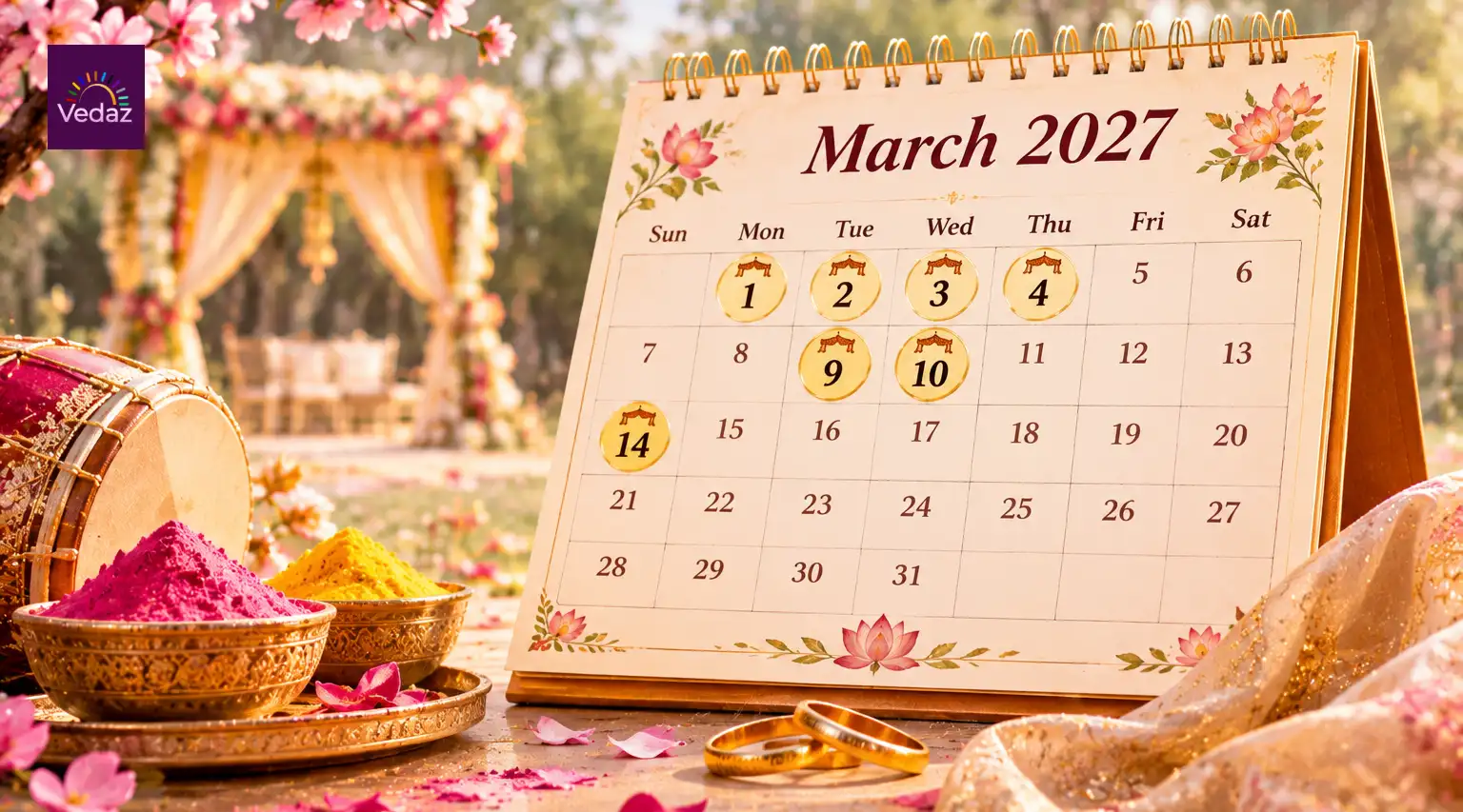
Shubh muhurat March 2027 has 7 marriage windows across 7 dates, from 1 to 14 March, as per the Hindu Panchang. The longest runs on 10 March under Uttara Bhadrapada and Revati. Timings shift with local sunrise, so confirm them for your city.
- ◦March 2027 marriage muhurat at a glance
- ◦Full list of shubh vivah muhurat dates in March 2027
- ◦Date-by-date guide to March 2027 muhurats
- ◦Why the March 2027 dates fall where they do
- ◦The nakshatras behind March 2027 weddings
- ◦Weekend marriage dates in March 2027
- ◦Regional traditions to know for March
- ◦How a vivah muhurat is calculated
- ◦Planning a March 2027 wedding
- ◦Before you lock the date: match the couple, not just the calendar
- ◦Common mistakes to avoid
- ◦The bottom line
Here's the catch with March: the wedding season is short, and it ends early. All seven windows sit in the first half of the month. After 15 March, Meen Kharmas begins and the calendar goes quiet for almost five weeks.
So if you missed February, or you want a spring wedding before the real heat arrives, these early-March dates are your last chance until mid-April.
Below you'll find every window with its start and end time, nakshatra and tithi. You'll also see which date lands on a weekend and how to turn this general list into a date that fits your family. One honest note first: a muhurat is about timing. It doesn't decide the fate of a marriage. Effort, understanding and family support matter just as much.
March 2027 marriage muhurat at a glance
| Fact | Detail |
|---|---|
| Total muhurat windows | 7 |
| Dates with a window | 7 (1, 2, 3, 4, 9, 10, 14) |
| First window | 1 March, Monday, from 11:14 PM |
| Last window | 14 March, Sunday, until 6:46 AM (15 Mar) |
| Longest window | 10 March (22 hr 14 min) |
| Shortest window | 3 March (5 hr 48 min) |
| Weekend windows | 1 |
| Hindu lunar months | Phalguna and Chaitra |
| Season | Early spring, warming into the first heat of summer |
Full list of shubh vivah muhurat dates in March 2027
| Date | Day | Muhurat window (start to end) | Nakshatra | Tithi |
|---|---|---|---|---|
| 1 March 2027 | Monday | 11:14 PM to 6:58 AM (2 Mar) | Mula | Navami, Dashami |
| 2 March 2027 | Tuesday | 7:03 AM to 3:21 PM | Mula | Dashami |
| 3 March 2027 | Wednesday | 1:08 AM to 6:56 AM (pre-dawn of 4 Mar) | Uttara Ashadha | Ekadashi |
| 4 March 2027 | Thursday | 7:01 AM to 1:32 AM (5 Mar) | Uttara Ashadha | Dwadashi |
| 9 March 2027 | Tuesday | 10:00 AM to 6:51 AM (10 Mar) | Uttara Bhadrapada | Pratipada, Dwitiya |
| 10 March 2027 | Wednesday | 6:56 AM to 5:10 AM (11 Mar) | Uttara Bhadrapada, Revati | Dwitiya, Tritiya |
| 14 March 2027 | Sunday | 5:12 PM to 6:46 AM (15 Mar) | Rohini | Saptami |
Timings are in IST for a reference location. Windows that cross midnight end on the date shown in brackets. Local timings can shift by a few minutes, so check the Vedaz Panchang for your city before you fix the date.
Date-by-date guide to March 2027 muhurats
The table gives you the facts. This part tells you what each window actually feels like in real life, so you can match it to the way your family likes to do a wedding.
1 March 2027, Monday: Mula, Navami, Dashami
- Timing: 11:14 PM to 6:58 AM the next morning, a night window of 7 hr 44 min.
- Best for: Families who follow the North Indian style, with an evening baraat and late-night pheras.
- Nakshatra: Mula (also written Moola) is ruled by Ketu, and its deity is Nirriti. Many regional Panchangs still include it in the wedding list, as this calendar does. Some families avoid it by custom, so check your own family practice before you book.
2 March 2027, Tuesday: Mula, Dashami
- Timing: 7:03 AM to 3:21 PM, a daytime window of 8 hr 18 min.
- Best for: South Indian style morning muhurtham ceremonies, followed by a lunch reception.
- Good to know: Mula also appeared on the 1st, so you get a second option if your family is comfortable with it.
3 March 2027, Wednesday: Uttara Ashadha, Ekadashi
- Timing: 1:08 AM to 6:56 AM, which is 5 hr 48 min. It falls in the pre-dawn hours after midnight. The Panchang counts a day from sunrise to sunrise, so it's listed under the 3rd.
- What to expect: Most families hold the main ritual in the brahma muhurta stretch, so plan the night's functions and guest rest around it.
- Nakshatra: Uttara Ashadha is ruled by the Sun, and its deity is the Vishvadevas, the universal deities. It's a fixed nakshatra linked with lasting achievement, and it shows up regularly in wedding lists.
4 March 2027, Thursday: Uttara Ashadha, Dwadashi
- Timing: 7:01 AM to 1:32 AM the next morning, a stretch of 18 hr 31 min.
- Why it's handy: It starts in the daytime and runs late into the night, so you can pick a comfortable hour for the main ritual.
- Good to know: Uttara Ashadha also appeared on the 3rd, so you have two chances at this nakshatra.
9 March 2027, Tuesday: Uttara Bhadrapada, Pratipada, Dwitiya
- Timing: 10:00 AM to 6:51 AM the next morning, a stretch of 20 hr 51 min.
- Why it's handy: You get almost a full day, so there's plenty of room to schedule the ritual.
- Nakshatra: Uttara Bhadrapada is ruled by Saturn, and its deity is Ahirbudhnya. It's a fixed nakshatra, linked with depth, patience and stability, which are exactly what families hope for in a long marriage.
10 March 2027, Wednesday: Uttara Bhadrapada, Revati, Dwitiya, Tritiya
- Timing: 6:56 AM to 5:10 AM the next morning, a stretch of 22 hr 14 min, the longest window of the month.
- Why it's handy: It runs from early morning until just before the next dawn, so the family can choose almost any hour.
- Good to know: Uttara Bhadrapada also appeared on the 9th, and Revati joins it here, so this date has two nakshatras on its side.
14 March 2027, Sunday: Rohini, Saptami
- Timing: 5:12 PM to 6:46 AM the next morning, a stretch of 13 hr 34 min.
- Best for: An evening wedding with late-night pheras.
- Heads up: It's a Sunday, and it's the last window before the break, so venues and pandits will be in high demand.
- Nakshatra: Rohini is the Moon's favourite nakshatra in Puranic stories, and the Moon rules it. Its deity is Prajapati, the creator. It's a fixed (dhruva) nakshatra, so it's seen as a good fit for lasting commitments. That's why it ranks so high for weddings.
Why the March 2027 dates fall where they do
Two things shape the month:
- Holashtak: The end of Phalguna is a festive stretch that includes Holi. Many families avoid wedding ceremonies in the eight days before Holi, a period known in North India as Holashtak.
- Meen Kharmas: Once the Sun enters Pisces around mid-March, Panchangs pause marriages until the Sun moves into Aries in mid-April. That's why every March 2027 date sits between the 1st and the 15th.
- Maha Shivratri: It also falls in this broad season, and some families like to schedule a wedding soon after it, as a nod to Shiva and Parvati's union.
Confirm the 2027 festival dates on the Panchang before planning around them. And if you missed the earlier part of the season, the February 2027 dates are worth a look.
The nakshatras behind March 2027 weddings
Five nakshatras carry the marriage windows this month: Mula, Uttara Ashadha, Uttara Bhadrapada, Revati and Rohini.
In Vedic tradition, the nakshatra describes the quality of the moment. Classical texts sort them by temperament, such as fixed (dhruva), gentle (mridu) and movable (chara). Weddings lean towards the fixed and gentle ones, because a marriage is meant to be steady and kind.
What about the couple's own birth nakshatra? Customs differ:
- Some families pick a matching or friendly nakshatra for the wedding.
- Others avoid the birth nakshatra completely.
Both are followed, so ask your family pandit which one is yours.
Weekend marriage dates in March 2027
Weekends are easiest for guests and hardest to book. Only one window falls on a Saturday or Sunday:
- 14 March (Sunday): 5:12 PM to 6:46 AM (15 Mar), Rohini
If it's already full, look at a window that starts on a Friday evening or ends on a Monday morning. Overnight windows often let you hold the reception on the weekend while the ritual itself stays inside the muhurat.
Regional traditions to know for March
- North India: The gap created by Holashtak and Meen Kharmas makes the first fortnight unusually busy.
- Maharashtra and Karnataka: Gudi Padwa and Ugadi, the lunar new year, fall around the end of March or early April. Some families prefer to wait for the new year before holding a wedding.
- Tamil Nadu: The month of Panguni has its own wedding tradition. Panguni Uthiram, the celestial wedding festival of several deities, is a popular day for temple marriages.
- Bengal: Falgun is a traditional wedding month, and the Panjika will show its own list of dates.
How a vivah muhurat is calculated
How does a calendar decide that one date is shubh and the next isn't? It comes down to the Panchang's five limbs and a set of seasonal rules.
- The nakshatra: It must be one that tradition links with marriage, such as Rohini, Mrigashira, Uttara Phalguni, Hasta, Swati, Anuradha, Uttara Ashadha, Uttara Bhadrapada or Revati. Magha and Mula are accepted in many regional lists.
- Tithi, yoga and karana: These must be suitable, which means avoiding Bhadra and some difficult yogas.
- The season: It must be open. Weddings pause during Kharmas (the Sun in Sagittarius or Pisces), during Chaturmas, and when Jupiter or Venus is combust, since both planets govern marriage in Vedic astrology.
- The lagna: Finally, the window is narrowed by the rising sign at the time of the ritual.
Because sunrise and lagna timing change with location, the same date can show different start and end times in Delhi, Mumbai and Chennai. Vedaz calculates all of this with Swiss Ephemeris and the Lahiri ayanamsa.
Planning a March 2027 wedding
With only seven windows and a long gap afterwards, plan backwards.
- Book early: If 9 or 10 March is your target, have the venue and pandit confirmed by December 2026.
- Mind the heat: Weather is comfortable across most of India in early March, but daytime heat starts building in the South and in Rajasthan. Evening functions are more pleasant than afternoon ones.
- Have a backup: If none of the March windows works for your family, the next dates arrive on 18 April.
A simple timeline helps:
- 9 to 12 months ahead: Shortlist dates.
- Next: Do your kundli matching and have the family conversations.
- After that: Book the venue and the pandit together. A venue without a priest on the same window doesn't help much.
- About 3 months ahead: Send save-the-dates.
- 2 to 3 weeks before: Confirm the final muhurat time with the pandit, when local timings can be rechecked.
Before you lock the date: match the couple, not just the calendar
Before you send the invitations, check the date against the couple's charts. The general muhurat only tells you the day is broadly auspicious.
Kundli matching looks at the couple's compatibility through the 36-point guna milan and checks Manglik dosha with its cancellation rules. Read the results as guidance for a conversation, not a final judgement. An astrologer will look at the whole chart, not a single number.
Many families also ask for a personalised muhurat, which checks the shortlisted dates against the bride's and groom's Moon signs and current dashas. Keep your shortlist ready and chat with a Vedaz astrologer to do this.
Common mistakes to avoid
- Using another city's timings. Muhurat windows shift with local sunrise. A window calculated for Delhi can differ by 20 to 40 minutes in Kolkata or Mumbai. Always check the timings for your venue's city.
- Choosing the date first and the venue later. Popular dates book out quickly. Shortlist two or three muhurat dates and approach venues with all of them.
- Treating one source as final. Panchang publishers use slightly different methods, which is why lists differ online. Confirm with your family pandit or the Vedaz Panchang for your city.
- Treating a guna score as pass or fail. A compatibility score is a prompt for a deeper look, not a final verdict on the relationship.
- Ignoring the practical side. Weather, guest travel and the health of older relatives matter as much as the date on paper. A good muhurat should also be a date your family can comfortably attend.
The bottom line
March 2027 gives you 7 muhurat windows to choose from. Start with the shortlist above, then filter it by your city's timings, your family's customs and what your guests can manage. Check the couple's charts before you commit. A good date supports a good beginning, but a happy marriage is built by the two people and the families around them.
Waiting for the season to reopen? Take a look at Shubh Muhurat April 2027.
Planning a wedding, griha pravesh or a new car?
Nandini Rao
Marriage Astrology, Kundli Matching, Vivah Muhurat and Relationship Compatibility. | 11 Years
Nandini Rao explores the relationship between Vedic astrology, marriage and long-term compatibility. Her interests include kundli matching, planetary influences on partnerships and traditional wedding customs.
Frequently Asked Questions
1. How many auspicious marriage dates are there in March 2027??
The reference Panchang list shows 7 muhurat windows across 7 dates in March 2027, from 1 March to 14 March.
2. Why are there no marriage muhurats after 15 March 2027??
Meen Kharmas begins when the Sun enters Pisces in mid-March. Most North Indian Panchangs pause weddings until the Sun moves into Aries in mid-April. The next marriage window in this list is on 18 April.
3. Can we marry during Holashtak?
Many North Indian families avoid weddings during Holashtak, the eight days before Holi, by tradition. It's a custom, not a fixed rule everywhere, so ask your family pandit.
4. Is a muhurat more important than the couple's compatibility?
They do different jobs. The muhurat is about timing, while compatibility is about the couple. Most families treat compatibility, family readiness and practical planning as equally important.
5. Why do online lists of marriage dates disagree?
Publishers use different calculation methods, ayanamsas and regional traditions. Treat any list, including this one, as a shortlist to confirm your city and family custom.
Related Blogs

Boost Your Health with Astrology
Boost your health with astrology using zodiac-based habits, wellness tips, and simple routines for better physical and mental balance.

The Socking Truth Behind Wearing A Black Thread
Uncover the mystery behind the black thread. From protection to spiritual energy—here’s why everyone’s suddenly wearing one.

Hidden Messages In Your Moles
What if that little mole on your cheek is more than just a mark? Explore the fascinating meanings behind mole placements and what they reveal about your future.

Who Is Your Ishta Devata?
Explore the concept of your personal God in Hinduism. Learn how to discover, connect with, and build a relationship with your Ishta Devata for inner peace and spiritual growth.