Vedic Astrology Soulmate Indicators: Karmic Love, Compatibility & Destiny
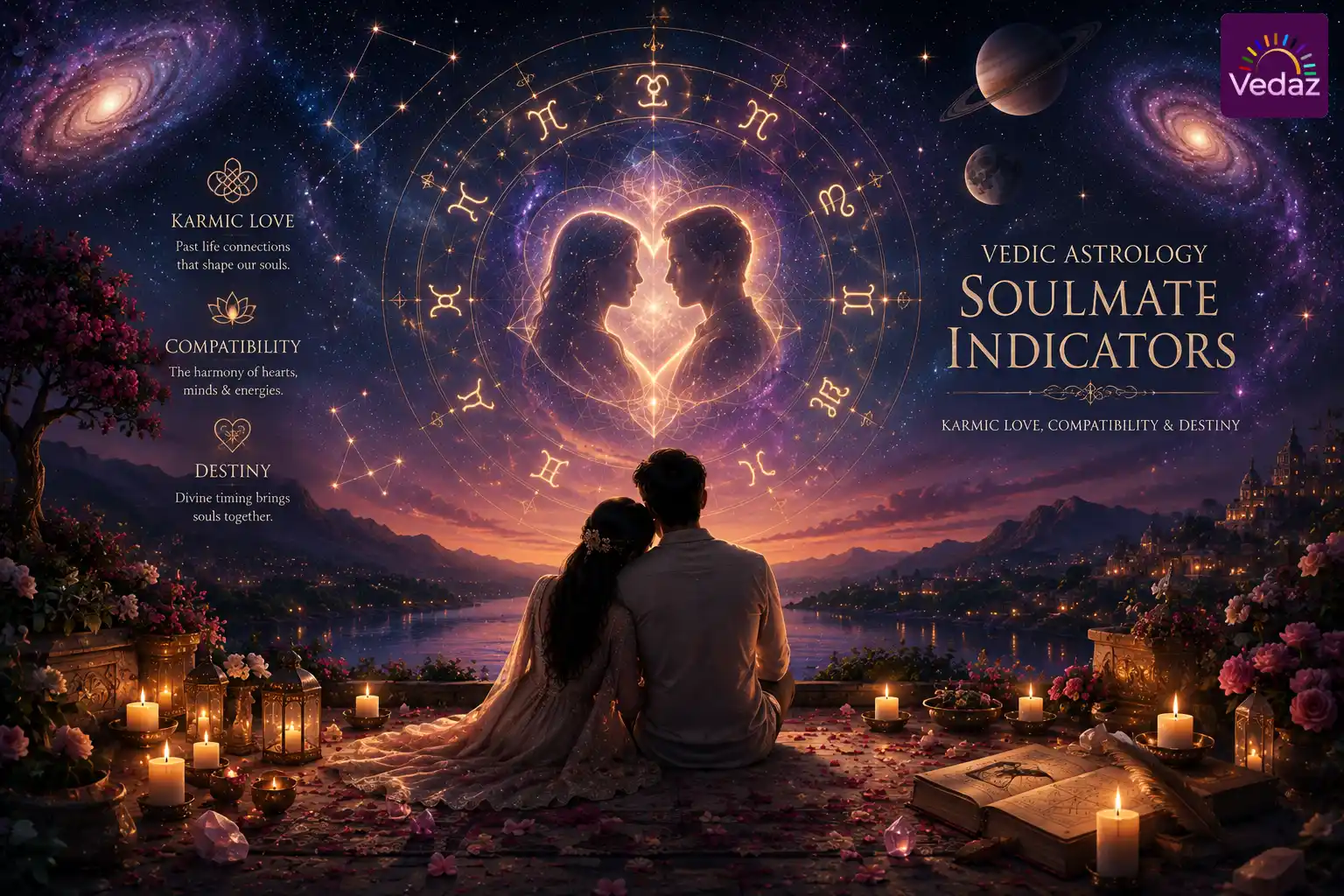
In Vedic astrology, soulmate indicators are specific astrological signatures — across Guna Milan, synastry, composite charts, Jaimini Atmakaraka-Darakaraka, and the Navamsa — that signal deep karmic connection between two souls. They do not guarantee happy marriages. They indicate that the relationship was structurally meant to occur for purposes of mutual soul evolution.
A soulmate in kundli is read through karmic relationship astrology, and you can begin with soulmate compatibility by date of birth before going into the deeper layers below.
- ◦Quick Answer: Soulmate in Kundli
- ◦Karmic Relationship Astrology: What "Soulmate" Actually Means in Vedic Astrology
- ◦Layer 1: Soulmate Indicators in Guna Milan
- ◦Layer 2: Soulmate Indicators in Synastry
- ◦Layer 3: Soulmate Indicators in the Composite Chart
- ◦Layer 4: Darakaraka Soulmate Indicators in Jaimini Astrology (The Deepest Layer)
- ◦Layer 5: Navamsa Compatibility and Soulmate Indicators
- ◦Cross-Layer Patterns: When Multiple Layers Confirm a Soulmate Connection
- ◦Soulmate Calculator: What It Can and Cannot Show
- ◦Common Misconceptions About Soulmates in Vedic Astrology
- ◦Past Life Connection Astrology: Past-Life Indicators in Vedic Astrology
- ◦When Soulmate Connections Look Different Than Expected
- ◦Twin Flame in Vedic Astrology
- ◦Soulmate in Kundli: A Summary by Layer
- ◦Final Thought
The word "soulmate" gets used everywhere. Sometimes it means "the one perfect person for me." Sometimes it means "a really deep connection." Sometimes it just means "person I really like right now." No judgment — but when you bring that word into astrology, it deserves something more precise than a feeling.
Vedic astrology actually has that precision. There are specific astrological signatures — spread across five distinct layers of chart analysis — that classical tradition recognizes as indicators of deep karmic connection. These are not romantic guarantees.
They don't promise you a happy marriage, or that the relationship will be easy, or that it will even last. What they do reveal is that two charts are structurally connected at the soul level in ways that surface compatibility analysis simply cannot reach.
This is the complete guide to what soulmate connection actually looks like in classical Vedic terms — what it means, where to find it, and what to do with it once you have.
This post completes our 5-layer compatibility series, drawing from each of the previous layers — Guna Milan, synastry - synastry vs kundli matching, composite chart, Jaimini Atmakaraka-Darakaraka, and Navamsa - navamsa chart marriage compatibility — to show how soulmate indicators appear across all five.
Quick Answer: Soulmate in Kundli
- What "soulmate" means in Vedic terms: A person whose chart shows structural karmic recognition with yours — a relationship the soul was meant to encounter for spiritual evolution, not predestined perfection
- Strongest single indicator: Atmakaraka-Darakaraka cross-match (one partner's soul-significator = the other's spouse-significator)
- Other key indicators: Rahu-Ketu contacts in synastry, mutual benefic activations, composite Sun in the 7th house, vargottama marriage planets in Navamsa
- Does it mean easy? No — karmic relationships are often among the most challenging
- Only one soulmate? Vedic tradition doesn't require this — multiple karmic connections are possible across a lifetime
- Does it guarantee marriage? No — karmic connection is not the same as marital compatibility
Check soulmate compatibility by date of birth — free on Vedaz
Karmic Relationship Astrology: What "Soulmate" Actually Means in Vedic Astrology
Let's start with an honest definition, because the Western romantic version of "soulmate" creates real problems when applied to astrology.
In Western culture, "soulmate" usually implies: one perfect predestined partner, whose compatibility is complete and effortless, whose arrival solves the relationship question for the rest of your life.
This framing sets people up for disappointment. It makes relationships feel like failures the moment they require effort. And it creates the painful illusion that real love shouldn't be hard.
The Vedic framework is more useful — and more honest. In classical Vedic astrology, what makes a relationship karmically meaningful is not predestination but recognition — the structural sense that two souls have genuine business with each other, that their charts mirror each other in significant ways, that the relationship serves both partners' spiritual evolution.
A few things worth stating clearly before we go further:
- Multiple charts can produce this recognition across a lifetime. Vedic tradition does not require that there be only one.
- Karmic connection does not guarantee a happy marriage. It guarantees that the marriage will matter — that it will produce the lessons each soul came here to learn.
- A soulmate, in precise Vedic terms, is not the partner who completes you. It is the partner whose presence in your life produces the karma your soul came to work through.
That framing is less romantic than the Western version. It is also considerably more useful when you're actually making decisions about your relationships.
Layer 1: Soulmate Indicators in Guna Milan
Even at the surface-level Guna Milan screen, some soulmate-related indicators appear. These are the ones worth paying attention to:
- Same nakshatra (Eka Nakshatra): When both partners' Moons occupy the same nakshatra, classical tradition recognizes strong karmic resonance — though it can produce both unusual closeness and friction depending on padas and other factors
- Same nakshatra pada: Even more specific shared karmic imprinting than the nakshatra alone
- Perfect Yoni Kuta match (same animal, opposite genders): The classical sexual-instinctual soulmate indicator within Guna Milan
- Strong Graha Maitri score (4–5 points): Shared planetary friendships indicating genuine intellectual and emotional karmic resonance
A Guna Milan score of 32–36 with strong Yoni and Graha Maitri sub-scores is the surface-level soulmate signature. But this layer alone is never the full picture — Kundli Matching for Marriage is the structural screen, not the soulmate verdict. The deeper indicators live in the layers below.
Layer 2: Soulmate Indicators in Synastry
Synastric overlays between two charts can reveal genuine soulmate signatures — some of the most recognizable ones. For a deeper comparison of how synastry stacks up against traditional Kundli matching, that full breakdown lives in its own guide.
- Rahu-Ketu (Lunar Node) Conjunctions When one partner's Rahu or Ketu falls on the other's personal planets (Sun, Moon, Venus, Mars) or angular points (Ascendant, MC), the relationship carries strong karmic or past-life resonance.
Many couples who describe their relationship as "fated" or "from another lifetime" have these contacts prominently placed in their synastry. The nodal axis is the karmic axis — contacts here are rarely accidental.
- Mutual Benefic Activations Each partner's Jupiter falling in the other's 1st, 5th, 7th, or 9th house. Each partner's Venus activating favorable houses in the other's chart.
This kind of mutual blessing structurally indicates that the partners are genuinely good for each other in karmic terms — the relationship lifts both people.
- Sun-Moon Mutual Contacts When Partner A's Sun is conjunct or in a favorable aspect to Partner B's Moon — and ideally the reverse also holds — the identity-emotion match is structurally encoded.
This is one of the most reliable synastric soulmate signatures and one of the first things experienced astrologers look for.
- Pluto and Outer Planet Contacts In Western synastry (less common in pure Vedic practice), Pluto on someone's Sun or Venus indicates a profound transformative connection — one that will fundamentally alter both people.
These relationships tend to feel inescapable, even when they're difficult.
If you want to explore whether you and a partner share these nodal or karmic synastric contacts, Maitreyi - maitreyi on Vedaz specialises in past-life astrology and can interpret these indicators directly from your specific charts.
Layer 3: Soulmate Indicators in the Composite Chart
The composite chart — the third chart that describes the relationship itself as its own entity — can carry several distinct soulmate signatures. Understanding how this composite chart analysis works as a full compatibility layer is worth exploring in depth alongside this guide.
- Composite Sun in the 7th house: The relationship is structurally about partnership — one of the most marriage-soulmate-favorable composite placements possible
- Composite Sun-Moon conjunction: Identity and emotion are unified in the relationship; the partnership has unusual purpose-emotion alignment that most composite charts lack
- Composite Venus or Jupiter on the Ascendant or Descendant: The relationship leads with love or with wisdom — both are structurally favorable for deep bonding
- Harmonious composite Saturn aspects to Sun, Moon, or Venus: The relationship has durable commitment structurally built in. Hard Saturn aspects produce restriction; harmonious ones produce bonds that genuinely deepen over decades
- Composite Chiron in marriage-significant positions: The relationship serves deep healing for both partners — this is a soulmate signature, though often not a comfortable one
The composite chart shows what the relationship is as an entity. When that entity is built around partnership, love, and mutual evolution — the composite is confirming what the individual charts suggested.
Layer 4: Darakaraka Soulmate Indicators in Jaimini Astrology (The Deepest Layer)
The Jaimini Atmakaraka-Darakaraka system is where Vedic astrology offers its most profound soulmate indicators. This layer has no Western equivalent whatsoever, and it goes directly to the soul-level architecture of the relationship — not just the dynamic or the emotional texture, but the fundamental karmic design.
- Atmakaraka-Darakaraka Cross-Match When one partner's Atmakaraka (soul-significator — the planet with the highest degree in their chart) is the same planet as the other partner's Darakaraka (spouse-significator — the planet with the lowest degree), classical Jaimini tradition treats this as one of the strongest soulmate indicators in the entire Vedic system.
The soul-purpose of one is structurally identical to the spouse-archetype of the other. The connection is designed into the karmic architecture, not stumbled upon.
- Shared Atmakaraka When both partners have the same planet as their Atmakaraka, their souls are working on the same fundamental karmic lessons this lifetime.
This produces unusual mutual understanding — a sense that the other person "gets it" without needing to explain. It can also produce shared blind spots, since both are navigating the same karmic challenges.
- Karakamsa Lagna Resonance When both partners' Atmakarakas fall in compatible signs in their Navamsa charts (Karakamsa Lagna), the souls share karmic terrain at the deepest level.
This is the soul-marriage confirmed in the D9 — arguably the most structurally meaningful alignment possible across two charts.
- Mutual Aspects Between Atmakarakas When the Atmakarakas of both partners aspect each other across the two charts — especially in trine — the souls structurally see and support each other. This isn't just compatibility; it's karmic recognition at the level of soul purpose.
Layer 5: Navamsa Compatibility and Soulmate Indicators
The Navamsa (D9) contributes soulmate signatures that go beyond surface attraction and reveal what the marriage will mature into:
- Vargottama planets in marriage-significant positions in both charts: Unusually durable marital structure — what appears at the surface is genuinely what's underneath
- Both partners' Navamsa Lagnas in compatible signs or in trine: The karmic design of marriage is mutually confirmed at the D9 level
- Navamsa 7th house occupied by benefics in both charts: Marriages that mature over decades into genuinely meaningful partnerships
- Mutual benefic activations across both Navamsa charts: The maturation of the marriage is structurally supported by both partners' charts simultaneously
- Strong Navamsa Atmakaraka placement combined with Jaimini cross-match: The soul-marriage design of one partner deeply confirms the other's karmic archetype — both layers agreeing is one of the rarest and most significant patterns in compatibility analysis
Cross-Layer Patterns: When Multiple Layers Confirm a Soulmate Connection
What classical Vedic astrology recognizes as a genuine soulmate signature is never a single indicator — it's the convergence of multiple layers. When several of the following appear together, the karmic depth of the relationship is unusual:
- Strong Guna Milan (24+) with strong Yoni and Graha Maitri sub-scores
- Rahu-Ketu nodal contacts and mutual benefic activations in synastry
- Composite Sun in the 7th house or composite Sun-Moon conjunction
- Atmakaraka-Darakaraka cross-match between the two charts
- Compatible Navamsa Lagnas with vargottama marriage indicators in both D9 charts
When all five layers are pointing in the same direction, classical tradition recognizes the relationship as structurally significant at the soul level. These matches are not common. But they exist — and many people in deeply meaningful marriages can find these patterns when they look carefully across all five layers together.
You can begin exploring your own cross-layer compatibility picture with the compatibility tool on Vedaz, or go deeper with the love calculator for a first look at what the charts are showing.
Soulmate Calculator: What It Can and Cannot Show
A soulmate calculator works from both partners' birth details and gives you a quick first read. In practice it screens the first layer, Guna Milan and the nakshatra matches, and sometimes a few planetary contacts. That is a useful starting point, and it is why a date-of-birth check is the easiest place to begin.
What a calculator cannot do is confirm a soulmate on its own. The deeper indicators, such as the Atmakaraka-Darakaraka cross-match, composite placements, and the Navamsa, need both full charts read together. Treat a high score as a reason to look further, and a low score as one layer of the picture, not a verdict.
Common Misconceptions About Soulmates in Vedic Astrology
- "Soulmates Have Easy Relationships" Often the opposite is true. Karmic relationships frequently involve significant challenges because the souls have come together specifically to work through the lessons each chart describes.
A soulmate relationship can be one of the most difficult of a lifetime — and one of the most meaningful. Difficulty does not negate karmic significance. Sometimes it confirms it.
- "There Is Only One Soulmate" Vedic tradition does not insist on a single soulmate across an entire lifetime. Different souls can serve different aspects of your karmic evolution at different life phases.
The "one true love" framing is a Western romantic construct — it's not how classical Vedic tradition understands karmic connection.
- "Soulmate Means We Will Marry" Karmic connection does not guarantee marriage. Some of the deepest soulmate connections are friendships, mentor relationships, family bonds, or short-lived encounters that produce specific karmic exchanges.
The soulmate framework is wider than marriage — marriage is one expression of it, not the only one.
- "Soulmate Means the Relationship Is Predestined" The karmic structure is encoded in the charts. What both partners do with that structure is not. Two souls with deep karmic indicators can fail at marriage if neither commits to what the relationship requires.
Two souls with modest indicators can build exceptional marriages through genuine conscious choice. Karmic structure informs. It does not determine outcomes.
Past Life Connection Astrology: Past-Life Indicators in Vedic Astrology
Vedic astrology contains specific past-life indicators that often appear alongside soulmate connections:
- Rahu and Ketu placements: The karmic axis. Strong Rahu or Ketu activations between two charts — especially on personal planets or angles — suggest past-life karmic continuation between the two souls. If either partner is currently running a Rahu Mahadasha or Ketu Mahadasha, these karmic themes tend to surface with extraordinary force during that period
- 12th house emphasis: The 12th house represents past-life karma. Mutual 12th house activations between charts indicate that the relationship is continuing a theme from a previous lifetime
- Saturn contacts: Saturn is the planet of karma, time, and accumulated consequence. Strong Saturn contacts between charts often indicate karmic debt or service carried from previous lives into the present
- Dasha synchronization: When both partners are running dashas of the same planet — especially during the period of meeting or marriage — classical tradition recognizes this as karmic timing, not coincidence
These indicators don't romanticize the relationship. They identify it as karmic. Whether the experience of that karma is sweet or demanding depends on everything else in the charts. What matters is that the meeting was structurally meant to happen.
When Soulmate Connections Look Different Than Expected
Not all karmic connections look the way people expect. A few patterns worth knowing:
The Difficult Soulmate Some of the most karmically significant relationships are the hardest. Strong karmic indicators combined with difficult chart configurations often manifest as relationships that produce profound growth through significant challenge.
The relationship feels unmistakably fated even when it doesn't feel easy. Sometimes — especially with Saturn or Pluto involvement — the difficulty is the karmic curriculum.
The Brief Soulmate Not all soulmate connections lead to long marriages. Sometimes a soul comes into your life briefly to produce a specific karmic exchange, then leaves. The relationship is no less karmic for being short. Sometimes the brevity was exactly the point.
The Non-Marital Soulmate Some of the deepest karmic connections are not romantic at all — they are mentor figures, close friendships, family members, or even strangers whose brief presence shifts something fundamental. Vedic tradition recognizes karmic connection in many forms. Marriage is one expression of it, not the defining one.
The Multiple-Soulmate Lifetime Some charts structurally include multiple soulmate connections, each serving a different phase of the soul's evolution. Experiencing more than one deep karmic relationship across a lifetime is not failure to find "the one" — it can be precisely what the chart was designed for.
If you're working through the meaning of a difficult karmic relationship and want astrological guidance on navigating it, Yajna - yajna on Vedaz specialises in problem-solving through astrology and can offer a grounded, practical reading.
Twin Flame in Vedic Astrology
Twin flame is a modern spiritual term, not a classical Vedic one. Traditional texts do not describe a twin flame yoga, so no single chart pattern proves one.
What people usually mean by a twin flame is an intense, mirror-like bond that pulls two people together and pushes them apart. In Vedic terms, the closest indicators are the ones already covered above: Rahu-Ketu contacts in synastry, the Atmakaraka-Darakaraka cross-match, and strong Saturn or 12th house links. These point to a karmic relationship, which can feel exactly like the twin flame experience.
Use the label carefully. An intense pull is not proof of a good relationship, and a painful, unstable bond does not become healthy because it feels fated. The charts can show that a connection is karmic. They cannot say it is right for you.
Soulmate in Kundli: A Summary by Layer
| Layer | Key Soulmate Indicator | What It Reveals |
|---|---|---|
| Guna Milan (L1) | Same nakshatra / strong Yoni + Graha Maitri | Surface karmic resonance |
| Synastry (L2) | Rahu-Ketu contacts; mutual benefic activations | Karmic / past-life structural link |
| Composite (L3) | Composite Sun in 7th; Sun-Moon conjunction | The relationship entity is built for depth |
| Jaimini (L4) | Atmakaraka-Darakaraka cross-match | Soul-level karmic design — deepest indicator |
| Navamsa (L5) | Compatible Navamsa Lagnas; vargottama marriage planets | The marriage matures into karmic meaning |
| Cross-layer | Multiple layers converging | Classical recognition of soul-level connection |
Final Thought
Soulmate connection in Vedic astrology is not a fairy tale, and it's not a verdict. It is the recognition that certain relationships were structurally meant to occur — for karmic exchange, for mutual soul evolution, for the lessons only that particular pairing can produce.
When you find the indicators in your charts, you haven't found a guarantee of happiness. You've found a relationship that will matter — one that is structurally designed to engage both partners at a depth most relationships never reach. What you do with that is still yours to decide.
The soulmate is not the partner who completes you. It is the partner whose presence makes you become more of who your soul came here to be.
Ready to look for these indicators in your own chart? Get your Kundali - kundligpt, explore your compatibility - compatibility, join the astrology community to discuss what you find, or chat with an AI astrologer who can walk through the karmic layers of your specific charts with you.
Astro Parvati
She is a Vedic astrologer at Vedaz who reads birth charts, dashas, and planetary transits to help people make clearer life decisions.
Frequently Asked Questions
1. What does "soulmate" mean in Vedic astrology?
A soulmate in Vedic tradition is a person whose chart shows structural karmic recognition with yours — a relationship the soul was meant to encounter for purposes of spiritual evolution. This is more precise than the Western romantic concept. Soulmates are not predestined perfect partners; they are people whose presence produces karma that genuinely matters for both souls.
2. How do I find out if my partner is my soulmate?
Examine the relationship across all five layers: Guna Milan (especially Yoni and Graha Maitri), synastry (nodal contacts and mutual benefic activations), composite chart (Sun in 7th, Sun-Moon conjunction), Jaimini Atmakaraka-Darakaraka cross-match, and Navamsa comparison. When several layers show karmic indicators converging simultaneously, the relationship has soulmate-level depth in classical Vedic terms.
3. What is the strongest soulmate indicator in Vedic astrology?
The Atmakaraka-Darakaraka cross-match — one partner's soul-significator being the same planet as the other's spouse-significator — is one of the strongest soulmate indicators in the Vedic tradition. Strong Rahu-Ketu synastric contacts on personal planets or angles are also among the most profound karmic indicators.
4. Can I have multiple soulmates?
Yes, in Vedic understanding. Multiple deeply karmic connections can exist across a lifetime, each serving different aspects of soul evolution at different phases. The "one true love" framing is Western romantic, not classically Vedic. Some lifetimes are structurally designed to include several soulmate-level connections.
5. Are soulmate relationships always marriages?
No. Soulmate connections can be marital, but they can also be deep friendships, mentor relationships, family bonds, or significant brief encounters. Marriage is one form of soulmate connection — an important one, but not the only one the Vedic tradition recognizes.
6. Do soulmate relationships have to feel easy?
No — often they're the hardest relationships of a lifetime. Karmic relationships frequently involve significant challenges because the souls came together specifically to work on the lessons each chart describes. Difficulty does not cancel karmic significance. In many cases, the difficulty is the point.
7. Should I marry someone just because the chart shows soulmate indicators?
No. Compatibility analysis informs the marriage decision; it doesn't make the decision. Even strong soulmate indicators do not guarantee a happy marriage. The decision to commit requires your own considered judgment — about your values, your partner, your circumstances, and what you want from a shared life. Astrology reveals the karmic structure. The choice is yours.
Related Blogs

7 Secrets to a Happy Relationship Everyone Misses
Click to learn the top 7 secrets for a strong and happy relationship.

Boost Your Love Life with 5 Astrology Tips
Tap into cosmic wisdom to improve relationships, deepen emotional bonds, and attract real love with these 5 powerful astrology-backed love tips.
Unlock Love with VEDAZ’s Step by Step Romance Guide
Discover how to deepen your love life using astrology with this human, step-by-step guide that helps you align with cosmic timing and emotional insight.
Ways of loving of each zodiac sign
Uncover the secrets behind each sign's way of loving and get inspired by their unique expressions of passion and care