How to Read Your Mahadasha: A Beginner’s Vedic Astrology Guide
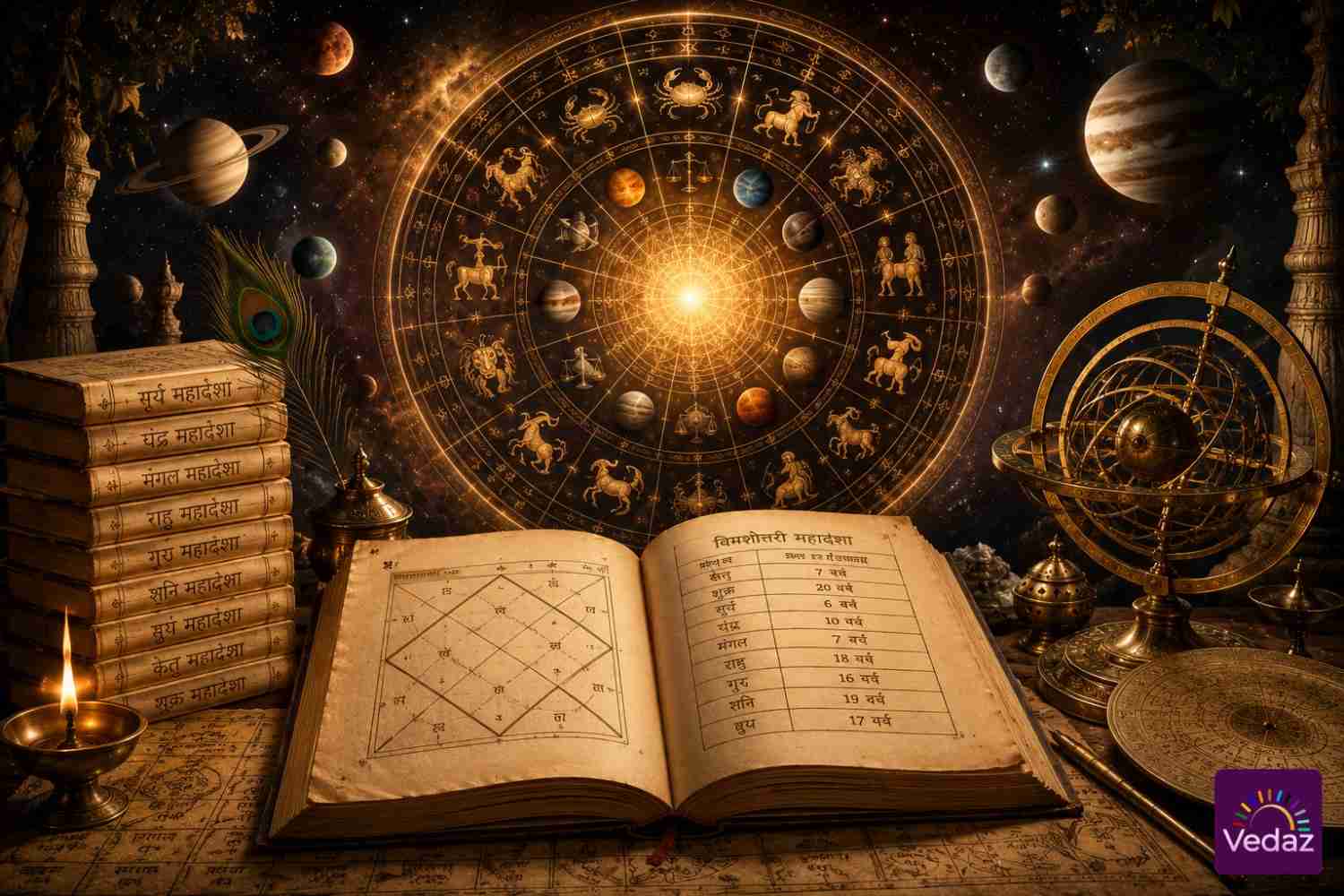
The Mahadasha system divides life into nine planetary periods in a fixed 120-year cycle called Vimshottari Dasha. Your starting period is determined by the Moon's nakshatra at birth. Each period activates specific chart potentials, themes, and life areas — making it Vedic astrology's primary timing tool.
- ◦What Is the Mahadasha System — and Why Should You Care?
- ◦The Vimshottari Dasha — Nine Periods, One Fixed Sequence
- ◦Where Your Sequence Starts — It All Comes Down to the Moon's Nakshatra
- ◦Mahadasha, Antardasha, and the Layers Underneath
- ◦How to Actually Read Your Current Period
- ◦The Misunderstandings That Cause the Most Harm
- ◦How Mahadasha Connects to Everything Else in This Library
- ◦Final Thought
You've probably heard someone say, "I'm in my Saturn Mahadasha" — usually with that particular kind of exhausted resignation. Or maybe you've come across something that says a certain period is "great for career" or "terrible for relationships" and thought: how does anyone actually figure that out?
This is how.
The Mahadasha system is genuinely one of the most fascinating parts of Vedic astrology — and one of the most misunderstood. It's not just a birth chart telling you what your potential is. It's a timing framework that tells you when that potential is most likely to show up in your actual life.
Career breakthroughs, marriages, major losses, sudden opportunities — in Vedic astrology, these aren't random. They tend to cluster around specific planetary periods.
If the birth chart is the map, the Mahadasha is the schedule. Learn the schedule, and nearly every timing question starts making a lot more sense.
Quick Answers
- What is it? A system of planetary periods that time when your chart's potentials actually manifest
- Most common system: Vimshottari Dasha — a 120-year cycle across nine planetary periods
- Starting point: Determined by which nakshatra the Moon was in at your birth
- How it layers: Mahadasha (major) → Antardasha (sub) → Pratyantardasha (sub-sub) and deeper
- What it's used for: Timing — understanding when latent chart potentials get activated
- Honest truth: It shows activation windows and tendencies — not fixed, fated events
What Is the Mahadasha System — and Why Should You Care?
Here's the thing about a birth chart: it contains dozens of potentials. Strong placements, yogas, dignified planets — all sitting there, loaded with possibility. But they don't all fire at once. Some activate in your twenties. Some in your forties. Some, honestly, you may never fully experience in this lifetime.
So the real question isn't just what does my chart say — it's when does it actually happen?
The Mahadasha system is the classical Vedic answer to that question. Life gets divided into a sequence of planetary periods, and during each period, the ruling planet steps into the spotlight. Its themes, the houses it rules in your chart, the yogas it's involved in — all of it gets amplified in your lived experience during that window.
A powerful Raja Yoga involving Jupiter? It'll manifest most strongly during Jupiter's Mahadasha. Your chart's career potential often becomes real during the period of the 10th house lord. That placement that's been sitting quietly in your chart for two decades? It's waiting for its period to arrive.
This is the core insight: the chart describes the potential; the dasha schedules when it shows up.
And if you're still getting comfortable with how the chart itself works, How to Read Your Vedic Birth Chart is the natural place to start before diving into timing.
The Vimshottari Dasha — Nine Periods, One Fixed Sequence
The Vimshottari Dasha is the system almost every Vedic astrologer works with. It's a 120-year cycle — the symbolic full human lifespan — split across nine planetary periods in a fixed, unchanging order:
| Planet | Duration |
|---|---|
| Ketu | 7 years |
| Venus | 20 years |
| Sun | 6 years |
| Moon | 10 years |
| Mars | 7 years |
| Rahu | 18 years |
| Jupiter | 16 years |
| Saturn | 19 years |
| Mercury | 17 years |
The order never changes. It always runs Ketu → Venus → Sun → Moon → Mars → Rahu → Jupiter → Saturn → Mercury, then loops back. What does change — what makes your sequence uniquely yours — is where you enter that cycle. And that depends entirely on one thing: where the Moon was at the moment you were born.
Where Your Sequence Starts — It All Comes Down to the Moon's Nakshatra
The 27 nakshatras (lunar mansions) each carry a planetary ruler from the Vimshottari sequence. Whichever nakshatra the Moon occupied at your birth determines:
- Which Mahadasha you were born into
- How much of it was left — based on how far through that nakshatra the Moon had already travelled
From that entry point, your sequence unfolds in the fixed order for the rest of your life.
This is why two people born on the same day can be living through completely different planetary chapters — different Mahadashas, different themes, different activation windows — simply because their birth times placed the Moon in different nakshatras.
It's also why accurate birth data matters just as much for dasha analysis as it does for reading the chart itself. Get the birth time wrong, and you could be analysing entirely the wrong period.
Mahadasha, Antardasha, and the Layers Underneath
The Mahadasha is just the top layer. The system goes much deeper — and that depth is where the real timing precision lives.
Each Mahadasha is subdivided into nine Antardashas (sub-periods), each ruled by one of the nine planets in the same Vimshottari order. Their lengths are proportional to the planets' full Mahadasha lengths. Each Antardasha breaks down further into Pratyantardashas, and finer still for detailed event timing.
Why does this matter practically?
- The Mahadasha sets the overarching theme — the big life chapter, spanning years or even close to two decades
- The Antardasha modulates that theme — and it can do so significantly. A broadly favorable Mahadasha can contain a genuinely rough Antardasha. A difficult Mahadasha can have genuinely productive, even joyful sub-periods within it
- Finer layers help narrow the timing for specific events
Here's the practical takeaway: always look at the Mahadasha-Antardasha combination together. Anyone reading dasha from the major period alone is working with half the picture — which is worth keeping in mind whenever you receive a timing reading from anyone.
How to Actually Read Your Current Period
You don't need years of study to start working with your dasha thoughtfully. Here's a grounded, step-by-step approach:
- Step 1 — Find your current periods. Any accurate Vedic calculator (like the free tool at Vedaz) generates the full dasha sequence from your birth data. Identify both your current Mahadasha and Antardasha
- Step 2 — Assess the Mahadasha lord's condition in your chart. Is it well-placed? Dignified? Favorable for your Lagna? Involved in any notable yogas? A strong, well-placed period lord tends to activate positive themes. A weak or afflicted one activates more challenging ones
- Step 3 — Note which houses it rules and occupies. These are the life areas being foregrounded right now
- Step 4 — Do the same for the Antardasha lord. It's either supporting or creating friction within the broader chapter — worth knowing which
- Step 5 — Connect it to your actual questions. Career timing, marriage timing, finances — the specific guides in this library all explain which dasha activations matter for which life areas
- Step 6 — Hold it as perspective, not prophecy. This framing is not a disclaimer — it's genuinely how the system works best
If you want to think through what your current dasha might be activating and what it means for your chart specifically, Buddhi - buddhi — Vedaz's AI advisor for astrological knowledge and chart understanding — is a good place to start that conversation.
The Misunderstandings That Cause the Most Harm
A lot of unnecessary fear circulates around Mahadasha — most of it based on oversimplifications that get repeated until they feel like established fact. Let's be direct about what's actually true:
- "A bad Mahadasha means bad years are fated" — No. A challenging period lord means a chapter that requires more effort and where headwinds are more likely. It does not fate misfortune. Many people navigate genuinely difficult periods with awareness and come out the other side stronger
- "A good Mahadasha guarantees good things" — Also no. A favorable period supports positive outcomes — it doesn't deliver them without engagement. Favorable windows that go unused tend to pass quietly
- "Saturn Mahadasha is always terrible" — This one is particularly unhelpful. What matters is Saturn's specific condition and placement in your chart. For some Lagnas, Saturn's period is among the most constructive, stable, and rewarding chapters of a lifetime
- "Dasha can tell you exactly what happens on exactly which date" — No. It identifies activation windows and tendencies. Finer subdivisions narrow the timing, but the honest output is windows and likelihoods — not dated certainties
If you want to understand where these boundaries actually sit, What Vedic Astrology Can and Cannot Do makes the case clearly — and How to Evaluate an Astrologer covers the red flags to watch for when someone is reading your dasha in a fear-based or guarantee-laden way.
How Mahadasha Connects to Everything Else in This Library
Once you understand the Mahadasha system, you'll notice it underpins almost every timing-related guide here. Career timing, marriage windows, children, foreign settlement, property, finances — they all follow the same core logic:
- Identify which planets govern the relevant life area
- Assess when their Mahadasha and Antardasha periods activate that area
- Look for convergence with supportive transits — especially Jupiter and Saturn
The Yogas cluster connects here too. A powerful yoga in your chart doesn't just sit there indefinitely — it waits for the right planetary period to fully express itself. Knowing your dasha sequence helps you understand when a yoga is most likely to actually show up in your life, not just exist on paper.
And for those wanting to understand how timing works across different dimensions of the chart — not just the main chart but the divisional layers — Divisional Charts (Vargas) Explained is the natural next step from here.
Final Thought
The Mahadasha system is genuinely one of the most elegant ideas in Vedic astrology. The chart holds the potential; the planetary periods schedule when it surfaces. A 120-year cycle, a fixed sequence, a starting point written in the Moon's position at the moment you arrived — it's a framework that takes the sprawling complexity of a birth chart and gives it a rhythm.
Understanding that rhythm changes how you read every specific-topic guide in this library. The same logic keeps appearing: find the relevant planets, identify when their periods activate the relevant life area, look for convergence with transits. That's the Mahadasha principle in action, every time.
But hold the honest framing firmly alongside it. Dasha shows activation windows and tendencies — assessed through the actual condition of your period lords in your actual chart. Not generic good or bad years. Not fated outcomes. Not dated certainties.
Challenging periods are navigable with awareness. Favorable ones require real engagement to bear fruit.
Held that way, the Mahadasha system becomes what it genuinely is at its best: a way of understanding the rhythm of your life — so you can align effort with supportive seasons, and meet the harder ones with preparation instead of fear.
See your full Mahadasha sequence and current period — free at vedaz.io - www.vedaz.io
Frequently Asked Questions
1. What is the Mahadasha system in Vedic astrology?
The Mahadasha system is the timing layer of Vedic astrology. It divides life into a sequence of planetary periods — and during each period, the ruling planet's themes, house rulerships, and yogas get foregrounded in lived experience. If the birth chart describes the static potentials of a life ("what"), the Mahadasha system describes their timing ("when"). The most widely used version is the Vimshottari Dasha: a 120-year cycle of nine planetary periods.
2. What are the Vimshottari Dasha periods and their lengths?
In fixed order: Ketu (7 years), Venus (20), Sun (6), Moon (10), Mars (7), Rahu (18), Jupiter (16), Saturn (19), Mercury (17) — totalling 120 years. The sequence always repeats in this order. Where you enter it — which period you're born into and how much remains — is determined by the nakshatra the Moon occupied at your birth.
3. How is my dasha starting point determined?
By the nakshatra (lunar mansion) the Moon was in at the moment of your birth. Each of the 27 nakshatras is ruled by one of the nine Vimshottari planets. The Moon's nakshatra tells you which Mahadasha you were born into and how much of it remained. From there, the sequence moves in the fixed order. This is why accurate birth time matters as much for dasha analysis as it does for the chart.
4. What is the difference between Mahadasha and Antardasha?
The Mahadasha is the major period — the overarching life chapter. Each Mahadasha is subdivided into nine Antardashas (sub-periods), each ruled by one of the nine planets, which modulate the major theme. A favorable Mahadasha can contain a genuinely difficult Antardasha, and vice versa. Genuine timing analysis always uses the Mahadasha-Antardasha combination together — never the Mahadasha alone.
5. Does a bad Mahadasha mean difficult years are fated?
No. A challenging period lord indicates a chapter requiring more conscious effort and where headwinds are likelier — not a fated stretch of misfortune. Many people navigate difficult periods well through awareness and preparation. And what "challenging" even means depends entirely on that planet's specific condition in your specific chart — not its general reputation.
6. Can dasha predict exact events on exact dates?
No. It identifies activation windows and tendencies — which life areas are foregrounded and approximately when. Finer subdivisions narrow the timing, but the honest output is windows and likelihoods, not dated certainties. Be sceptical of any reading that predicts exact events from dasha, treats periods as generically good or bad regardless of your chart, or uses a "bad dasha" to generate fear.
Related Blogs

How Your Ruling Planet Affects You?
The impact of your ruling planet upon yourself and your course of action in life. Find the hidden meaning behind your zodiac sign’s star guide.

How the Moon Phases Impacts Body & Mind
Can the Moon’s phases impact your sleep, mood, and health? Explore the fascinating connection between lunar cycles and wellness and how to harness their energy for personal growth

What Are The Hidden Connection Between Planets and Emotions
Do planets influence your emotions? Explore how astrology connects to mental health, from Mercury retrograde effects to Saturn return life changes—and what science says about it!

Mercury Retrograde Survival Guide: Mental Health Tips for Every Sign
Turn Mercury Retrograde chaos into clarity with actionable mental health hacks for every zodiac sign.