Which Kundli Doshas Actually Matter — and Which Are Mostly Used to Frighten You

If you have ever been told you have a kundli dosha, you are not alone because most charts contain at least one. This guide explains which doshas genuinely deserve deeper analysis, how cancellation rules work, and why fear-based astrology often exaggerates doshas to create anxiety and sell expensive remedies.
- ◦Quick Facts
- ◦What a Dosha Actually Is — and Why Almost Everyone Has One
- ◦The Truth Fear-Sellers Often Leave Out
- ◦Which Doshas Genuinely Warrant Contextual Analysis
- ◦Rigorous Assessment vs Frightening Sales Pitch
- ◦How to Engage With a Dosha Diagnosis Honestly
- ◦Get an Honest, Cancellation-Aware Dosha Assessment — Free on Vedaz
- ◦Final Thought
If you have ever had a kundli reading, there is a good chance someone told you that you have a dosha.
Manglik Dosha, Kaal Sarp Dosha, Nadi Dosha and Pitra Dosha. The names sound serious, sometimes even frightening. For many people, hearing one of these labels is enough to create immediate anxiety.
But here is the part that often gets left out: most charts contain at least one dosha, and many contain several.
That does not mean most people are destined for unhappy marriages, financial problems, or lifelong struggles.
The truth is much more nuanced than that.
Some doshas deserve careful analysis. Many are heavily influenced by chart context. Almost all major doshas have cancellation or mitigation rules that fear-based astrology rarely mentions. Yet dosha diagnoses remain one of the most common ways people are frightened into expensive remedies and unnecessary worry.
This guide explains what doshas actually are, which ones genuinely deserve attention, how cancellation rules work, and how to tell the difference between a careful dosha assessment and a fear-based sales pitch.
Quick Facts
| Topic | Honest Reality |
|---|---|
| What a dosha is | A chart pattern traditionally linked to a possible area of challenge or imbalance |
| Key fact | Most charts contain at least one dosha |
| What many people are not told | Almost every major dosha has cancellation or mitigation rules |
| What actually matters | Strength, context, timing, and the full chart |
| Common exploitation pattern | Dosha diagnosis + fear + expensive remedy + urgency |
| Honest framing | A dosha is a factor to understand, not something to fear automatically |
What a Dosha Actually Is — and Why Almost Everyone Has One
A dosha is a planetary combination that classical astrology associates with some form of challenge, imbalance, or area of life that may require extra attention.
That is the honest definition.
Notice what is not included in that definition:
-
a curse,
-
guaranteed suffering,
-
bad luck forever,
-
or a fixed destiny.
A dosha is simply a chart factor. It is something to examine, not something to panic about.
What many people are not told is that doshas are extremely common. Many of the combinations used to define major doshas appear so frequently that a large percentage of charts contain at least one. Many people have several.
Once you understand that, the fear starts to lose some of its power.
If most people have a dosha, then being told "you have a dosha" is not very useful information by itself.
The real questions are:
-
How strong is it?
-
Is it active right now?
-
Is it cancelled or reduced?
-
Does the rest of the chart support it?
-
Is it actually creating a meaningful challenge?
Those questions matter far more than the label itself.
The honest approach to astrology is not to ask, "Do I have a dosha?"
It is to ask, "How important is this dosha in the context of my entire chart?"
The Truth Fear-Sellers Often Leave Out
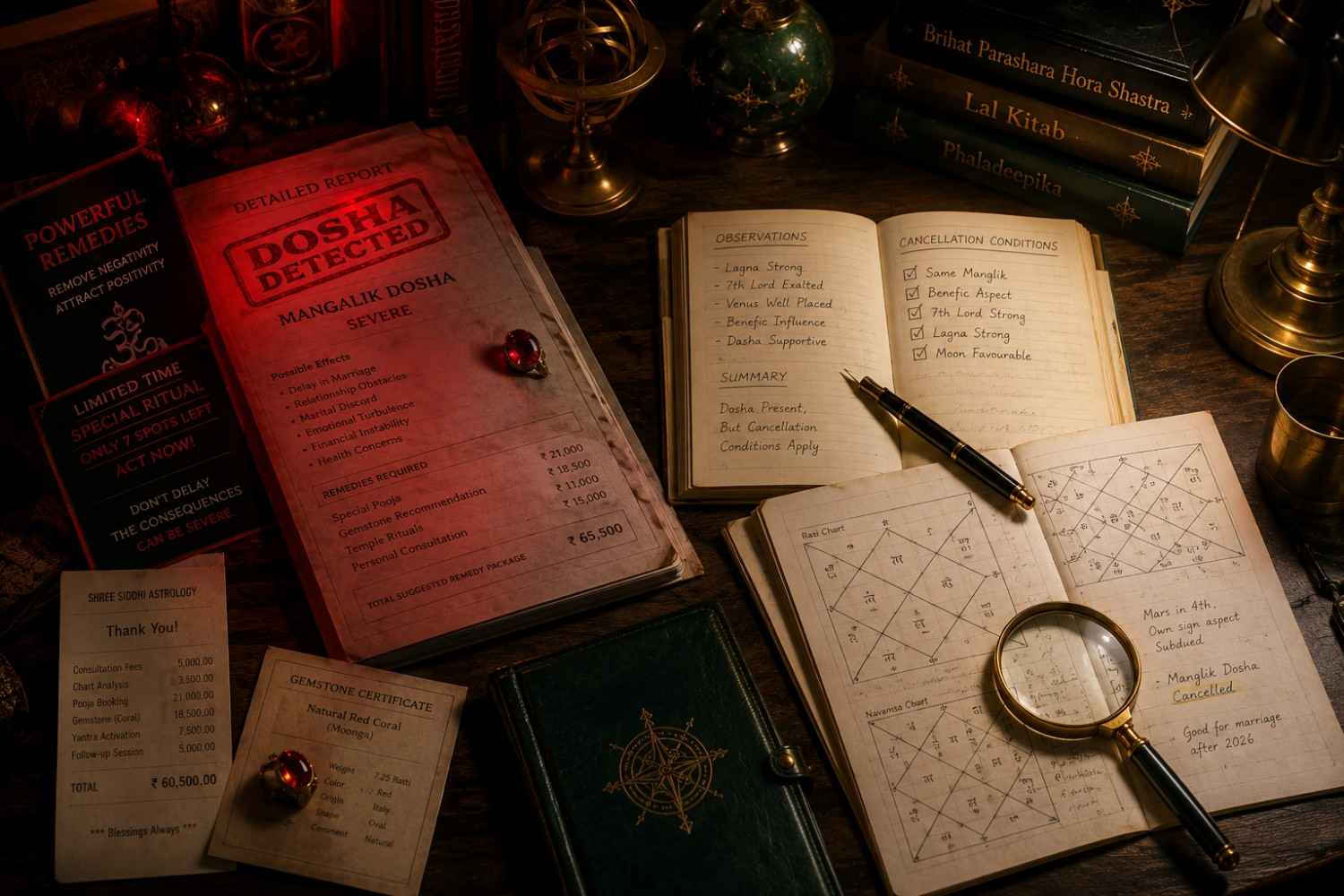
One of the biggest problems with fear-based astrology is that the conversation often stops as soon as a dosha is identified.
But genuine astrology was never meant to work that way.
Finding a dosha is only the beginning of the analysis. The next step is understanding whether that dosha remains significant after the rest of the chart is taken into account.
Some important facts are often left out of fear-based readings:
-
Almost every major dosha has cancellation or mitigation rules — classical astrology includes ways a dosha can become weaker, balanced, or less important.
-
A dosha label is not a complete analysis — identifying a dosha is only one step in understanding a chart.
-
Manglik Dosha has multiple cancellation conditions — mutual Manglik status, certain house placements, and supportive planetary influences can reduce its impact.
Readers interested in understanding these exceptions in more detail may also find our guide to Manglik Dosha useful, particularly because classical astrology contains several recognised cancellation principles.
-
Nadi Dosha and Bhakoot Dosha also have exceptions — compatibility analysis is often more nuanced than a simple "match" or "no match."Those evaluating marriage compatibility may also appreciate our explanation of Nadi Dosha, including traditional cancellation rules and broader chart considerations.
-
Kaal Sarp Dosha is often exaggerated — its significance depends heavily on the overall chart and cannot be judged in isolation. For a more balanced discussion of common misconceptions, remedies, and full-chart analysis, readers can explore our complete guide to Kaal Sarp Dosha.
-
Sade Sati is not a rare curse — it is a Saturn transit that almost everyone experiences during life.
-
A responsible astrologer checks cancellation conditions before drawing conclusions — strength, timing, and chart support all matter.
-
Ignoring cancellations creates unnecessary fear — and fear is often easier to sell than nuance.
-
The important question is not whether a dosha exists, but whether it remains significant after proper analysis.
This is one reason why two astrologers can look at the same chart and give very different interpretations.
One stops at the label.
The other continues into the actual analysis.
Which Doshas Genuinely Warrant Contextual Analysis
Not all doshas deserve the same level of attention.
Some become more important because they are strong, active, repeated across the chart, or supported by other factors. Others remain weak, partial, or heavily mitigated.
Doshas associated with ancestral themes can also benefit from deeper contextual study, which we discuss in our guide to Pitra Dosha.
That is why context matters so much.
-
Strong and exact doshas deserve closer attention than weak or loosely formed combinations.
-
Uncancelled doshas usually matter more than doshas that have clear mitigation factors.
-
Repeated indications increase significance — when several chart factors point toward the same theme, astrologers pay closer attention.
-
Dasha activation matters — a dosha that is currently active may feel very different from one that remains dormant.
-
Marriage-related doshas deserve deeper analysis during kundli matching — especially Manglik, Nadi, and Bhakoot considerations.
-
The full chart matters far more than one dosha — no single factor should be allowed to dominate the interpretation.
-
The same dosha can range from minor to meaningful depending on the surrounding chart conditions. This principle applies equally to combinations such as Guru Chandal Dosha, where planetary strength, context, and mitigating influences often matter more than the label itself.
-
A weak dosha in a strong chart may have very little practical impact.
-
The real question is never "Do you have this dosha?" but "How strong, active, and relevant is it?"
That is where genuine astrology begins.
Rigorous Assessment vs Frightening Sales Pitch
Once you understand how doshas are supposed to be analyzed, the difference between genuine guidance and fear-based selling becomes much easier to spot.
| Rigorous Assessment | Frightening Sales Pitch |
|---|---|
| Checks exact strength and placement | Announces the dosha dramatically |
| Evaluates cancellation conditions | Ignores cancellation conditions |
| Looks at the entire chart | Focuses on one frightening label |
| Considers timing and dasha activation | Treats every dosha as severe |
| Explains reasoning clearly | Uses vague warnings and fear |
| Acknowledges when a dosha is weak or cancelled | Treats the label as a final verdict |
| Encourages understanding | Encourages panic |
| Respects your judgment | Creates emotional dependence |
| Keeps interpretation proportionate | Makes everything sound urgent |
| Does not pressure immediate payments | Quickly introduces expensive remedies |
A simple rule often helps:
Good analysis becomes more nuanced as it goes deeper. Fear-based astrology becomes more dramatic.
How to Engage With a Dosha Diagnosis Honestly

Most of the harm around doshas comes from fear, not from the chart itself.
A healthier approach looks like this:
-
Start with perspective — most people have at least one dosha, so the diagnosis itself is not unusual.
-
Do not panic because the name sounds frightening — astrology contains many dramatic terms that sound worse than they often are in practice.
-
Ask about cancellation conditions — every serious dosha assessment should include them.
-
Ask whether the dosha is strong, weak, partial, or active — those details matter far more than the label.
-
Request a full-chart analysis — one factor rarely explains an entire life.
-
Treat fear-plus-expensive-remedy-plus-urgency as a major warning sign.
-
Keep remedies proportionate — avoid making large financial decisions because someone frightened you.
-
Remember that your choices still matter — relationships, effort, communication, maturity, and circumstances continue to shape outcomes.
-
Use astrology as guidance for reflection, not as a verdict about your future.
The goal should always be understanding, not fear.
Get an Honest, Cancellation-Aware Dosha Assessment — Free on Vedaz
Vedaz approaches dosha analysis through strength assessment, cancellation conditions, full-chart context, and dasha timing rather than fear-based conclusions.
The goal is not to create anxiety or dependence. It is to help people understand when a dosha is genuinely important, when it is mitigated, and when it may not be a major concern at all.
Astrology becomes far more useful when context is allowed to matter.
Free at vedaz.io.
Final Thought
Doshas carry enormous emotional weight because the language around them often sounds alarming.
But once you understand how common these combinations are, how many cancellation rules exist, and how much context affects their significance, the picture becomes much calmer.
The honest position is neither "doshas are meaningless" nor "doshas determine your fate."
Some chart combinations deserve thoughtful attention, especially when they are strong, active, uncancelled, and supported by other factors in the chart.
But many dosha diagnoses are weaker, partially cancelled, or far less significant than fear-based readings suggest.
The real divide is not between people who have doshas and people who do not.
Almost everyone does.
The real divide is between careful analysis and fear-based simplification.
A good astrologer explains strength, timing, chart context, and cancellation rules. A fear-seller announces a frightening label, skips the nuance, and quickly moves toward an expensive solution.
Once you understand that pattern, much of the fear loses its power.
Fear-based astrology depends on people hearing the label and stopping the investigation there. Honest astrology begins where the label ends.
Approached honestly, a dosha becomes what it was always meant to be: one factor among many in understanding a chart — not a verdict hanging over a life.
Dr. Tanvi Deshpande
Astrology Education, Jyotish Philosophy & Consultation Ethics | 11+ Years
Dr. Tanvi Deshpande is an astrology educator and researcher specializing in astrology literacy, consultation ethics, and the philosophical foundations of Jyotish. Her work encourages informed engagement, realistic expectations, and thoughtful interpretation of traditional astrological concepts.
Frequently Asked Questions
1. What is a kundli dosha?
A dosha is a pattern in your birth chart that traditional astrology flags as worth paying attention to — think of it as a yellow flag, not a red one. It marks an area of potential tension to examine, not a confirmed problem.
2. Does having a dosha mean something is wrong with my chart?
Almost certainly not on its own — because here's what most practitioners won't tell you upfront: nearly everyone has one. The major doshas are so common that if you checked a room full of people's charts, the majority would have at least one. A scary-sounding label that applies to most people doesn't actually tell you much.
3. Do doshas have cancellation conditions?
Yes — and this is the part fear-based practitioners routinely leave out. Every major dosha has classical cancellation conditions built right into the tradition. Manglik dosha has several; Nadi and Bhakoot have recognized ones too. Any practitioner who pronounces a dosha without first checking cancellations isn't doing rigorous work.
4. Which doshas actually matter?
The ones that are strong, exact, unmitigated, and currently active in your planetary period. A dosha that's partial, weak, cancelled, or dasha-inactive is correspondingly much less significant. The real question was never "do you have it" — it's "how strong is it, is it cancelled, and what does the full chart say?"
5. How do I tell a rigorous assessment from a sales pitch?
One clear tell: does this person ever tell anyone their dosha isn't a concern? A genuine astrologer says that regularly. A fear-seller essentially never does — because that's not the business model. Add an expensive "only" remedy and artificial urgency, and you have the full exploitation signature.
6. Should I get a remedy for my dosha?
Only if an honest, contextualized assessment actually warrants it — not because a label frightened you. Start from the base rate (most people have a dosha), ask specifically about strength and cancellation, and be most skeptical exactly when you're most scared. That moment of fear is precisely when it's being exploited.
Related Blogs

Dreaming of moving abroad? Check Foreign Travel Astrology
Is your destiny written in the stars? Discover if the universe is guiding you toward a life abroad!

The Best Places to Travel Abroad Foreign Travel Astrology
Is foreign travel written in your stars? Explore how astrology influences your journeys and uncover the best destinations for your zodiac sign!

Can Your Birth Chart Predict Depression Symptoms?
This article examines whether astrological birth charts can predict depression symptoms, contrasting astrological beliefs with psychological research on personality traits and mental health.
The Manifestation Secrets Hidden in Celebrity Birth Charts
Find out what makes fame unique and special. This guide lets you know how some of the biggest celebrities use planetary help to become successful—and how you can do the same.