Nadi Dosha in Kundli Matching: Truth, Myths and Real Compatibility
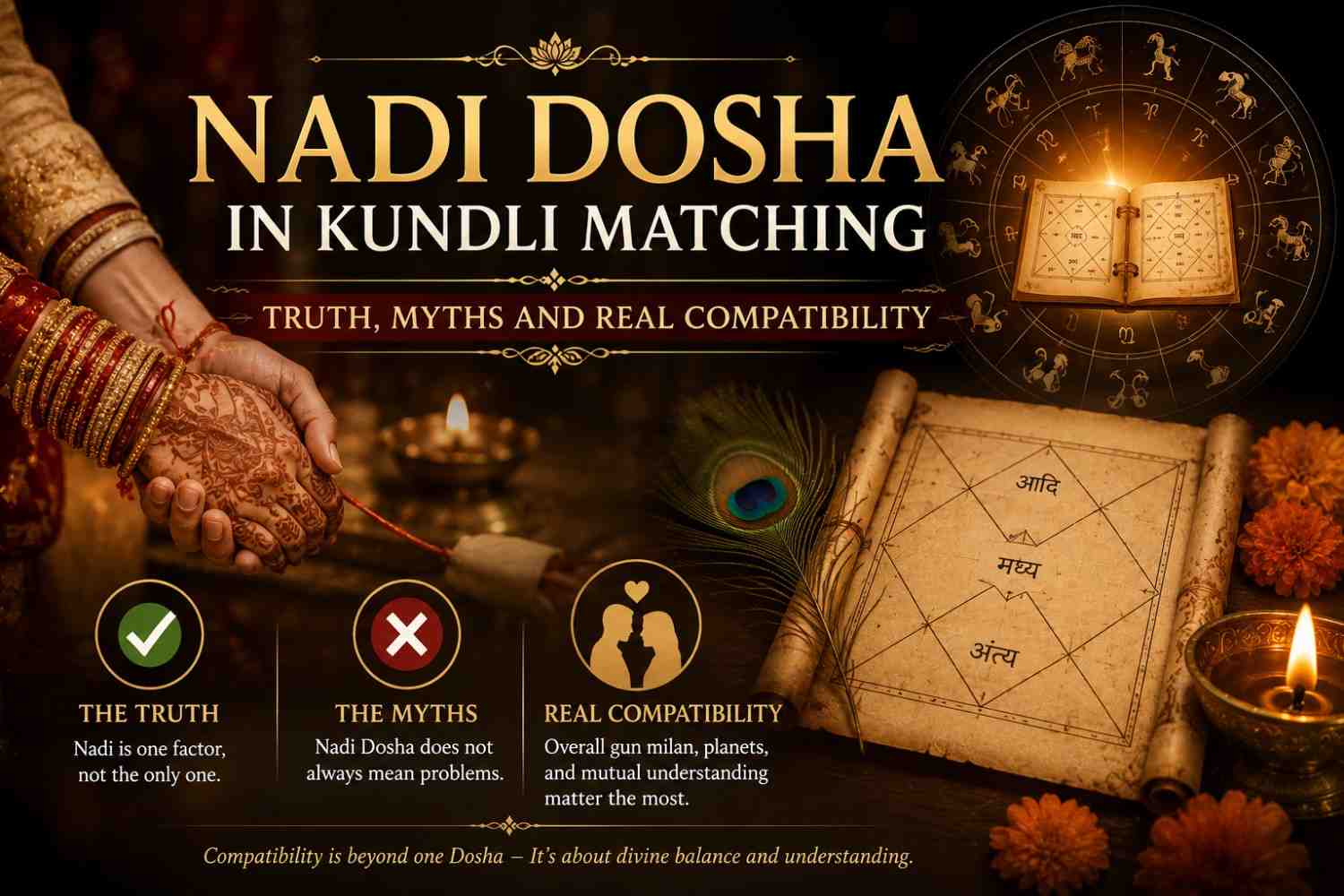
In the 36-point Guna Milan system, Nadi Dosha carries 8 points — the single largest allocation of any compatibility factor. It forms when both partners share the same Nadi based on their birth nakshatras. Classical tradition recognizes multiple cancellation conditions that are frequently overlooked.
- ◦Why Nadi Dosha Stops So Many Marriages — And What the Full Picture Actually Says
- ◦What Nadi Actually Means in Vedic Astrology
- ◦How the 27 Nakshatras Divide Into the Three Nadis
- ◦Classical Cancellation Conditions for Nadi Dosha — The Part Most People Miss
- ◦The Honest Framing on Nadi Dosha Severity
- ◦Classical Remedies for Nadi Dosha
- ◦How to Actually Evaluate Nadi Dosha in a Marriage Match
- ◦Critical Cautions for Families Evaluating Marriage Matches
- ◦Final Thought
Why Nadi Dosha Stops So Many Marriages — And What the Full Picture Actually Says
Eight points out of thirty-six. That's what's at stake when Nadi Dosha comes up in a marriage compatibility reading. No other factor in the Ashta Koota system carries this kind of weight — and because of that, Nadi Dosha has become the single most common reason good matches get questioned or flat-out rejected.
The problem isn't that Nadi Dosha isn't real. It is. The problem is that most families hear "Nadi Dosha" and stop right there — without anyone checking whether the cancellation conditions apply, without looking at the overall compatibility picture, and without understanding what the classical concern is actually about.
This guide gives you the full picture. What Nadi actually means, how the dosha forms, when classical tradition says it's canceled, and how to evaluate it honestly — so you're not making a life decision based on an incomplete reading.
Quick Answers: Nadi Dosha at a Glance
- What it is: Both partners sharing the same Nadi group based on birth nakshatras
- Points at stake: 8 out of 36 — the highest single allocation in Guna Milan
- Three Nadis: Aadi (Vata), Madhya (Pitta), Antya (Kapha)
- Classical concern: Health of progeny and vitality of the marriage
- How to check: Identify each partner's birth nakshatra and match their Nadi group
- Cancellation conditions: Yes — several, and they're classically recognized
- Does it mean the match fails? No — many successful marriages exist between same-Nadi partners
What Nadi Actually Means in Vedic Astrology
Most people hear "Nadi Dosha" without understanding what Nadi even is. So let's start there.
Nadi is a classification system that divides all 27 nakshatras into three groups, each linked to one of the three doshas from Ayurveda — the ancient Indian system of medicine and constitution. These three constitutional energies govern physical health, mental temperament, and life vitality.
The three Nadis are:
- Aadi Nadi (Vata Nadi) — linked to the air and movement principle; governs nervous system, circulation, and mobility
- Madhya Nadi (Pitta Nadi) — linked to the fire and transformation principle; governs digestion, metabolism, and intensity
- Antya Nadi (Kapha Nadi) — linked to the water-earth and structure principle; governs stability, immunity, and endurance
The classical logic is rooted in Ayurvedic constitutional theory. When two partners share the same Nadi, they share the same dominant constitutional energy.
The classical concern: this similarity may concentrate constitutional vulnerabilities rather than create the diversity that supports healthy progeny and a vital marriage.
How the 27 Nakshatras Divide Into the Three Nadis
To check Nadi compatibility, identify each partner's birth nakshatra, find which Nadi it belongs to, and compare. If both fall in the same group, Nadi Dosha is present.
Aadi Nadi (Vata) Nakshatras: Ashwini, Ardra, Punarvasu, Uttara Phalguni, Hasta, Jyeshtha, Mula, Shatabhisha, Purva Bhadrapada
Madhya Nadi (Pitta) Nakshatras: Bharani, Mrigashira, Pushya, Purva Phalguni, Chitra, Anuradha, Purva Ashadha, Dhanishta, Uttara Bhadrapada
Antya Nadi (Kapha) Nakshatras: Krittika, Rohini, Ashlesha, Magha, Swati, Vishakha, Uttara Ashadha, Shravana, Revati
Each group has exactly nine nakshatras — the distribution is balanced by design. If you're unsure which nakshatra you were born under, checking your birth chart will give you that detail along with all your other planetary placements.
Classical Cancellation Conditions for Nadi Dosha — The Part Most People Miss
This is genuinely the most important section in this entire guide. Classical tradition is much more nuanced about Nadi Dosha than a simple same-Nadi = zero points rule.
Several recognized cancellation conditions exist — and a thorough astrologer checks all of them before concluding incompatibility.
- Same nakshatra, different pada — if both partners are born in the same nakshatra but different quarters (padas), Nadi Dosha is considered canceled in many traditions. This is one of the most commonly overlooked cancellations
- Same Nadi, different nakshatra, same rashi — some traditions recognize this combination as canceling the dosha
- Nakshatra lords different and well-placed — when the ruling planets of each partner's nakshatra differ and are favorably positioned, the constitutional concern is considered moderated
- Strong overall Guna Milan score (28+ of 36) with only Nadi as deficit — many experienced astrologers consider the marriage viable when overall compatibility is strong and Nadi is the only weak point
- Both nakshatras ruled by the same planet but in different signs — specific planetary lordship combinations that classical texts recognize as exempt
- Specific exempt nakshatra combinations within the same Nadi — the texts identify certain pairings considered non-problematic even within the same Nadi group
- Powerful benefic yogas in both charts — strong Jupiter, Venus, or other benefic configurations can override the Nadi concern at the individual chart level
Just as with Manglik Dosha Deep analysis, where cancellation conditions are frequently missed and good matches get rejected unnecessarily, the same pattern repeats with Nadi — the cancellation step is the one most often skipped.
If you're unsure whether any of these apply to your match, Shubha - shubha — Vedaz's AI astrologer specializing in marriage compatibility — can evaluate all cancellation conditions against both charts in detail.
The Honest Framing on Nadi Dosha Severity
Here's what the full classical tradition actually says — versus what most families hear:
- The 8-point weighting reflects genuine classical concern, but was never meant to be an automatic veto on an otherwise compatible match
- The primary concern is progeny health and marriage vitality — not whether the partners are emotionally or personality compatible with each other
- Modern medical understanding of genetics and reproductive health doesn't map cleanly onto the Nadi framework — many experienced astrologers treat Nadi Dosha as a traditional factor to be evaluated carefully, not a medical prediction
- Cancellation conditions are real and classically recognized — an astrologer who skips this step is doing an incomplete reading
- Rejecting an otherwise excellent match on Nadi Dosha alone, without checking exceptions, is not what the complete classical tradition recommends
- Couples who are already committed and discover Nadi Dosha should consult an experienced astrologer about cancellation conditions and remedies rather than treating it as a crisis
Classical Remedies for Nadi Dosha
When Nadi Dosha is present and no cancellation conditions apply, classical tradition offers clear remedies. The consistent, sustained practices matter more than expensive one-time rituals.
- Perform Nadi Dosha Nivaran Pooja before marriage — typically involves Mahamrityunjaya Mantra recitation as the central practice
- Recite Mahamrityunjaya Mantra regularly — the primary mantra for health and longevity protection
- Both partners worship Lord Shiva together, particularly on Mondays
- Donate to healthcare or children's health causes — directly addressing the classical concern about progeny vitality. Families worried about the Pitra Dosha Guide impact on children's wellbeing will find this remedy overlaps meaningfully
- Perform anna daan (food donation) before marriage as a protective act
- Some traditions recommend the groom donate a cow or equivalent charitable value
- Recite Vishnu Sahasranama for overall marriage protection
- Both partners maintain a health-conscious lifestyle — the classical concern is constitutional vitality, and addressing it practically is entirely valid
- For couples planning children, conscious prenatal and reproductive health care addresses the underlying concern most directly
The Bhakoot Dosha Guide also covers remedies for the other major Guna Milan factor that affects marriage longevity — worth reading alongside this.
For mantra practice guidance specific to your chart — including the right timing and method for Mahamrityunjaya recitation — Apala - apala at Vedaz can walk you through it in detail.
How to Actually Evaluate Nadi Dosha in a Marriage Match
Nadi Dosha should never be evaluated in isolation. Here's how experienced astrologers approach it:
- Check both partners' birth nakshatras accurately — errors at this step cascade through the entire assessment
- Identify which Nadi each nakshatra belongs to and compare
- If same-Nadi, immediately check all cancellation conditions before concluding dosha is active
- Evaluate the overall Guna Milan score — a 28+ score with only Nadi as deficit is a very different situation from a 20/36 with Nadi also missing
- Look at individual chart strengths — benefic yogas, Jupiter placement, Venus strength — that may offset the concern
- Consider progeny-related houses and lords (5th house especially) in both charts for a more complete picture
- Treat Nadi as one factor among many — families evaluating the Kaal Sarp Dosha Guide alongside Nadi concerns will recognize this same principle applies there too
- Treat Nadi as one factor among many — not the deciding factor on its own
Critical Cautions for Families Evaluating Marriage Matches
- Nadi Dosha is the single most common reason otherwise excellent matches are rejected — and frequently over incomplete analysis
- Same nakshatra, different pada is a classically recognized cancellation that is overlooked surprisingly often
- A strong overall Guna Milan score with only Nadi as deficit is considered viable by many experienced astrologers
- Consult an astrologer who genuinely evaluates exceptions and cancellation conditions — not one who applies the 8-point rule mechanically
- Couples already committed should approach Nadi Dosha through cancellation analysis and remedies, not as a relationship crisis
- The classical concern is about progeny health and marriage vitality — both addressable through remedies and practical health consciousness
- Honest astrologers discuss cancellation conditions openly. Be cautious of practitioners who emphasize fear without discussing exceptions
Final Thought
Nadi Dosha carries the heaviest single weighting in Vedic marriage compatibility — and because of that, it's the factor most likely to derail an otherwise excellent match. But the real classical tradition is far more thoughtful than mechanical point-counting suggests.
The texts recognize cancellation conditions. They recognize that overall compatibility matters. They never intended a single factor — even one worth 8 points — to override a genuinely strong compatibility profile.
If Nadi Dosha appears in your match evaluation, don't treat it as the final word. Get the complete picture: cancellation conditions, overall Guna Milan, individual chart strengths, and honest remedy guidance.
The tradition is wiser than its most fear-based application. And so should the evaluation be.
Vaishnavi Bhardwaj
Marriage Astrology, Kundli Matching & Dosha Remedies | 11+ Years
Vaishnavi Bhardwaj focuses on compatibility analysis, marriage astrology, and traditional dosha assessments. Her writing combines classical astrological knowledge with modern perspectives, making complex topics accessible to readers of all experience levels.
Frequently Asked Questions
1. What is Nadi Dosha?
Nadi Dosha is a Vedic marriage compatibility factor that forms when both prospective partners share the same Nadi — one of three nakshatra groups (Aadi/Vata, Madhya/Pitta, Antya/Kapha) linked to Ayurvedic constitutional principles. In the 36-point Guna Milan system, the Nadi koota carries 8 points — the largest single allocation — and same-Nadi partners receive zero of those points. Classical tradition recognizes multiple cancellation conditions that can negate the dosha even when the same Nadi is shared.
2. How do I check for Nadi Dosha?
Identify each partner's birth nakshatra, determine which Nadi each falls into (Aadi, Madhya, or Antya from the nakshatra lists above), and compare. If both partners fall in the same Nadi group, Nadi Dosha is technically present. However, several classical cancellation conditions — same nakshatra different pada, strong overall score, benefic yogas, and others — can negate the dosha and should always be checked before concluding incompatibility.
3. What are the exceptions to Nadi Dosha?
Classical cancellation conditions include: same nakshatra but different pada; same Nadi but different nakshatra and same rashi (in some traditions); nakshatra lords different and well-placed; strong overall Guna Milan score (28+) with only Nadi as deficit; specific exempt nakshatra combinations within the same Nadi; and powerful benefic yogas in both charts.
4. Is Nadi Dosha a reason to reject a marriage?
Not automatically. While the 8-point weighting reflects genuine classical concern about progeny health and marriage vitality, the complete tradition recognizes multiple cancellation conditions. Rejecting an otherwise excellent match on Nadi Dosha alone — without checking cancellation conditions — is not consistent with the full classical approach. Many successful marriages exist between same-Nadi partners.
5. What are the best remedies for Nadi Dosha?
Nadi Dosha Nivaran Pooja before marriage, regular Mahamrityunjaya Mantra recitation, both partners worshipping Lord Shiva together on Mondays, donations to healthcare or children's health causes, anna daan (food donation), and Vishnu Sahasranama recitation. For couples planning children, conscious prenatal and reproductive health care addresses the classical concern practically and directly. The Bhakoot Dosha Guide also covers remedies for the other major Guna Milan factor that affects marriage longevity — worth reading alongside this.
6. Can a couple with Nadi Dosha have healthy children?
Yes. The classical concern relates to progeny health and marriage vitality as a tendency — not a certainty. Many couples with Nadi Dosha have healthy children and successful marriages. The classical tradition recognizes cancellation conditions that negate the dosha and recommends remedies addressing the concern. Modern prenatal care and reproductive health consciousness address the underlying concern practically.
Related Blogs

Dreaming of moving abroad? Check Foreign Travel Astrology
Is your destiny written in the stars? Discover if the universe is guiding you toward a life abroad!
The Best Places to Travel Abroad Foreign Travel Astrology
Is foreign travel written in your stars? Explore how astrology influences your journeys and uncover the best destinations for your zodiac sign!

Can Your Birth Chart Predict Depression Symptoms?
This article examines whether astrological birth charts can predict depression symptoms, contrasting astrological beliefs with psychological research on personality traits and mental health.
The Manifestation Secrets Hidden in Celebrity Birth Charts
Find out what makes fame unique and special. This guide lets you know how some of the biggest celebrities use planetary help to become successful—and how you can do the same.