Bhakoot Dosha in Kundli Matching: Meaning, Effects and Solutions
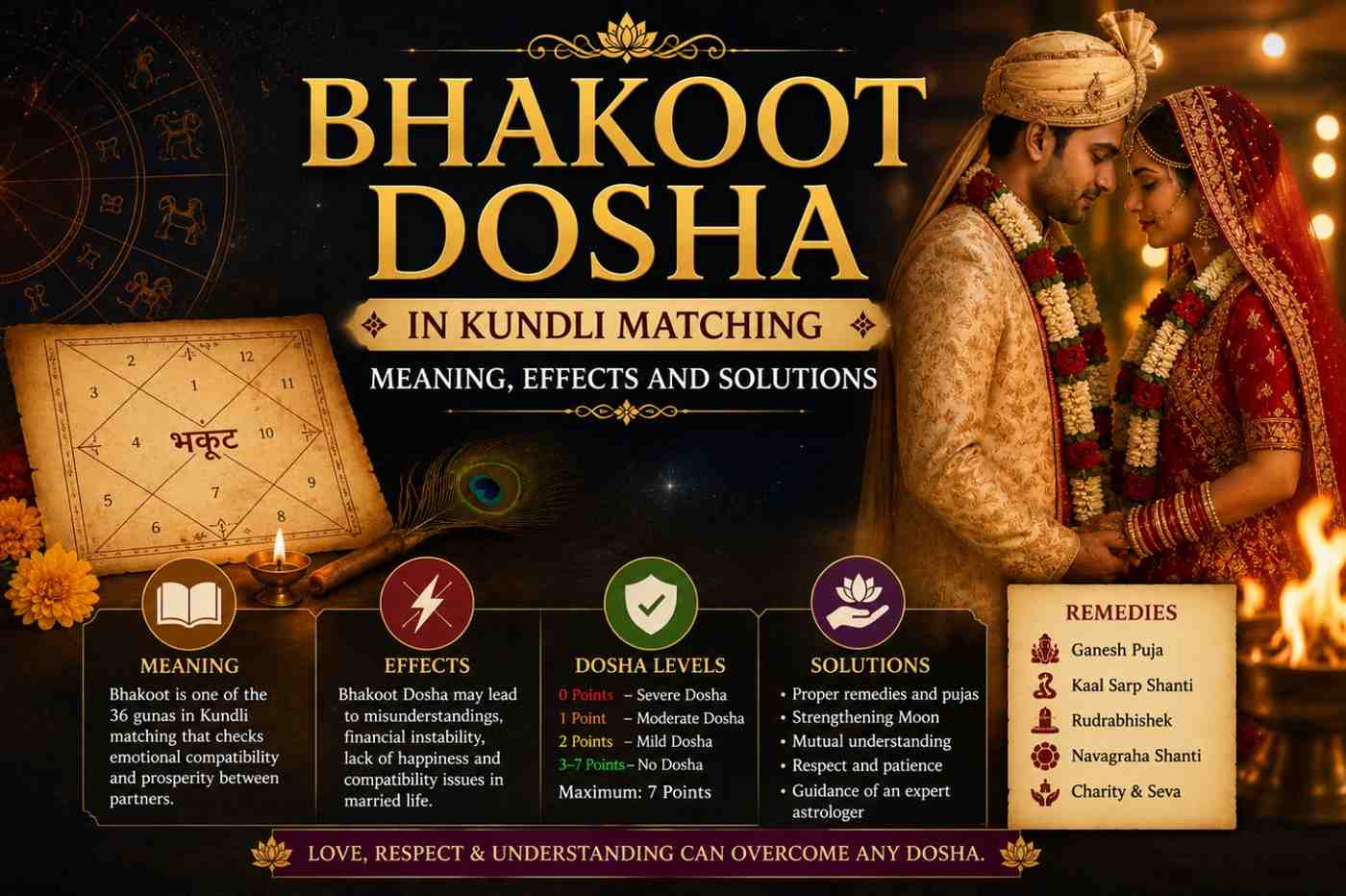
Bhakoot Dosha forms when the two partners' Moon signs fall into specific difficult positional relationships — 6-8, 2-12, or 5-9 — in the Guna Milan system. It carries 7 of 36 points, the second-largest allocation after Nadi. Classical tradition recognizes several cancellation conditions that are frequently overlooked.
- ◦Why Bhakoot Dosha Gets So Many Matches Rejected — And What the Tradition Actually Says
- ◦What Bhakoot Actually Means in Vedic Astrology
- ◦The Three Bhakoot Dosha Positions — And How Serious Each One Really Is
- ◦Classical Cancellation Conditions for Bhakoot Dosha — Always Check These First
- ◦How to Actually Evaluate Bhakoot Dosha in a Marriage Match
- ◦Classical Remedies for Bhakoot Dosha
- ◦Critical Cautions for Families Evaluating Marriage Matches
- ◦Final Thought
Why Bhakoot Dosha Gets So Many Matches Rejected — And What the Tradition Actually Says
Seven points. Out of thirty-six. That's the weight Bhakoot Dosha carries in the Guna Milan system — and it's enough to sink an otherwise strong compatibility score when those points go missing.
What makes Bhakoot particularly tricky is that it's not always obvious which Moon sign combinations trigger it. Families often discover it mid-evaluation and treat it as a closed case.
The match gets rejected. And in many of those situations, nobody stopped to check the cancellation conditions that classical tradition explicitly recognizes.
This guide covers the full picture — what Bhakoot Dosha actually is, which Moon sign relationships create it, how severe each type really is, and when classical tradition says the dosha is canceled. Because in marriage compatibility, incomplete analysis isn't neutral — it has consequences.
Checking your birth chart accurately is the essential first step.
Quick Answers: Bhakoot Dosha at a Glance
- What it is: Difficult positional relationship between the two partners' Moon signs
- Points at stake: 7 of 36 — second-largest koota allocation in Guna Milan
- Three difficult positions: 6-8 (Shadashtak), 2-12 (Dwirdwadash), 5-9 (Navpancham)
- Classical concern: Health, prosperity, longevity, and emotional harmony in marriage
- How to check: Count each partner's Moon sign position from the other's
- Cancellation conditions: Yes — several, with Moon sign lord friendship being the most important
- Does it mean the match fails? No — cancellation conditions and overall score matter significantly
What Bhakoot Actually Means in Vedic Astrology
In Vedic astrology, the Moon governs the mind, emotions, and daily emotional experience. So when we talk about the relationship between two partners' Moon signs, we're really talking about how their emotional natures interact across the marriage — day to day, year to year.
Bhakoot compatibility measures exactly this. It evaluates whether the two partners' Moon signs sit in harmonious or difficult positional relationships counted from each other.
The method is straightforward: count the position of partner B's Moon sign from partner A's Moon sign, and vice versa. Some positional relationships are considered harmonious — others trigger Bhakoot Dosha.
The key thing to understand is that not all Bhakoot Dosha is equal. The three problem positions vary meaningfully in severity, and experienced astrologers treat them very differently.
The Three Bhakoot Dosha Positions — And How Serious Each One Really Is
1. Shadashtak (6-8 Relationship) — The Most Serious
When one partner's Moon sign sits in the 6th house from the other's, and correspondingly the other's is in the 8th, Shadashtak Bhakoot forms.
This is the most difficult of the three positions. The 6-8 axis is the axis of difficulty in Vedic astrology — the 6th governs conflict and health, the 8th governs longevity and transformation.
Classical concern: health complications, persistent conflict, and significant obstacles in the marriage. This position deserves serious evaluation — but even Shadashtak has cancellation conditions, and those must be checked before concluding incompatibility.
2. Dwirdwadash (2-12 Relationship) — Moderate
When one partner's Moon sign sits in the 2nd house from the other's, and correspondingly the other's is in the 12th, Dwirdwadash Bhakoot forms. The 2-12 axis relates to wealth accumulation and loss.
Classical concern: financial drain, expenses exceeding income, and resource-related tension in the marriage. The concern is more material than physical — this position tends to show up in financial friction rather than health-related themes.
3. Navpancham (5-9 Relationship) — The Mildest
When one partner's Moon sign sits in the 5th house from the other's, and correspondingly the other's is in the 9th, Navpancham Bhakoot forms. This is the mildest of the three — and many traditions don't treat it as full Bhakoot Dosha at all.
The 5-9 axis is the dharmic trinal axis in Vedic astrology. Some schools see mild concern around children and value differences; others consider Navpancham essentially neutral. If Bhakoot Dosha appears in a match evaluation, Navpancham is significantly less alarming than the other two positions.
Classical Cancellation Conditions for Bhakoot Dosha — Always Check These First
This is the step that gets skipped most often — and it's the most important one. Before concluding Bhakoot incompatibility, every one of these conditions should be evaluated:
- Same Moon sign for both partners — no Bhakoot Dosha at all; the 1-1 relationship is considered compatible
- Both Moon sign lords are the same planet — Bhakoot Dosha is canceled. This is the single most important cancellation condition and is frequently overlooked
- Moon sign lords are friends with each other — significantly reduces the dosha even when the positional relationship is difficult
- Moon signs in mutual trine with friendly lords — often considered acceptable in most traditions
- Strong Nadi koota score (full 8 points) — some traditions treat full Nadi compatibility as compensating for Bhakoot deficit
- Strong Navamsa (D9) compatibility — when the deeper chart layer shows harmony, many experienced astrologers weigh that heavily
- Moon sign lords in mutual exchange (Parivartana) or conjunction — specific planetary relationships that classical texts recognize as canceling
- Overall Guna Milan score 28+ with only Bhakoot as deficit — considered viable by many experienced astrologers
Just as the Nadi Dosha cancellation step is the one most families skip before rejecting a match, Bhakoot follows exactly the same pattern — the cancellation check is what separates a complete reading from an incomplete one.
If you're unsure whether cancellation conditions apply to your specific Moon sign combination, Shubha - shubha — Vedaz's AI astrologer focused on marriage compatibility — can evaluate all conditions across both charts.
How to Actually Evaluate Bhakoot Dosha in a Marriage Match
Bhakoot Dosha should never be the only factor in a compatibility decision. Here's how experienced astrologers approach it:
- Identify both partners' Moon signs accurately — errors here affect every subsequent calculation
- Count the positional relationship between Moon signs in both directions
- Identify which type of Bhakoot is present — Shadashtak, Dwirdwadash, or Navpancham — since severity differs significantly
- Immediately check Moon sign lord relationship — same lord or friendly lords is the most powerful cancellation
- Evaluate the overall Guna Milan score — a 28+ score with only Bhakoot missing is a very different situation from a 20/36
- Check Navamsa (D9) compatibility for the deeper emotional and marriage picture
- Evaluate 7th house strength in both charts — the house of marriage itself
- Consider Manglik Dosha Deep status alongside Bhakoot — both are significant compatibility factors that experienced astrologers evaluate together in the same assessment
- Treat Bhakoot as one factor among many — full evaluation includes Navamsa, 7th house, Manglik status, and overall chart compatibility
Classical Remedies for Bhakoot Dosha
When Bhakoot Dosha is present and no cancellation conditions apply, classical tradition recommends the following. As always, sustained consistent practice outperforms expensive one-time interventions.
- Worship Lord Vishnu and Goddess Lakshmi together — particularly effective for marriage harmony and prosperity themes
- Both partners recite Vishnu Sahasranama regularly
- Perform Bhakoot Dosha Nivaran Pooja before marriage if the dosha is significant and uncanceled
- Worship Lord Shiva and Goddess Parvati together on Mondays — the divine couple as the model for conscious marriage
- Donate to causes supporting married couples in need — charitable acts performed jointly before marriage
- Both partners worship the planet ruling their respective Moon signs individually
- For Shadashtak (6-8) specifically: Mahamrityunjaya Mantra recitation for health protection — the classical remedy when the 8th house axis is involved
- For Dwirdwadash (2-12) specifically: Lakshmi worship and conscious financial discipline for resource stability
For mantra-based remedy practice — including the right method and timing for Mahamrityunjaya or Vishnu Sahasranama — Atri - atri at Vedaz can guide you through a structured remedy approach based on your specific chart.
Critical Cautions for Families Evaluating Marriage Matches
A few things every family should know before acting on a Bhakoot Dosha flag:
- Always check Moon sign lord friendship first — this is the most important cancellation condition and is the one most frequently skipped
- Navpancham (5-9) Bhakoot is mild — many traditions treat it as only partially problematic or neutral; it should not be weighted equally with Shadashtak
- A strong overall Guna Milan score with only Bhakoot as deficit is considered viable by many experienced astrologers
- Shadashtak (6-8) deserves serious evaluation — but is not automatically disqualifying when cancellation conditions apply
- Consult an astrologer who evaluates cancellation conditions thoroughly, not one who applies the 7-point rule mechanically
- Bhakoot is one factor among many — comprehensive evaluation always includes Navamsa, 7th house, Manglik status, and the broader chart picture
- Couples evaluating both Pitra Dosha and Bhakoot together should know that experienced astrologers weigh the overall dosha burden across the chart — not each factor in isolation
Final Thought
Bhakoot Dosha carries the second-heaviest weighting in Vedic marriage compatibility — and like Kaal Sarp Dosha, it tends to generate more fear than the classical tradition actually warrants.
The honest tradition recognizes that the three Bhakoot positions vary in severity. That Navpancham is mild. That Moon sign lord friendship is a genuine and powerful cancellation. That a strong overall profile with only Bhakoot as a deficit is not the same as a genuinely incompatible match.
If Bhakoot Dosha appears in a marriage evaluation, the responsible approach is thorough cancellation analysis by an experienced astrologer — not automatic rejection. Marriage compatibility is a multi-factor evaluation. The tradition is wiser, and more permissive, than its most fear-based application.
Achyut Venkatesh
Vedic Astrology, Dosha Analysis & Kundli Interpretation | 15+ Years
Achyut Venkatesh is a Vedic astrology researcher specializing in birth chart analysis, planetary doshas, and relationship compatibility. He has spent over fifteen years studying classical Jyotish principles and helping readers understand complex astrological combinations in a practical and balanced manner.
Frequently Asked Questions
1. What is Bhakoot Dosha?
Bhakoot Dosha (also called Rashi Dosha or Bhakut Dosha) is a Vedic marriage compatibility factor based on the positional relationship between both partners' Moon signs. In the 36-point Guna Milan system, the Bhakoot koota carries 7 points — the second-largest allocation. It forms when Moon signs fall into three specific relationships: 6-8 (Shadashtak), 2-12 (Dwirdwadash), or 5-9 (Navpancham, the mildest). Cancellation conditions significantly modify whether the dosha is actually active.
2. How do I check for Bhakoot Dosha?
Identify each partner's Moon sign, then count the positional relationship between them in both directions. If the relationship is 6-8, 2-12, or 5-9, Bhakoot Dosha may be present. However, cancellation conditions — especially whether the Moon sign lords are the same planet or friendly — must be evaluated before concluding incompatibility.
3. Which Bhakoot Dosha is the most serious?
Shadashtak (6-8) is the most difficult, with classical concern about health complications and persistent obstacles. Dwirdwadash (2-12) is moderate, with concern about financial drain and resource tension. Navpancham (5-9) is the mildest — many traditions treat it as only partially problematic or neutral, since the 5-9 axis is the dharmic trinal axis. All three have cancellation conditions that should be evaluated.
4. What cancels Bhakoot Dosha?
The most important cancellation: both Moon sign lords being the same planet or being friends with each other. Additional cancellation conditions include: same Moon sign for both partners; Moon signs in mutual trine with friendly lords; strong Navamsa compatibility; Moon sign lords in mutual exchange or conjunction; full Nadi koota score (8 points); and strong overall Guna Milan score (28+) with only Bhakoot as deficit.
5. Is Bhakoot Dosha a reason to reject a marriage?
Not automatically. While Bhakoot carries significant weighting, the classical tradition recognizes multiple cancellation conditions. Navpancham is mild. Even Shadashtak has recognized cancellations. A strong overall Guna Milan score with only Bhakoot as deficit is considered viable by many experienced astrologers. The responsible approach is thorough cancellation analysis — not automatic rejection on a single factor.
6. What are the best remedies for Bhakoot Dosha?
Vishnu-Lakshmi worship together, Vishnu Sahasranama recitation by both partners, Bhakoot Dosha Nivaran Pooja before marriage if uncanceled, Shiva-Parvati worship on Mondays, joint charitable acts, and worship of each partner's Moon sign ruling planet. For Shadashtak specifically, Mahamrityunjaya Mantra for health protection. For Dwirdwadash, Lakshmi worship and financial discipline. Sustained consistent practice matters far more than expensive one-time interventions.
Related Blogs

Dreaming of moving abroad? Check Foreign Travel Astrology
Is your destiny written in the stars? Discover if the universe is guiding you toward a life abroad!
The Best Places to Travel Abroad Foreign Travel Astrology
Is foreign travel written in your stars? Explore how astrology influences your journeys and uncover the best destinations for your zodiac sign!
Can Your Birth Chart Predict Depression Symptoms?
This article examines whether astrological birth charts can predict depression symptoms, contrasting astrological beliefs with psychological research on personality traits and mental health.
The Manifestation Secrets Hidden in Celebrity Birth Charts
Find out what makes fame unique and special. This guide lets you know how some of the biggest celebrities use planetary help to become successful—and how you can do the same.