Pitra Dosh — Causes, Effects & Remedies
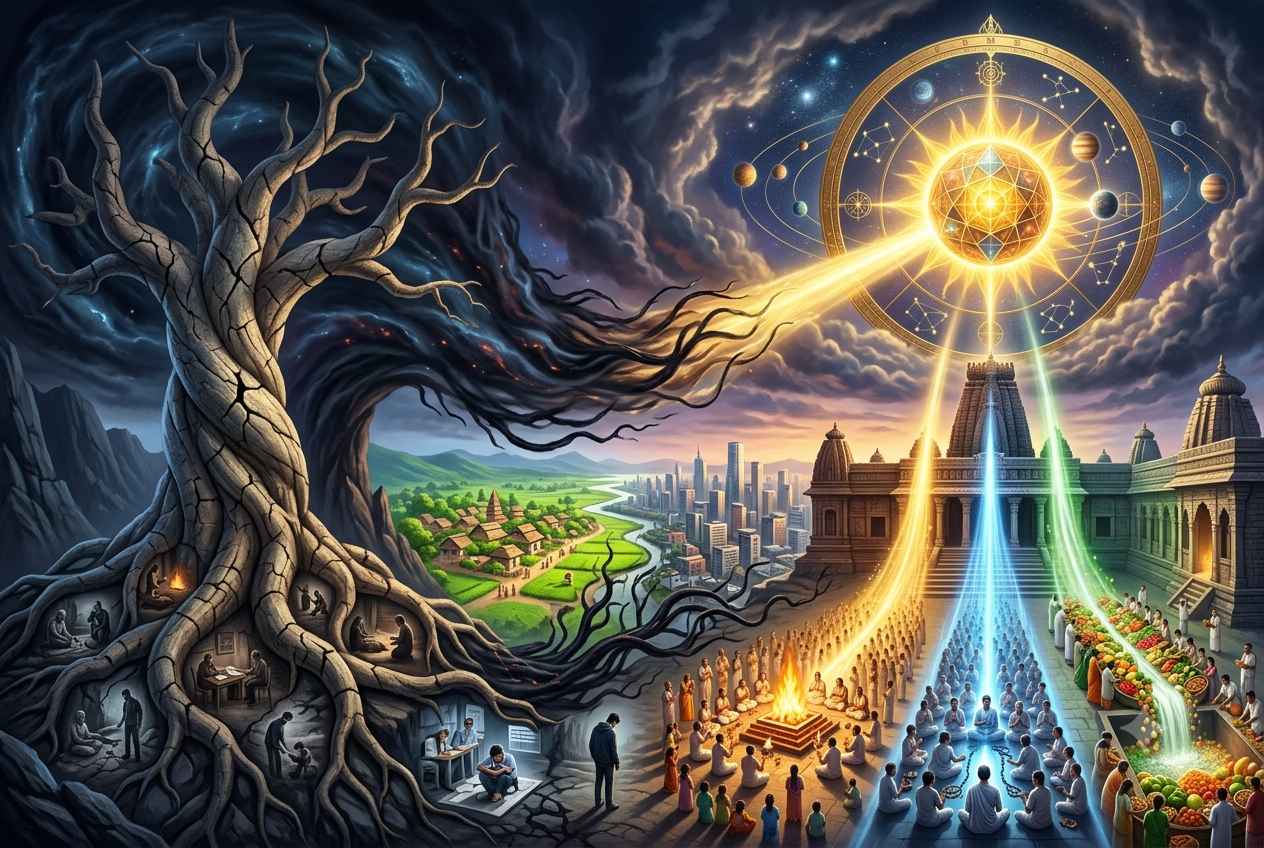 Pitra Dosha is the ancestral debt formed by an afflicted Sun and ninth house. It's linked to family obstacles and delayed progeny, but it can often be softened or cancelled. This guide covers its causes, signs, and the remedies used to ease it.
Pitra Dosha is often called the "ancestral debt." It's a condition linked to an afflicted Sun and ninth house in your birth chart, and traditionally, it points to unresolved duties toward one's ancestors.
People usually connect it with recurring family troubles, delays in having children, and problems that keep showing up in a family no matter how hard everyone tries to fix them. But here's the thing: like every dosha, it's a matter of degree. Other factors in the chart can partly or fully cancel it out.
And where it does remain, there are remedies for it. Pitru Paksha rituals, offering water to ancestors and the Sun, and charity are the traditional ways to ease it. This guide walks through the causes, the signs, how cancellation works, and the remedies people turn to. For the bigger picture on doshas in general, check out the Kundli Dosha guide.
You can also check whether your birth chart shows Pitra Dosha using our free Pitra Dosha Calculator before exploring its effects and remedies.
Quick Answer
- What it is: An ancestral dosha linked to an afflicted Sun and ninth house in the birth chart.
- Linked to: Family obstacles, ancestral karma, delayed progeny, recurring setbacks, and father-related matters.
- Can it be cancelled: Yes — a strong Sun, benefic influences, and the overall birth chart can significantly reduce or cancel its effects.
- Main remedy: Perform Shraddha and Tarpan during Pitru Paksha, offer water to the Sun, give charity in your ancestors' name, and honour your parents and elders.
- Important note: A Pitra Dosha indication from a calculator is not a final diagnosis. Its strength should always be confirmed through a complete birth chart analysis.
What Is Pitra Dosha?
The name comes from pitra, meaning ancestors or forefathers. Tradition holds that when duties toward ancestors go unfulfilled, or when karma from earlier generations stays unresolved, it can show up in the chart as an affliction to the planets and houses tied to ancestry.
The two big ones here are the Sun, which represents the father and forefathers, and the ninth house, which governs father, fortune, and dharma.
It's worth saying clearly: this isn't about blame. It's more like an inherited pattern, and the idea is that the living can help settle it through remembrance and remedy.
How Pitra Dosha Forms
A few patterns tend to point toward Pitra Dosha:
-
The Sun afflicted by Rahu, Ketu, or Saturn. Since the Sun represents the forefathers, having it conjunct or aspected by these shadow or malefic planets is a common trigger.
-
Rahu or Ketu sitting in the ninth house, or afflicting the ninth-house lord. The ninth house belongs to the father and ancestors, so this hits close to home.
-
Malefics placed in houses connected to lineage and progeny, which can disturb how the family line flows.
-
The Sun and Rahu together. This combination is especially associated with the dosha.
-
The exact combination actually matters a lot here. It decides how strong the dosha is and which remedies make sense for it. That's why you really need a full chart reading to confirm anything.
A complete Kundli helps determine whether the dosha is genuine or cancelled, so it's worth checking your full birth chart rather than relying on one combination alone.
Signs Associated with Pitra Dosha
Tradition links a handful of recurring patterns to Pitra Dosha, though none of these prove it on their own:
-
Trouble conceiving, or obstacles around children that keep coming back.
-
Problems that seem to repeat across the family, almost like the same struggles keep passing down the generations.
-
Delays and obstacles that stick around no matter how much genuine effort goes in.
-
Ongoing discord or a lack of peace at home.
-
A stuck feeling around fortune (the ninth house) that doesn't have an obvious explanation.
These are pointers, not proof. Most of life's difficulties have ordinary explanations that have nothing to do with any dosha, so you really do need a proper chart reading before drawing conclusions.
Is Pitra Dosha Always Serious? Cancellation
Just like every other dosha, the strength varies quite a bit, and cancellation is genuinely possible.
A Pitra Dosha formed by a strong, well-placed Sun plays out very differently than one formed by a deeply afflicted Sun. Benefic influences on the ninth house or the Sun can soften things considerably too.
This is exactly why a calculator flag doesn't mean much by itself. It's the whole chart that decides how much the dosha actually operates, if at all. So please don't treat it as a family curse. Think of it as a pattern worth understanding, and where it's genuinely present, something to address calmly.
Remedies for Pitra Dosha
Where the dosha does genuinely remain, here are the traditional remedies used to honour the ancestors and ease things:
-
Perform Shraddha and Tarpan during Pitru Paksha. This fortnight is considered the most important time to remember the forefathers, through shraddha rites and tarpan (water offerings). It's widely seen as the foremost remedy for this dosha.
-
Offer water (tarpan) to the ancestors and to the Sun. A simple daily practice: offer water to the Sun at sunrise and take a moment to remember your ancestors.
-
If you'd like to understand why offering water to the Sun is recommended, see our complete guide to Surya (Sun) Remedies.
-
Feed crows, cows, and brahmins, and offer food in the ancestors' name. Feeding crows during Pitru Paksha specifically is considered an especially meaningful act.
-
Offer water to a Peepal tree and light a lamp beneath it. This is linked to ancestral peace.
-
Give charity in the ancestors' name, particularly food, to people in need, on Amavasya (new-moon days).
-
Consider a Pitra Dosha Nivaran Puja. This is a dedicated shanti puja, traditionally performed at sacred sites like Gaya, Trimbakeshwar, or Haridwar. It's meant for cases where the chart shows a genuinely strong dosha, so it's best done on the guidance of a proper reading.
-
Respect and care for your living elders. Tradition holds this up as one of the foremost remedies of all, since honouring living parents and elders is the living expression of respect for your lineage.
Everyday Practices for Ancestral Peace
Beyond the bigger rituals, there are gentle daily habits that tradition treats as ongoing ways to honour ancestors and keep the ninth house at peace.
Offer water to the Sun each morning. Keep a photograph of departed elders somewhere clean and respected, and take a moment to remember them. Feed crows, cows, and dogs regularly. Keep harmony among the living family, since discord among descendants is thought to disturb ancestral peace. And give a little food in charity now and then, in the ancestors' name.
None of these are one-time fixes. They're small, cumulative practices, and they carry the same spirit as the bigger remedies: remembrance and respect for your lineage.
Pitra Dosha and Progeny — a Careful Note
Because Pitra Dosha gets tied so often to difficulty having children, this part deserves some care.
Tradition does link an afflicted ninth house and ancestral line to obstacles around progeny, and that's a common reason people go looking into this dosha in the first place. But difficulty conceiving has plenty of ordinary medical causes, and those need to be investigated and treated first, with a qualified doctor.
A dosha is a traditional framework for reflection, and where it's present, for remedy. It's never a diagnosis, and it's never a reason to delay medical care. Used the right way, remembering your ancestors sits alongside proper medical support. It doesn't replace it.
When to Get a Reading or Puja
Because Pitra Dosha depends on the exact affliction to the Sun and ninth house, and because cancellation happens often, the reliable way to know if it's actually present and strong is a reading with a Vedaz astrologer. They can also tell you which remedy actually fits your chart.
If a Nivaran puja is recommended, Vedaz's puja services can help arrange it. Treat a calculator result as a prompt to go check, never as the final word.
A Word of Caution
Pitra Dosha is something to understand calmly, not a curse to fear or a reason to feel guilty about your ancestors. Tradition frames it around remembrance and respect, not blame.
Remedies are there to honour the forefathers and support your own efforts. They're not a guarantee of outcomes, and they never replace medical care where progeny or health is concerned, or sensible action in any other area of life. Go into it with clarity, get it confirmed with a reading, and let respect guide you rather than fear.
Frequently Asked Questions
What is Pitra Dosha in simple terms? It's the "ancestral debt," a condition linked to an afflicted Sun and ninth house, connected in tradition to unfulfilled duties toward the forefathers. It's associated with family obstacles and delays in progeny, but it's read in degree and can be cancelled.
What causes Pitra Dosha? Generally, it traces back to the Sun (the significator of ancestors) being afflicted by Rahu, Ketu, or Saturn, or to Rahu/Ketu sitting in or afflicting the ninth house. The exact combination decides how strong it is.
What are the signs of Pitra Dosha? Traditionally: difficulty with progeny, problems repeating across generations, ongoing obstacles and delays despite real effort, and family discord. These are pointers rather than proof, since ordinary life explains most difficulties anyway, so a reading is needed to confirm anything.
What is the best remedy for Pitra Dosha? Performing shraddha and tarpan during Pitru Paksha, offering water to ancestors and the Sun, feeding crows and brahmins, and respecting living elders are considered the foremost remedies. A dedicated Nivaran puja comes into play where the chart shows a genuinely strong dosha.
Can Pitra Dosha be cancelled? Yes. Its strength varies, and benefic influences on the Sun or ninth house can soften it quite a bit. A calculator flag alone doesn't mean much. The whole chart is what decides how much the dosha actually operates.
When should Pitra Dosha remedies be done? Pitru Paksha is the most important window. Amavasya (new-moon days) are also traditional for charity and remembrance in the ancestors' name. Daily water offerings to the Sun can be an ongoing practice.
Does Pitra Dosha affect childbirth? Tradition does associate it with obstacles around progeny, which is one reason people look into it. But difficulty conceiving has plenty of medical causes that need proper care first. A dosha is a traditional framework, never a substitute for a doctor.
Is respecting living parents a remedy for Pitra Dosha? Yes. Tradition holds that honouring and caring for living parents and elders is among the foremost remedies, since it's the living expression of respect for the lineage the dosha concerns.
Do I need to go to Gaya or Trimbakeshwar for the remedy? Not necessarily. Those sacred sites are traditional for a formal Nivaran puja when the chart shows a strong dosha, but everyday remedies like Pitru Paksha rites, tarpan, feeding crows, charity, and respecting elders can be done anywhere. A reading will tell you whether a dedicated puja is even needed.
Can Pitra Dosha affect the whole family? Since it concerns the lineage, tradition links it with patterns that repeat across a family rather than sticking to one person. That said, it's still read from each individual's chart, and its strength varies, so it shouldn't be treated as some inescapable family curse.
How is Pitra Dosha different from Pitra Rin in Lal Kitab? They're related ideas from different systems. Pitra Rin is Lal Kitab's term for the ancestral debt, addressed through its own totke, while Pitra Dosha is the classical dosha read from the Sun and ninth house. Both are about duty to the ancestors, and both get approached through remembrance and remedy.
Should I feel guilty if I have Pitra Dosha? No, not at all. Tradition frames this around remembrance and respect, not blame or guilt. It points to an inherited pattern that the living can help settle by honouring the ancestors. The right response is calm respect, not guilt or fear. Treating it as a chance to reconnect with your lineage is much closer to its real spirit than treating it like a punishment.