Career Change Timing by Birth Chart, Dasha and Transits
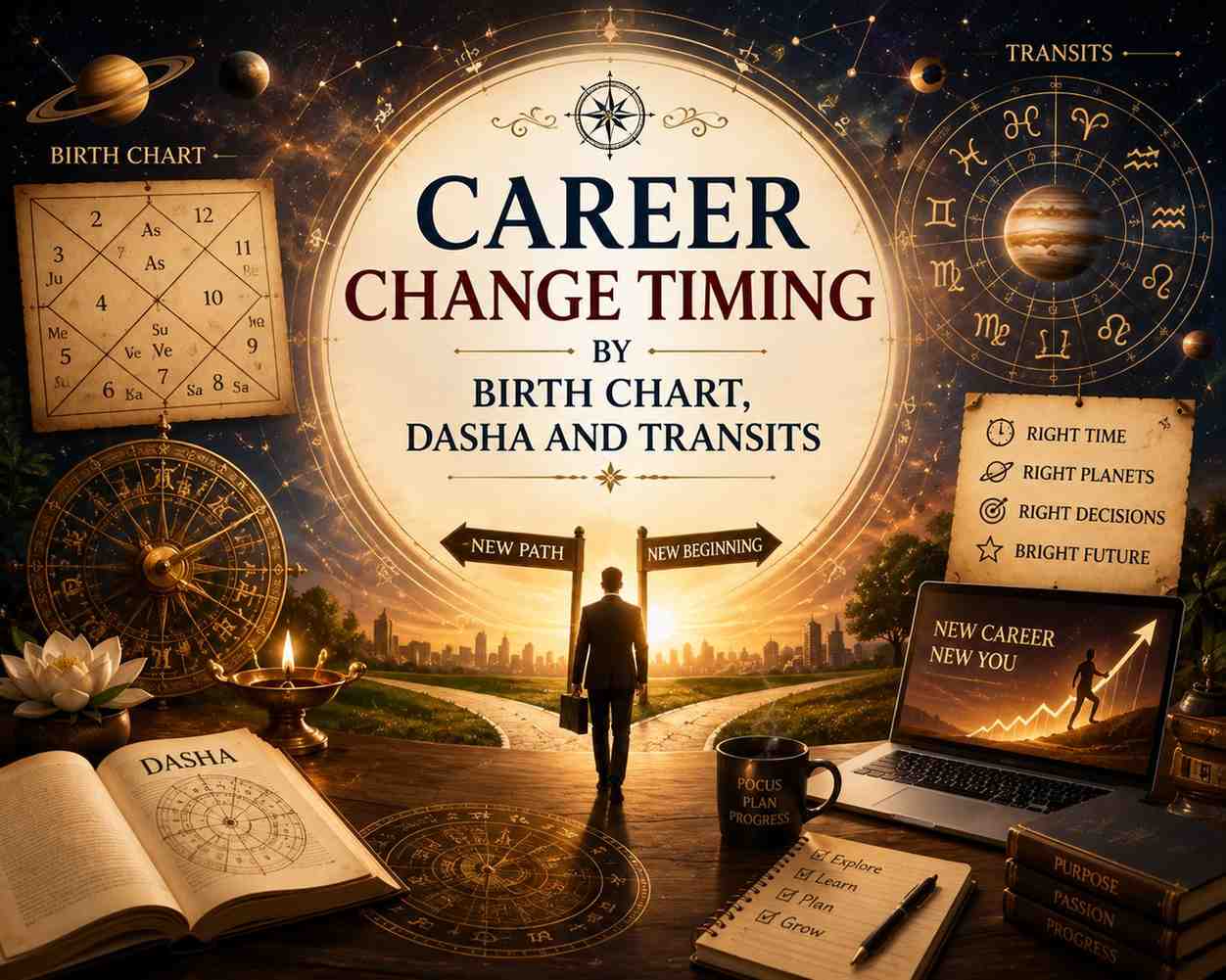
In Vedic astrology, career change timing is read through the 10th house and its lord, the Vimshottari Mahadasha-Antardasha sequence, and Saturn-Jupiter transits. The dasha of a strong 10th lord or yogakaraka is classically the most supportive period for professional transition.
- ◦Career Change Timing in Vedic Astrology — Quick Facts
- ◦The Mahadasha-Antardasha System: The Primary Tool for Career Change Timing
- ◦Saturn and Jupiter Transits: The Secondary Timing Layer for Career Change
- ◦How to Actually Read Career Change Timing — A Layer-by-Layer Approach
- ◦Common Career Timing Scenarios — What the Analysis Actually Looks Like
- ◦Career Change Timing vs. Other Career Questions in Vedic Astrology
- ◦The Honest Truth About Career Timing Astrology
- ◦Final Thought
"Is this the right time to leave?" It's one of the most honest questions a person can ask — and one of the hardest to answer. You've got the opportunity in front of you, the doubt in your chest, and no reliable way to know whether the timing is with you or against you.
This is exactly what Vedic astrology was built to address. Not to make the decision for you — but to tell you whether the cosmic currents are supporting a move or counseling patience. That's a genuinely useful thing to know, especially when the stakes are high.
This guide breaks down the whole system — which houses matter, how the dasha sequence times career events, what Saturn and Jupiter transits actually signal, and how to read all of it together for an honest picture of your career change window.
Career Change Timing in Vedic Astrology — Quick Facts
| Factor | What It Tells You |
|---|---|
| Primary houses | 10th (career), 6th (job/service), 7th (business), 2nd & 11th (income) |
| Primary timing tool | Vimshottari Mahadasha-Antardasha sequence |
| Secondary timing tool | Saturn and Jupiter transits to the 10th house and its lord |
| Most supportive periods | Dasha of strong 10th lord, yogakaraka, or Lagna lord |
| Periods requiring caution | Difficult Antardasha, Sade Sati peak, hard Saturn transit to 10th |
| Honest scope | Astrology identifies tailwinds and headwinds — it doesn't make decisions |
0## The Houses That Govern Career in a Vedic Birth Chart
Before you can read the timing, you need to know what is being timed. Career in Vedic astrology isn't one house — it's a constellation of houses, each covering a different dimension of professional life.
- 10th house (Karma Bhava) — the primary career house; your profession, public reputation, authority, and the work you're known for in the world
- 6th house — the job dimension specifically; daily work, service, employment, competition — distinct from career calling
- 7th house — business, partnership, dealings with the public; most relevant for self-employment and entrepreneurial moves
- 2nd house — earned income, accumulated resources; the financial layer of any professional change
- 11th house — gains, fulfillment of ambitions, income from work, professional networks; shows whether career efforts actually pay off
- 9th house — dharma, fortune, higher purpose; becomes especially relevant when a career change is also a values shift or calling
- Lagna (1st house) and its lord — the self doing the work; central to whether a change genuinely aligns with who you are
A real career timing analysis — the kind worth trusting — examines the lords of these houses, their placements, mutual relationships, and which of them the current dasha is activating.
Reading How to Read Your Vedic Birth Chart first gives you the foundation for understanding how these house lords interact in your specific chart.
The Mahadasha-Antardasha System: The Primary Tool for Career Change Timing
The Mahadasha timing system (Vimshottari Dasha) is Vedic astrology's most powerful tool for timing life events — and career change is one of the clearest areas where it shows up.
The core principle: your chart contains many latent potentials. Those potentials activate most strongly during the Mahadasha (major period) and Antardasha (sub-period) of the planets that govern them.
Dashas That Support Career Change
- Mahadasha or Antardasha of the 10th lord — typically the most direct career-activation period; this is when major professional developments tend to crystallize
- Mahadasha or Antardasha of a strong yogakaraka (a planet that is simultaneously a Kendra and Trikona lord for your specific Lagna) — among the most powerful periods in any chart for positive career movement
- Mahadasha or Antardasha of planets placed in the 10th house — these planets carry specific themes into your career; their period activates those themes
- Mahadasha or Antardasha of the Lagna lord — periods of self-direction; often support changes that genuinely align with your nature rather than externally driven moves
- 6th lord periods — particularly relevant for job changes (as distinct from deeper career-calling changes); often indicate shifts driven by work environment factors
Dashas That Counsel More Caution
- Difficult Antardashas of weak, afflicted, or functionally malefic planets for your chart — these periods add friction to voluntary change
- The interplay of Mahadasha and Antardasha is what actually matters — a favorable Mahadasha with a difficult Antardasha produces a very different picture than a difficult Mahadasha with a favorable Antardasha
This is why quick answers about career timing are rarely reliable. The combination active at the time of the planned transition is what determines the reading — not any single factor in isolation.
Saturn and Jupiter Transits: The Secondary Timing Layer for Career Change
Beyond the dasha sequence, Saturn and Jupiter are the two transit-level planets that matter most for career timing. They move slowly enough to shape extended windows — not just single months.
What Saturn Transits Signal for Career
- Saturn transiting the 10th house — often a period of career restructuring, increased responsibility, or significant professional reorientation; Saturn tests and rewards disciplined effort here
- Saturn transiting the 10th lord — can produce career pressure and reorganization
- Sade Sati (Saturn moving through the 12th, 1st, and 2nd from the natal Moon) — a major life-restructuring period that frequently includes career change; the peak phase over the natal Moon is the most intense stretch
- Saturn's transiting aspect to the 10th house — creates periodic pressure points worth noting
What Jupiter Transits Signal for Career
- Jupiter transiting the 10th house — classically one of the most favorable windows for positive career moves; expansion, opportunity, and growth energy
- Jupiter transiting the 2nd or 11th — favorable for income-related professional change
- Jupiter aspecting the 10th house or 10th lord during transit — supportive periods for growth-oriented moves
- The Jupiter Return (approximately every 12 years) — often correlates with significant life-direction reassessment, including career
The ideal window combines both: a career-supportive dasha period and a favorable Jupiter transit, without simultaneous difficult Saturn pressure. When all three align, the traditional analysis is clear. When they don't, nuance is required.
How to Actually Read Career Change Timing — A Layer-by-Layer Approach
This is where it comes together. A genuine career change timing analysis works through six layers — and skipping any of them produces an incomplete picture.
Layer 1 — Chart Foundation Is the 10th house and its lord fundamentally strong? Does the chart support the kind of career being considered? This is the "what" question before the "when" question — and it matters more.
Layer 2 — Current Mahadasha What major period is active right now, and is it broadly career-supportive for this chart?
Layer 3 — Current and Upcoming Antardasha What sub-period is active during the planned transition window? Does it add support or friction?
Layer 4 — Saturn and Jupiter Transits Are the slow-planet transits supportive, neutral, or challenging during the relevant window?
Layer 5 — Specific Transit Triggers Are there shorter-term activations — Jupiter crossing the 10th lord, for example — that point to specific favorable months within the broader window?
Layer 6 — Honest Integration Put it all together into a real assessment: strongly supported, mixed but workable, or genuinely challenging.
The output of honest analysis isn't "change jobs on March 15." It's "the period from X to Y carries tailwind because of these specific dasha and transit factors, while the period from A to B presents headwinds because of these."
That's the kind of guidance that actually helps — it informs your decision without pretending to replace it. To understand how these layers interact with your personal placements, reading your birth chart with these frameworks in mind is the essential starting point.
Common Career Timing Scenarios — What the Analysis Actually Looks Like
"Should I Leave My Stable Job for an Uncertain Opportunity?"
This is the most common question — and the most personal. Astrologically, it helps to examine whether the current period supports risk-taking (strong Lagna lord or yogakaraka dasha, supportive Jupiter transit) or counsels stability (difficult Antardasha, Sade Sati peak phase).
The analysis identifies whether timing adds tailwind or headwind to what is ultimately a very human decision.
"My Career Feels Stuck — When Will Things Change?"
The analysis here shifts to identifying when the next career-supportive dasha or transit window arrives. Sometimes a supportive window is genuinely close. Sometimes the honest answer is that the current difficult period has a known duration and the improvement follows it.
Both are useful to know — the second one especially, because it turns an open-ended sense of stagnation into a defined waiting period with an end point.
"I Was Laid Off — What Should I Do Next?"
When the change is involuntary, the analysis shifts entirely. Instead of "should I change," the question becomes "what kind of next move does this period best support?" And whether the difficult period is transitional (with clear improvement ahead) or requires patient navigation without forcing a premature move.
"I Want to Change Fields Entirely — Not Just Jobs"
A complete field change involves the deeper chart factors — the 9th house (dharma, calling), the Lagna lord (alignment with your nature), and whether the new field aligns with the chart's genuine career significators.
This is the most substantial form of career change and deserves the deepest analysis. Exploring Career Field Selection alongside this timing framework gives you the full picture — the "what" and the "when" together.
For ongoing career navigation — especially when you're in the middle of a transition and not sure what the next step should be — Niti - niti, Vedaz's AI astrologer specializing in career astrology, can help you think through which direction your chart actually supports.
Career Change Timing vs. Other Career Questions in Vedic Astrology
Career timing is just one dimension of career astrology. It's worth knowing how it connects to the broader questions:
- Government Job Astrology — specific planetary combinations (strong Sun, Saturn, Moon) that indicate government service; timing analysis identifies when those combinations activate
- Business vs Job — a foundational chart-reading question about whether the 7th house or 6th house is more naturally prominent; this determines whether timing is better read through entrepreneurial or employment lenses
- Both of those questions sit upstream of the timing analysis — which is why the chart foundation always comes before the timing window
The Honest Truth About Career Timing Astrology
This needs saying clearly, because a lot of what circulates as career astrology isn't honest.
- Astrology identifies supportive versus challenging windows — it does not dictate decisions. The decision remains yours, informed by practical factors (financial runway, family circumstances, opportunity quality) that no chart can capture
- No period is categorically forbidden for career change. Difficult periods add headwind — they make transitions harder, not impossible. Many successful career changes have happened during challenging astrological windows through conscious effort and solid preparation
- Be deeply skeptical of false precision — "change jobs on this exact date for guaranteed success" is not astrology; it is the performance of astrology. Genuine timing analysis identifies windows and tendencies, not dates and guarantees
- The chart foundation matters more than the timing. If your chart supports a particular direction, timing optimizes the move into it. If the chart doesn't support the direction, favorable transits won't make it sustainable
- The most useful application of all this is planning ahead — knowing when a supportive window is approaching so you can prepare, position yourself, and be ready to act when the timing opens
Final Thought
Career change is one of the most consequential decisions you'll make — and the question of timing is one of the most genuinely useful things astrology can speak to.
The tradition gives you a structured framework: the career houses, the Mahadasha-Antardasha sequence, the Saturn and Jupiter transits. Together, they map which windows carry genuine support and which carry friction.
But the honest engagement with all of this is clear: astrology informs the decision; it doesn't make it. It identifies tendencies, not guarantees. It optimizes timing for directions the chart actually supports — it doesn't override the deeper question of whether the direction itself is right for you.
The most practical way to use career timing astrology is preparation. Know when your next supportive window is arriving. Use the quieter periods to build skills, financial runway, and the readiness to act.
When the window opens — with the dasha supportive and the transits aligned — you're not scrambling to catch up. You're ready to move, with both the chart's tailwind and your own preparation working together.
The chart suggests the season. The preparation and the decision remain entirely yours.
Achyut Venkatesh
Career Astrology, Professional Growth & Timing Analysis | 15+ Years
Achyut Venkatesh specializes in career astrology, professional transitions, and predictive techniques. His work helps readers understand traditional astrological indicators associated with career shifts and long-term vocational planning.
Frequently Asked Questions
1. How does Vedic astrology determine career change timing?
Through three layers: the houses governing work (10th primarily, plus 6th, 7th, 2nd, 11th), the Vimshottari Mahadasha-Antardasha sequence that activates latent chart potentials, and the Saturn and Jupiter transits that shape extended windows of support or challenge. Genuine analysis examines all three layers together rather than any one factor in isolation.
2. Which dasha periods support career change?
The Mahadasha or Antardasha of a strong 10th lord, a yogakaraka (Kendra + Trikona lord for the specific Lagna), planets placed in the 10th house, or the Lagna lord (for changes aligned with one's genuine nature). Difficult Antardashas of weak or afflicted planets add friction — but they are not categorical prohibitions.
3. What do Saturn and Jupiter transits mean for career timing?
Jupiter transiting the 10th house is classically favorable for positive career moves. Saturn transiting the 10th often brings restructuring and increased demand — workable but requiring effort. Sade Sati frequently includes significant career change, with the peak phase being the most intense. A window supported by both favorable dasha and favorable Jupiter transit, without difficult Saturn pressure, is classically the strongest combination.
4. Is there a bad time to change careers astrologically?
No period is categorically off-limits. Difficult periods (challenging Antardasha, Sade Sati peak, hard Saturn transit to the 10th) add headwind — they make transitions more demanding, not impossible. The honest framing is tailwinds and headwinds, not green lights and red lights.
5. Can astrology tell me the exact date to change jobs?
No. And skepticism is the right response to anyone offering this. Genuine timing analysis identifies windows and tendencies — "the period from X to Y is well-supported because of these factors" — not specific dates with guaranteed outcomes. The decision, and the preparation, remain yours.
6. What matters more — the chart foundation or the timing?
The chart foundation matters more. If your chart genuinely supports a particular career direction, timing optimizes when to move toward it. If the chart doesn't support the direction, favorable transits won't produce sustainable success. The deepest career in astrology asks "what" before "when."
Related Blogs

Manifestation techniques every Entrepreneur Should Know
Find out how mindset and manifestation can influence your entrepreneurial journey. Uncover powerful daily practices to manifest success and abundance.

Priyanka Chopra’s Bollywood Break – Horoscope Insights
From Bollywood royalty to Hollywood powerhouse—Priyanka Chopra’s chart shows her destiny was always global. See how Rahu, Saturn, and Jupiter shaped her journey.

This is How Shah Rukh Khan’s stars Helped Him Rule Bollywood
Before Bollywood crowned him, the cosmos had already declared him King. Explore how SRK’s stars—Mars, Rahu & more—crafted his journey to superstardom.

Best Careers for Each Life Path Number – Numerology Guide
Open your career future with the hidden power of numerology! Discover the Life Path Number to find out the most enjoyable career choices.