Gana Dosha in Kundli Matching: Meaning, Effects and Solutions
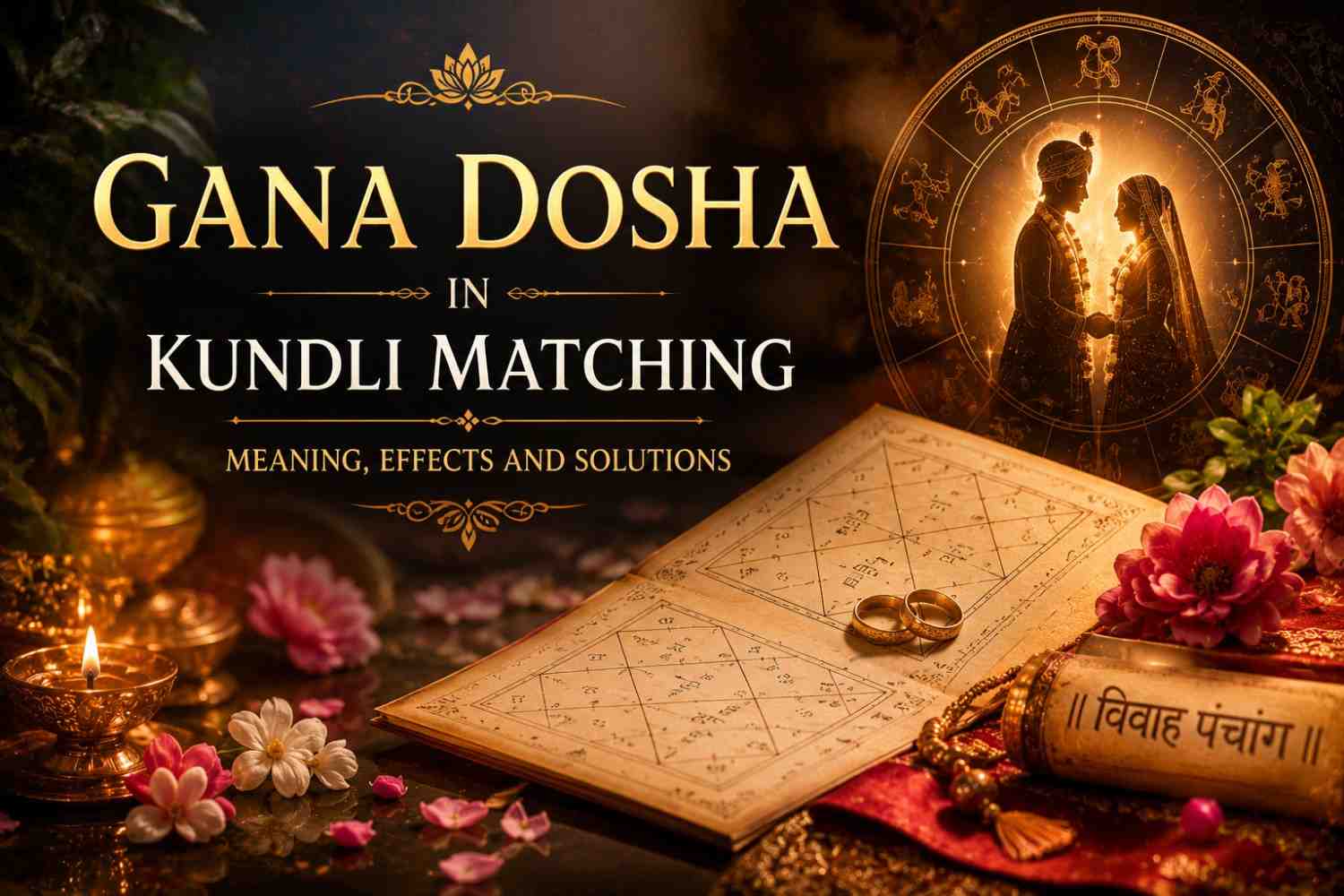
Gana Dosha forms when the birth nakshatras of two marriage partners fall into incompatible temperament classifications — particularly the Deva-Rakshasa combination. In the 36-point Guna Milan system, Gana koota carries 6 points. Classical tradition recognizes cancellation conditions that are frequently overlooked before matches are rejected.
- ◦What Is Gana Dosha — And Why Rakshasa Gana Is So Misunderstood
- ◦What the Three Ganas Actually Mean
- ◦Gana Compatibility — Which Combinations Work and Which Don't
- ◦Classical Cancellation Conditions for Gana Dosha — Check These Before Concluding Anything
- ◦The Honest Framing on Gana Dosha Severity
- ◦Classical Remedies for Gana Dosha
- ◦Critical Cautions for Families Evaluating Marriage Matches
- ◦Final Thought
What Is Gana Dosha — And Why Rakshasa Gana Is So Misunderstood
Here's something that comes up in almost every Gana Dosha conversation: someone's been told their partner is "Rakshasa Gana" and the word alone has created panic in the family. Rakshasa. Demonic. How could this be a good match?
The thing is — that reading is completely wrong.
Rakshasa Gana is not about being evil or dangerous. It describes intensity, willpower, and a self-determined nature. Some of the most accomplished, transformative people you'll ever meet are Rakshasa Gana.
The misreading of this term causes far more unnecessary marriage rejections than the actual temperamental difference ever would.
Gana Dosha is real — it describes a genuine temperamental gap between certain nakshatra types. But it's a gap to be understood and navigated, not a verdict to be feared.
This guide gives you the honest picture: what the three Ganas actually mean, which combinations create the dosha, when it's canceled, and how to evaluate it properly.
Quick Answers: Gana Dosha at a Glance
- What it is: Temperamental incompatibility between partners' birth nakshatra Gana classifications
- Points at stake: 6 of 36 in the Guna Milan system
- Three Ganas: Deva (divine/gentle), Manushya (human/balanced), Rakshasa (intense/willful)
- Most difficult combination: Deva + Rakshasa — zero points awarded
- Primary concern: Temperamental harmony and day-to-day emotional compatibility
- Cancellation conditions: Yes — same Moon sign, same nakshatra lord, and others
- Is Rakshasa Gana bad? No — it describes intensity and willpower, not moral deficiency
What the Three Ganas Actually Mean
The Gana system divides all 27 nakshatras into three temperament types. Understanding what each actually describes — beyond the surface-level labels — is essential to honest evaluation.
Deva Gana (Divine Temperament)
Deva Gana natives are associated with gentleness, refinement, spiritual orientation, and a harmonious disposition.
They tend toward peace-seeking, ethical conduct, and a generally pleasant temperament in daily life. They prefer harmony over confrontation and typically approach relationships with sensitivity and care.
Deva nakshatras: Ashwini, Mrigashira, Punarvasu, Pushya, Hasta, Swati, Anuradha, Shravana, Revati
Manushya Gana (Human Temperament)
Manushya Gana natives carry a balanced mix of qualities — practical, ambitious, emotionally complex, and recognizably human in their blend of strengths and flaws.
They engage with material life, relationships, and goals in a grounded, realistic way. Neither as gentle as Deva nor as intense as Rakshasa — they're the bridge temperament.
Manushya nakshatras: Bharani, Rohini, Ardra, Purva Phalguni, Uttara Phalguni, Purva Ashadha, Uttara Ashadha, Purva Bhadrapada, Uttara Bhadrapada
Rakshasa Gana (Intense Temperament)
Rakshasa Gana natives are associated with intensity, willpower, independence, and a powerful self-determined disposition. The label is deeply misunderstood in popular discussion.
Rakshasa does not mean evil, dangerous, or morally inferior — it describes someone who is strong-willed, direct, and doesn't easily compromise their nature. Many highly accomplished, transformative, and deeply purposeful people are Rakshasa Gana.
Rakshasa nakshatras: Krittika, Ashlesha, Magha, Chitra, Vishakha, Jyeshtha, Mula, Dhanishta, Shatabhisha
Gana Compatibility — Which Combinations Work and Which Don't
The Gana koota awards points based on how well the two temperament types interact:
| Combination | Points | Assessment |
|---|---|---|
| Deva + Deva | 6/6 | Fully compatible |
| Manushya + Manushya | 6/6 | Fully compatible |
| Rakshasa + Rakshasa | 6/6 | Fully compatible — two intense temperaments understand each other |
| Deva + Manushya | 5-6/6 | Generally compatible depending on tradition |
| Manushya + Rakshasa | Partial | Moderate compatibility — manageable |
| Deva + Rakshasa | 0/6 | Classical Gana Dosha — most difficult combination |
The primary concern is the Deva-Rakshasa combination. The gentle, harmony-seeking Deva temperament and the intense, self-determined Rakshasa temperament can generate meaningful friction in daily life — particularly around conflict style, decision-making pace, and emotional expression.
The Manushya-Rakshasa combination is considered less problematic. The practical, grounded human temperament can bridge to the intense Rakshasa nature more readily than the gentle Deva temperament can. If Gana Dosha appears in an assessment, it matters which type it is.
Also, for a broader view of how Mars placements interact with temperament in compatibility — the Manglik Dosha Deep guide covers a related set of Mars-driven dynamics that experienced astrologers evaluate alongside Gana in the same compatibility assessment..
Classical Cancellation Conditions for Gana Dosha — Check These Before Concluding Anything
Just as Nadi Dosha analysis requires checking cancellation conditions before concluding incompatibility, Gana Dosha follows exactly the same principle — and the same step gets skipped just as often. Classical tradition recognizes the following:
- Same Moon sign (rashi) for both partners — Gana Dosha is canceled in many traditions; shared emotional foundation overrides temperamental classification
- Same nakshatra lord for both partners — significantly reduces or cancels the dosha; shared planetary rulership creates underlying compatibility
- Moon sign lords of both partners are friends — substantially reduces the dosha even when the Gana combination is difficult
- Male is Deva, female is Rakshasa — some traditions treat this direction as less problematic than the reverse
- Strong overall Guna Milan score (28+) with only Gana as deficit — considered viable by many experienced astrologers
- Powerful benefic yogas in both charts — strong Jupiter or Venus configurations can offset the temperamental concern
- Harmonious nakshatra padas — sub-divisional compatibility within the nakshatra can moderate the Gana mismatch
Checking your birth chart accurately for nakshatra, Moon sign, and nakshatra lord is the essential first step before any cancellation condition can be evaluated properly.
If you're unsure how these cancellation conditions interact with your specific chart combination, Shubha - shubha — Vedaz's AI astrologer focused on marriage compatibility — can walk through the full Gana and cancellation picture for both charts.
The Honest Framing on Gana Dosha Severity
Here's what the full classical tradition actually says — versus the fear-based version:
- Rakshasa Gana is not negative — it is a temperament classification describing intensity and willpower, not moral worth. Never allow it to be framed as one partner being inferior
- Gana Dosha is about temperamental harmony — whether two people's natural operating styles create friction or flow in daily life
- Gana carries 6 points — significant, but less heavily weighted than Nadi (8 points) or Bhakoot (7 points). It should not override an otherwise strong compatibility profile
- The Deva-Rakshasa combination requires more conscious mutual understanding — but many successful marriages exist with this combination, particularly when both partners are self-aware
- Temperamental difference, consciously managed, can produce complementary partnership — the Deva partner's gentleness softens the Rakshasa partner's intensity; the Rakshasa partner's directness gives the Deva partner grounding
- A Deva-Rakshasa marriage where both partners understand the dynamic is far more stable than a same-Gana marriage where both partners are unconscious of their patterns
Classical Remedies for Gana Dosha
When Gana Dosha is present and no cancellation conditions apply, classical tradition recommends these practices. The behavioral and relational remedies here are particularly important — Gana Dosha is temperamental, so the most effective remedies are also temperamental.
- Both partners worship their Ishta Devata (chosen personal deity) for temperamental harmony and inner balance
- Recite Vishnu Sahasranama jointly — for marriage harmony and mutual protection
- Worship Lord Shiva and Goddess Parvati together on Mondays — the divine couple who themselves embody deeply different and complementary natures
- Perform Gana Dosha Nivaran Pooja before marriage if the dosha is significant and uncanceled
- The Rakshasa Gana partner consciously develops patience and gentleness practices — not to suppress their nature, but to extend understanding toward the Deva partner
- The Deva Gana partner consciously develops resilience and directness practices — not to harden, but to meet the Rakshasa partner's intensity without withdrawal
- Both partners engage in conscious communication practices that honor temperamental difference — this is the most practically effective remedy for Gana Dosha
- Donate to causes supporting harmonious family life
- Both partners worship the planets ruling their respective birth nakshatras
For remedy guidance specific to your nakshatra and chart situation, Atri - atri at Vedaz can recommend a structured approach that fits the actual planetary configuration behind your Gana placement.
Critical Cautions for Families Evaluating Marriage Matches
- Rakshasa Gana is not "demonic" — this misreading causes more unnecessary match rejections than the actual temperamental difference ever would. Correct this framing immediately if it appears in your evaluation
- Gana Dosha is about temperamental match, not moral worth — never allow it to be framed as one partner being a lesser person
- Always check cancellation conditions first — same Moon sign and same nakshatra lord are the most powerful and most frequently overlooked
- The Deva-Rakshasa combination requires conscious understanding — not automatic rejection
- Gana Dosha (6 points) is less heavily weighted than Nadi (8) or Bhakoot (7) — it should not override an otherwise strong compatibility profile
- Temperamental difference, consciously managed, often produces complementary partnership — many of the strongest marriages are between people whose temperaments complement rather than mirror each other
- When evaluating Gana Dosha alongside other factors like Pitra Dosha, experienced astrologers weigh the total dosha burden across the chart rather than treating each factor as a separate veto
Final Thought
Gana Dosha is fundamentally about temperamental compatibility — and the most important thing to carry away from this guide is that Rakshasa Gana is not a flaw. The intense, willful, self-determined temperament it describes belongs to some of the most accomplished and purposeful people.
The Deva-Rakshasa combination in marriage simply means the partnership requires more conscious mutual understanding to bridge a genuine temperamental difference.
With cancellation conditions properly checked, and with both partners aware of how their natures interact, this is entirely navigable — and can even become a source of genuine complementarity.
The Kaal Sarp Dosha Guide covers another significant natal factor that sometimes appears alongside Gana considerations in comprehensive chart readings — worth understanding as part of the complete picture.
Gana Dosha describes a real dynamic. But it is a dynamic to be navigated with awareness — not a verdict to be feared.
Ishani Chaturvedi
Horoscope Analysis, Doshas & Spiritual Astrology | 10+ Years
Ishani Chaturvedi is a spiritual astrology writer who specializes in horoscope interpretation, dosha analysis, and remedial traditions. Her content bridges classical astrological wisdom with practical guidance for modern readers.
Frequently Asked Questions
1. What is Gana Dosha?
Gana Dosha is a Vedic marriage compatibility factor based on the temperamental classification of both partners' birth nakshatras. The 27 nakshatras divide into three Ganas: Deva (divine/gentle), Manushya (human/balanced), and Rakshasa (intense/willful). In the 36-point Guna Milan system, the Gana koota carries 6 points. Gana Dosha primarily forms in the Deva-Rakshasa combination, where the two temperamental styles require the most conscious mutual understanding to bridge successfully.
2. Is Rakshasa Gana bad?
No — and this is probably the most important clarification in this entire guide. Rakshasa Gana does not mean evil, demonic, or morally deficient. It describes intense, willful, self-determined, powerful temperament. Many highly accomplished, strong, and transformative people are Rakshasa Gana. It is a temperament classification — not a moral judgment — and should never be treated as one.
3. Which Gana combinations are compatible?
Same-Gana combinations (Deva-Deva, Manushya-Manushya, Rakshasa-Rakshasa) all receive full 6 points. Deva-Manushya is generally compatible. Manushya-Rakshasa receives partial points and is considered manageable. Deva-Rakshasa receives zero points — this is the classical Gana Dosha and the most difficult combination, requiring the most conscious mutual understanding between partners.
4. What cancels Gana Dosha?
The most powerful cancellations: same Moon sign for both partners and same nakshatra lord for both partners. Additional conditions include Moon sign lords being friends, strong overall Guna Milan score (28+) with only Gana as deficit, powerful benefic yogas in both charts, and harmonious nakshatra padas despite the Gana mismatch. Some traditions also treat male-Deva/female-Rakshasa as less problematic than the reverse.
5. Is Gana Dosha a serious problem for marriage?
It's significant but not the most heavily weighted factor — Nadi (8 points) and Bhakoot (7 points) both outweigh it. The Deva-Rakshasa combination requires more conscious mutual understanding but is not automatically disqualifying. Many successful marriages exist with this combination. Temperamental difference, consciously managed, frequently produces complementary rather than conflicting partnership. Cancellation conditions are real and must be checked.
6. What are the best remedies for Gana Dosha?
Both partners worshipping their chosen deity for temperamental harmony, joint Vishnu Sahasranama recitation, Shiva-Parvati worship on Mondays (the divine couple who embody complementary natures), Gana Dosha Nivaran Pooja before marriage if uncanceled, and conscious temperament practices — the Rakshasa partner developing patience, the Deva partner developing resilience. Conscious communication practices that honor temperamental difference are the most practically effective remedy for this dosha specifically.
Related Blogs
Dreaming of moving abroad? Check Foreign Travel Astrology
Is your destiny written in the stars? Discover if the universe is guiding you toward a life abroad!
The Best Places to Travel Abroad Foreign Travel Astrology
Is foreign travel written in your stars? Explore how astrology influences your journeys and uncover the best destinations for your zodiac sign!
Can Your Birth Chart Predict Depression Symptoms?
This article examines whether astrological birth charts can predict depression symptoms, contrasting astrological beliefs with psychological research on personality traits and mental health.
The Manifestation Secrets Hidden in Celebrity Birth Charts
Find out what makes fame unique and special. This guide lets you know how some of the biggest celebrities use planetary help to become successful—and how you can do the same.