Kundali Milan Score Meaning: What 18, 24, 28 or 32 Gunas Really Mean
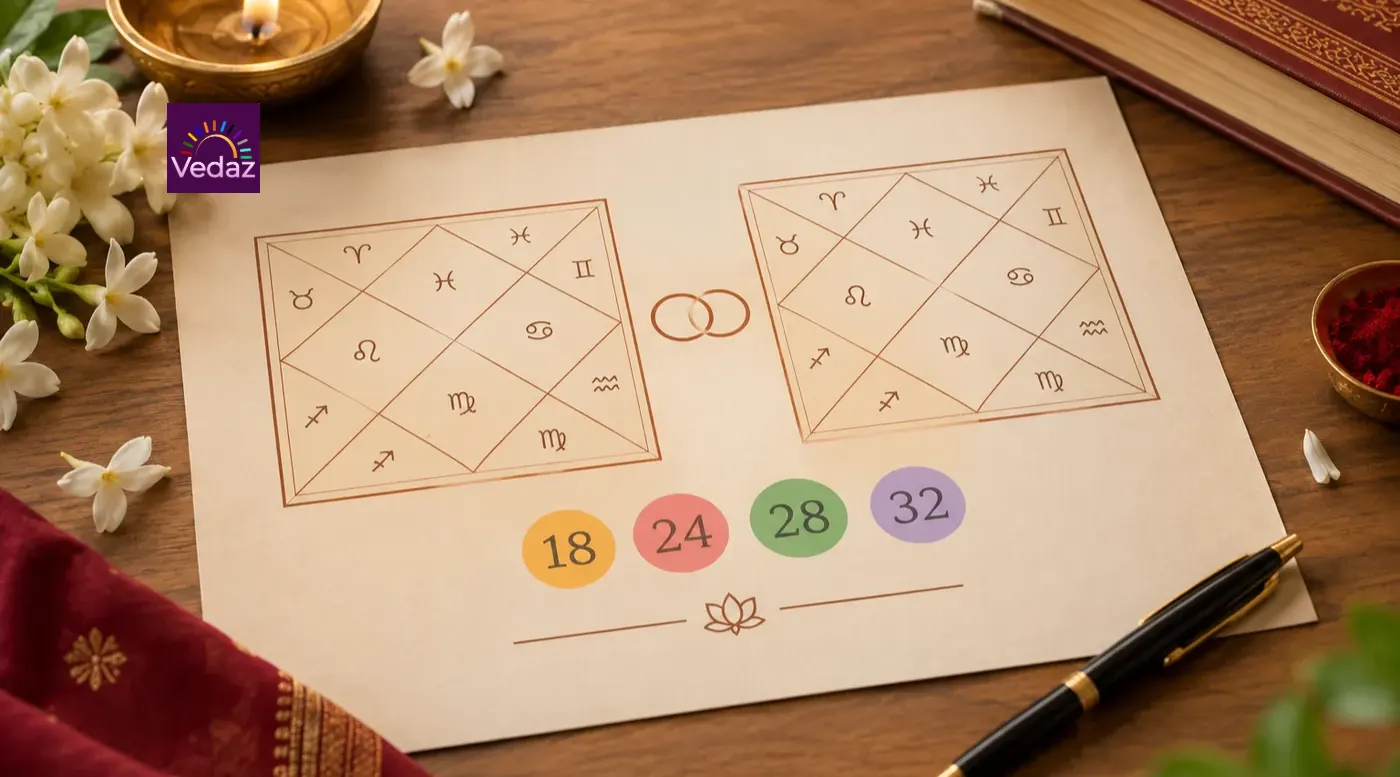
In kundali milan, a score under 18 out of 36 gunas is traditionally seen as weak, 18 to 24 as average, 25 to 32 as good and 33 to 36 as excellent. Astrologers also check Nadi and Bhakoot doshas and their cancellations alongside the total.
- ◦Kundali Milan Score at a Glance: Quick Facts
- ◦Kundali Milan Score Chart: What Each Range Means
- ◦Kundali Milan Score Meaning, Range by Range
- ◦Why the Kundali Milan Score Is Not the Whole Story
- ◦How Astrologers Actually Read a Kundali Milan Score
- ◦What Each Low Koota Means in Everyday Life
- ◦Common Kundali Milan Score Questions Families Ask
- ◦Key Takeaways
You run a kundali matching and a number pops up. 19. Or 23. Or 28. Before you've even closed the tab, the family WhatsApp group is asking, "So, is this good?"
Fair question. And the honest answer is "it depends", which nobody likes hearing. So let's make that answer a little more useful.
We'll start with the traditional score chart. Then we'll get to the part most reports skip: how to read the number in context. If you're curious how the score is built in the first place, our guide on how kundli matching is calculated walks through the maths.
Kundali Milan Score at a Glance: Quick Facts
- Classical minimum: 18 out of 36 gunas is the traditional threshold.
- Below 18: Traditionally weak, but not an automatic no.
- 18 to 24: Average or acceptable, a workable match.
- 25 to 32: Good to very good.
- 33 to 36: Excellent, and quite rare.
- What weighs more: Nadi and Bhakoot, which carry 15 of the 36 points.
- Not in the score: Manglik status, the 7th house and dasha timing.
Kundali Milan Score Chart: What Each Range Means
| Gunas (out of 36) | Traditional label | What astrologers usually say |
|---|---|---|
| 0 to 17 | Below average | Traditionally needs deeper analysis. Check cancellations and the full charts. |
| 18 to 24 | Average / acceptable | Workable match. Look at which kootas scored low. |
| 25 to 32 | Good to very good | Strong natural compatibility on most factors. |
| 33 to 36 | Excellent | Rare. Very high traditional compatibility. |
18 is the classical threshold. It's exactly half of 36, and it's the number you'll hear in most family discussions: "Kam se kam 18 gun milne chahiye." (At least 18 gunas should match.)
Every one of those 36 points comes from the eight kootas of guna milan. So if a term in this post feels new, that guide explains each koota from scratch.
Kundali Milan Score Meaning, Range by Range
Here's what each band really tells you, in plain language.
Below 10 Gunas
Several big kootas are scoring zero, usually some mix of Nadi, Bhakoot and Gana. Before you react, check two things:
- Are the zeros cancelled? Classical texts list cancellation conditions for both Nadi and Bhakoot. We cover them in our guide to Nadi Dosha and Bhakoot Dosha.
- Are the birth details correct? A wrong birth time near a nakshatra boundary can wipe out 8 to 15 points.
An astrologer will want to see the full charts here. A low score is a reason to look deeper, not a verdict.
10 to 17 Gunas
This is traditionally below the threshold. But very often, a score in this range is low because of just one or two big kootas, like Nadi (8) or Bhakoot (7). If those doshas are cancelled, the real compatibility can be much higher than the number suggests. This is the range where a proper consultation helps the most.
18 to 20 Gunas
Is 18 gunas good for marriage? Traditionally, yes. It's acceptable. But look at where the points came from:
- Strong Nadi, Bhakoot and Gana, weaker small kootas: A solid foundation.
- Strong small kootas, but Nadi and Bhakoot both at 0: Check the cancellations carefully.
21 to 24 Gunas
A comfortable average-to-good match. Plenty of couples who go through kundli milan land somewhere between 18 and 28. The low-scoring kootas simply show where you'll need to put in a bit more effort, whether that's communication, temperament or family adjustment.
25 to 28 Gunas
A good match. Most kootas agree. The conversation usually shifts from "should we?" to "when?", which means looking at dasha periods and a good muhurat.
29 to 32 Gunas
A very good match, with strong agreement on almost every factor. Still, check Manglik status and the 7th house, because ashtakoot doesn't cover either one. Our guide on Manglik Dosha in kundli matching explains how that works.
33 to 36 Gunas
Excellent, and rare. A score this high needs different nadis, a favourable Bhakoot and agreement in Gana, Yoni and Graha Maitri. Even then, a full chart reading is wise. A perfect score can't measure your communication habits, your values or your life goals.
Fun fact: Two people born in the same nakshatra share the same Nadi. That means Nadi = 0 before cancellations, so a same-nakshatra couple can't reach 36 on the raw score. It's also one of the classic Nadi Dosha cancellation cases, but only when the padas or Moon signs differ. You can read the full conditions in our guide to Nadi Dosha cancellation and remedies.
Why the Kundali Milan Score Is Not the Whole Story
Here's the most useful idea in this whole series:
Two couples with the same score can have completely different compatibility.
Look at these two made-up reports:
| Koota (max) | Couple A | Couple B |
|---|---|---|
| Varna (1) | 1 | 0 |
| Vashya (2) | 2 | 0 |
| Tara (3) | 3 | 1.5 |
| Yoni (4) | 4 | 1 |
| Graha Maitri (5) | 3 (lords neutral) | 0.5 |
| Gana (6) | 6 | 0 |
| Bhakoot (7) | 0 (not cancelled) | 7 |
| Nadi (8) | 0 (not cancelled) | 8 |
| Total | 19 | 18 |
Couple A scored 19, which looks better on paper. But the two heaviest kootas are both zero and neither dosha is cancelled. Traditionally, that calls for careful analysis.
Couple B scored 18, a point lower. But the two most important kootas are full, with no Nadi or Bhakoot Dosha. Their challenges are in temperament (Gana) and mental wavelength (Graha Maitri). Those are real, but workable with awareness and communication.
Most astrologers would feel more comfortable with Couple B, even with the lower total.
How Astrologers Actually Read a Kundali Milan Score
When an experienced astrologer opens a report, they usually check things in roughly this order:
- Nadi: Is it 8 or 0? If 0, is it cancelled?
- Bhakoot: Is it 7 or 0? If 0, is it cancelled?
- Gana: Any big mismatch, like Deva with Rakshasa or Manushya with Rakshasa?
- Graha Maitri: Do the two minds connect?
- Total score: Is it above or below 18?
- Manglik status of both partners, which isn't part of the 36 at all.
- The 7th house, Venus, Navamsa and dashas. We cover these in what astrologers check beyond 36 gunas.
See where the total sits? Fifth. That's why chasing a high number alone can mislead you.
What Each Low Koota Means in Everyday Life
If one koota scores low, here's what it usually means in day-to-day terms, and what tends to help:
| Low koota | Traditional concern | Everyday translation | What helps |
|---|---|---|---|
| Varna | Ego and role imbalance | Different attitudes to work and duty | Agree on roles early |
| Vashya | Uneven influence | One partner may dominate decisions | Make big decisions together, on purpose |
| Tara | Wellbeing and luck | Your "bad days" may land together | Patience during stressful phases |
| Yoni | Physical and instinctive | Different rhythms and comfort levels | Open, respectful conversation |
| Graha Maitri | Mental friendship | Different ways of thinking | Shared hobbies, active listening |
| Gana | Temperament | Different conflict styles | Agree on "rules" for arguments |
| Bhakoot | Emotional bond, finances | Emotional or money friction | Be transparent about money and family |
| Nadi | Health, progeny | Traditionally linked to health and children | Premarital medical screening plus an astrologer's review |
This turns a score into a practical relationship guide, which is honestly the best way to use kundli matching.
Common Kundali Milan Score Questions Families Ask
"Only 16 gunas matched. Should we say no?"
Not on that basis alone. Find out why it's 16. If Nadi or Bhakoot is zero but cancelled, the real compatibility is higher than it looks. If the charts are otherwise supportive, many astrologers would consider moving ahead with suitable remedies.
"We got 30+ gunas. Do we even need an astrologer?"
A high score is lovely news. But ashtakoot doesn't check Manglik Dosha, the 7th house or timing. A short review covering those is still worth it.
"Two websites gave us different scores."
Usually it comes down to the ayanamsa, small differences in the Vashya and Gana tables, or whether a site adds points back after cancellation. Pick a tool that shows the full koota breakdown. Our step-by-step kundli matching calculation explains every cause.
"Does a low score affect a love marriage?"
Classical astrology doesn't separate love marriages from arranged ones. Couples who already know each other well often find the low kootas describe friction points they've already learned to handle. So use the score for insight, not as a test to pass or fail.
Key Takeaways
- 0 to 17 is below average, 18 to 24 is acceptable, 25 to 32 is good and 33 to 36 is excellent.
- 18 gunas is the classical minimum, but where the points come from matters more than the total.
- Check Nadi and Bhakoot first, then look at the total.
- Every low koota can be read as a practical relationship tip.
- Doshas need context. Read more on Nadi Dosha and Bhakoot Dosha.
Want to see your full koota breakdown and not just a total? Try the free kundli matching tool. Got a question about your score? Ask Veda.
Raghav Mishra
Guna Milan, Ashtakoot matching, marriage compatibility, doshas. | 14 years
Raghav Mishra approaches marriage astrology by explaining the reasoning behind traditional compatibility systems rather than focusing on scores alone. He breaks down matching factors, unfamiliar terminology, and common misconceptions so readers can better understand Kundli matching reports and their cultural context.
Frequently Asked Questions
1. How many gunas should match for marriage?
Traditionally, at least 18 out of 36 gunas should match for a marriage to be considered acceptable. A score of 25 or more is seen as good, and 33 or more as excellent. Astrologers also check Nadi and Bhakoot doshas, their cancellations and Manglik status before advising.
2. Is 18 gunas good for marriage?
Yes. 18 gunas is the traditional minimum for an acceptable match. Whether it's a strong 18 depends on which kootas scored. Full Nadi and Bhakoot points make an 18 much stronger than one where both are zero.
3. Is 36 gunas matching possible?
Yes, but it's rare. A 36 out of 36 needs full points in all eight kootas, including different nadis and a favourable Moon-sign distance. Even a perfect score should be paired with a check of Manglik status and the 7th house.
4. What if fewer than 18 gunas match?
A score below 18 is traditionally considered weak, but it is not automatically a rejection. Check whether Nadi or Bhakoot Dosha is cancelled, go through the full charts with an astrologer, and look at the classical remedies before deciding.
5. Which is better: high gunas or no doshas?
Most astrologers prefer having no uncancelled Nadi or Bhakoot Dosha over a slightly higher total. Those two kootas carry 15 of the 36 points and are traditionally the most important for long-term married life.
Related Blogs

Dreaming of moving abroad? Check Foreign Travel Astrology
Is your destiny written in the stars? Discover if the universe is guiding you toward a life abroad!

The Best Places to Travel Abroad Foreign Travel Astrology
Is foreign travel written in your stars? Explore how astrology influences your journeys and uncover the best destinations for your zodiac sign!

Can Your Birth Chart Predict Depression Symptoms?
This article examines whether astrological birth charts can predict depression symptoms, contrasting astrological beliefs with psychological research on personality traits and mental health.

The Manifestation Secrets Hidden in Celebrity Birth Charts
Find out what makes fame unique and special. This guide lets you know how some of the biggest celebrities use planetary help to become successful—and how you can do the same.