How Kundli Matching Is Calculated: The Math Behind 36 Gunas
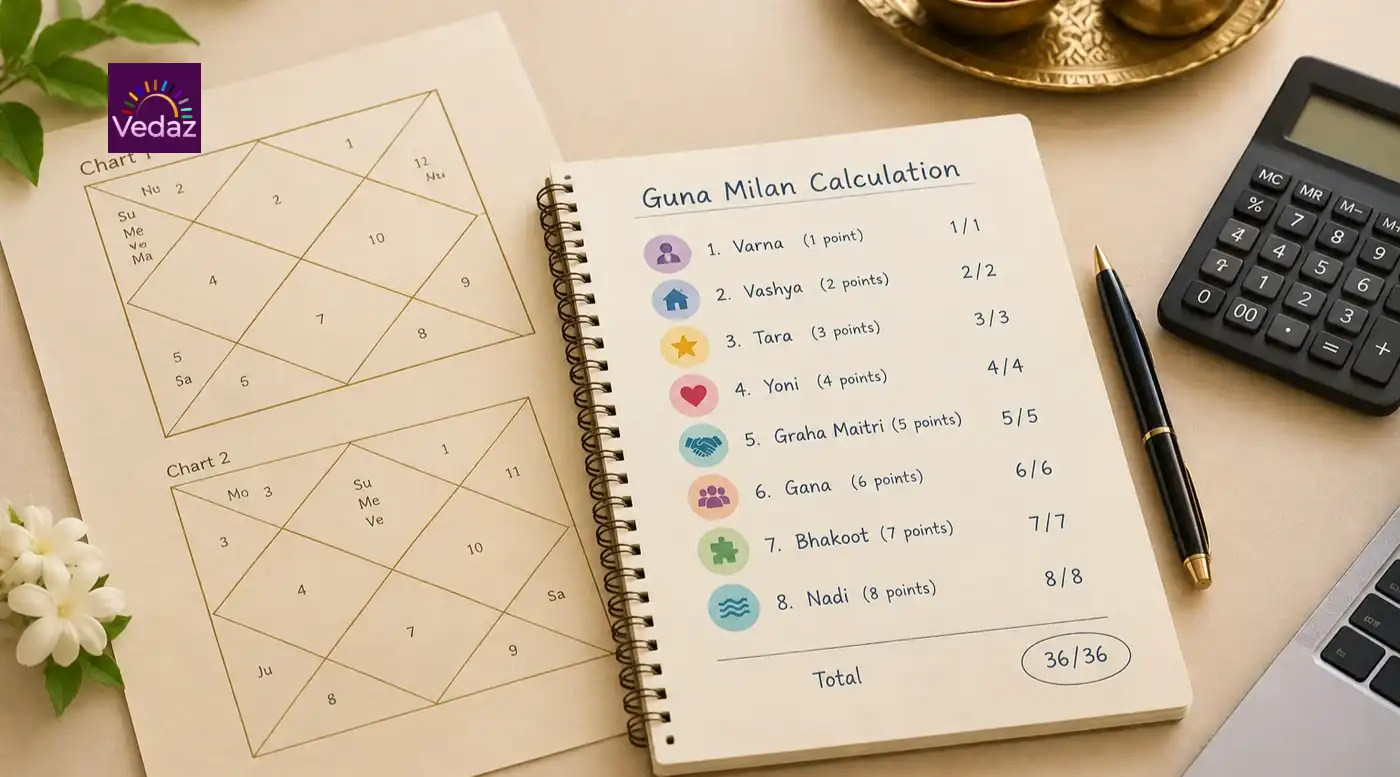
Kundli matching is calculated from each partner's Moon sign and Moon nakshatra. The eight ashtakoot kootas are scored with fixed rules, such as counting nakshatras and dividing by 9, then added up to give a guna milan total out of 36.
- ◦Kundli Matching Calculation at a Glance: Quick Facts
- ◦How Kundli Matching Is Calculated: Start With the Two Moons
- ◦Our Example Couple for the Kundli Matching Calculation
- ◦Kundli Matching Calculation Step by Step: All 8 Kootas
- ◦Final Scorecard: Guna Milan Calculation Result
- ◦How to Calculate Kundli Matching: The Whole Method on One Card
- ◦Why Your Kundli Matching Calculation May Differ From an App
- ◦Key Takeaways
You've probably seen a matching report that says "Total: 27/36". It looks official. But where does that number actually come from?
Honestly, there's no magic in it. It's mostly counting, a bit of dividing by 9, and some table lookups. If you can handle school maths, you can do this.
We'll take one example couple and work out their whole kundli milan by hand, one koota at a time. Grab a pen. By the end, you'll be able to check any report yourself.
Kundli Matching Calculation at a Glance: Quick Facts
- Starting point: The Moon's sidereal longitude in each person's chart.
- Moon sign: Longitude ÷ 30, take the whole number, add 1.
- Nakshatra: Longitude ÷ 13.333, take the whole number, add 1.
- Tara koota: Count nakshatras both ways, divide by 9, and check the remainder.
- Bhakoot koota: Count the distance between the Moon signs. The pairs 2/12, 5/9 and 6/8 score 0.
- Final score: The eight kootas add up to a maximum of 36 gunas.
- Inputs needed: Date, time and place of birth for both people.
- Why results differ: Ayanamsa, point tables and cancellation handling change from tool to tool.
How Kundli Matching Is Calculated: Start With the Two Moons
Every koota is based on the Moon. So before any scoring begins, you need two things for each person:
- Moon sign (rashi)
- Moon nakshatra, and ideally the pada (quarter)
Not sure what these are? Our guide on what a kundli is explains them from scratch. And if you want to know what each koota actually measures before you calculate it, read our ashtakoot guna milan guide first.
The Maths Behind the Moon Sign and Nakshatra
Here's the setup:
- The zodiac is a 360° circle.
- It splits into 12 signs of 30° each.
- It also splits into 27 nakshatras of 13°20′ each (360 ÷ 27 = 13.333°).
- Each nakshatra has 4 padas of 3°20′. That makes 108 padas, and exactly 9 padas fit into each sign.
Now take the Moon's sidereal longitude (worked out with the Lahiri ayanamsa) and use these three formulas:
- Sign number = whole part of (longitude ÷ 30) + 1
- Nakshatra number = whole part of (longitude ÷ 13.333) + 1
- Pada = whole part of ((longitude − start of that nakshatra) ÷ 3.333) + 1
Let's try it on our example couple.
Groom: Moon at 48° sidereal
- Sign: 48 ÷ 30 = 1.6, so 1 + 1 = 2, which is Taurus (Vrishabha)
- Nakshatra: 48 ÷ 13.333 = 3.6, so 3 + 1 = 4, which is Rohini
Bride: Moon at 63° sidereal
- Sign: 63 ÷ 30 = 2.1, so 2 + 1 = 3, which is Gemini (Mithuna)
- Nakshatra: 63 ÷ 13.333 = 4.72, so 4 + 1 = 5, which is Mrigashira
- Pada: Mrigashira starts at 53.333°. (63 − 53.333) ÷ 3.333 = 2.9, so it's pada 3
Why precision matters: Mrigashira sits across two signs. Padas 1 and 2 fall in Taurus, and padas 3 and 4 fall in Gemini. If a calculation is off by even half a degree near a boundary, the Moon sign changes. And with it, Varna, Vashya, Graha Maitri and Bhakoot all change too. That's why Vedaz uses Swiss Ephemeris with the Lahiri ayanamsa for every match.
Our Example Couple for the Kundli Matching Calculation
| Detail | Groom | Bride |
|---|---|---|
| Moon sign | Taurus (Vrishabha) | Gemini (Mithuna) |
| Sign number | 2 | 3 |
| Moon nakshatra | Rohini (#4) | Mrigashira (#5), pada 3 |
| Sign lord | Venus | Mercury |
Got it? Now let's score all eight kootas.
Kundli Matching Calculation Step by Step: All 8 Kootas
Step 1: Varna Koota (Max 1)
| Moon sign | Varna | |
|---|---|---|
| Groom | Taurus | Vaishya |
| Bride | Gemini | Shudra |
Rule: 1 point if the groom's varna is equal to or higher than the bride's. The traditional order is Brahmin, Kshatriya, Vaishya, Shudra. (Here, varna means temperament in the astrological sense, not birth caste.)
Vaishya is higher than Shudra, so Varna = 1 / 1.
Step 2: Vashya Koota (Max 2)
| Moon sign | Vashya group | |
|---|---|---|
| Groom | Taurus | Chatushpad (four-legged) |
| Bride | Gemini | Manava (human) |
Rule: Same group scores 2. Chatushpad with Manava is a partly compatible pairing, and the commonly used table gives it 1.
So Vashya = 1 / 2.
Step 3: Tara Koota (Max 3), the "Divide by 9" Step
This is the step most people find mysterious. It's really just counting.
The rule, in plain steps:
- Count from one nakshatra to the other, including both the starting and the ending nakshatra.
- Divide that count by 9 and note the remainder.
- Remainders 3, 5 and 7 are unfavourable (Vipat, Pratyari, Vadha). All the others are favourable.
- Do it in both directions. Every favourable direction earns 1.5 points.
Bride to groom (Mrigashira #5 to Rohini #4):
Counting forward from #5 to #27 gives 23 nakshatras. Then #1 to #4 adds 4 more. That's 27 in total. 27 ÷ 9 = 3 with remainder 0, and a remainder of 0 is treated as 9. That's Parama Mitra (best friend), which is favourable, so 1.5.
Groom to bride (Rohini #4 to Mrigashira #5):
Counting #4 and #5 gives 2. 2 ÷ 9 leaves remainder 2, which is Sampat (wealth). Favourable again, so 1.5.
Both directions are favourable, so Tara = 3 / 3.
Quick formula: count = ((target − start + 27) mod 27) + 1. Then remainder = count mod 9.
A practice example with an unfavourable result: Say the bride is in Ashwini (#1) and the groom is in Krittika (#3).
- Bride to groom: count = 3, remainder 3, which is Vipat (unfavourable), so 0
- Groom to bride: from #3 to #27 is 25, plus #1 makes 26. 26 mod 9 = 8, which is Mitra (favourable), so 1.5
That pair would get Tara = 1.5 / 3.
Step 4: Yoni Koota (Max 4)
| Nakshatra | Yoni animal | |
|---|---|---|
| Groom | Rohini | Serpent |
| Bride | Mrigashira | Serpent |
Rule: Same animal scores 4.
So Yoni = 4 / 4.
(If the bride had been in Uttara Ashadha, whose yoni is Mongoose, the Serpent and Mongoose pair would be sworn enemies and Yoni would be 0.)
Step 5: Graha Maitri Koota (Max 5)
| Moon sign | Lord | |
|---|---|---|
| Groom | Taurus | Venus |
| Bride | Gemini | Mercury |
Rule: Check how each lord feels about the other, using the natural planetary friendships.
- Venus treats Mercury as a friend.
- Mercury treats Venus as a friend.
Mutual friends means Graha Maitri = 5 / 5.
Step 6: Gana Koota (Max 6)
| Nakshatra | Gana | |
|---|---|---|
| Groom | Rohini | Manushya (human) |
| Bride | Mrigashira | Deva (divine) |
Rule (common table): Same gana scores 6. A Manushya groom with a Deva bride scores 5 in most software, though some traditions give 6.
So Gana = 5 / 6.
Step 7: Bhakoot Koota (Max 7), the Sign-Distance Step
The rule: Count the signs from bride to groom and from groom to bride, counting both ends. The pairs 2/12, 5/9 and 6/8 score 0. Everything else scores 7.
Quick formula: distance = ((target sign − start sign + 12) mod 12) + 1
- Groom to bride: Taurus (2) to Gemini (3) = 2
- Bride to groom: Gemini (3) to Taurus (2) = 12
That makes it a 2/12 pair (Dwirdwadash), so Bhakoot = 0 / 7. This is called Bhakoot Dosha.
But wait. Check the cancellation first. Classical texts say Bhakoot Dosha is cancelled when the two Moon-sign lords are the same planet or are friends. We already saw in Step 5 that Venus and Mercury are mutual friends. So the dosha is cancelled.
Here's where tools differ:
- Some software then awards the full 7 points.
- Others keep the raw 0 and simply flag "dosha cancelled".
So always read the notes, not just the number. For the full cancellation rules, see our guide to Nadi Dosha and Bhakoot Dosha, and our read on Bhakoot Dosha effects and remedies.
Step 8: Nadi Koota (Max 8)
| Nakshatra | Nadi | |
|---|---|---|
| Groom | Rohini | Antya (Kapha) |
| Bride | Mrigashira | Madhya (Pitta) |
Rule: Different nadis score 8. The same nadi scores 0, which is Nadi Dosha.
The nadis are different here, so Nadi = 8 / 8.
Had they matched, classical texts list cancellations too, and you can read them in the Nadi section of the guide linked above. One more thing: Nadi is traditionally linked to health, but astrology isn't a medical test. A simple premarital health screening is a good idea for any couple, whatever the report says.
Final Scorecard: Guna Milan Calculation Result
| Koota | Max | Score | Note |
|---|---|---|---|
| Varna | 1 | 1 | Vaishya ≥ Shudra |
| Vashya | 2 | 1 | Chatushpad and Manava |
| Tara | 3 | 3 | Both directions favourable |
| Yoni | 4 | 4 | Both Serpent |
| Graha Maitri | 5 | 5 | Venus and Mercury are friends |
| Gana | 6 | 5 | Manushya and Deva |
| Bhakoot | 7 | 0 | 2/12, dosha cancelled (friendly lords) |
| Nadi | 8 | 8 | Antya vs Madhya |
| Total | 36 | 27 |
The raw score is 27 / 36, and the only dosha (Bhakoot) is classically cancelled. In traditional terms, that's a good match. If a tool adds back the Bhakoot points after cancellation, you'd see 34 / 36 instead.
So what do 27 or 34 really mean for a marriage? Our guide on kundali milan score meaning answers that.
How to Calculate Kundli Matching: The Whole Method on One Card
- Get each person's Moon longitude (sidereal, Lahiri).
- Convert it to a sign (÷ 30) and a nakshatra (÷ 13.333).
- Varna: compare sign groups (1 point).
- Vashya: compare sign animal-groups (0 to 2).
- Tara: count nakshatras both ways, mod 9, and avoid remainders 3, 5 and 7 (0 to 3).
- Yoni: compare nakshatra animals (0 to 4).
- Graha Maitri: compare the friendship of the sign lords (0 to 5).
- Gana: compare nakshatra temperaments (0 to 6).
- Bhakoot: count the sign distance and avoid 2/12, 5/9 and 6/8 (0 or 7). Check cancellations.
- Nadi: compare nakshatra nadis. Same means 0 (0 or 8). Check cancellations.
- Add it all up. Then look beyond the number.
Why Your Kundli Matching Calculation May Differ From an App
Tried this yourself and got a different answer from a website? Here are the usual reasons:
| Reason | Effect |
|---|---|
| Different ayanamsa (Lahiri, Raman or KP) | The Moon can shift nakshatra, or even sign, near boundaries |
| Time zone or daylight saving errors | Common for births before 1950 or outside India |
| Different Vashya and Gana tables | A difference of 0.5 to 1 guna |
| Cancellation handling | Some tools add points back after cancellation, others only flag it |
| Name-based matching | Uses the name's first syllable to guess the nakshatra instead of the real Moon position |
A trustworthy tool shows you the koota-by-koota breakdown, like the scorecard above, and not just a total. The free Vedaz kundali matching tool shows every koota, the reasoning behind it and any cancellations.
Key Takeaways
- Every kundli matching calculation starts with the Moon's sidereal longitude.
- Sign = ÷ 30, nakshatra = ÷ 13.333. Tara uses mod 9, and Bhakoot uses sign distance.
- Our example couple scored 27/36, with a cancelled Bhakoot Dosha.
- Always check the koota-by-koota breakdown and the cancellation notes, not just the total.
Want to skip the maths? Get your 36 gunas worked out with the free kundli milan tool, or try free kundli matching with full koota details.
Raghav Mishra
Guna Milan, Ashtakoot matching, marriage compatibility, doshas. | 14 years
Raghav Mishra approaches marriage astrology by explaining the reasoning behind traditional compatibility systems rather than focusing on scores alone. He breaks down matching factors, unfamiliar terminology, and common misconceptions so readers can better understand Kundli matching reports and their cultural context.
Frequently Asked Questions
1. How is kundli matching calculated?
It's calculated from each partner's Moon sign and Moon nakshatra. Eight kootas (Varna, Vashya, Tara, Yoni, Graha Maitri, Gana, Bhakoot and Nadi) are scored with fixed classical rules and then added up. The total is out of 36 gunas.
2. How is Tara koota calculated in kundli milan?
Count the nakshatras from the bride's to the groom's, and then from the groom's to the bride's, including both ends each time. Divide each count by 9. A remainder of 3, 5 or 7 is unfavourable. Each favourable direction earns 1.5 points, up to 3.
3. How do you calculate Bhakoot in kundli matching?
Count the signs from one partner's Moon sign to the other's, in both directions. If the pair is 2/12, 5/9 or 6/8, Bhakoot scores 0, which is called Bhakoot Dosha. Otherwise it scores 7. Classical texts say the dosha is cancelled if the sign lords are the same planet or are friends.
4. Can I calculate guna milan manually?
Yes. With both Moon signs, both nakshatras and the standard koota tables, you can work out all 36 gunas by hand in about 15 minutes. The hardest part is getting the Moon's position right, since that needs accurate ephemeris software.
5. Which inputs are needed to calculate kundli matching?
The date, time and place of birth for both people. These give the precise Moon position. If you only have names, the first syllable gives a rough nakshatra estimate, which is less accurate.
Related Blogs

Boost Your Health with Astrology
Boost your health with astrology using zodiac-based habits, wellness tips, and simple routines for better physical and mental balance.

The Socking Truth Behind Wearing A Black Thread
Uncover the mystery behind the black thread. From protection to spiritual energy—here’s why everyone’s suddenly wearing one.

Hidden Messages In Your Moles
What if that little mole on your cheek is more than just a mark? Explore the fascinating meanings behind mole placements and what they reveal about your future.
Who Is Your Ishta Devata?
Explore the concept of your personal God in Hinduism. Learn how to discover, connect with, and build a relationship with your Ishta Devata for inner peace and spiritual growth.