Ashtakoot Milan: The 8 Kootas and 36 Gunas Explained Simply
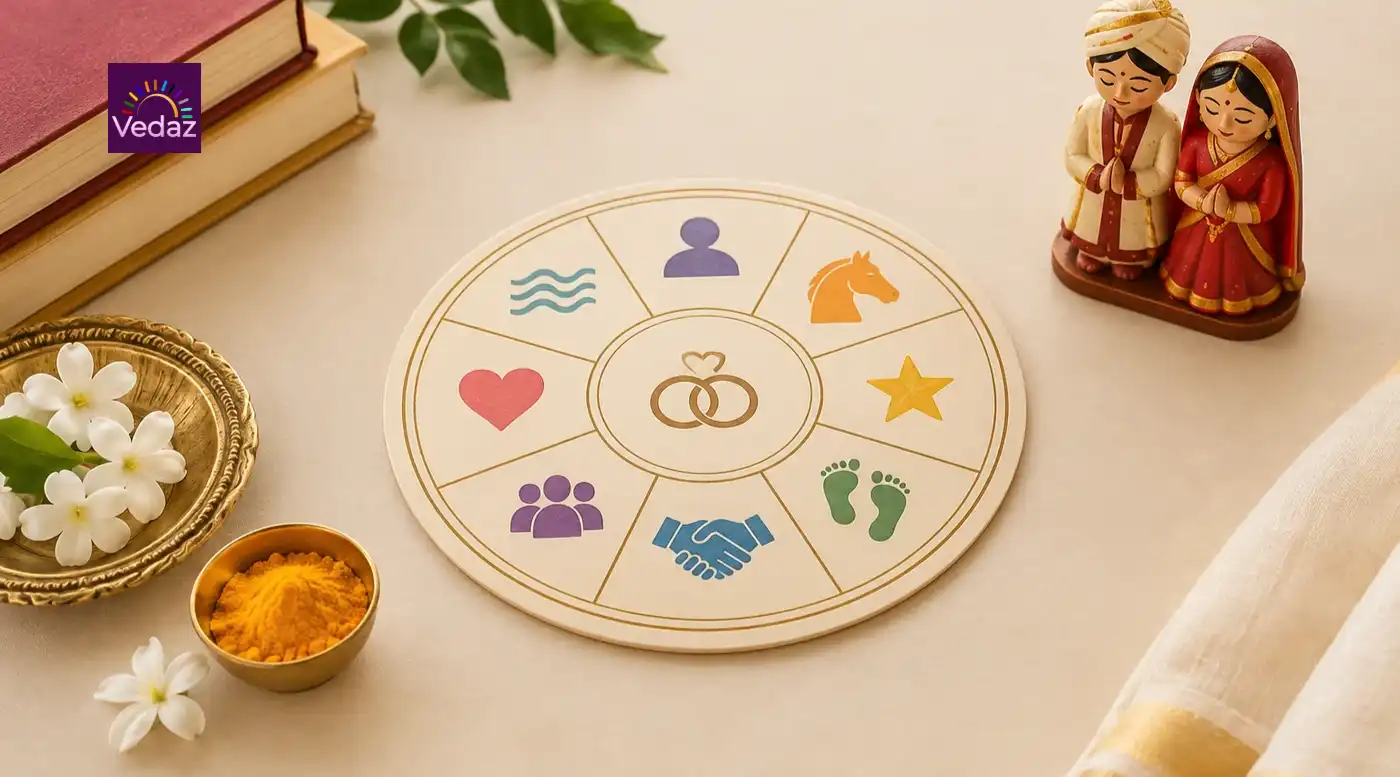
Ashtakoot Milan is the 8-factor guna milan system used in kundli matching. The eight kootas are Varna, Vashya, Tara, Yoni, Graha Maitri, Gana, Bhakoot and Nadi. Together they carry 36 gunas, calculated from each partner's Moon sign and nakshatra.
- ◦Ashtakoot Milan at a Glance: Quick Facts
- ◦What Does Ashtakoot Milan Actually Mean?
- ◦Ashtakoot Milan Chart: The 8 Kootas and Their Gunas
- ◦How Ashtakoot Milan Compares Two Charts
- ◦1. Varna Koota (1 Guna): Work Style and Outlook
- ◦2. Vashya Koota (2 Gunas): Attraction and Influence
- ◦3. Tara Koota (3 Gunas): Luck and Wellbeing Together
- ◦4. Yoni Koota (4 Gunas): Physical and Instinctive Compatibility
- ◦5. Graha Maitri Koota (5 Gunas): Mental Friendship
- ◦6. Gana Koota (6 Gunas): Temperament
- ◦7. Bhakoot Koota (7 Gunas): Emotional Bond and Family Prosperity
- ◦8. Nadi Koota (8 Gunas): Health and Progeny
- ◦Which Kootas Matter Most in Ashtakoot Milan?
- ◦Ashtakoot vs Dashakoot: North Indian and South Indian Matching
- ◦Key Takeaways
Someone says, "Their kundli matched 24 gunas." Sounds good, right? But 24 out of what, and who decided what each point stands for?
That "out of" is 36, and it comes from ashtakoot milan, the scoring method at the heart of kundli matching. Once you know what its eight parts measure, those numbers stop feeling like a riddle.
So let's open the box and go through it one koota at a time. No heavy jargon, promise.
Ashtakoot Milan at a Glance: Quick Facts
- Meaning: "Ashta" is eight and "koota" is a group, so ashtakoot means eight categories.
- Total score: The eight kootas add up to 36 gunas.
- The eight kootas: Varna (1), Vashya (2), Tara (3), Yoni (4), Graha Maitri (5), Gana (6), Bhakoot (7) and Nadi (8).
- Based on: The Moon in each chart: its sign, its nakshatra, or the lord of its sign.
- Heaviest kootas: Nadi (8), Bhakoot (7) and Gana (6) carry 21 of the 36 points.
- Why apps differ: Small differences in point tables can shift a total by 1 to 3 gunas.
- Low score? It's a reason to talk and look closer, not a final verdict.
What Does Ashtakoot Milan Actually Mean?
"Ashta" means eight and "koota" means a group or category. So when someone says "24 gunas matched", they're giving you the total from these eight categories.
If you'd like the big picture first, our beginner guide on what kundali matching is covers it. Here, we look at each koota on its own: what it checks, how it's decided, and why it carries the points it does. And when you're ready to see the numbers in action, there's a full worked example of how kundli matching is calculated with two real charts.
Ashtakoot Milan Chart: The 8 Kootas and Their Gunas
| # | Koota | Max gunas | Based on | Life area (traditional view) |
|---|---|---|---|---|
| 1 | Varna | 1 | Moon sign | Work temperament, ego balance |
| 2 | Vashya | 2 | Moon sign | Attraction, mutual influence |
| 3 | Tara | 3 | Moon nakshatra | Wellbeing, fortune together |
| 4 | Yoni | 4 | Moon nakshatra | Physical and instinctive comfort |
| 5 | Graha Maitri | 5 | Lords of Moon signs | Mental friendship, understanding |
| 6 | Gana | 6 | Moon nakshatra | Temperament and behaviour |
| 7 | Bhakoot | 7 | Moon signs (distance) | Emotional bond, prosperity, family growth |
| 8 | Nadi | 8 | Moon nakshatra | Health, genes, progeny |
| Total | 36 |
Here's a neat way to remember it: the points go 1, 2, 3 and so on up to 8. Add them (1+2+3+4+5+6+7+8) and you get 36. That's where the famous number comes from.
How Ashtakoot Milan Compares Two Charts
Everything is worked out from the Moon, specifically its sign (rashi) and its nakshatra. That's why your exact Moon position matters so much in kundali matching, and why we explained it slowly in our guide on what a kundli is.
A quick note on variations: The core rules below are standard across North Indian practice. But small details, like the exact point tables for Vashya and Gana, or which nakshatra pada belongs to which sign, differ a little between classical sources and between software. If two apps show scores that are 1 or 2 gunas apart, this is usually the reason.
1. Varna Koota (1 Guna): Work Style and Outlook
What it checks: The working and spiritual temperament of each person, and whether the two of you will feel balanced about ego and roles.
How it's decided: Every Moon sign belongs to one of four varnas. Important: here the word is used in its astrological sense of temperament, not birth caste.
| Varna | Moon signs (element) | Temperament (simplified) |
|---|---|---|
| Brahmin | Cancer, Scorpio, Pisces (water) | Reflective, idealistic, learning-oriented |
| Kshatriya | Aries, Leo, Sagittarius (fire) | Protective, leading, action-oriented |
| Vaishya | Taurus, Virgo, Capricorn (earth) | Practical, enterprising, resource-building |
| Shudra | Gemini, Libra, Aquarius (air) | Service-minded, social, adaptive |
Scoring: Traditionally, 1 point if the groom's varna is equal to or higher than the bride's, otherwise 0.
Modern view: With just 1 point at stake, Varna rarely changes the overall picture. Many astrologers today simply read it as "do both people approach work and duty in a compatible way?"
2. Vashya Koota (2 Gunas): Attraction and Influence
What it checks: How naturally the two of you attract and influence each other, and whether one person tends to dominate.
How it's decided: Each Moon sign (or half of a sign) falls into one of five groups.
| Vashya group | Moon signs |
|---|---|
| Chatushpad (four-legged) | Aries, Taurus, second half of Sagittarius, first half of Capricorn |
| Manava / Nara (human) | Gemini, Virgo, Libra, first half of Sagittarius, Aquarius |
| Jalachara (water creatures) | Cancer, Pisces, second half of Capricorn |
| Vanachara (wild) | Leo |
| Keeta (insect) | Scorpio |
Scoring (simplified):
- Same group: 2
- Naturally compatible groups: 1
- Partly compatible: 0.5
- One group overpowers the other (for example Leo/Vanachara with Manava): 0
3. Tara Koota (3 Gunas): Luck and Wellbeing Together
What it checks: Whether your birth stars support each other's health, fortune and peace of mind.
How it's decided: It's a simple counting game.
- Count the nakshatras from the bride's nakshatra to the groom's.
- Divide that number by 9 and note the remainder.
- Now count the other way, from the groom's nakshatra to the bride's, and do the same.
Each remainder points to a tara (star):
| Remainder | Tara | Nature |
|---|---|---|
| 1 | Janma (birth) | Neutral/mixed |
| 2 | Sampat (wealth) | Favourable |
| 3 | Vipat (danger) | Unfavourable |
| 4 | Kshema (wellbeing) | Favourable |
| 5 | Pratyari (obstacle) | Unfavourable |
| 6 | Sadhaka (achievement) | Favourable |
| 7 | Vadha / Naidhana (hardship) | Unfavourable |
| 8 | Mitra (friend) | Favourable |
| 0 (same as 9) | Parama Mitra (best friend) | Favourable |
Scoring: Each direction that lands on a favourable tara earns 1.5. Both favourable gives 3, one gives 1.5, none gives 0.
Want to see this counting done step by step? It's in our worked example of the kundli matching calculation.
4. Yoni Koota (4 Gunas): Physical and Instinctive Compatibility
What it checks: Physical attraction, intimacy and how comfortable you feel with each other on an instinctive level.
How it's decided: Each of the 27 nakshatras is linked to an animal symbol, called its yoni.
| Yoni (animal) | Nakshatras |
|---|---|
| Horse | Ashwini, Shatabhisha |
| Elephant | Bharani, Revati |
| Sheep / Goat | Krittika, Pushya |
| Serpent | Rohini, Mrigashira |
| Dog | Ardra, Moola |
| Cat | Punarvasu, Ashlesha |
| Rat | Magha, Purva Phalguni |
| Cow | Uttara Phalguni, Uttara Bhadrapada |
| Buffalo | Hasta, Swati |
| Tiger | Chitra, Vishakha |
| Deer | Anuradha, Jyeshtha |
| Monkey | Purva Ashadha, Shravana |
| Mongoose | Uttara Ashadha |
| Lion | Dhanishta, Purva Bhadrapada |
Scoring:
- Same animal: 4
- Friendly animals: 3
- Neutral: 2
- Unfriendly: 1
- Natural enemies: 0
The classical "sworn enemy" pairs (0 points) are easy to picture: Cat and Rat, Dog and Deer, Serpent and Mongoose, Cow and Tiger, Horse and Buffalo, Elephant and Lion, Sheep and Monkey.
Modern view: Many astrologers read a low Yoni score as "different rhythms and comfort levels" that need open communication. On its own, it isn't a deal-breaker.
5. Graha Maitri Koota (5 Gunas): Mental Friendship
What it checks: Whether your minds "get" each other. Think shared wavelength, mutual respect, and the ability to be friends and not just spouses.
How it's decided: Find the ruling planet (lord) of each person's Moon sign, then check how friendly those two planets are with each other.
| Moon sign | Lord |
|---|---|
| Aries, Scorpio | Mars |
| Taurus, Libra | Venus |
| Gemini, Virgo | Mercury |
| Cancer | Moon |
| Leo | Sun |
| Sagittarius, Pisces | Jupiter |
| Capricorn, Aquarius | Saturn |
Natural planetary friendships (classical):
| Planet | Friends | Neutral | Enemies |
|---|---|---|---|
| Sun | Moon, Mars, Jupiter | Mercury | Venus, Saturn |
| Moon | Sun, Mercury | Mars, Jupiter, Venus, Saturn | None |
| Mars | Sun, Moon, Jupiter | Venus, Saturn | Mercury |
| Mercury | Sun, Venus | Mars, Jupiter, Saturn | Moon |
| Jupiter | Sun, Moon, Mars | Saturn | Mercury, Venus |
| Venus | Mercury, Saturn | Mars, Jupiter | Sun, Moon |
| Saturn | Mercury, Venus | Jupiter | Sun, Moon, Mars |
Scoring:
- Same lord, or mutual friends: 5
- One friend, one neutral: 4
- Both neutral: 3
- One friend, one enemy: 1
- One neutral, one enemy: 0.5
- Mutual enemies: 0
Why it matters more than it looks: Graha Maitri is also used to cancel Bhakoot Dosha, so a good score here can make up for a 0 in Bhakoot. We explain how in our guide to Nadi Dosha and Bhakoot Dosha.
6. Gana Koota (6 Gunas): Temperament
What it checks: Basic nature and behaviour. How each of you reacts, argues, celebrates and handles stress.
How it's decided: Every nakshatra belongs to one of three ganas.
| Gana | Nature | Nakshatras |
|---|---|---|
| Deva (divine) | Gentle, giving, idealistic | Ashwini, Mrigashira, Punarvasu, Pushya, Hasta, Swati, Anuradha, Shravana, Revati |
| Manushya (human) | Balanced, practical, ambitious | Bharani, Rohini, Ardra, Purva Phalguni, Uttara Phalguni, Purva Ashadha, Uttara Ashadha, Purva Bhadrapada, Uttara Bhadrapada |
| Rakshasa (intense) | Strong-willed, independent, fierce | Krittika, Ashlesha, Magha, Chitra, Vishakha, Jyeshtha, Moola, Dhanishta, Shatabhisha |
Scoring (common table):
- Same gana: 6
- Deva with Manushya: 5 or 6, depending on who is which
- Deva with Rakshasa: 0 or 1
- Manushya with Rakshasa: 0
A word on "Rakshasa": It sounds scary, but in astrology it just describes an intense, self-driven, protective nature. Plenty of successful, loving people have Rakshasa-gana nakshatras. And two Rakshasa-gana partners score a full 6.
7. Bhakoot Koota (7 Gunas): Emotional Bond and Family Prosperity
What it checks: Your emotional connection, financial wellbeing as a couple, and family growth.
How it's decided: Count the distance between the two Moon signs, from bride to groom and from groom to bride.
| Moon-sign relationship | Example | Result |
|---|---|---|
| Same sign (1/1) | Leo and Leo | 7 |
| 3/11 | Aries and Gemini | 7 |
| 4/10 | Aries and Cancer | 7 |
| 7/7 (opposite) | Aries and Libra | 7 |
| 2/12 | Aries and Taurus | 0 (Dwirdwadash) |
| 5/9 | Aries and Leo | 0 (Navam-Pancham) |
| 6/8 | Aries and Virgo | 0 (Shadashtak) |
A 0 here is called Bhakoot Dosha. But classical texts list clear cancellations. The key one: if both Moon signs share the same lord (like Aries and Scorpio, both ruled by Mars), or the two lords are friends, the dosha is considered cancelled. The full cancellation rules are in our guide to Nadi Dosha and Bhakoot Dosha, and there's also an in-depth read on Bhakoot Dosha effects and remedies.
8. Nadi Koota (8 Gunas): Health and Progeny
What it checks: Traditionally the most important koota of all. It's linked to physiological compatibility, health and children.
How it's decided: Each nakshatra belongs to one of three nadis, which connect to the Ayurvedic doshas.
| Nadi | Ayurvedic link | Nakshatras |
|---|---|---|
| Aadi | Vata | Ashwini, Ardra, Punarvasu, Uttara Phalguni, Hasta, Jyeshtha, Moola, Shatabhisha, Purva Bhadrapada |
| Madhya | Pitta | Bharani, Mrigashira, Pushya, Purva Phalguni, Chitra, Anuradha, Purva Ashadha, Dhanishta, Uttara Bhadrapada |
| Antya | Kapha | Krittika, Rohini, Ashlesha, Magha, Swati, Vishakha, Uttara Ashadha, Shravana, Revati |
Scoring: Different nadis score 8. The same nadi scores 0, and that 0 is called Nadi Dosha.
Since 8 points hang on a single comparison, Nadi Dosha has an outsized effect on the total. It also has well-known cancellations, for example when both partners share the same Moon sign but have different nakshatras. You'll find them explained in our Nadi Dosha guide.
Health note: Nadi is traditionally linked to health and progeny, but astrology isn't a medical test. If this worry matters to your family, a simple premarital health screening (blood group, Rh factor, thalassemia and haemoglobin carrier status) gives real, usable information. Please speak to a doctor.
Which Kootas Matter Most in Ashtakoot Milan?
Look at the weights again. Bhakoot (7) and Nadi (8) together are worth 15 of the 36 gunas, which is more than 40%. Add Gana (6) and the top three make up 21 points.
That's why:
- Big swings: A couple can lose 15 points to Bhakoot and Nadi alone and still be a reasonable match once cancellations are applied.
- Same total, different story: "24 with full Nadi" is not the same as "24 with Nadi Dosha".
- Look at the breakdown: The total alone hides what's really going on.
Curious how to read a total properly? Our guide on what your kundali milan score really means goes deeper.
Ashtakoot vs Dashakoot: North Indian and South Indian Matching
In Tamil Nadu, Kerala and parts of Karnataka and Andhra Pradesh, families often use the 10-porutham system (Dashakoot). It overlaps with ashtakoot milan in Gana, Yoni, Rasi, Rasi Adhipathi and Vasya, but adds factors like Rajju (similar in importance to Nadi), Vedha, Mahendra and Stree Deergha.
The other big difference is how it's read. Instead of a points total, it's usually counted as how many poruthams agree. Both systems grow from the same root: comparing Moon nakshatras and signs.
Key Takeaways
- Ashtakoot milan has 8 kootas, scored 1 to 8, for a total of 36 gunas.
- Everything depends on the Moon sign, Moon nakshatra and the Moon-sign lord.
- Nadi, Bhakoot and Gana carry the most weight (21 of 36).
- A low score in one koota is a conversation starter, and many have classical cancellations.
- Next up, see the maths in action: How Kundli Matching Is Calculated
Want every koota worked out for you, with cancellations shown? Try the free Vedaz kundli milan tool.
Raghav Mishra
Guna Milan, Ashtakoot matching, marriage compatibility, doshas. | 14 years
Raghav Mishra approaches marriage astrology by explaining the reasoning behind traditional compatibility systems rather than focusing on scores alone. He breaks down matching factors, unfamiliar terminology, and common misconceptions so readers can better understand Kundli matching reports and their cultural context.
Frequently Asked Questions
1. What are the 8 kootas in kundli matching?
The eight kootas are Varna (1 guna), Vashya (2), Tara (3), Yoni (4), Graha Maitri (5), Gana (6), Bhakoot (7) and Nadi (8). Together they add up to 36 gunas. All of them are calculated from each partner's Moon sign, Moon nakshatra or the lord of the Moon sign.
2. Why are there 36 gunas in kundli milan?
The eight kootas carry 1 to 8 points in sequence, and 1+2+3+4+5+6+7+8 equals 36. Each koota's maximum reflects how important classical astrologers considered that area of married life.
3. Which is the most important koota in guna milan?
Nadi, with 8 points, is traditionally the most important. Bhakoot (7) and Gana (6) come next. These three carry 21 of the 36 points, so doshas in them get the most attention.
4. Is ashtakoot milan based on the Moon sign?
Yes. All eight kootas use the Moon: its sign, its nakshatra, or the lord of its sign. That's why accurate Moon positions, including the exact nakshatra pada, matter so much.
5. What is the difference between guna milan and kundli matching?
Guna milan (ashtakoot) is the 36-point scoring part of kundli matching. Full matching also looks at Manglik Dosha, cancellations, the 7th house, the Navamsa chart and dasha periods.
Related Blogs

Dreaming of moving abroad? Check Foreign Travel Astrology
Is your destiny written in the stars? Discover if the universe is guiding you toward a life abroad!
The Best Places to Travel Abroad Foreign Travel Astrology
Is foreign travel written in your stars? Explore how astrology influences your journeys and uncover the best destinations for your zodiac sign!
Can Your Birth Chart Predict Depression Symptoms?
This article examines whether astrological birth charts can predict depression symptoms, contrasting astrological beliefs with psychological research on personality traits and mental health.
The Manifestation Secrets Hidden in Celebrity Birth Charts
Find out what makes fame unique and special. This guide lets you know how some of the biggest celebrities use planetary help to become successful—and how you can do the same.