What Is Kundali Matching? Kundli Milan Explained for Beginners
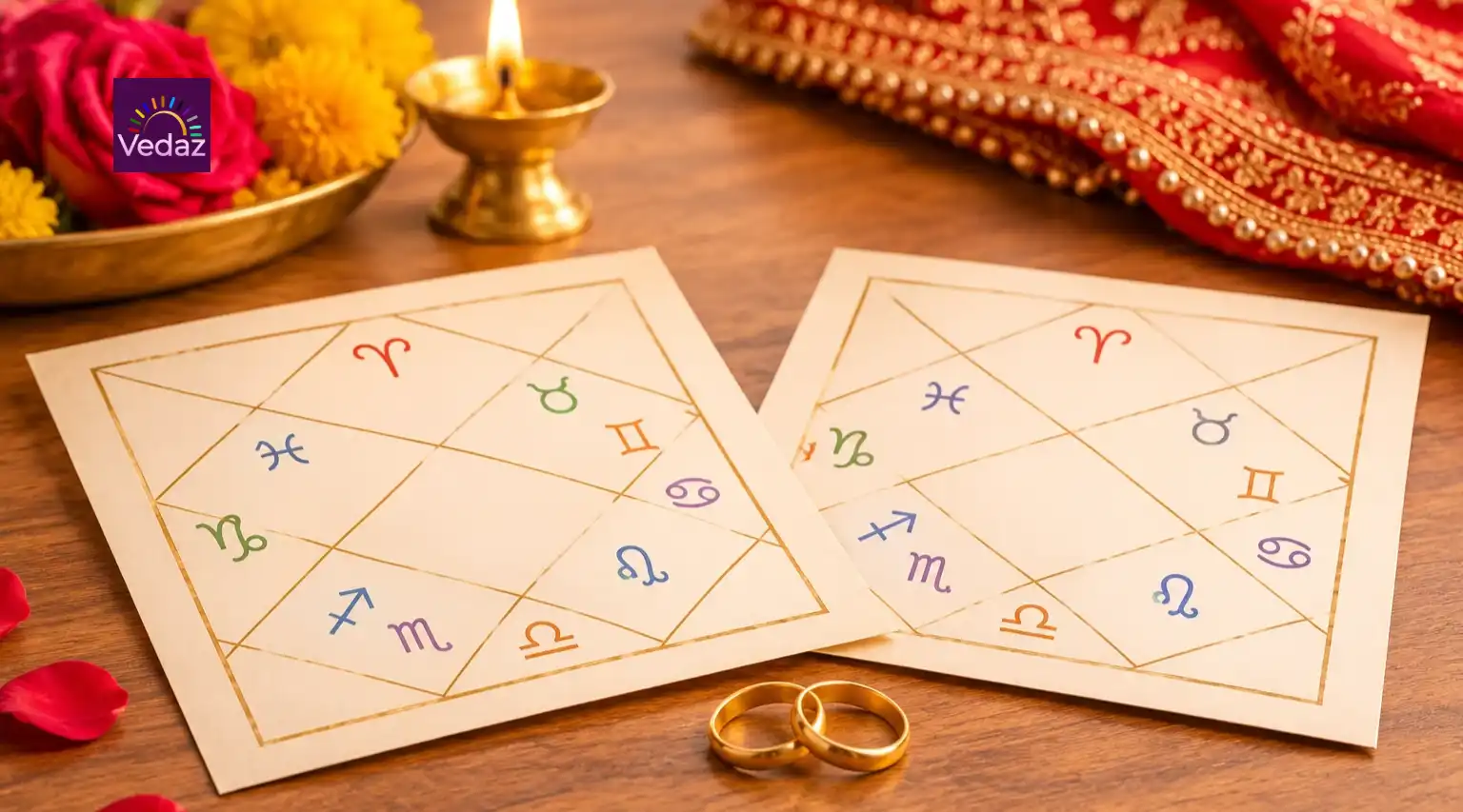
Kundali matching, also called kundli milan or horoscope matching, is the Vedic practice of comparing two people's birth charts before marriage. It gives a compatibility score out of 36 gunas using the Ashtakoot system and checks for doshas like Manglik and Nadi.
- ◦Kundali Matching at a Glance
- ◦What Is Kundali Matching? The Simple Definition
- ◦What Else Is Kundali Matching Called?
- ◦Why Do Families Still Do Kundli Milan Before Marriage?
- ◦What Are the 3 Layers of Kundali Matching?
- ◦What Does a Kundali Matching Score Mean?
- ◦What Does Kundali Matching NOT Do?
- ◦Kundali Matching for Love Marriage vs Arranged Marriage
- ◦Do You Need Both Birth Times for Kundali Matching?
- ◦How to Get Your Kundli Matched
Every Indian family has heard it at least once: "Pehle kundli mila lo." Just like that, a happy rishta turns into a small tension.
Some people treat that kundali matching score as the final word. Others laugh it off as pure superstition. The truth sits somewhere in the middle, and most of us have never been told what the process actually does.
If you've already read our guide on what a kundli is, you know a kundli is a map of the sky at your birth. Now we put two of those maps side by side. Let's go through it in plain language, so you can decide for yourself.
Kundali Matching at a Glance
- What it is: Comparing two birth charts before marriage.
- The score: Out of 36 gunas, using the Ashtakoot system.
- The checks: Doshas like Manglik, Nadi and Bhakoot.
- Minimum score: 18 out of 36 is the traditional "acceptable" mark.
- What you need: Date, time and place of birth for both people.
- The catch: It's a starting point for a conversation, not a final verdict.
What Is Kundali Matching? The Simple Definition
Kundali matching compares two birth charts to see how two people's temperaments, emotions, values and life timing are likely to fit together in marriage.
Think of it like checking a map before a long road trip together. It won't tell you whether the trip will be great. It will tell you where the smooth roads are and where you might want to slow down.
What Else Is Kundali Matching Called?
You'll see this practice under many names across India:
- Kundli milan / Kundali milan: the common name in the Hindi belt
- Guna milan / Gun milan: named after the scoring system
- Horoscope matching: the English term
- Patrika julavne: Marathi
- Jathaka porutham / Thirumana porutham: Tamil Nadu and Kerala, which use a related 10-porutham system
- Kundli matching for marriage: the phrase most people type into Google
Different names, same idea.
Why Do Families Still Do Kundli Milan Before Marriage?
For centuries, marriages in India were arranged between families who barely knew each other. Kundli matching gave them a shared language to ask the hard questions:
- Will these two understand each other emotionally?
- Are their temperaments complementary, or likely to clash?
- Is there physical and practical compatibility?
- Are there any challenges the couple should be ready for?
- Is this a good time in both their lives to marry?
And it hasn't gone away. Even in love marriages, plenty of couples ask for it. They don't always want permission. Often they just want reassurance, some preparation, and an easy way to start the conversation with the family.
What Are the 3 Layers of Kundali Matching?
Most people think kundali matching is only "the score". A thorough astrologer actually looks at three layers.
Layer 1: Ashtakoot Guna Milan (the score out of 36)
This is the famous part. Eight factors, called kootas, are compared. Each one carries a fixed number of points (gunas), and together they add up to 36.
| # | Koota | Max gunas | What it reflects (simplified) |
|---|---|---|---|
| 1 | Varna | 1 | Work ethic and spiritual outlook |
| 2 | Vashya | 2 | Mutual attraction and influence |
| 3 | Tara | 3 | Wellbeing and luck together |
| 4 | Yoni | 4 | Physical and instinctive compatibility |
| 5 | Graha Maitri | 5 | Mental wavelength and friendship |
| 6 | Gana | 6 | Temperament (gentle, human, intense) |
| 7 | Bhakoot | 7 | Emotional bonding, family welfare, finances |
| 8 | Nadi | 8 | Health and progeny (traditionally) |
| Total | 36 |
Look at how the weight grows as you go down. Nadi alone is worth 8 points, while Varna is worth just 1. Classical astrologers gave the most weight to the factors they felt mattered most for a long married life.
Want the full story on each one? Our guide to Ashtakoot Guna Milan and its 8 kootas covers them one by one. And if you like seeing the actual maths, there's a worked example on how kundli matching is calculated.
Layer 2: Dosha checks
Some chart patterns are traditionally flagged during matching:
- Manglik Dosha (Mangal Dosha): Mars placed in certain houses. We explain it in our guide on Manglik Dosha in kundli matching.
- Nadi Dosha: both partners share the same Nadi, which gives 0 out of 8. Our guide on Nadi Dosha and Bhakoot Dosha goes deeper.
- Bhakoot Dosha: an unfavourable Moon-sign distance (2/12, 5/9 or 6/8), which gives 0 out of 7.
Here's the important bit. Every one of these doshas has classical cancellation conditions (called dosha bhanga or parihara). A dosha showing up in a basic report doesn't mean it applies in full. A good report, and a good astrologer, will always check the cancellations.
Layer 3: Full chart comparison
This is where experienced astrologers spend most of their time. They look at:
- The 7th house and its lord in both charts (the house of marriage)
- Venus, the planet of love and marriage, and Jupiter in a woman's chart, which is traditionally seen as the significator of the husband
- The Navamsa (D9) chart, the divisional chart dedicated to marriage
- The dasha periods: are both people entering supportive or tougher phases?
- Overall chart strength and life direction
Two people can score 30/36 and still have a difficult 7th-house picture. Two others can score 19/36 and have beautifully supportive charts. That's why we wrote a whole guide on what astrologers really check beyond 36 gunas.
What Does a Kundali Matching Score Mean?
These are the traditional ranges most astrologers use:
| Gunas matched | Traditional reading |
|---|---|
| Below 18 | Traditionally not recommended without deeper analysis |
| 18–24 | Acceptable / average match |
| 25–32 | Good to very good match |
| 33–36 | Excellent match (rare) |
18 is the classical minimum for a match to be called acceptable. But a number is only the beginning of the conversation. A score of 17 with cancelled doshas and strong 7th houses can be a better prospect than a 26 with an uncancelled Nadi Dosha.
Wondering where your own number lands? Our guide on what each kundali milan score means breaks it down.
What Does Kundali Matching NOT Do?
Being honest about the limits builds trust, so here they are:
- It doesn't measure love. It reflects traditional indicators of temperament and life fit. Love, respect and commitment are built by two people.
- It doesn't replace knowing each other. Talking about values, money, children, careers and families matters more than any chart.
- It doesn't replace medical checks. Nadi Dosha is traditionally linked to health and progeny, but a modern premarital health screening (blood group, thalassemia carrier status and so on) gives you real medical information. Do both if you value both.
- It's not a verdict. Classical astrology itself offers cancellations and remedies. The tradition never meant a single number to end a proposal.
Kundali Matching for Love Marriage vs Arranged Marriage
It works a little differently in each case:
- Arranged marriages: Kundli milan is often done very early, sometimes before the families even meet. The score acts as a first filter.
- Love marriages: The couple has already chosen each other. Here, matching works best as a guide to strengths and watch-outs: which areas need extra patience, which timings suit the wedding, and whether any doshas need attention. There's no reason to treat it as a pass/fail test.
Do You Need Both Birth Times for Kundali Matching?
It depends on what you want checked:
- For the 36-guna score: you mostly need each person's Moon sign and Moon nakshatra. These depend on the date of birth and, if someone was born close to a nakshatra change, an approximate time.
- For Manglik Dosha from the Lagna, 7th-house analysis and Navamsa: you need accurate birth times.
Don't know the birth time? You can still try kundli matching without birth time. And if all you have are names, a name-based kundli match uses the first syllable of each name to estimate the nakshatra. It's a handy traditional shortcut, just less precise.
How to Get Your Kundli Matched
Here's the simple way to do it today:
- Collect the birth details for both people: date, time and place.
- Run a free kundali milan with the Vedaz kundli matching tool. It calculates all 8 kootas using Swiss Ephemeris and the Lahiri ayanamsa, and shows dosha cancellations too.
- Read the report section by section. Our guide on how to read your kundli matching report walks you through it.
- Talk it through before deciding anything. If something worries you, speak to an astrologer or ask Veda, our AI astrologer.
Raghav Mishra
Guna Milan, Ashtakoot matching, marriage compatibility, doshas. | 14 years
Raghav Mishra approaches marriage astrology by explaining the reasoning behind traditional compatibility systems rather than focusing on scores alone. He breaks down matching factors, unfamiliar terminology, and common misconceptions so readers can better understand Kundli matching reports and their cultural context.
Frequently Asked Questions
1. What is kundali matching in simple words?
Kundali matching is comparing two people's birth charts before marriage. Using the Ashtakoot system, it gives a score out of 36 gunas and checks for doshas like Manglik and Nadi. The aim is to understand compatibility in temperament, emotions, health and family life.
2. Is kundli matching necessary for marriage?
It isn't legally or religiously mandatory for everyone. Many families value it as a traditional compatibility check and a source of reassurance. It works best as guidance on strengths and challenges, not as a final yes-or-no.
3. How many gunas should match for marriage?
Traditionally, at least 18 out of 36 gunas is considered acceptable, and 25 or more is considered good. Astrologers also check doshas, cancellations and the 7th house, so the score alone shouldn't decide a marriage.
4. What is the difference between kundli matching and kundli milan?
There's no difference. "Milan" is Hindi for "meeting" or "matching", so kundli milan, kundali milan, kundli matching and kundali matching all describe comparing two birth charts for marriage.
5. Can kundli matching be done by name only?
Yes, roughly. Name-based matching uses the first syllable of each name to estimate the nakshatra, then calculates the gunas. It's less accurate than matching by date of birth, because a name doesn't always reflect the actual birth nakshatra.
Related Blogs

Dreaming of moving abroad? Check Foreign Travel Astrology
Is your destiny written in the stars? Discover if the universe is guiding you toward a life abroad!
The Best Places to Travel Abroad Foreign Travel Astrology
Is foreign travel written in your stars? Explore how astrology influences your journeys and uncover the best destinations for your zodiac sign!

Can Your Birth Chart Predict Depression Symptoms?
This article examines whether astrological birth charts can predict depression symptoms, contrasting astrological beliefs with psychological research on personality traits and mental health.
The Manifestation Secrets Hidden in Celebrity Birth Charts
Find out what makes fame unique and special. This guide lets you know how some of the biggest celebrities use planetary help to become successful—and how you can do the same.