What Is a Kundli? A Simple Guide to Your Vedic Birth Chart
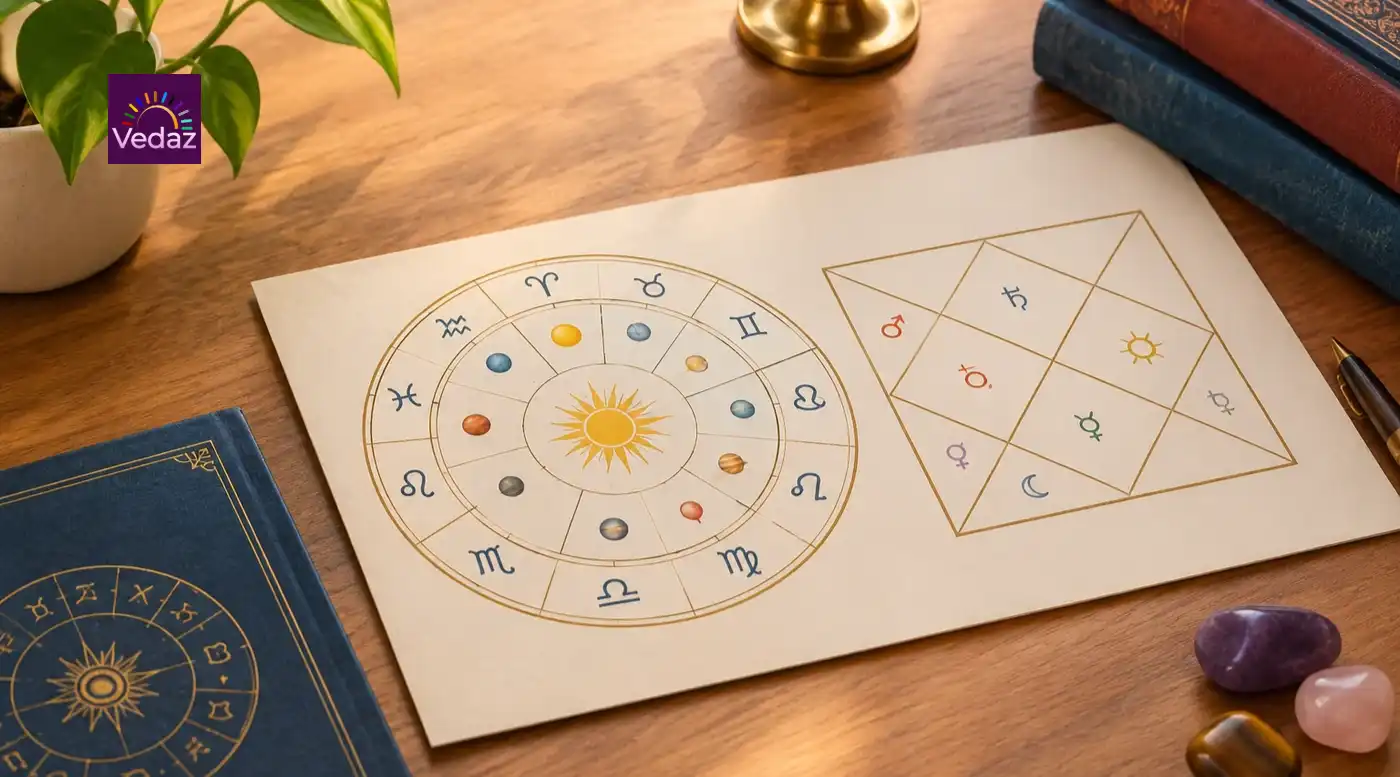
A kundli (also spelt kundali, or called a janam kundli) is a Vedic birth chart: a map of where the nine planets stood across twelve signs and twelve houses at your exact time and place of birth. Astrologers read it for personality, timing and compatibility.
- ◦Kundli at a Glance
- ◦What Is a Kundli? The Simple Definition
- ◦What Do You Need to Make a Kundli?
- ◦What Is Inside a Kundli? The 4 Building Blocks
- ◦Lagna, Rashi and Sun Sign: What's the Difference?
- ◦Why Is My Kundli Sign Different From My Western Sign?
- ◦North Indian vs South Indian Kundli: Same Chart, Different Layout
- ◦What Can a Kundli Tell You?
- ◦How Is a Kundli Used in Kundli Matching?
- ◦4 Common Myths About Kundli
Someone in the family asks, "Kundli mili kya?" and the whole room sits up a little straighter. That question is really about kundali matching, the old tradition of comparing two charts before a wedding. The elders lean in. Somebody goes looking for the pandit's number.
But how many of us actually know what that kundli is? For most people it's a folded paper that lives in a steel almirah and comes out only when a rishta turns up.
So let's slow down and look at the chart itself. This is the first guide in our Kundli Matching Guide series. By the end, you'll be able to open any kundli and know what you're looking at, even if you've never read a single astrology book.
Kundli at a Glance
- What it is: A map of the sky at your birth time and place.
- What you need: Your date, exact time and place of birth.
- What's inside: 12 houses, 12 signs, 9 planets and 27 nakshatras.
- Key sign for marriage: Your Moon sign (rashi) and Moon nakshatra.
- Why it differs from Western astrology: Vedic astrology uses the sidereal zodiac with the Lahiri ayanamsa.
- What it shows: Tendencies and timing, not a fixed fate.
What Is a Kundli? The Simple Definition
Imagine you could freeze the sky at the minute you were born and draw it on paper. Every planet is in its place, and the zodiac sign rising on the eastern horizon is marked. That drawing is your kundli.
The word comes from Sanskrit and loosely means something coiled or circular. That fits, because the chart squeezes the circle of the sky onto a flat page. If you'd like someone to walk you through yours, you can ask Veda, our AI astrologer.
You'll hear it called by many names, depending on where you are in India:
- Kundli / Kundali: the everyday word across North India
- Janam Kundli: "birth kundli", to tell it apart from charts made for other moments
- Janma Patrika: common in Maharashtra and Karnataka
- Jathakam: used in the South, for example in Kerala and Tamil Nadu
- Birth chart / horoscope: the English words
Different names, same thing.
What Do You Need to Make a Kundli?
Just three details. That's all.
| Detail | Why it matters |
|---|---|
| Date of birth | Shows where the slow-moving planets (Jupiter, Saturn, Rahu, Ketu) were placed |
| Time of birth | Decides your Lagna (rising sign) and which house each planet falls in. The rising sign changes roughly every two hours, so this is the most sensitive detail. |
| Place of birth | Gives the latitude, longitude and time zone, so the sky is worked out from your exact spot on Earth |
This is why two people born on the same date can have completely different kundlis. A baby born at 6 a.m. in Kolkata and another born at 6 p.m. in Mumbai will end up with different rising signs and different house placements.
Don't know your exact birth time? You can still get a useful Moon-sign-based reading. Our guide on kundli matching without birth time explains what you can and can't learn without it.
What Is Inside a Kundli? The 4 Building Blocks
A kundli can be drawn in the North Indian diamond style or the South Indian square style. Either way, it holds the same four things. Here's an easy way to remember them: houses are the rooms, signs are the paint on the walls, planets are the people living inside, and nakshatras are the fine print.
1. The 12 Houses (Bhavas): The Life Areas
The chart is split into 12 boxes called houses or bhavas. Each one stands for an area of life.
| House | Area of life (simplified) |
|---|---|
| 1st | Self, body, personality, overall direction |
| 2nd | Family, speech, savings |
| 3rd | Courage, siblings, communication, short travel |
| 4th | Home, mother, comfort, property |
| 5th | Children, creativity, romance, intelligence |
| 6th | Work routine, health habits, competition, debts |
| 7th | Marriage, spouse, partnerships |
| 8th | Longevity, sudden changes, in-laws, hidden matters |
| 9th | Luck, father, dharma, higher learning |
| 10th | Career, status, public life |
| 11th | Gains, income, friends, wishes fulfilled |
| 12th | Expenses, foreign lands, sleep, spirituality |
For marriage, astrologers look closely at three of these:
- 7th house: the partner
- 2nd house: family life
- 8th house: how lasting the bond is, and in-laws
We go deeper on this in our guide on what astrologers really check beyond 36 gunas.
2. The 12 Signs (Rashis): The Flavour
The sky is divided into 12 zodiac signs, called rashis: Mesha (Aries), Vrishabha (Taurus), Mithuna (Gemini), Karka (Cancer), Simha (Leo), Kanya (Virgo), Tula (Libra), Vrishchika (Scorpio), Dhanu (Sagittarius), Makara (Capricorn), Kumbha (Aquarius) and Meena (Pisces).
If houses are the rooms of your life, signs are the paint on the walls. They colour how each area behaves. Mars in Aries, for example, acts very differently from Mars in Cancer.
3. The 9 Planets (Grahas): The Actors
Vedic astrology works with nine grahas:
- Surya (Sun): soul, father, authority
- Chandra (Moon): mind, emotions, mother
- Mangal (Mars): energy, courage, conflict
- Budh (Mercury): intellect, speech, business
- Guru / Brihaspati (Jupiter): wisdom, children, blessings
- Shukra (Venus): love, comfort, marriage, beauty
- Shani (Saturn): discipline, delay, hard work
- Rahu: desire, obsession, the unconventional
- Ketu: detachment, past patterns, spirituality
One small thing: Rahu and Ketu aren't physical planets. They are the two points where the Moon's path crosses the Sun's path. Even so, Vedic astrology treats them as powerful influences.
4. The 27 Nakshatras: The Fine Print
This is where Vedic astrology gets really detailed. The sky is also split into 27 nakshatras (lunar mansions) of 13°20′ each. Ashwini, Bharani, Krittika, Rohini and the rest each come with their own symbol, deity and temperament.
Your birth nakshatra is the one your Moon was sitting in when you were born. Remember this one, because kundli matching leans on it heavily. Most of the 36-guna scoring system is built on the Moon's sign and nakshatra, and our guide to Ashtakoot Guna Milan and its 8 kootas shows exactly how.
Lagna, Rashi and Sun Sign: What's the Difference?
Ask three people "what's your sign?" and you may get three different answers. In Vedic astrology, three signs matter:
| Term | What it is | Used for |
|---|---|---|
| Lagna (Ascendant) | The sign rising on the eastern horizon at birth | Your body, personality, and the starting point for all 12 houses |
| Rashi (Moon sign) | The sign your Moon was in | Your mind and emotions. This is the main sign for kundli matching and daily rashifal. |
| Sun sign | The sign your Sun was in | Popular in Western astrology, less central in Vedic practice |
So when an aunty asks, "ladki ki rashi kya hai?", she means the Moon sign. She isn't asking about the sun sign from your magazine horoscope. That Moon sign is the starting point of every kundli milan done in India.
Why Is My Kundli Sign Different From My Western Sign?
Plenty of people find out they're a Leo in Western astrology but a Cancer in their kundli. Nothing is wrong with the chart. The two systems simply measure the sky differently.
- Western astrology mostly uses the tropical zodiac, which is tied to the seasons.
- Vedic astrology uses the sidereal zodiac, which is tied to the actual constellations.
- Earth's axis wobbles very slowly (this is called precession), so the two zodiacs have drifted about 24 degrees apart.
- Indian astrologers most commonly correct for this using the Lahiri ayanamsa, the standard adopted by the Government of India's calendar reform committee.
At Vedaz, every kundli is calculated with Swiss Ephemeris data and the Lahiri ayanamsa, the same precision professional astrologers rely on.
North Indian vs South Indian Kundli: Same Chart, Different Layout
If two kundlis of the same person look nothing alike, don't panic. India has two main drawing styles, plus an East Indian style used in Bengal and Odisha.
- North Indian (diamond) chart: The houses stay fixed. The top centre diamond is always the 1st house, and the sign numbers move around. It's popular in UP, Bihar, Delhi, MP, Rajasthan and Gujarat.
- South Indian (square) chart: The signs stay fixed. Pisces is always the top-left box, and you find the Lagna by looking for its marking. It's popular in Tamil Nadu, Kerala, Karnataka and Andhra Pradesh.
The information inside is identical. Only the layout changes.
What Can a Kundli Tell You?
Traditionally, astrologers use a kundli to look at:
- Personality and temperament: from the Lagna, the Moon and the strong planets
- Strengths and challenges: from where the planets sit in the houses
- Timing: through the Vimshottari Dasha system, which divides life into planetary periods (a 20-year Venus period or a 19-year Saturn period, for example)
- Yogas: special planet combinations like Raj Yoga or Dhan Yoga
- Doshas: placements traditionally seen as challenging, like Kaal Sarp Dosha or Manglik Dosha
- Compatibility: comparing two kundlis, which is exactly what kundli matching does
One honest note from us: a kundli describes tendencies and timing. It doesn't hand out fixed verdicts. Your effort, choices, communication and circumstances shape how any chart plays out in real life, and that idea runs through this whole series.
How Is a Kundli Used in Kundli Matching?
This is the bridge to the rest of the series. When two families compare kundlis, the most common method is Ashtakoot Guna Milan. It mostly looks at three things:
- Each person's Moon sign (rashi)
- Each person's Moon nakshatra
- The relationship between the lords of those Moon signs
From these, you get a score out of 36 gunas. Astrologers then go deeper and check the 7th house, Venus, Mars (for Manglik Dosha), the Navamsa chart and the dasha periods.
So the next time someone says "18 gunas matched", remember where that number came from: two kundlis like the one you just learned to read. If you'd like to see it in action, try our free kundli matching tool for an instant 36-guna score. And if you only have names, you can try kundli matching by name.
4 Common Myths About Kundli
Myth 1: "A kundli decides your fate." Classical thinking says the kundli shows karmic tendencies, and free will and effort still count. Many astrologers compare it to a weather forecast. It tells you when to carry an umbrella, not whether you're allowed to step outside.
Myth 2: "Any app gives the same kundli." Not always. Different ayanamsa settings, wrong time-zone handling (especially for births before 1950 or abroad) and rounding errors can push a planet into a different sign or nakshatra. That's why it helps to use a calculator that tells you which ayanamsa it follows, like our kundli calculators. Accuracy matters most when you're matching nakshatras.
Myth 3: "No birth time means a useless kundli." You do lose accuracy on the Lagna and the houses. But the Moon sign is usually still known, and the Moon nakshatra often is too. A lot of Guna Milan runs on the Moon alone.
Myth 4: "My sun sign is my rashi." In Vedic usage, rashi nearly always means the Moon sign.
Tanvi Deshpande
Vedic traditions, astrology terminology, cultural and spiritual context. | 10 years
Tanvi Deshpande approaches traditional knowledge through context, interpretation, and accessible explanations. Her writing connects astrological terminology with broader Indian cultural traditions, helping readers understand the background of commonly discussed concepts rather than relying on isolated definitions.
Frequently Asked Questions
1. What is a kundli in simple words?
A kundli is a chart of the sky at your exact time and place of birth. It shows where the Sun, Moon, planets and Rahu–Ketu stood across 12 signs and 12 houses. Vedic astrologers use it to read personality, life timing and marriage compatibility.
2. What is the difference between kundli and kundali?
There is no difference. "Kundli" and "kundali" are two spellings of the same Hindi/Sanskrit word for the birth chart. You'll also see "janam kundli", "janma patrika" and "jathakam" used across India.
3. Is the kundli based on the Moon sign or the Sun sign?
A Vedic kundli shows all the planets. For daily predictions and kundli matching, the **Moon sign (rashi)** and the Moon's nakshatra matter most. The Lagna (ascendant) is used to set up the 12 houses.
4. How accurate does my birth time need to be?
For Moon-based matching, a roughly correct time is often enough. For house-based analysis (the 7th house, Manglik Dosha from the Lagna, Navamsa), even 10–15 minutes can matter, because the rising sign changes about every two hours.
5. Can I make my kundli for free online?
Yes. Vedaz generates a free kundli using Swiss Ephemeris and the Lahiri ayanamsa. Just enter your date, time and place of birth and you'll have your chart in seconds.
Related Blogs

Dreaming of moving abroad? Check Foreign Travel Astrology
Is your destiny written in the stars? Discover if the universe is guiding you toward a life abroad!
The Best Places to Travel Abroad Foreign Travel Astrology
Is foreign travel written in your stars? Explore how astrology influences your journeys and uncover the best destinations for your zodiac sign!
Can Your Birth Chart Predict Depression Symptoms?
This article examines whether astrological birth charts can predict depression symptoms, contrasting astrological beliefs with psychological research on personality traits and mental health.
The Manifestation Secrets Hidden in Celebrity Birth Charts
Find out what makes fame unique and special. This guide lets you know how some of the biggest celebrities use planetary help to become successful—and how you can do the same.