Litigation and Legal Disputes in Vedic Astrology: The Chart Factors for Court Cases and Their Outcomes
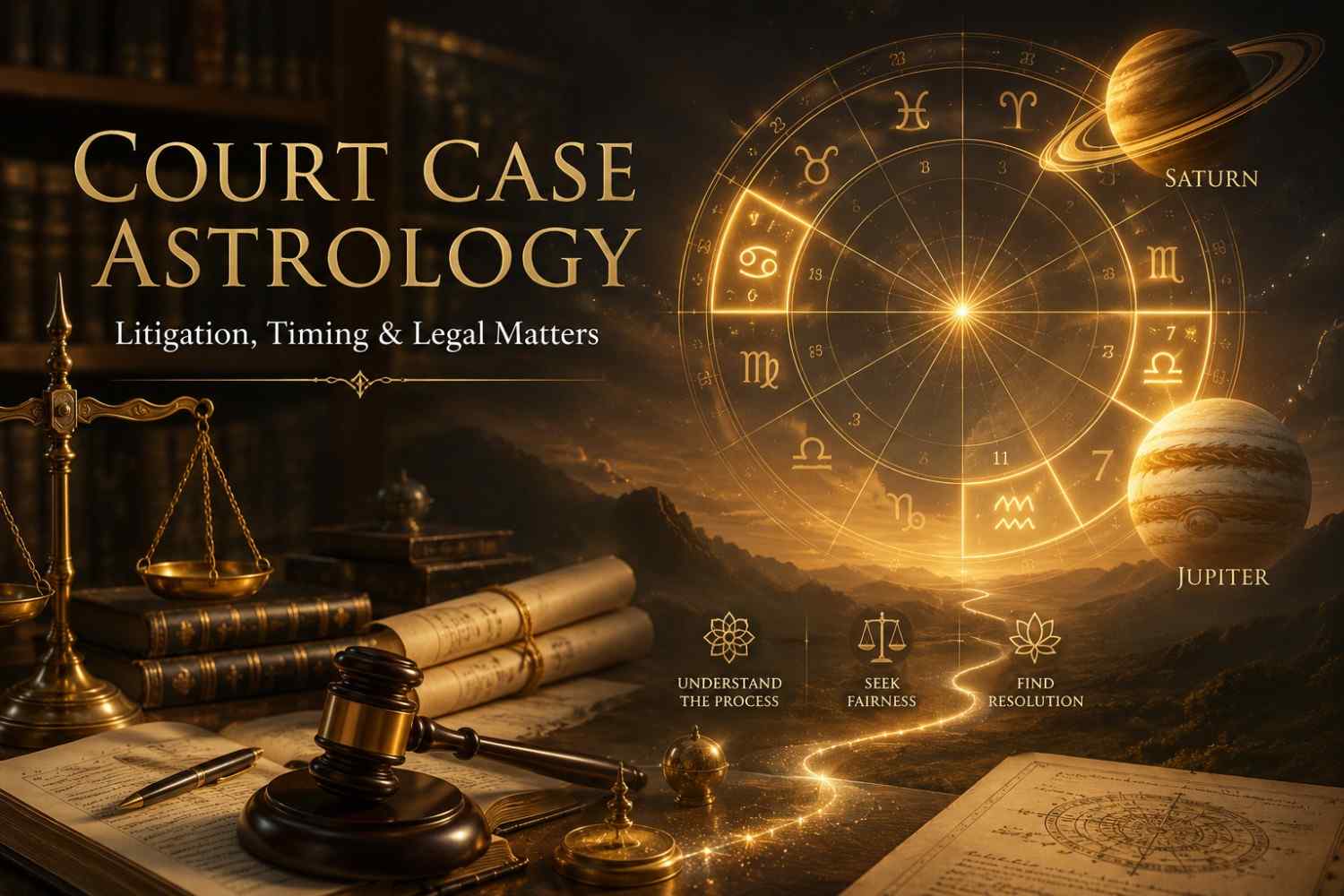
Litigation in Vedic astrology is primarily analyzed through the 6th house, along with the 7th, 8th, 11th, and 12th houses.
Saturn, Jupiter, Mars, and Mercury play important roles in legal disputes, court cases, and litigation timing, while dashas and transits help identify periods of challenge, progress, and potential resolution.
If you're dealing with a legal dispute, questions like "will I win this case," "when will it finally end," and "what does my chart say about the outcome" are some of the most common things people bring to Vedic astrology.
And it makes sense — legal matters come with real stakes, real stress, and outcomes that genuinely affect your life.
Vedic astrology does have a classical framework for looking at litigation: which houses relate to disputes and opponents, which planets connect to legal matters and justice, and what timing factors tend to line up with when a case is likely to move or resolve, and in whose favor.
This guide walks through that framework honestly — with one thing made clear from the start: astrology plays a supporting role here, and competent legal counsel remains the actual foundation of any legal matter.
Quick Facts
| Factor | Signification |
|---|---|
| Primary House (Dispute) | 6th House — disputes, enemies, litigation, competition, opposition |
| Supporting Houses | 7th House — opposing party, legal opponent |
| 8th House — obstacles, hidden factors, complications | |
| 12th House — losses, expenses, confinement | |
| 11th House — gains, success, favorable outcome | |
| Primary Planets | Mars — conflict, aggression, legal battles |
| Saturn — law, justice, delays, discipline | |
| Jupiter — judgment, fairness, wisdom, protection | |
| Mercury — arguments, documentation, legal paperwork | |
| Favorable Outcome Indicators | Strong 6th House and 6th Lord relative to the 7th House and its lord |
| Benefic influence from Jupiter on key litigation houses or lords | |
| Timing Tools | Mahadasha–Antardasha of relevant planets |
| Major transits of Saturn and Jupiter | |
| Important Note | Astrology may indicate trends and probabilities, but competent legal counsel remains the irreplaceable foundation of any legal case. |
The Foundational Framing — Legal Counsel First
Before getting into any of the astrology, here's the thing that needs to be said plainly: legal matters require competent legal counsel.
Astrology is, at most, a supplementary input — it's never a substitute for qualified legal advice, and it's definitely never a reason to act against it.
The stakes in litigation are real, the systems involved are complicated, and decisions made along the way often can't be undone.
So however this chart-based perspective gets used, it has to sit inside that frame.
The chart might offer some sense of timing or tendency, but the actual strategy, the decisions, the day-to-day conduct of the case — that all belongs to the lawyer and the client, guided by the law and the evidence.
Keep that in mind as you read through everything below.
The Houses Involved in Litigation
The 6th house is the main one — it governs disputes, enemies, litigation, opposition, and conflict generally.
In a legal context, when someone's 6th house and its ruling planet (the 6th lord) are strong, that's classically read as supporting their position in the dispute, since the 6th house is also associated with overcoming enemies and coming out ahead in conflicts.
The 7th house represents the other side — the opposing party in the dispute.
A big part of this kind of analysis comes down to comparing the 6th house (your side) against the 7th (theirs) and seeing which one looks stronger.
The 8th house covers obstacles, hidden factors, delays — basically the difficult or concealed dimensions of a dispute.
The 12th house relates to losses and expenses, and in more serious matters, things like imprisonment or confinement.
It's the "loss" side of litigation.
The 11th house is about gains and favorable outcomes, so it's relevant to whether a matter is likely to resolve in your favor.
The 10th house comes into play for cases involving your authority, status, or career — anything where the legal issue could affect your professional standing.
And then there's the Lagna (ascendant) and its ruling planet, which together reflect your overall strength and your capacity to handle the dispute as a whole.
Readers unfamiliar with houses, planetary rulerships, and timing techniques may find How to Read Your Vedic Birth Chart helpful before exploring the litigation-specific combinations discussed below.
The Planets Associated With Legal Matters
Mars represents conflict, aggression, and disputes — basically the combative side of litigation.
How Mars is placed in the chart relates to how contentious or heated the matter feels.
Saturn is really central here.
Saturn represents law itself — justice, courts, delay, and the slow, grinding nature of legal processes.
Legal matters are classically described as "Saturnine" because of how slow and consequence-driven they tend to be, and Saturn's role in the chart is one of the first things looked at in any litigation reading.
Jupiter represents justice, judgment, and wisdom — Jupiter is the natural significator of dharma and of a just outcome.
When Jupiter is strong and well-placed, that's traditionally read as a good sign for a fair resolution, especially when the person's case actually has merit.
Mercury relates to arguments, documents, communication, and contracts — so Mercury's condition connects to the documentary and argumentative side of a legal matter.
The Sun represents authority, government, and judges, so it's relevant to anything involving state authority or judicial decisions.
Cases involving regulatory bodies, government departments, or public-sector employment may also intersect with themes discussed in Government Job Astrology, where authority, public institutions, and administrative structures are examined from a traditional perspective.
Rahu and Ketu, when they're involved, are associated with complications, deception, or disputes that are unusually messy or karmically tangled in some way.
Classical Indicators for Favorable Outcomes
Classical tradition points to a few things as favorable — and again, these are read as tendencies, not guarantees of outcome:
-
A strong 6th house and 6th lord, stronger than the 7th house and 7th lord — meaning your side of the dispute looks stronger than the opponent's.
-
Benefic influence on the 6th house, particularly from a supportive Jupiter — since Jupiter is the just-outcome significator, its support is seen as favoring your position.
-
A strong Lagna and Lagna lord relative to the 7th house — your overall strength in the chart outweighing the opponent's.
-
Favorable activation of the relevant houses during the period when the matter is actually being decided.
-
Mars and Saturn being constructively placed rather than causing problems for your key significators.
-
The 11th house lord (which relates to gains and favorable outcomes) being well-connected to your significators.
Indicators suggesting a more difficult position
-
A weak 6th house and lord compared to a strong 7th house — meaning the opponent looks stronger.
-
Heavy difficult (malefic) influence on the Lagna and 6th house during the active period of the matter.
-
A difficult dasha or transit period happens right when the matter is being decided.
-
The 8th and 12th houses being especially prominent in the timing of the matter — more obstacles, more emphasis on losses.
It's worth repeating clearly here: these are tendencies that the classical framework points to — they are not guarantees of how a legal matter will turn out.
What actually determines a legal outcome is the law, the evidence, the quality of representation, and the facts of the case.
The chart, at most, offers some perspective on tendency and timing.
It doesn't decide cases.
Timing — When a Legal Matter Is Likely to Resolve

Saturn's role is central when it comes to timing.
Because legal matters are classically slow and Saturn-ruled, Saturn's transits and dasha relationships to the relevant houses often correlate with the pace of a matter and with its turning points.
The Mahadasha or Antardasha of the 6th house lord relates to activation of the dispute itself — it can correspond to the more active or decisive phases of the matter.
The Mahadasha or Antardasha of Jupiter — the just-outcome significator — is traditionally seen as favorable for resolution when it's supportive, especially when the person's case is sound.
A Jupiter transit through the relevant houses (the 6th, or the Lagna) can correlate with favorable turning points or windows where resolution becomes more likely.
And Saturn completing its transit through the relevant houses can correlate with the conclusion of long-running matters — which fits with Saturn's broader association with the eventual resolution of long, drawn-out processes.
What all of this gives you, honestly, is a sense of likely pace and possible turning-point windows — not a prediction of the verdict itself, and definitely not a date for it.
Common Scenarios — With Honest Framing
"Will I win my court case?"
The honest answer is that astrology can't reliably predict legal verdicts, and any astrologer who claims to know for certain whether you'll win is overreaching.
What the chart can offer is some perspective on whether your position carries classical strength relative to the opponent's, and whether the current timing looks supportive or not.
But that's it — it's perspective, not prediction.
The actual outcome comes down to the law, the evidence, and the quality of your representation.
A more honest way to frame it might be something like: "the chart suggests your position has relative strength (or difficulty), and the timing looks supportive (or challenging) — but this is perspective, not a prediction, and what actually determines the outcome is your legal counsel and the facts of the case."
"When will my long legal matter finally end?"
This is actually a more useful question to bring to astrology.
Since litigation is classically tied to Saturn's slow, grinding nature, looking at the timing — whether Saturn is completing relevant transits, whether Jupiter activation is coming up — can give you a sense of whether a resolution-supportive period might be approaching, or whether the difficult phase still has further to run.
That kind of perspective can genuinely help with managing expectations and stress during a long process.
Just hold it alongside your lawyer's actual read on the procedural timeline, not instead of it.
Lengthy legal disputes sometimes coincide with broader life transitions involving work, relocation, or professional redirection.
Readers interested in these larger transition periods may also enjoy our guide on Career Change Timing.
"Should I settle or keep fighting?"
This isn't a decision astrology should be making for you.
It's a legal and strategic call that belongs to you and your lawyer, based on the merits of the case, the costs involved, and the risks on either side.
At most, astrology might offer some sense of whether the period ahead looks generally supportive or challenging for your position — but that should be one small, minor input among all the legal, financial, and personal factors that should actually be driving the decision.
Your legal counsel's assessment needs to be the primary thing here.
"An astrologer guaranteed I'd win my case — should I rely on that?"
No.
If an astrologer guarantees a legal victory, that's a serious red flag.
It's an overreach that astrology genuinely cannot support, and relying on a guarantee like that instead of sound legal strategy can cause real harm.
At most, litigation astrology offers some perspective on tendency and timing — "guaranteed victory" claims go well beyond that, and given how much is actually at stake in legal matters, this kind of claim is a particularly dangerous form of exploitation.
Honest Framing
Competent legal counsel is the irreplaceable foundation of any legal matter.
Astrology is, at most, a supplementary input — never a substitute for qualified legal advice, and never a reason to act against it.
Legal outcomes are determined by the law, the evidence, the quality of representation, and the facts of the case — not by what's in a chart.
What astrology can offer is perspective on tendency and timing, not a prediction of verdicts.
Where the chart is genuinely useful is in giving some perspective on likely pace (especially given how slow legal processes tend to be) and in helping manage expectations and stress during what's often a long and draining process — not in making strategic legal decisions.
People looking for ways to cultivate perspective, emotional steadiness, and inner resilience during prolonged disputes may also find Moksha AI useful as a reflective companion alongside practical legal support.
Be very wary of any astrologer who guarantees a legal victory, who leans on the stress of litigation to sell expensive remedies, or who encourages you to act against your lawyer's advice because the "timing looks favorable."
Given how much is genuinely at stake, this is an especially harmful kind of exploitation.
Decisions about legal strategy — whether to settle, how to proceed — belong with the client and their counsel, based on the merits of the case.
Astrology should be, at most, a small and peripheral input into that picture.
And if remedial spiritual practices bring someone genuine comfort during the stress of litigation, that has real value — as support for the person's wellbeing during a hard time.
That's a separate thing from any claim about influencing the legal outcome itself.
For readers who draw strength from spiritual observances, Yajna AI explores traditional practices that may offer personal comfort and psychological support during challenging periods, while remaining entirely separate from legal strategy or expectations regarding case outcomes.
Devaditya Narayanan
Classical Jyotish, Karmic Patterns & Legal Astrology | 14+ Years
Devaditya Narayanan is a classical Jyotish researcher with expertise in karmic astrology, planetary influences, and legal matters in horoscope interpretation. His work focuses on explaining complex astrological combinations with clarity, context, and respect for traditional teachings.
Frequently Asked Questions
1. Which house indicates court cases and litigation in Vedic astrology?
The 6th house is the primary house of disputes, enemies, litigation, and opposition — a strong 6th house and 6th lord classically supports a person's position in a dispute, since the 6th house is also the house of overcoming enemies and winning conflicts. The 7th house represents the opposing party, and comparing the relative strength of the 6th versus the 7th is a core part of this kind of analysis. The 8th house (obstacles), 12th house (losses), and 11th house (favorable outcomes) all contribute as well. The chart offers perspective on tendency here, not a prediction of verdicts.
2. Which planets are involved in legal matters?
Saturn is central — it represents law itself, justice, courts, and the slow, grinding nature of legal processes, which is why litigation is classically described as Saturnine. Jupiter is the natural significator of justice, judgment, and a just outcome, and a supportive Jupiter is classically seen as favorable when someone's case has merit. Mars governs the combative side of things, Mercury governs arguments, documents, and contracts, and the Sun relates to judicial authority. When Rahu or Ketu are involved, that's typically associated with complications or deception.
3. Can astrology predict whether I will win a court case?
No — astrology can't reliably predict legal verdicts, and any astrologer who claims certainty about whether you'll win a case is overreaching. What the chart can offer is some perspective on whether your position carries classical strength relative to the opponent's, and whether the timing looks supportive or challenging. But legal outcomes are determined by the law, the evidence, and the quality of representation — not by chart indicators. The honest framing here is perspective on tendency and timing, never a prediction of the verdict, and competent legal counsel remains the irreplaceable foundation throughout.
4. When will my legal case resolve according to astrology?
Because litigation is classically Saturnine and slow, timing analysis looks at things like Saturn's transit and dasha relationship to the relevant houses (which often correlates with pace and turning points), activation of the 6th house lord, supportive Jupiter activation (the just-outcome significator), and Saturn completing its movement through the relevant houses (which often correlates with the conclusion of long-running matters). What comes out of this is a sense of likely pace and possible turning-point windows — not a prediction of the verdict or an exact date — and it should be held alongside your lawyer's actual assessment of the procedural timeline.
5. Should I make legal decisions based on astrology?
No. Decisions about legal strategy — whether to settle, how to proceed — belong with the client and competent legal counsel, based on the merits, costs, and risks of the case. At most, astrology can offer some perspective on whether the period ahead looks generally supportive or challenging — one small, peripheral input among the legal, financial, and personal factors that should actually be driving the decision. Legal counsel's assessment needs to be primary; astrology should never substitute for it or be a reason to act against it.
6. An astrologer guaranteed I would win my case — is that credible?
No — that's something to be quite skeptical of. Guaranteeing a legal victory goes beyond what astrology can honestly support, and relying on that kind of guarantee instead of sound legal strategy can cause real harm, given how much is genuinely at stake in legal matters. At most, litigation astrology offers perspective on tendency and timing — "guaranteed victory" claims are a particularly dangerous kind of exploitation, because the consequences of misplaced reliance in a legal matter can be so serious. What a legal matter actually requires is sound legal counsel, not astrological guarantees.
Related Blogs

Boost Your Health with Astrology
Boost your health with astrology using zodiac-based habits, wellness tips, and simple routines for better physical and mental balance.

The Socking Truth Behind Wearing A Black Thread
Uncover the mystery behind the black thread. From protection to spiritual energy—here’s why everyone’s suddenly wearing one.

Hidden Messages In Your Moles
What if that little mole on your cheek is more than just a mark? Explore the fascinating meanings behind mole placements and what they reveal about your future.

Who Is Your Ishta Devata?
Explore the concept of your personal God in Hinduism. Learn how to discover, connect with, and build a relationship with your Ishta Devata for inner peace and spiritual growth.