Manglik Dosha in Kundli Matching: Meaning, Myths and Cancellation
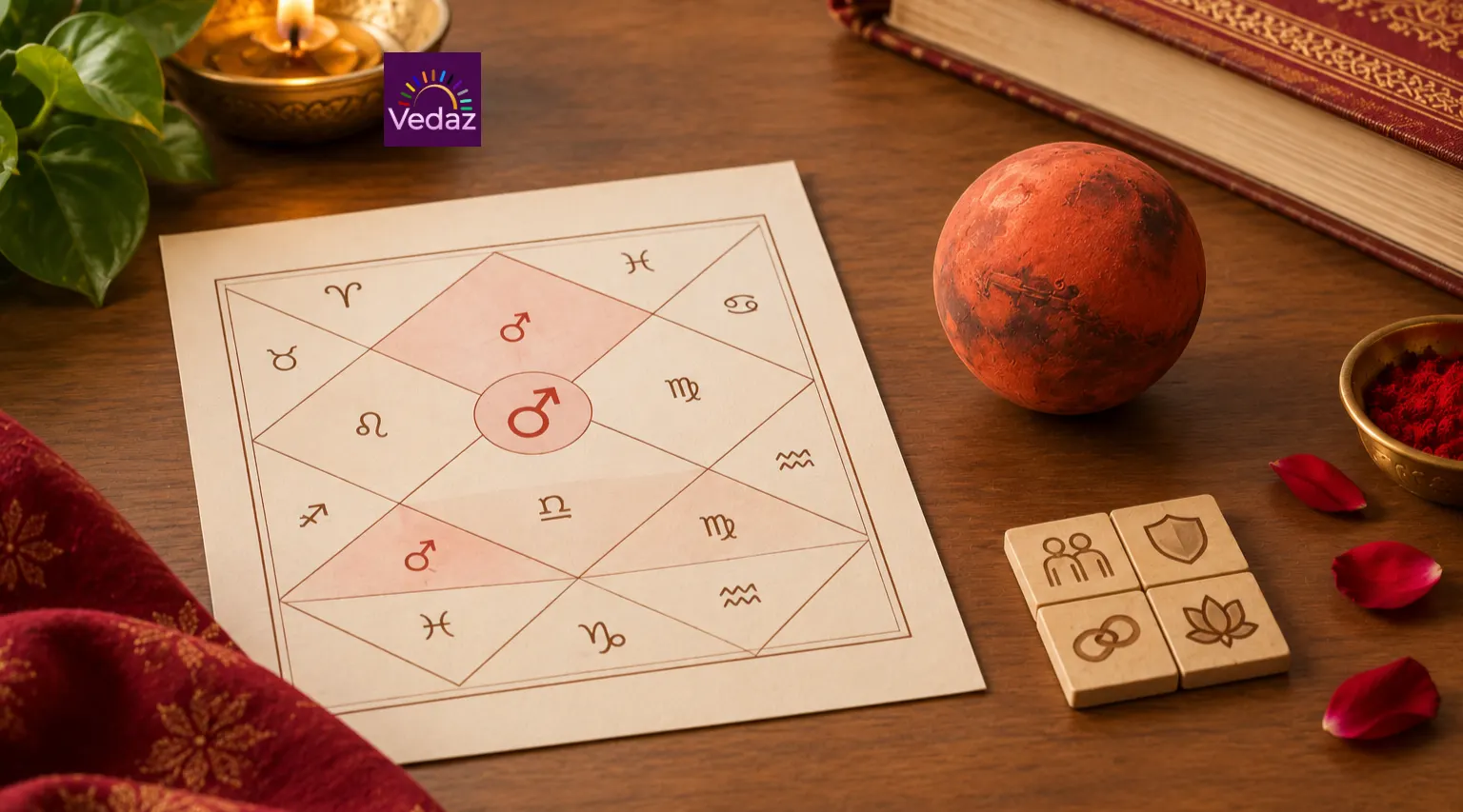 Manglik Dosha in kundli matching is a traditional flag raised when Mars sits in the 1st, 2nd, 4th, 7th, 8th or 12th house of a birth chart. It is checked separately from the 36 gunas and has many classical cancellations, most commonly when both partners are Manglik.
- ◦Manglik Dosha in Kundli Matching at a Glance
- ◦What Is Manglik Dosha in Kundli Matching?
- ◦How Common Is Manglik Dosha? (Almost Half of All People)
- ◦Why Manglik Dosha Isn't Part of the 36 Gunas
- ◦Manglik Dosha Cancellation: 7 Classical Exceptions
- ◦Is Manglik Dosha Over at 28? Fact or Myth
- ◦Manglik and Non-Manglik Marriage: Can It Work?
- ◦Traditional Remedies for Manglik Dosha
- ◦Key Takeaways
Hardly any word in Indian matchmaking makes a room go quiet like "Manglik". One line from a relative, and a promising rishta is suddenly on hold. Some families wait years. Some drop the proposal altogether.
Here's the thing: very often nobody checks whether the dosha is even real in that chart, or whether it's already cancelled. So let's go through it calmly, the way classical astrology actually treats it.
And if you'd like to see your own result, a free kundali matching report shows the Manglik status for both charts.
Manglik Dosha in Kundli Matching at a Glance
- What it is: Mars placed in the 1st, 2nd, 4th, 7th, 8th or 12th house.
- Also known as: Mangal Dosha.
- How common: roughly 40–50% of people are Manglik.
- Gunas: it isn't part of the 36 gunas and is checked separately.
- Best-known cancellation: both partners are Manglik.
- Age 28: a popular belief, not a universal classical rule.
What Is Manglik Dosha in Kundli Matching?
Mangal is Mars, the planet of energy, drive, courage, anger and action. In marriage astrology, Mars in certain houses is traditionally thought to bring intensity. That could mean strong opinions, impatience, a need for independence, or friction in the partnership.
A person is called Manglik (also Mangalik, Kuja Dosha in Telugu and Kannada, Chevvai Dosham or Sevvai Dosham in Tamil) when Mars sits in one of these houses:
| House | Life area | Traditional concern |
|---|---|---|
| 1st | Self, temperament | Assertiveness, short temper |
| 2nd | Family, speech | Harsh speech, family friction (counted especially in South Indian practice) |
| 4th | Home, peace of mind | Restlessness at home |
| 7th | Spouse, partnership | Direct friction with the partner |
| 8th | Longevity, in-laws | Sudden ups and downs |
| 12th | Bed pleasures, expenses | Expenses, emotional distance |
These houses are counted from the Lagna (ascendant). Many astrologers also check them from the Moon and from Venus. A dosha showing up from all three is treated as stronger than one showing up from only one.
How Common Is Manglik Dosha? (Almost Half of All People)
This one fact takes away most of the fear.
Mars has to be in some house. So it's simple arithmetic:
- 5 houses count (1, 4, 7, 8, 12): 5 ÷ 12 ≈ 42%.
- Add the 2nd house, as South Indian practice does: 6 ÷ 12 = 50%.
- Check from the Moon and Venus too, and an even bigger share of people show some Manglik placement.
That's plain probability, not a survey. Still, roughly every second person you meet has a Mars placement that some method would call Manglik. A condition that common can't be a rare curse. This is exactly why classical astrology built in so many cancellations.
Why Manglik Dosha Isn't Part of the 36 Gunas
The 36 gunas (Ashtakoot) are worked out from the Moon. If you want a refresher, our guide to Ashtakoot Guna Milan: The 8 Kootas and 36 Gunas covers it. Manglik Dosha, on the other hand, depends on Mars's house. That needs the Lagna, and the Lagna needs an accurate birth time.
So a report can show 30/36 gunas and still flag Manglik Dosha. It can also show 18/36 with no Manglik issue at all. Always look for the Manglik section separately.
No birth time? Manglik status can only be estimated from the Moon or Venus. Our page on kundli matching without birth time explains what's still possible.
Manglik Dosha Cancellation: 7 Classical Exceptions
This is the most important section. Classical texts and centuries of practice list many conditions where Manglik Dosha is cancelled (Mangal Dosha bhanga) or greatly reduced. These are the ones applied most often:
- Both partners are Manglik: This is the most accepted rule. The traditional reasoning is that two equally "intense" Mars energies balance each other instead of overpowering. It's why families have long looked for a Manglik partner for a Manglik person.
- Mars is in its own or exaltation sign: Mars in Aries or Scorpio (own signs) or Capricorn (exaltation) is considered dignified and well-behaved. Many astrologers treat the dosha as cancelled or much weaker here.
- Jupiter's influence: If Jupiter aspects Mars or sits with it, Jupiter's wisdom is traditionally said to soften Mars's aggression.
- Sign-and-house exceptions: Classical texts list particular combinations where Mars in a "Manglik house" is exempt because of the sign it occupies. Examples are certain placements in the 2nd, 4th, 7th, 8th or 12th, depending on the sign. The exact list varies by text, which is why an astrologer's review matters.
- Mars is a yogakaraka: For Cancer and Leo ascendants, Mars rules both a kendra and a trikona and becomes a highly beneficial planet. Many astrologers consider Manglik Dosha negligible for these ascendants.
- Balancing malefics in the partner's chart: If the non-Manglik partner has Saturn, Rahu, Ketu or the Sun in the same sensitive houses (1, 2, 4, 7, 8, 12), many astrologers consider the charts balanced.
- Strong overall match. Some practitioners treat the dosha as reduced when the guna score is high and the 7th house and Venus are well supported. This is a softer, judgement-based rule.
Is Manglik Dosha Over at 28? Fact or Myth
You'll often hear that Manglik Dosha "goes away" after age 28. The idea is that Mars "matures" around then. It's a popular belief, not a universal classical rule, and astrologers disagree on it.
What is true is that many people marry later now. Maturity, communication and life experience help any marriage, Manglik or not. Just don't delay a good match only because of the "28" belief. Get a proper chart review first.
Manglik and Non-Manglik Marriage: Can It Work?
Yes, and very often it does. Here's how astrologers usually go about it:
- Check if the dosha is real. Is it from the Lagna, the Moon or Venus? Is it cancelled by any rule above?
- Check the non-Manglik partner for balancing placements (rule #6).
- Look at the 7th house, Venus and Navamsa in both charts (see Beyond 36 Gunas).
- If an active, uncancelled dosha remains, traditional remedies are suggested (see Kundli Matching Remedies).
Above all, talk to each other. What Mars stands for in daily life (temper, impatience, independence, drive) is very manageable with self-awareness and mutual respect.
Traditional Remedies for Manglik Dosha
We cover remedies fully in Part 9. These are the ones most often suggested:
- Hanuman worship: reciting the Hanuman Chalisa, especially on Tuesdays.
- Mangal mantra: "Om Angarakaya Namah" or the Mangal beej mantra, chanted regularly.
- Tuesday fasting (Mangalvar vrat): only for those whose health permits.
- Mangal Shanti puja: sometimes done at temples linked with Mars, such as Mangalnath Temple in Ujjain.
- Kumbh Vivah / Arka Vivah: symbolic traditional rituals some families choose. Whether to do them is a personal and family decision, not a requirement.
- Charity on Tuesdays: red lentils (masoor dal), jaggery or red cloth.
Our view: no remedy needs to be expensive, and none should be sold to you through fear. Gemstones like red coral should only be worn after a full chart review by a qualified astrologer.
Key Takeaways
- Manglik = Mars in the 1st, 2nd, 4th, 7th, 8th or 12th house (from the Lagna, and often from the Moon and Venus).
- About 40–50% of people are Manglik. It's common, not a curse.
- It's checked separately from the 36 gunas and needs an accurate birth time.
- Many cancellations exist, most famously when both partners are Manglik.
- Remedies are simple and devotional. Fear-based selling has no place here.
Check both charts' Manglik status, with cancellations, using the free kundali matching tool, or try our Mangal Dosha calculator.
Karan Malhotra
Astrology fundamentals, selecting astrologers, understanding reports. | 8 years
Karan Malhotra focuses on helping readers approach astrology with clearer expectations. His articles explain unfamiliar concepts, outline useful questions to ask, and organize information into practical guidance so readers can evaluate astrological services and understand reports more confidently.
Frequently Asked Questions
1. What is Manglik Dosha in kundli matching?
Manglik Dosha is a traditional flag raised when Mars is in the 1st, 2nd, 4th, 7th, 8th or 12th house of the birth chart. It's checked separately from the 36 gunas in kundli matching. Many classical conditions cancel it, most notably when both partners are Manglik.
2. Can a Manglik marry a non-Manglik?
Yes. First check whether the dosha is cancelled, by Mars's sign, Jupiter's aspect, the ascendant, or balancing planets in the partner's chart. Many Manglik and non-Manglik marriages are approved after a full review. Remedies are suggested where needed.
3. How common is Manglik Dosha?
Very common. With Mars in 5 or 6 of the 12 houses counting as Manglik, roughly 40–50% of people are Manglik from the Lagna alone. That's why classical astrology includes so many cancellation rules.
4. Is Manglik Dosha cancelled if both are Manglik?
Yes. This is the most widely accepted cancellation rule. When both partners are Manglik, the dosha is traditionally considered mutually neutralised.
5. Does Manglik Dosha end after 28?
It's a popular belief that it weakens after 28, but it isn't a universal classical rule, and astrologers differ on it. A chart-specific review is more reliable than an age-based assumption.
Related Blogs

Dreaming of moving abroad? Check Foreign Travel Astrology
Is your destiny written in the stars? Discover if the universe is guiding you toward a life abroad!

The Best Places to Travel Abroad Foreign Travel Astrology
Is foreign travel written in your stars? Explore how astrology influences your journeys and uncover the best destinations for your zodiac sign!

Can Your Birth Chart Predict Depression Symptoms?
This article examines whether astrological birth charts can predict depression symptoms, contrasting astrological beliefs with psychological research on personality traits and mental health.
The Manifestation Secrets Hidden in Celebrity Birth Charts
Find out what makes fame unique and special. This guide lets you know how some of the biggest celebrities use planetary help to become successful—and how you can do the same.