Beyond 36 Gunas: What Astrologers Really Check in Kundli Matching for Marriage
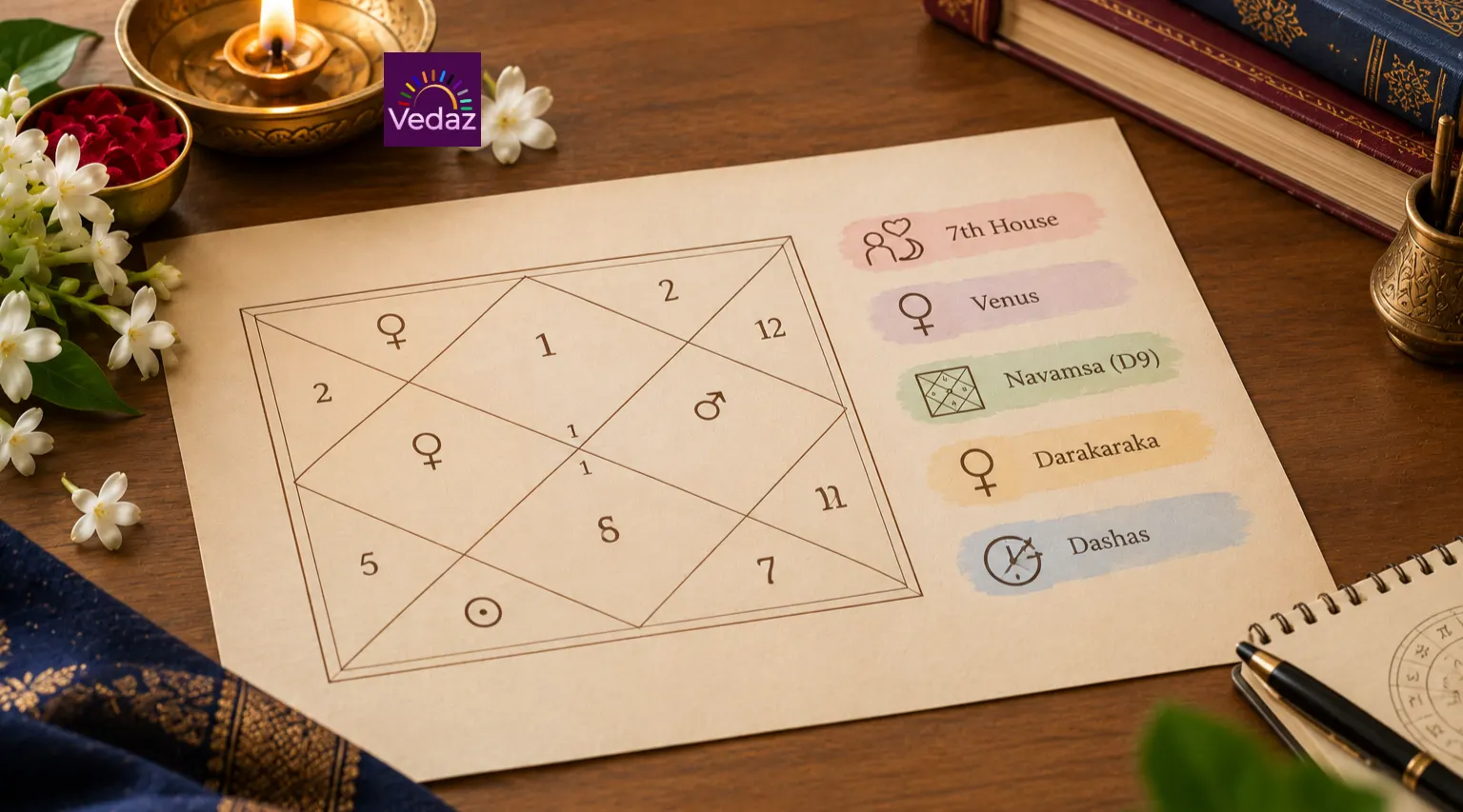
Kundli matching beyond guna milan means checking the 7th house, Venus, Jupiter, the Navamsa (D9) chart, Darakaraka and dasha periods in both charts. The 36 gunas compare only the two Moons, so these checks add marriage potential, partner nature and timing.
- ◦Quick Facts: Kundli Matching Beyond Guna Milan
- ◦Why Is Kundli Matching Beyond Guna Milan Needed?
- ◦How Does the 7th House Shape Kundli Matching for Marriage?
- ◦What Role Do Venus and Jupiter Play in Kundli Matching?
- ◦What Is Navamsa (D9) Matching in Kundli Matching for Marriage?
- ◦What Is Darakaraka and How Does It Point to Your Spouse?
- ◦What Is Upapada Lagna and Why Do Astrologers Check It?
- ◦How Do Dasha Periods Affect Kundli Matching Beyond Guna Milan?
- ◦Why Do Astrologers Check the 2nd, 5th, 8th and 12th Houses?
- ◦Why Does Each Person's Own Chart Strength Matter?
- ◦The Full Kundli Matching Checklist Beyond 36 Gunas
- ◦Key Takeaways
Picture a family sitting with a kundali matching report. The score says 30 out of 36. Everyone's smiling, and someone is already talking about sweets.
Then the family astrologer looks at the page for a minute and says, "Achha, ab poori kundli dikhaiye." (Okay, now show me the full chart.)
Why? Because the score is only a first look. Ashtakoot Guna Milan compares two Moons and nothing else. This post covers the part that comes next, the full chart check. If you want the basics first, here's how the three layers of kundli matching work.
Quick Facts: Kundli Matching Beyond Guna Milan
- Guna score: Compares only the two Moons, so it shows emotional and everyday fit.
- 7th house: Shows the spouse and marriage in each chart.
- Venus and Jupiter: The two main marriage significators.
- Navamsa (D9): The divisional chart traditionally read for marriage.
- Darakaraka: The planet that hints at your spouse's nature.
- Dasha periods: Help with timing, not just a yes or no.
- Birth time: Needed for most of these deeper checks.
Why Is Kundli Matching Beyond Guna Milan Needed?
Think of the 36-guna score as a first impression. It's useful, but it only covers so much.
| What Ashtakoot (36 gunas) checks | What it doesn't check |
|---|---|
| Moon sign compatibility | The 7th house (marriage) in each chart |
| Moon nakshatra compatibility | Venus and Jupiter, the natural marriage significators |
| Friendship of Moon-sign lords | The Navamsa (D9), the dedicated marriage chart |
| Manglik Dosha | |
| Dasha timing: is this the right time for both? | |
| Each person's own capacity for a stable marriage |
Here's a simple way to see it. Say one couple scores 32 out of 36, but both charts show a heavily stressed 7th house. Another couple scores 20, but both have strong, well-supported 7th houses. Astrologers would often look at the first couple more carefully.
So kundli milan is rarely a one-number decision. The score is where the conversation starts.
How Does the 7th House Shape Kundli Matching for Marriage?
In every kundli, the 7th house stands for the spouse, marriage and committed partnerships. When astrologers open a chart, they usually look at four things:
- The sign on the 7th house: the kind of partnership a person naturally looks for.
- Planets sitting in the 7th: Jupiter there is traditionally seen as supportive. Saturn can point to a delay, or to a more mature partner.
- The 7th lord: where it sits, how strong it is, and which planets aspect it.
- Aspects on the 7th: Jupiter's aspect is seen as protective. Heavy Saturn, Rahu or Mars influence may simply ask for more patience.
In matching, astrologers compare both 7th houses to see if they support each other. One example: one partner's Moon or Lagna falling in the other's 7th house. That's traditionally read as a warm connection.
What Role Do Venus and Jupiter Play in Kundli Matching?
These two planets get a lot of attention in marriage charts. Each one has its own job.
Venus (Shukra)
Venus is the natural significator (karaka) of love, romance, comfort and marriage. A well-placed Venus suggests affection, harmony and a happy married life.
An afflicted Venus doesn't mean doom. It's just a sign that some areas may need extra effort. Astrologers usually flag Venus when it is:
- Combust (too close to the Sun)
- Debilitated in Virgo
- Heavily aspected by malefic planets
Jupiter (Guru)
Traditionally, Jupiter is the significator of the husband in a woman's chart. Many modern astrologers read it more broadly, as wisdom, commitment and blessings in the marriage for both partners. A strong Jupiter is widely seen as a protective influence on family life.
In matching, astrologers like both Venus and Jupiter to be reasonably strong in each chart. They also look for helpful cross-chart links, like one partner's Venus falling on the other's Moon sign.
What Is Navamsa (D9) Matching in Kundli Matching for Marriage?
The Navamsa, or D9, is a divisional chart. Each sign is split into 9 equal parts, and each part is the size of one nakshatra pada. Astrologers call it the chart of the spouse and of dharma, so it's treated as the marriage chart inside your chart.
Here's what they check in it:
- Lagna and 7th house of the D9: the inner nature of married life.
- Venus in D9: is it stronger or weaker than in the birth chart?
- Vargottama planets: a planet in the same sign in both D1 and D9 is considered very strong.
- Navamsa Moon signs of both partners: sometimes used to cancel Bhakoot Dosha. You can read more on that in our guide to Nadi Dosha and Bhakoot Dosha cancellation.
Why birth time matters here: the D9 Lagna changes roughly every 12 to 13 minutes. So even a small error in birth time can change the reading. No exact time? You can still try kundli matching without birth time, but the deeper D9 checks will be limited.
What Is Darakaraka and How Does It Point to Your Spouse?
In the Jaimini system, the planet with the lowest degree in your chart is called the Darakaraka. Rahu and Ketu are left out in the commonly used method. This planet is seen as the significator of the spouse, and its sign and nature are traditionally read as hints about the partner's personality.
A few examples:
- Venus as Darakaraka: an artistic, charming, comfort-loving partner.
- Saturn as Darakaraka: a mature, responsible, maybe older partner.
- Mercury as Darakaraka: a youthful, talkative, sharp partner.
Curious about yours? Try our Atmakaraka and Darakaraka calculator.
What Is Upapada Lagna and Why Do Astrologers Check It?
Upapada Lagna (UL) is another Jaimini tool. It's the arudha, or image, of the 12th house.
Experienced astrologers use it to see how a marriage holds up over time. That includes family support, shared resources, and how the world sees the marriage. Strong benefic influence on the UL and its 2nd house is traditionally considered supportive.
How Do Dasha Periods Affect Kundli Matching Beyond Guna Milan?
Honestly, this is the most underrated part of kundli matching. Two compatible people can still struggle if they marry during tough planetary periods for both.
Astrologers usually check:
- Current Mahadasha and Antardasha of both partners. Are they supportive of marriage, like the periods of the 7th lord, Venus or Jupiter?
- Dasha sandhi: the gap between two Mahadashas. It's often seen as a transition phase, so many astrologers avoid big new beginnings then.
- Sade Sati and major transits: not a reason to reject a match, but they can matter when choosing the wedding date.
- Wedding muhurat: once the match is approved, the next step is an auspicious date and time.
Practical takeaway: sometimes the advice isn't "don't marry." It's "marry a little later, once this period ends." That kind of timing advice is one of the most useful things a full reading gives you. Want to know your marriage window? Try our When will I get married? tool.
Why Do Astrologers Check the 2nd, 5th, 8th and 12th Houses?
Besides the 7th, a few other houses add to the picture.
| House | Why astrologers check it in matching |
|---|---|
| 2nd | Family life, harmony with in-laws, speech at home |
| 5th | Children, romance, the creative bond |
| 8th | Longevity of the bond, in-laws, joint finances, life changes |
| 12th | Intimacy, expenses, emotional retreat |
The 2nd, 8th and 12th also show up in Manglik Dosha. That's why astrologers rarely judge Mars alone, and look at these houses fully. Our guide on Manglik Dosha in kundli matching explains how it works.
Why Does Each Person's Own Chart Strength Matter?
Finally, astrologers look at each chart on its own. A match is two individuals, not just a score. They ask things like:
- Is the Lagna lord strong? That points to health and self-confidence.
- Is the Moon well-placed? That points to emotional stability.
- Are there yogas that support a happy family life?
- Is anything afflicted, like the Moon or the 7th house, that may need support?
Two emotionally steady people with average gunas often do very well together.
The Full Kundli Matching Checklist Beyond 36 Gunas
Here's the whole thing in one place.
| Step | What's checked | Needs accurate birth time? |
|---|---|---|
| 1 | Ashtakoot Guna Milan (36 gunas) | Mostly no (Moon-based) |
| 2 | Nadi and Bhakoot Dosha and their cancellations | Mostly no |
| 3 | Manglik Dosha and its cancellations | Yes |
| 4 | 7th house, 7th lord, aspects | Yes |
| 5 | Venus and Jupiter in both charts | No (sign) / Yes (house) |
| 6 | Navamsa (D9) | Yes, very sensitive |
| 7 | Darakaraka and Upapada | Partially |
| 8 | Dasha periods and timing | Yes |
| 9 | Individual chart strength | Yes |
| 10 | Wedding muhurat | Separate calculation |
Key Takeaways
- 36 gunas compare two Moons. Marriage needs a look at the whole chart.
- Key checks: 7th house, Venus, Jupiter, Navamsa, Darakaraka, Upapada and dashas.
- Birth time matters. Several of these checks need it to be accurate.
- Timing advice ("marry after this period") is often more useful than a plain yes or no.
- A low score with strong individual charts can still be a good match.
Start with a free kundli matching report, then go deeper with Veda, the Vedaz AI astrologer, or see your correct chart on KundliGPT - kundligpt.
Tanvi Deshpande
Vedic traditions, astrology terminology, cultural and spiritual context. | 10 years
Tanvi Deshpande approaches traditional knowledge through context, interpretation, and accessible explanations. Her writing connects astrological terminology with broader Indian cultural traditions, helping readers understand the background of commonly discussed concepts rather than relying on isolated definitions.
Frequently Asked Questions
1. What do astrologers check in kundli matching apart from gunas?
Besides the 36 gunas, astrologers check each person's 7th house and 7th lord, Venus and Jupiter, the Navamsa (D9), Manglik Dosha, the Darakaraka and the current dasha periods. Together these show marriage potential, partner nature and good timing.
2. Why is the 7th house important in kundli matching for marriage?
The 7th house represents the spouse and marriage in every birth chart. Its sign, its lord and the planets influencing it show what a person looks for in a partner and how supportive their chart is for married life.
3. What is Navamsa matching?
Navamsa matching compares each partner's D9 chart, the divisional chart traditionally linked to marriage. Astrologers check the D9 Lagna, the 7th house and Venus. It needs an accurate birth time, since the D9 Lagna changes roughly every 12 to 13 minutes.
4. Can kundli matching be good even with low gunas?
Yes. If both charts have strong 7th houses, well-placed Venus and Jupiter, supportive Navamsas and good dasha timing, many astrologers consider the match workable even with a modest score, especially when doshas are cancelled.
5. Does dasha affect marriage compatibility?
Dashas affect timing more than compatibility. Two compatible people may still be advised to wait if both are in tough periods. A good reading often tells you when to marry, not just whether.
Related Blogs

Dreaming of moving abroad? Check Foreign Travel Astrology
Is your destiny written in the stars? Discover if the universe is guiding you toward a life abroad!
The Best Places to Travel Abroad Foreign Travel Astrology
Is foreign travel written in your stars? Explore how astrology influences your journeys and uncover the best destinations for your zodiac sign!
Can Your Birth Chart Predict Depression Symptoms?
This article examines whether astrological birth charts can predict depression symptoms, contrasting astrological beliefs with psychological research on personality traits and mental health.
The Manifestation Secrets Hidden in Celebrity Birth Charts
Find out what makes fame unique and special. This guide lets you know how some of the biggest celebrities use planetary help to become successful—and how you can do the same.