Marriage Timing in Vedic Astrology: When Marriage Is Supported, the Houses and Periods Involved, and Honest Framing
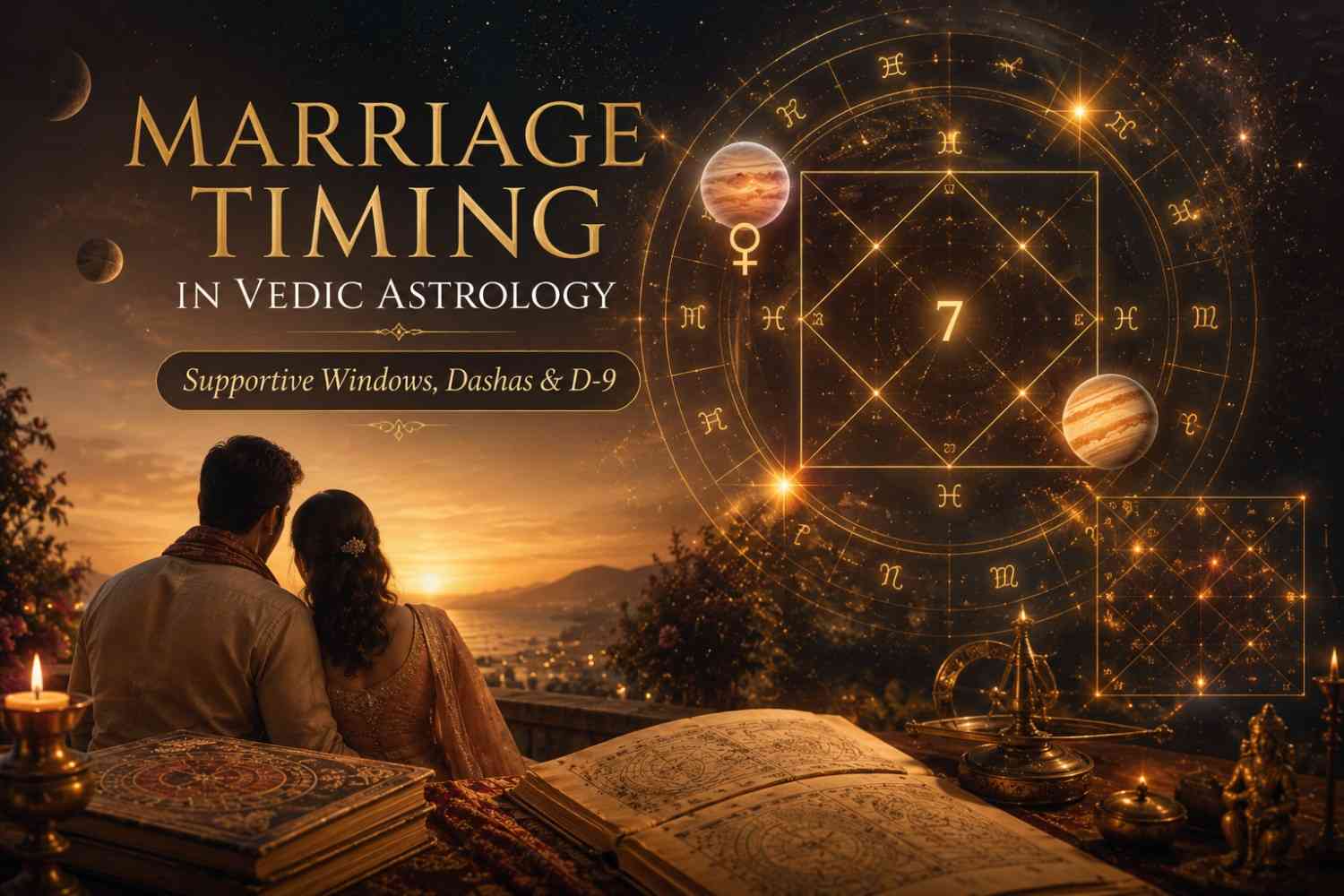
Marriage timing in Vedic astrology is primarily analyzed through the 7th house, Venus, Jupiter, and the Navamsha (D-9) chart. Marriage-supportive periods often arise through relevant dashas and Jupiter transits, helping identify favorable windows for partnership while emphasizing timing tendencies rather than fixed dates or guarantees.
Among the most common questions in Vedic astrology — and one that carries real emotional weight for a lot of people and families — is when marriage is likely to happen. This guide is specifically about timing (when), not about marital harmony or difficulty (that's covered elsewhere), and not about who someone marries either (that's explored in our guide on spouse characteristics).
Vedic astrology does have a fairly developed framework for marriage timing. There's the 7th house and the houses connected to it, the dasha periods that activate the marriage dimension, the Navamsha (D-9) chart used specifically for marriage analysis, and the transit factors that mark out supportive windows.
This guide goes through that framework honestly. The consistent message throughout is that astrology points to supportive windows, not fixed dates — and that "when will I marry" is a question best held without the anxiety that so often gets attached to it.
A Framing Note on Marriage-Timing Pressure
Before getting into the framework itself, it's worth saying this clearly: questions about marriage timing often come loaded with social and family pressure. That pressure can turn what should be a reflective question into a real source of anxiety.
The honest position here is that marriage-timing astrology is most useful when held lightly — as perspective on supportive windows, not as a countdown, and definitely not as a verdict on someone's worth or prospects. Astrology cannot, and shouldn't, be used to create urgency or distress around marriage.
If the question carries real pressure, that's worth acknowledging directly. The kindest framing keeps things gentle, non-deterministic, and free of the kind of false precision that tends to fuel anxiety.
Everything below is meant to sit within that frame.
Marriage Timing Quick Facts
| Category | Details |
|---|---|
| Primary house | 7th house — marriage and partnership |
| Supporting houses | 2nd house (family expansion), 11th house (fulfillment of desire), 5th house (romance, for love marriage) |
| Primary planets | Venus (marriage significator, all charts), Jupiter (for women's charts particularly) |
| Divisional chart | Navamsha (D-9) — the primary chart for marriage analysis |
| Timing tool | Mahadasha-Antardasha of marriage significators; Jupiter transit to the 7th |
| Honest framing | Identifies supportive windows, not fixed dates; held lightly, without manufactured urgency |
The Houses Involved in Marriage Timing

The 7th house is the main one — it's the house of the spouse, the partnership, the marital union itself. Where its ruling planet sits, and what's influencing it, is central to any timing analysis.
The 2nd house relates to family and the expansion of family. In the marriage-timing context, it's connected to the joining of two families and the growth of one's own.
The 5th house is about romance and love. This matters especially when marriage comes out of a romantic relationship — the love-marriage angle, which has its own guide.
The 11th house is about the fulfillment of desires, including the desire for partnership. When the 11th is activated, that can relate to the marriage wish actually being fulfilled.
The Lagna and its ruling planet represent the self entering into partnership — basically, the overall readiness dimension.
The Planets and the Navamsha
Venus is the natural significator of marriage across all charts. Its condition, and the periods it governs, sit at the center of marriage timing.
Jupiter is additionally a marriage significator for women's charts in particular — in the classical framework, Jupiter represents the husband. So Jupiter's condition and periods carry extra weight for women's marriage timing.
Here's something worth knowing: a properly done marriage analysis looks at the Navamsha (D-9) — the divisional chart made specifically for marriage and partnership. The D-9 Lagna and its ruler, the 7th house within the D-9, and where Venus and Jupiter sit there all feed significantly into the marriage picture, timing included.
If a marriage-timing reading is based only on the main chart, without looking at the D-9, it's skipping a key part of the classical method. That's a useful thing to keep in mind when evaluating any reading you come across.
Timing — When Marriage Is Most Supported
A few specific periods tend to come up as classically supportive:
-
Mahadasha or Antardasha of the 7th lord — a primary marriage-activation period
-
Mahadasha or Antardasha of Venus — since Venus is the universal marriage significator, this activates the relationship-and-marriage dimension
-
For women's charts, Mahadasha or Antardasha of Jupiter — particularly relevant given Jupiter's role as the husband significator
-
Mahadasha or Antardasha of a planet placed in the 7th house, or strongly connected to it
-
Jupiter transit to the 7th house, or over the 7th lord or Venus — a classically supportive marriage transit
-
Jupiter transit to the natal Moon or 2nd house — a broader life-expansion period that supports the marriage dimension too
The strongest version of a "supportive window" is when a favorable marriage-significator dasha lines up with a supportive Jupiter transit, during a time the person is genuinely open to marriage.
Marriage often unfolds alongside other major life transitions. Our guide on Career Change Timing explores how astrology traditionally evaluates periods of significant personal and professional change.
But it's worth being clear about what these windows actually mean. They show when the marriage dimension is supportively activated — not a fixed date, and not a guarantee that marriage happens in that window if circumstances don't align or the right person hasn't come along yet.
Common Scenarios — With Gentle Framing

"When will I get married?"
Here's the honest answer: the chart can point to periods that are classically supportive for marriage — times when the marriage significators are activated and the transits line up favorably. But it can't give a fixed date.
A supportive window is just that — a period where marriage is well-supported if things align. It's not a guarantee it happens right then.
For readers exploring relationship readiness alongside timing, traditional tools such as Compatibility Analysis and Kundli Matching are sometimes used to understand broader interpersonal dynamics and long-term alignment. They are best viewed as supplementary perspective rather than determinants of whether or when a marriage will occur.
The gentlest and most useful way to frame this is simply: "these periods look classically supportive for marriage in your chart." That's perspective, not a countdown — and it avoids the kind of false precision that turns a reflective question into something anxiety-inducing.
"My marriage is getting delayed — why, and when will it happen?"
This question often comes with real pressure attached, so the framing matters here especially.
Classical indicators of delay — Saturn's influence on the 7th house, certain placements of the 7th lord — point to a tendency toward later timing. Not a denial of marriage. Just later.
What's actually useful here is figuring out when the supportive windows arrive. That can turn anxious uncertainty into something a bit clearer — though still never a guarantee.
One more thing worth saying: "delay" in the classical sense usually just means "later than what was socially expected," not "never." And often, the social expectation itself — not anything in the chart — is the real source of the stress.
Some readers also explore the role of Manglik Dosha, which is traditionally associated with relationship dynamics and marriage-related timing considerations.
"An astrologer gave me an exact marriage date — is that reliable?"
Be skeptical of this. Genuine timing analysis points to supportive windows — periods — not precise dates. That's because marriage also depends on meeting the right person and circumstances aligning, and no chart can specify either of those.
An astrologer handing over a precise date is offering false precision. The honest version of this kind of reading is always a window, with an explicit acknowledgment that it indicates support, not certainty.
"The pressure about marriage timing is causing me real stress"
This one deserves a direct, caring response rather than a chart-based answer.
Pressure around marriage timing — especially from family and social expectations — is a genuine source of distress for a lot of people. And often, that distress comes from the pressure itself, not from anything in the chart.
Astrology should never add to this. If the pressure feels heavy, talking to people you trust, and holding the chart's perspective lightly rather than as some kind of verdict on your worth or prospects, is the healthier path.
The chart can offer gentle perspective on supportive windows. It has nothing to say about your worth as a person, and it should never become a source of urgency or self-judgment.
Honest Framing
-
Marriage timing astrology points to supportive windows, not fixed dates. Exact-date predictions are false precision and should be treated with skepticism.
-
A rigorous analysis uses the Navamsha (D-9), not just the main chart.
-
"Delay" in the classical sense usually means later than social expectation — not denial of marriage. And often the social expectation, not the chart, is the real source of distress.
-
Marriage timing astrology is best held lightly — as perspective, never as a countdown, a verdict on someone's worth, or a source of manufactured urgency.
-
Be wary of astrologers who give exact dates, who frame delay in a fatalistic way, or who use marriage-timing anxiety to sell expensive remedies. This exploits something a lot of people genuinely struggle with.
-
The most useful and caring application here is gentle perspective on supportive windows, held without anxiety — alongside the simple recognition that marriage depends on meeting the right person and circumstances aligning, which no chart can specify.
Get a gentle, honest marriage-timing analysis — free on Vedaz.
Vedaz looks at your 7th house, your marriage significators, and your Navamsha (D-9) to identify classically supportive marriage windows — framed gently, as perspective, never as an exact date, a verdict, or a source of pressure. Free at vedaz.io.
Final Thought
Marriage timing is one of the most commonly asked, and most pressure-laden, questions in Vedic astrology — and the tradition does offer a real framework for it: the 7th house, the marriage significators, the Navamsha divisional chart, the supportive timing windows.
But the honest and caring way to engage with this holds the framework lightly. It identifies supportive windows, not fixed dates. "Delay" usually means later than social expectation, not denial. And the analysis is most useful as gentle perspective, not a countdown or a verdict on someone's worth.
The pressure that so often surrounds this question is real — but it usually comes from social expectation, not from anything the chart actually says. Astrology should never add to it.
For some people, marriage timing is closely tied to achieving a sense of financial stability or vocational security first. Questions around Government Job Astrology sometimes arise within that broader planning process.
Others may find themselves balancing entrepreneurial goals, independent work, or more conventional career paths while considering marriage plans. Our guide on Business vs Job explores another dimension of evaluating long-term life direction and professional priorities.
The most a caring reading can offer is a gentle sense of when the marriage dimension is supportively activated, held without anxiety — alongside the simple truth that marriage depends on meeting the right person and circumstances aligning in ways no chart can specify.
Held that way, the question loses its sting and becomes what it should be: a reflective curiosity, not a source of distress.
Vaishnavi Bhardwaj
Marriage Astrology, Kundli Matching & Relationship Analysis | 12+ Years
Vaishnavi Bhardwaj is a Vedic astrology writer specializing in marriage timing, compatibility assessment, and relationship analysis. Her work focuses on helping readers understand classical Jyotish principles related to partnerships, marriage prospects, and significant life milestones.
Frequently Asked Questions
1. Which house indicates marriage timing in Vedic astrology?
The 7th house is the primary marriage house — where its ruling planet sits, and what's influencing it, is central to timing analysis. The 2nd house (family expansion), 11th house (fulfillment of the partnership desire), and 5th house (romance, for love marriage) all contribute too. Venus is the universal marriage significator, and Jupiter is additionally the husband significator for women's charts. A thorough analysis also looks at the Navamsha (D-9), the divisional chart made specifically for marriage.
2. When will I get married according to astrology?
The chart can point to periods that are classically supportive — times when the marriage significators (the 7th lord, Venus, and for women's charts, Jupiter) are activated alongside favorable Jupiter transits. The strongest combination is a supportive significator dasha lining up with a supportive Jupiter transit, during a period someone is genuinely open to marriage. But this is a supportive period, not a fixed date or a guarantee — marriage also depends on meeting the right person and circumstances aligning, which no chart specifies.
3. Why is my marriage getting delayed astrologically?
Classical indicators of delay — like Saturn's influence on the 7th house or certain placements of the 7th lord — point to a tendency toward later timing, not a denial of marriage altogether. "Delay" in the classical sense usually just means later than what was socially expected, not "never." The useful thing to do with this kind of analysis is figure out when the supportive windows actually arrive, which can replace anxious uncertainty with something a bit clearer (though still never guaranteed). Often, the social expectation itself — not the chart — is the real source of the distress.
4. Can an astrologer tell me my exact marriage date?
Be skeptical of this. Genuine timing analysis points to supportive windows — periods — not precise dates, because marriage also depends on meeting the right person and circumstances aligning, neither of which any chart can specify. An astrologer offering a precise date is giving you false precision. The honest version is always a window, along with an acknowledgment that it indicates support, not certainty.
5. Why is the Navamsha (D-9) important for marriage timing?
The Navamsha (D-9) is the divisional chart made specifically for marriage and partnership in Vedic astrology. The D-9 Lagna and its ruler, the 7th house within it, and where Venus and Jupiter sit there all feed meaningfully into the marriage picture, timing included. A marriage-timing reading based only on the main chart, without the D-9, is skipping part of the rigorous classical method — worth keeping in mind when judging any reading you come across.
6. The pressure about my marriage timing is stressing me — what should I do?
Pressure around marriage timing — especially from family and social expectations — is a genuine source of distress for a lot of people, and that distress often comes from the pressure itself rather than from anything in the chart. Astrology should never add to it. If the pressure feels heavy, talking to people you trust, and holding the chart's perspective lightly rather than as a verdict on your worth or prospects, is the healthier path. The chart can offer gentle perspective on supportive windows — it has nothing to say about your worth, and shouldn't become a source of urgency or self-judgment.
Related Blogs

7 Secrets to a Happy Relationship Everyone Misses
Click to learn the top 7 secrets for a strong and happy relationship.

Boost Your Love Life with 5 Astrology Tips
Tap into cosmic wisdom to improve relationships, deepen emotional bonds, and attract real love with these 5 powerful astrology-backed love tips.
Unlock Love with VEDAZ’s Step by Step Romance Guide
Discover how to deepen your love life using astrology with this human, step-by-step guide that helps you align with cosmic timing and emotional insight.
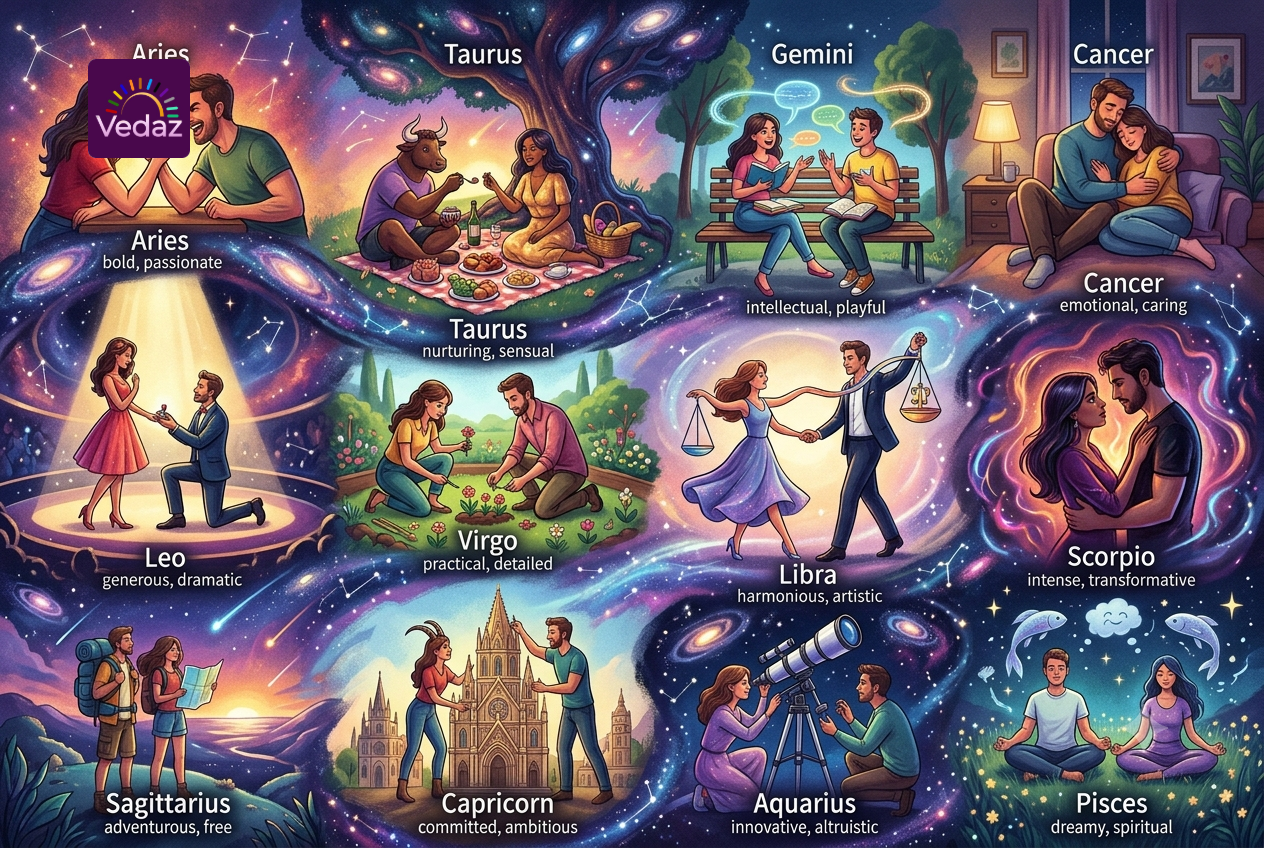
Ways of loving of each zodiac sign
Uncover the secrets behind each sign's way of loving and get inspired by their unique expressions of passion and care