Spouse Characteristics in Vedic Astrology: What the Chart Indicates About a Future Partner — and Its Real Limits
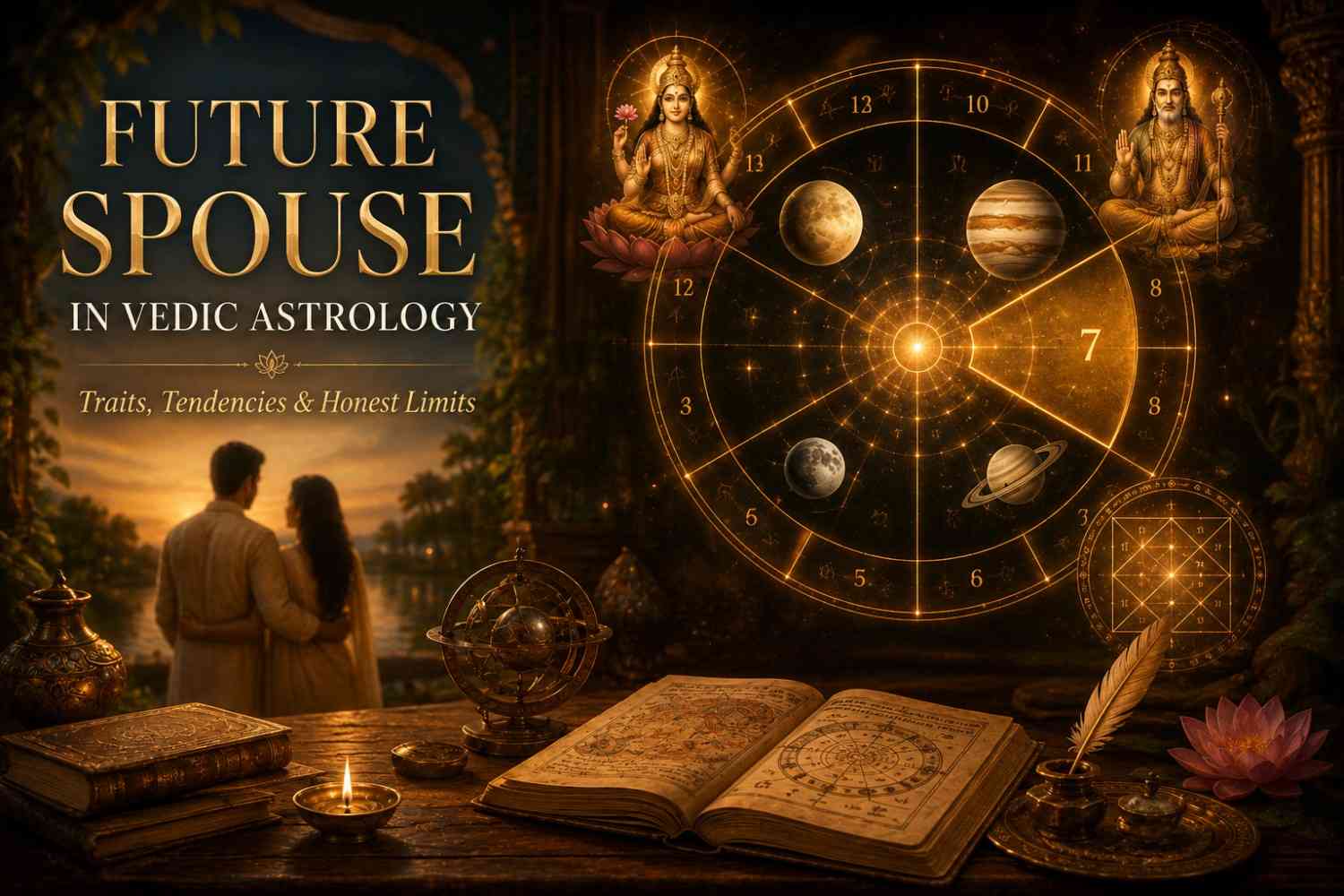
Vedic astrology reads future spouse qualities through the 7th house, its lord, planets aspecting it, Venus, and the Navamsha (D-9) chart. It reveals broad temperament and background tendencies only—not a name, appearance, or specific identity. It should never be used to evaluate a real partner.
- ◦Spouse Characteristics Quick Facts
- ◦The Framework — How the 7th House Describes a Partner
- ◦What the Chart Can and Cannot Indicate — The Crucial Distinction
- ◦The Real Risk — Forcing Real People Into Chart Expectations
- ◦Common Scenarios — With Honest Limits
- ◦Honest Framing
- ◦Get an honest spouse-characteristics sketch — free on Vedaz
- ◦Final Thought
There's a classical framework for this, built around the 7th house and its significators, and it's genuinely an interesting area of chart reading. But it's also one where honesty about the limits really matters.
The chart describes broad tendencies and qualities — not specific identifying details. Reading it as a precise description of a particular future person isn't technically supportable, and it can lead to disappointment, or worse, to forcing real people into chart-shaped expectations.
This guide walks through the genuine framework while keeping those limits clearly in view the whole way through.
Spouse Characteristics Quick Facts
| Aspect | Details |
|---|---|
| Primary house | 7th house — the spouse and the partnership |
| Key factors | 7th house sign, 7th lord placement, planets in/aspecting the 7th, Venus (and Jupiter for women) |
| Divisional chart | Navamsha (D-9) — refines the spouse picture significantly |
| What it can indicate | Broad temperament, general qualities, broad background tendencies, direction |
| What it cannot indicate | Specific identity, name, exact appearance, precise details about a particular person |
| Honest framing | Broad tendencies, not a precise portrait; never force real people into chart expectations |
The Framework — How the 7th House Describes a Partner

The classical framework reads spouse characteristics mainly through a handful of factors.
The sign on the 7th house colors the partner's general temperament, broadly speaking — fire signs leaning toward someone energetic, earth signs toward someone grounded, that kind of thing. Always in broad strokes.
The 7th lord's placement — the house and sign it sits in — points to broad themes about the partner and the context the partnership unfolds in.
Readers unfamiliar with houses, planetary rulerships, and relationship indicators may find How to Read Your Vedic Birth Chart helpful for understanding the chart factors discussed throughout this guide.
Planets in or aspecting the 7th house each add their own flavor. Jupiter aspecting the 7th might broadly suggest a partner with wisdom or dharmic qualities. Venus might lean toward refinement. Saturn toward seriousness or maturity. And so on.
Venus is the universal significator of the spouse and relationship — its condition relates broadly to the relational dimension overall.
Jupiter, especially in women's charts, is the husband significator in the classical framework. Its condition broadly relates to the husband's general qualities.
The Navamsha (D-9) is the divisional chart for marriage, and it significantly refines the spouse picture. Readers interested in a deeper understanding of varga charts can explore Navamsha (D-9) chart for a broader introduction to divisional-chart analysis.
Put all of this together and what you get is a picture of broad temperament and general qualities — an impressionistic sketch in broad strokes, not a detailed portrait.
What the Chart Can and Cannot Indicate — The Crucial Distinction
This is really the heart of honest spouse-characteristics astrology.
What the chart can broadly indicate
- Broad temperament tendencies — energetic vs. grounded, serious vs. lighthearted, in general strokes
- General quality themes — a partner inclined toward dharmic seriousness, or refinement, or practical capability, broadly speaking
- Broad background tendencies — whether the partnership context leans familiar or unfamiliar, near or distant, in general terms
- Direction or distance tendencies — some classical methods broadly point to the direction a partner might come from relative to the person, held loosely
- General relationship dynamics the chart leans toward (which the marital-harmony guide covers in more depth)
What the chart cannot indicate
- The specific identity of a particular person
- A name, or precise identifying details
- Exact physical appearance, beyond very broad tendencies — and even those should be held loosely
- A guarantee that someone you've met "is the one the chart describes"
- Anything precise enough to use as a checklist against real people you meet
Here's the crucial point: spouse-characteristics astrology operates in broad strokes. Treating it as a precise portrait — and especially using it as a checklist to evaluate real people — distorts both the astrology and your relationships. The chart sketches general tendencies. It doesn't describe a specific person who exists or will exist.
The Real Risk — Forcing Real People Into Chart Expectations

This deserves its own section, because it's where spouse-characteristics astrology can actually cause harm.
When someone treats a chart-derived spouse description as precise, two things tend to happen.
First, disappointment or doubt about a genuinely good partner, because they don't match an expectation that was never precise to begin with.
Second, forcing the interpretation onto a real person — convincing yourself someone "matches the chart" (or doesn't), and making relationship decisions based on that instead of on the actual qualities and compatibility of the real relationship.
Both of these swap out the real, specific knowledge that actually matters — knowing the actual person, their actual character, the actual compatibility — for a vague astrological sketch.
The honest framing here is firm: the chart's broad sketch should never override real knowledge of a real person. Using it to evaluate or doubt a genuine partner is a misuse, and it harms relationships.
Common Scenarios — With Honest Limits
-
"What will my future spouse be like?"
Here's the honest answer: the chart can sketch broad temperament and quality tendencies, and give a general sense of the partnership context. That's an impressionistic sketch, not a portrait.
It's genuinely interesting as broad perspective. It's useless — or even harmful — if taken as precise. The most honest approach is to offer these broad themes explicitly as broad themes, with a clear statement that they describe tendencies, not a specific person.
-
"I met someone — does my chart say they are the one?"
The chart can't say this, and any astrologer claiming to confirm a specific person against a chart is overreaching.
Whether someone is a good partner is answered by knowing them — their character, the actual compatibility, the real relationship — not by matching them against a vague chart sketch.
The honest answer redirects: whether this person is right for you comes down to the real relationship, not the chart. The chart shouldn't be used to validate or doubt a real person.
People reflecting on relationship questions may also find Radha AI helpful as a conversational space for exploring themes around connection, attraction, and relationship expectations alongside real-world experience.
Some readers also explore broader interpersonal assessment through Compatibility Analysis and traditional Kundli Matching.
These approaches are best understood as supplementary perspective on relationship dynamics rather than methods for confirming that a specific person is destined to be one's spouse.
-
"The person I love does not match my chart description — should I worry?"
No. The chart description was never precise enough to be a meaningful test in the first place.
A genuine, good relationship with a real person is vastly more significant data than a broad astrological sketch. Letting a vague chart-derived expectation create doubt about a genuinely good partner is exactly the kind of misuse this guide is warning against.
The real relationship is the real evidence — the chart sketch is, at most, a piece of broad background curiosity that should never override it.
Major relationships often emerge during periods of wider personal transition. Our guide on Career Change Timing explores how astrology traditionally evaluates significant periods of change and redirection.
Honest Framing
- Spouse-characteristics astrology operates in broad strokes — general temperament and quality tendencies, not a precise portrait of a specific person.
- A rigorous reading uses the Navamsha (D-9), not just the main chart's 7th house.
- The chart can't indicate specific identity, a name, exact appearance, or whether a particular real person "is the one." Claims to do so are overreach.
- The real risk is forcing real people into chart expectations — doubting a good partner who doesn't match a vague sketch, or making relationship decisions based on chart-matching instead of real compatibility. This is a genuine misuse that harms relationships.
- The chart's broad sketch should never override real knowledge of a real person. Whether someone is a good partner is answered by the actual relationship, not the chart.
- The honest and enjoyable use here is light curiosity — broad perspective, held loosely, never a checklist, never a verdict on a real person.
Get an honest spouse-characteristics sketch — free on Vedaz
Vedaz looks at your 7th house, its significators, and the Navamsha (D-9), offering a broad sketch of partner-related tendencies held loosely and honestly.
Readers interested in exploring relationship-related chart themes may also find Shubha AI useful for discussing marriage and partnership indicators.
Framed explicitly as general perspective, never a precise portrait or a tool for evaluating real people. Free at vedaz.io.
Final Thought
The question of what a future spouse will be like is one of the most naturally curiosity-driven in all of astrology, and the tradition does offer a real framework for it — the 7th house and its significators, refined through the Navamsha. It's a genuinely interesting area of chart reading.
But its honest value depends entirely on holding it in broad strokes. The chart sketches general temperament and quality tendencies, not a precise portrait of a specific person — and certainly not a name, an appearance, or a verdict on whether a particular real person "is the one."
The real risk — and the reason this framing matters so much — is the temptation to treat the vague sketch as precise, and then to doubt a genuinely good partner who doesn't match it, or to make relationship decisions through chart-matching rather than the real compatibility of a real relationship.
That's a misuse that harms relationships, swapping out the specific, lived knowledge of an actual person for an impressionistic astrological sketch.
Held lightly, as broad curiosity, spouse-characteristics astrology is an enjoyable part of chart reading. Held as a precise portrait or a checklist, it distorts both the astrology and the relationship.
The honest guidance is simple: enjoy the broad sketch, hold it loosely, and never let it override what you actually know about a real person you actually love.
For some people, ideas about a future spouse are closely tied to hopes around long-term stability, vocation, and family planning. Questions around Government Job Astrology occasionally arise within that broader conversation.
Others may imagine partnership alongside entrepreneurship, independent work, or more conventional employment paths. Our guide on Business vs Job explores another dimension of evaluating long-term lifestyle and professional priorities.
Ishani Chaturvedi
Relationship Astrology, Spouse Indicators & Horoscope Interpretation | 10+ Years
Ishani Chaturvedi specializes in relationship astrology, spouse-related indicators, and horoscope interpretation. She writes extensively about partnership tendencies, personality traits, and planetary influences traditionally associated with future spouse characteristics, helping readers understand classical Jyotish concepts in an accessible and balanced manner.
Frequently Asked Questions
1. What can Vedic astrology tell me about my future spouse?
The chart can sketch broad tendencies — general temperament (energetic vs. grounded, serious vs. lighthearted, in broad strokes), general quality themes, broad background or distance tendencies, and the general relationship dynamics the chart leans toward. This comes through the 7th house sign, the 7th lord's placement, planets influencing the 7th, Venus (and Jupiter for women's charts), and the Navamsha (D-9). It's an impressionistic sketch in broad strokes — not a detailed or specific portrait.
2. Can a chart tell me the name or exact appearance of my spouse?
No. The chart can't indicate specific identity, a name, precise identifying details, or exact appearance beyond very broad tendencies held loosely. Spouse-characteristics astrology operates in broad strokes — general temperament and quality tendencies — not a precise portrait of a specific person. Any astrologer claiming to provide a name or precise identifying details is overreaching well beyond what the framework can actually support.
3. Can astrology confirm whether someone I met is "the one"?
No, and any astrologer claiming to confirm a specific person against a chart is overreaching. Whether someone is a good partner comes down to knowing them — their actual character, the actual compatibility, the real relationship — not matching them against a vague chart sketch. The chart shouldn't be used to validate or doubt a real person; the real relationship is the real evidence.
4. The person I love does not match my chart's spouse description — should I worry?
No. The chart description was never precise enough to be a meaningful test, and a genuine, good relationship with a real person matters far more than a broad astrological sketch. Letting a vague chart-derived expectation create doubt about a genuinely good partner is a misuse of the framework, and it harms relationships. The real relationship is the real evidence — the chart sketch is, at most, broad background curiosity that should never override it.
5. Why is the Navamsha (D-9) important here?
The Navamsha (D-9) is the divisional chart for marriage and partnership in Vedic astrology, and it significantly refines the spouse picture beyond what the main chart's 7th house alone suggests. A rigorous reading of spouse-related tendencies looks at the D-9 Lagna and its lord, and where Venus and Jupiter sit within it. Readings based only on the main chart's 7th house, without the D-9, aren't following the rigorous classical method.
6. Is spouse-characteristics astrology useful at all?
Yes — as broad perspective, held lightly. It's genuinely interesting as an impressionistic sketch of general partner-related tendencies. The honest and enjoyable use is light curiosity, never a checklist against real people and never a verdict on a real relationship. It becomes harmful only when treated as precise — when it creates doubt about a good partner, or drives relationship decisions through chart-matching instead of real compatibility. Held loosely, as broad perspective, it's a fine and interesting part of chart reading. Held as a precise portrait, it distorts both the astrology and the relationship.
Related Blogs

7 Secrets to a Happy Relationship Everyone Misses
Click to learn the top 7 secrets for a strong and happy relationship.

Boost Your Love Life with 5 Astrology Tips
Tap into cosmic wisdom to improve relationships, deepen emotional bonds, and attract real love with these 5 powerful astrology-backed love tips.
Unlock Love with VEDAZ’s Step by Step Romance Guide
Discover how to deepen your love life using astrology with this human, step-by-step guide that helps you align with cosmic timing and emotional insight.
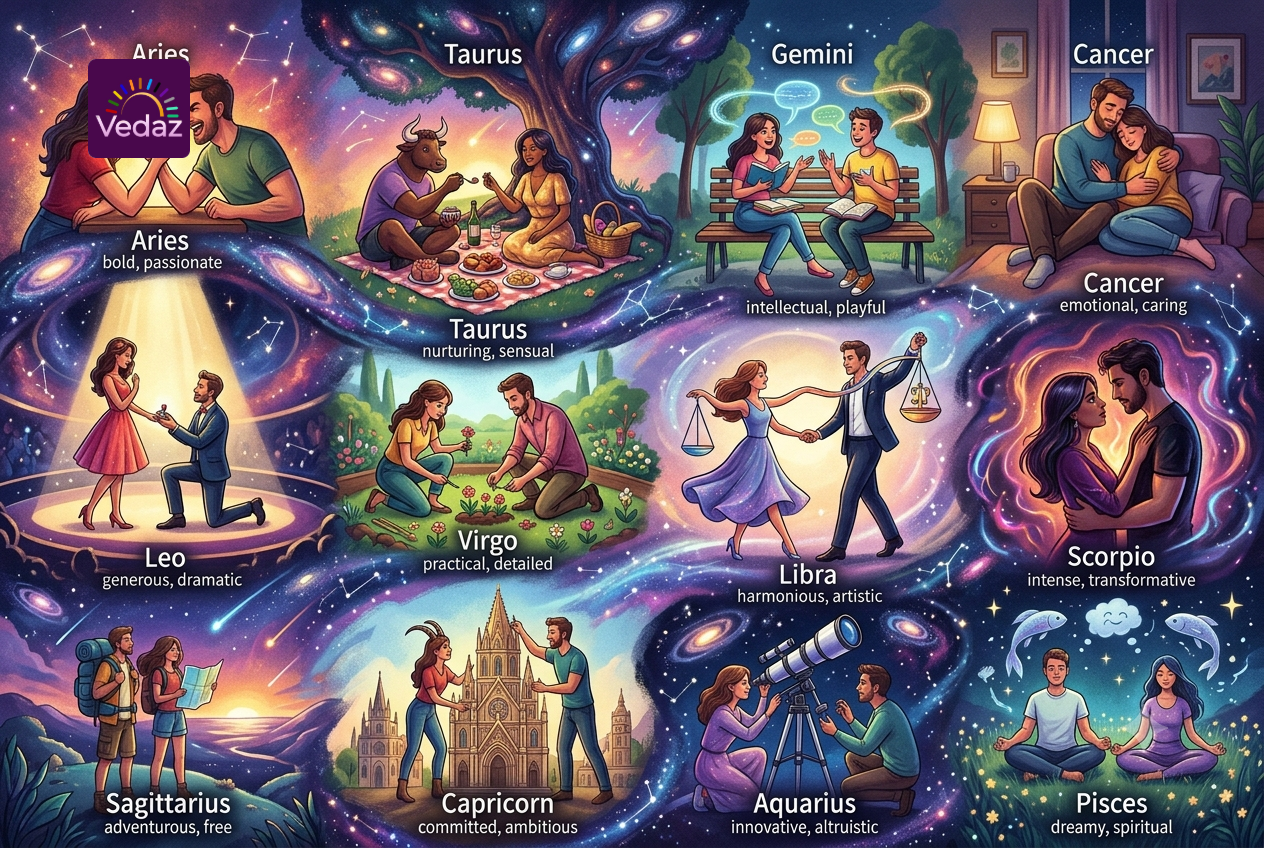
Ways of loving of each zodiac sign
Uncover the secrets behind each sign's way of loving and get inspired by their unique expressions of passion and care