How Saturn Return Reshapes Your Life, Purpose and Identity
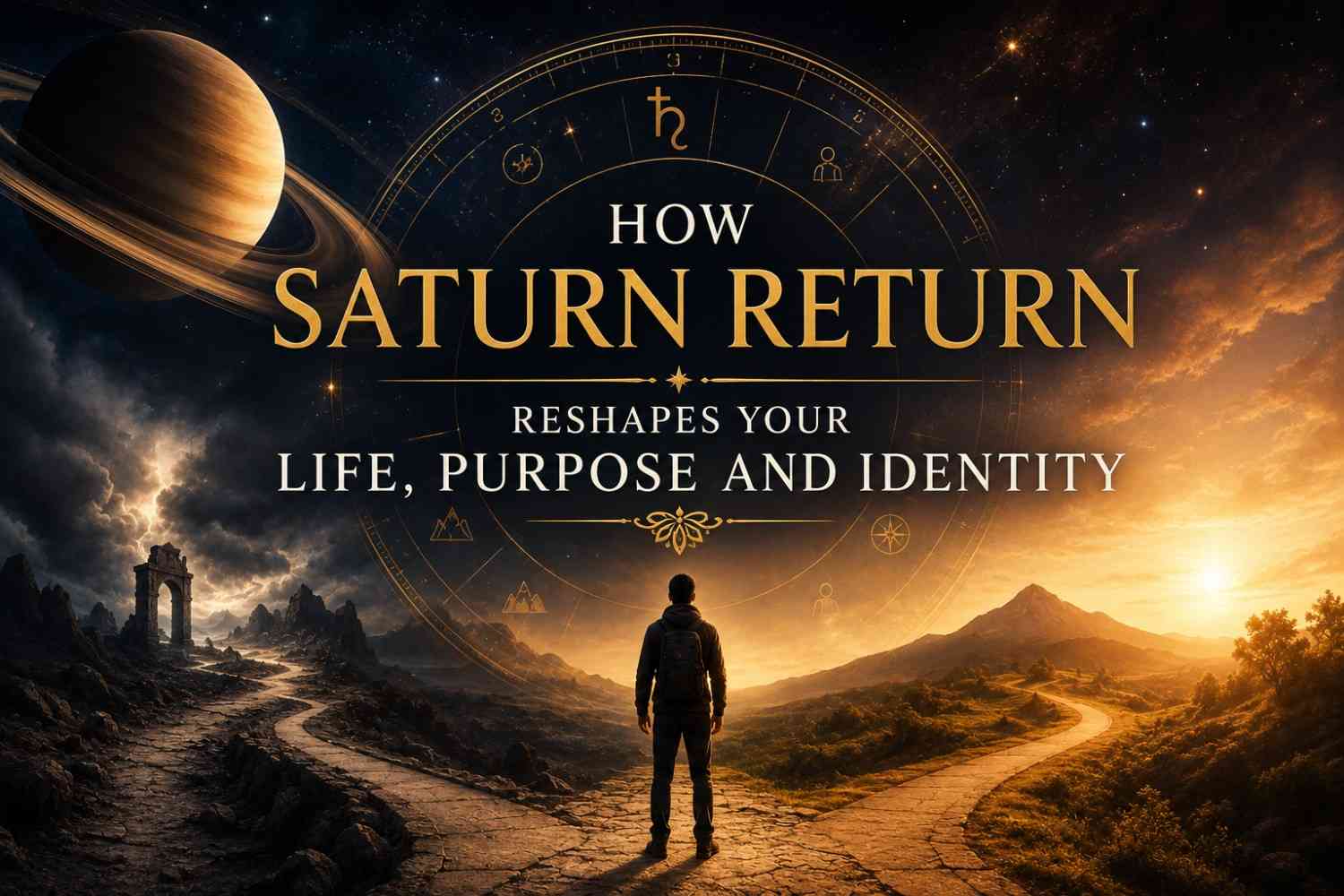
Saturn Return occurs when transiting Saturn returns to its exact natal position — approximately every 29.5 years. It marks a structural identity transition at ages 29–30, 58–60, and 87–90, forcing the kind of life choices that shape the next three decades.
- ◦Saturn Return Quick Facts
- ◦What Western Astrology Says About Saturn Return
- ◦What Vedic Astrology Says About the Same Phenomenon
- ◦How Saturn Return and Sade Sati Overlap
- ◦The First Saturn Return (Ages 29–30): What to Actually Expect
- ◦The Second Saturn Return (Ages 58–60): What to Actually Expect
- ◦The Third Saturn Return (Ages 87–90): What to Actually Expect
- ◦Navigating Saturn Return — Practical Guidance
- ◦Common Misconceptions About Saturn Return
- ◦How Saturn Return Connects to the Broader Saturn Picture
- ◦Final Thought
There's a reason so many people in their late twenties suddenly feel like the ground has shifted under them — careers that felt fine start feeling wrong, relationships get questioned, the future that seemed clear gets murky. And then someone mentions Saturn Return, and suddenly it has a name.
Here's the thing: Saturn Return is one of those rare astrological events that both Western and Vedic traditions acknowledge — they just describe it differently. Western astrology made it famous.
Vedic astrology situates it within a broader framework of Saturn transits, dasha periods, and dharmic responsibility. Both are pointing at the same astronomical reality, and both have something genuinely useful to say about it.
This guide bridges the two. We'll cover what Saturn Return actually is, how Vedic astrology interprets the same phenomenon, where it overlaps with Sade Sati, what each of the three Returns tends to produce, and how to navigate the transition without making it harder than it needs to be.
Saturn Return Quick Facts
| Definition (Western) | Transiting Saturn returns to its exact natal zodiacal position |
| Definition (Vedic) | Saturn completing one full revolution — often coinciding with Sade Sati for many natives |
| Frequency | Every approximately 29.5 years |
| Lifetime occurrences | Typically 3 in a 90-year lifespan: ages 29–30, 58–60, 87–90 |
| Duration of influence | ~12–18 months around the exact return date; felt experience often extends to 2–3 years |
| First Saturn Return age | ~29–30 years (the most famous and disorienting) |
| Second Saturn Return age | ~58–60 years (less dramatic, more consolidating) |
| Third Saturn Return age | ~87–90 years (completion themes, wisdom transmission) |
What Western Astrology Says About Saturn Return
Western astrology has done more than any other tradition to bring Saturn Return into mainstream awareness — particularly the First Return at ages 29–30. The Western interpretation centers on a few key ideas:
- Saturn Return marks the genuine transition from extended adolescence into true adulthood — the point where provisional life choices become structural ones
- The First Return frequently produces career restructuring, relationship recalibration, geographic moves, and fundamental identity reorientation
- Themes of "settling down," confronting unrealistic expectations, and accepting real structural responsibility all cluster here
- The "27 Club" — the famous grouping of musicians and artists who died around age 27 — is partly attributable to the build-up toward Saturn Return, when structural pressure intensifies before the exact return moment
- The Second Return at ~58–60 marks transition into elder adulthood — facing aging, legacy, and the recalibration of ambition
- The Third Return, for those who reach it, typically coincides with life-completion phases
What Western astrology captures well is the psychological dimension — the felt experience of identity restructuring. What it sometimes lacks is the broader karmic and dharmic context that Vedic tradition brings.
What Vedic Astrology Says About the Same Phenomenon
Vedic astrology doesn't typically use the phrase "Saturn Return" — but it absolutely recognizes the same astronomical event, just through a different lens.
The Vedic perspective emphasizes several things that Western framing often misses:
- Saturn's ~29.5-year revolution means the Return is as much a dharmic checkpoint as an identity crisis — Saturn coming back to ask whether you have genuinely taken up your duties in life
- The Return typically coincides with Sade Sati for many natives, since Saturn returning to its natal sign often places it in or near the Moon sign as well. When these two phenomena layer on top of each other, the experience intensifies considerably
- Dasha context matters enormously — which planet's Mahadasha is active during your Return substantially modulates what you actually experience. A benefic dasha running concurrently can soften the Return significantly; a Saturn or Rahu Mahadasha running at the same time amplifies it
- Vedic tradition places less emphasis on "identity crisis" as a frame and more on karmic responsibility — what patterns from the past are now asking for resolution, and what duties have been deferred long enough
- Specific yoga formations that occur during the Return — Saturn conjunct the natal Moon, Saturn conjunct the natal Sun — carry particular weight in the Vedic reading
The two traditions are genuinely complementary here. Western astrology gives you the psychological map; Vedic astrology gives you the karmic and timing context.
How Saturn Return and Sade Sati Overlap
This is one of the more practically important things to understand, because the two phenomena often compound each other in ways that explain why the First Return can feel so intense.
Here's how the overlap works:
- Sade Sati runs for 7.5 years — Saturn transiting the 12th, 1st, and 2nd signs from your natal Moon
- Saturn Return is the moment Saturn reaches its exact natal zodiacal position
- If your natal Saturn was placed in or near your natal Moon's sign — or in the 12th or 2nd from it — Saturn Return falls squarely within Sade Sati
- When Saturn Return coincides specifically with Sade Sati Phase 2 (Saturn directly on the natal Moon), the intensity peaks — many of the most famous "Saturn Return identity crises" are actually this compound Saturn-Moon transit phenomenon, not the Return alone
- For natives whose natal Saturn was placed far from the Moon, the two may not overlap at all — but Saturn Return still represents a significant structural identity transition regardless
Understanding whether your Return overlaps with Sade Sati gives you a much clearer picture of what to actually expect. The Sade Sati Phases & Calculator guide walks through how to identify your current Sade Sati phase in detail — worth reading alongside this one.
The First Saturn Return (Ages 29–30): What to Actually Expect
This is the one everyone talks about — and the reputation is earned. The First Return is the most disorienting of the three because it's the first time Saturn forces genuinely structural choices, and most people have no prior experience of what that feels like.
Common themes during this period:
- Career reorientation — leaving jobs or career paths that no longer fit, sometimes completely starting over professionally, or reorganizing professional identity at the most fundamental level
- Relationship restructuring — marriages, separations, and major partnership decisions cluster heavily in the 28–31 age range for exactly this reason
- Geographic moves — international relocations, moves to new cities, or unexpected returns to ancestral places
- Health changes — the body starting to require conscious attention in ways it simply didn't during adolescence
- Family reorientation — confronting parental relationships at a more adult level, often as parents themselves begin aging
- Philosophical or spiritual reorientation — questioning beliefs absorbed in childhood, sometimes finding entirely new frameworks
- First real encounters with mortality — a friend, a relative, or simply the internal recognition that life is finite
- The deep unresolved question: settle into current trajectory, or restart?
Why Does It Feel So Intense?
Saturn rules time, structure, discipline, and lawful order. When it returns to its natal position, it reactivates the part of your chart that holds the structural lessons you were specifically born to work through.
For most people, the years from 18–28 are spent in what feels like real adulthood but is actually extended development — education, early career, early relationships, all of which feel weighty but rarely produce genuinely irreversible structural commitments.
Saturn Return changes that. It forces the kind of choices that actually constrain the next 30 years of life. The intensity you feel is the lived experience of real responsibility — not provisional, not reversible, but actual. That's why it's disorienting. That's also why it matters.
The Second Saturn Return (Ages 58–60): What to Actually Expect
The Second Return is typically quieter than the First — but don't mistake quieter for less significant. Where the First Return is about building an adult identity from scratch, the Second is about taking honest stock of what you've built and deciding what the next chapter genuinely looks like.
Common themes:
- Career legacy decisions — retirement timing, professional consolidation, succession planning, and the transition from building to transmitting
- Partnership maturation — less reorientation than the First Return; often a deeper appreciation of long-tenured relationships and what they've actually meant
- Health attention — physical changes that demand acknowledgment and consistent care
- Parents' aging or death — confronting mortality at the parental generation level, which brings your own mortality into clearer view
- Financial restructuring — transitioning from accumulation to distribution, estate planning, retirement preparation
- Wisdom transmission — the genuine recognition that what you've learned across decades has real value to younger people, if you're willing to share it
- Spiritual deepening — many natives become more contemplatively or religiously engaged during this period, often for the first time since childhood
The Third Saturn Return (Ages 87–90): What to Actually Expect
For those who reach it — and more people are, with longer life expectancies — the Third Return carries a quality unlike the first two. The themes are completion, not construction. Life review, legacy transmission, family reconciliation, and the acceptance of mortality all converge here.
The intensity is usually quieter than the First or Second Returns, but the structural meaning runs deep. In many spiritual traditions, this age range marks the entry into genuine elder wisdom phases — the point where what you've lived becomes something you can genuinely offer. The Third Return symbolically marks that threshold.
Navigating Saturn Return — Practical Guidance
For the First Return (Ages 28–31)
- Take career decisions seriously, not impulsively — the moves you make now will shape the next three decades. Saturn rewards deliberate choices and punishes reactive ones
- Resist using geography or new relationships as escape routes from internal restructuring that needs to happen regardless of where you are
- Engage with therapy or genuine depth work if it's available to you — Saturn Return is one of the most productive windows for real psychological growth
- Honor your father and senior authority figures consciously — Saturn rules elders and lineage
- Begin Saturday Shani practices — Hanuman Chalisa, donations to elderly people, selective fasting — as ongoing discipline rather than one-off remedies
- Strengthen Saturn through ethical conduct — Saturn under pressure rewards integrity more than any ritual
- Accept that the version of yourself emerging is genuinely different from the one entering this period. Don't fight the transformation — work with it
If the emotional weight of the First Return feels genuinely heavy — the identity questioning, the relationship strain, the career uncertainty all at once — AI astrologer Chandra specializes in emotional intelligence and can help you navigate the inner dimension of what Saturn is bringing up.
For the Second Return (Ages 57–61)
- Engage with retirement planning consciously — both the financial dimension and the meaning-based dimension. What will you do with your time? What will give structure to your days?
- Strengthen relationships rather than testing them — partnerships at this stage carry substantial accumulated value worth protecting
- Begin or deepen contemplative practice — meditation, religious engagement, philosophical study. This is a natural window for it
- Honor your parents if they're still alive and address any unresolved relationship dimensions — this is often the last sustained window to do so
- Mentor younger people in your field — wisdom transmission has genuine dharmic significance in Vedic tradition and real psychological benefit in any tradition
- Take preventive health seriously — the habits built during the Second Return period set the physical foundation for the decade that follows
Common Misconceptions About Saturn Return
A few things worth clearing up because they circulate widely:
- Saturn Return is not a crisis to be survived. It's a structural transition that produces genuine adult identity when you move through it consciously rather than reactively
- It doesn't affect everyone the same way. Natal Saturn's strength, the overall chart configuration, your active dasha period, and the choices you actually make all shape what you experience
- It doesn't mean you must change everything. Many people consolidate and deepen existing structures rather than abandoning them. Saturn's influence is structural — it asks you to build on solid foundations, not necessarily to demolish what's already standing
- The "27 Club" isn't purely Saturn Return. The famous early-deaths involve multiple converging factors — substance use, extreme lifestyle pressure, complex psychological patterns — that the astrological period amplifies but does not cause. Most people navigate Saturn Return safely
- You can't predict it to the day. The exact natal position varies by birth time precision, and the felt influence extends over 12–18 months around the return. It's a season, not a date
How Saturn Return Connects to the Broader Saturn Picture
Saturn Return doesn't happen in isolation. It sits within a broader web of Saturn conditions that the Shani Dosha Complete Guide maps comprehensively — including natal Saturn afflictions that the Return will reactivate.
If concurrent Saturn transits are also running during your Return period, the Ashtama Shani Complete Guide and Kantaka Shani Complete Guide are both worth understanding alongside this one, since those transit conditions can layer on top of a Return and intensify the experience significantly.
And if you haven't looked carefully at your birth chart to establish where your natal Saturn actually sits — its house, sign, and aspects — that's genuinely the first step before any of the deeper interpretation makes full sense.
Final Thought
Saturn Return is the moment life stops being provisional and starts being real.
Not the trial run of early adulthood — the actual thing. The version where the choices you make genuinely constrain the next 30 years, where the identity questions are no longer philosophical but structural, and where the person you've been becoming either solidifies into someone substantial or keeps deferring the work.
The natives who navigate it best aren't the ones who fight the transition or escape into temporary solutions.
They're the ones who take Saturn's invitation seriously — who do the career work, the relationship work, the inner work — and who emerge on the other side with something they didn't have going in: a real, durable, honestly built adult identity.
The transition is hard because it's real. That's not a problem. That's the point.
Dr. Tanvi Deshpande
Comparative Astrology, Saturn Cycles & Astrology Education | 11+ Years
Dr. Tanvi Deshpande is an astrology educator and researcher specializing in comparative astrological traditions, planetary cycles, and spiritual development. She enjoys exploring similarities and differences between Vedic and Western astrological perspectives.
Frequently Asked Questions
1. What Is Saturn Return?
It's the astrological event when transiting Saturn returns to the exact position it occupied in your natal chart — happening roughly every 29.5 years. Most people experience three in a lifetime: at ages 29–30, 58–60, and 87–90. Each one marks a structural identity transition with themes specific to that life stage. The First is the most famous and typically the most disorienting.
2. How Long Does Saturn Return Last?
The exact return is a single moment, but the influence builds and resolves over time — typically 12–18 months around the exact date, with the broader felt experience often extending to 2–3 years. Saturn's retrograde motion can also produce multiple "passes" over the exact return position, spreading the intensity across a longer window.
3. Is Saturn Return the Same as Sade Sati?
No — but they frequently overlap. Sade Sati is a Vedic-specific concept: Saturn transiting the three signs around your natal Moon over 7.5 years. Saturn Return is Saturn reaching its exact natal position — emphasized in Western astrology and recognized but not separately named in Vedic tradition. For many natives, the First Return falls within the Sade Sati period. When they coincide, the intensity compounds. When they don't, each still produces its own distinct effects.
4. How Do I Prepare for My First Saturn Return?
Take career decisions deliberately, not reactively. Resist using moves or new relationships as escapes from internal work that needs to happen regardless. Engage with therapy or depth work if available. Begin Saturday Shani practices — Hanuman Chalisa, donations to elderly people — as ongoing discipline. Honor your father and senior figures. And perhaps most importantly: accept that the person emerging from this period is supposed to be different from the one entering it. That's the point.
5. Why Do So Many Famous People Die Around Age 27–30?
The "27 Club" involves multiple converging factors: substance use, extreme lifestyle pressure, complex psychological patterns, and yes, the structural intensity of the build-up to Saturn Return. The Return itself doesn't cause death — but when severe destabilizing factors are already present, the period's psychological weight can amplify them. The vast majority of people navigate Saturn Return safely. The cases that don't involve compound vulnerabilities that the astrological event alone doesn't explain.
6. Does Saturn Return Affect Men and Women Differently?
The astronomical event is identical for everyone. The lived experience differs — often because of cultural overlay, not the astrology itself. The late-twenties transition frequently compresses career-identity pressure, partnership-formation pressure, and in many cultures, fertility-timeline pressure into the same window for women. Men often face career and legacy-identity questions more acutely. The Saturn Return is gender-neutral; the social context wrapped around it is not.
Related Blogs

How Your Ruling Planet Affects You?
The impact of your ruling planet upon yourself and your course of action in life. Find the hidden meaning behind your zodiac sign’s star guide.

How the Moon Phases Impacts Body & Mind
Can the Moon’s phases impact your sleep, mood, and health? Explore the fascinating connection between lunar cycles and wellness and how to harness their energy for personal growth
What Are The Hidden Connection Between Planets and Emotions
Do planets influence your emotions? Explore how astrology connects to mental health, from Mercury retrograde effects to Saturn return life changes—and what science says about it!

Mercury Retrograde Survival Guide: Mental Health Tips for Every Sign
Turn Mercury Retrograde chaos into clarity with actionable mental health hacks for every zodiac sign.