Should I Make a Major Decision Based on Astrology? An Honest Guide to Where It Belongs
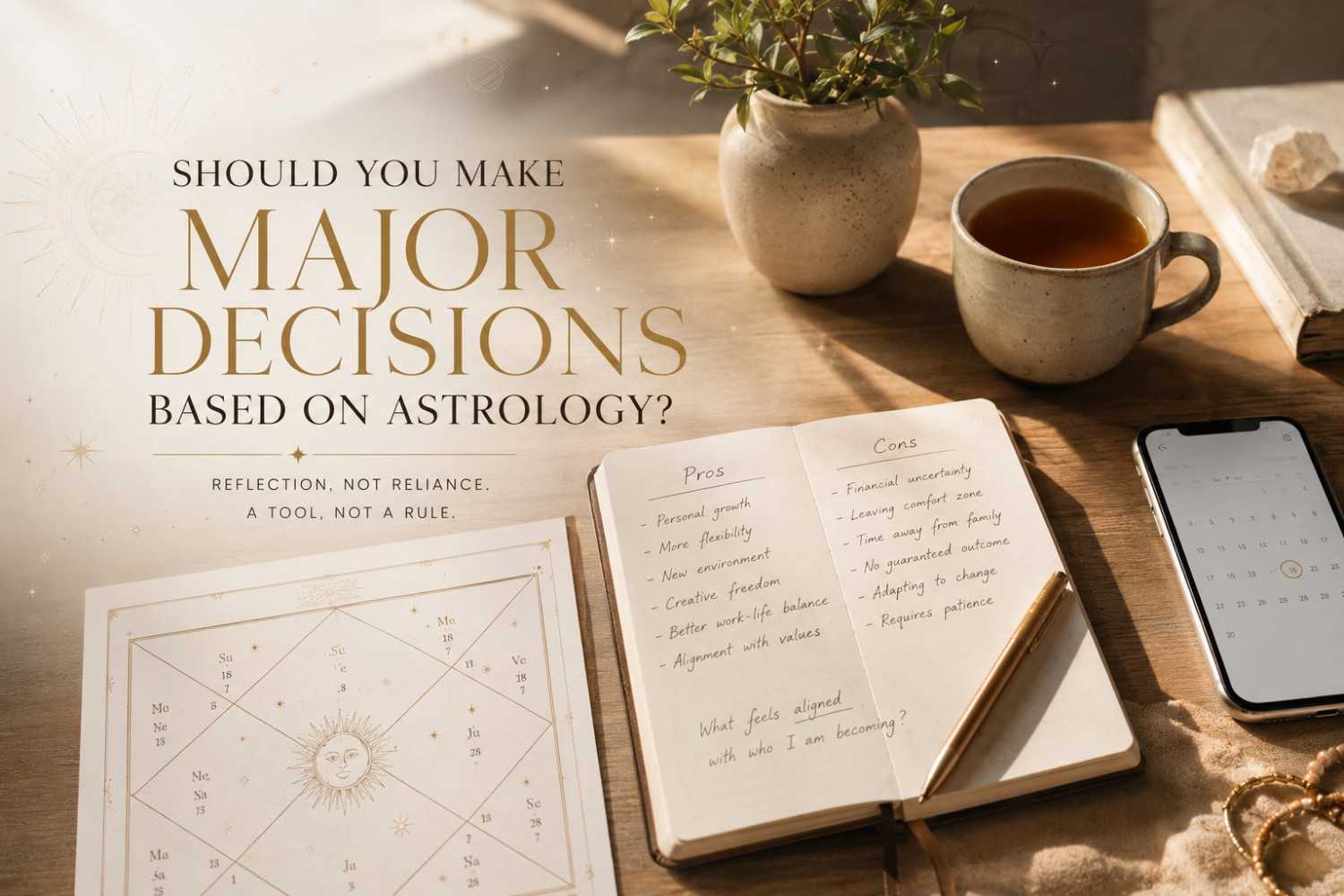
Astrology and major decision making guide

Should you make a major life decision based on astrology? This guide explains where astrology can honestly help as a reflective tool, where it becomes risky, and how to use chart guidance without replacing your own judgment, practical reasoning, or professional advice when making important decisions about relationships, career, money, or health.

People bring astrology into their biggest life decisions all the time — whether to marry someone, take the job, move abroad, leave a relationship, start a business, or make a major financial choice.

Questions about timing often arise alongside major decisions, whether around timing a career change, timing your marriage, or timing a property purchase.

The honest question underneath all of these decisions is usually the same:

How much weight should astrology actually have here?

Most discussions around this become extreme very quickly. Some people treat astrology as the final answer to every important choice. Others dismiss the entire question completely.

Neither approach is especially useful.

The more honest conversation is about where astrology genuinely belongs in decision-making, where it becomes risky, and how to use it without quietly handing over your judgment, responsibility, or emotional agency to predictions.

At its healthiest, astrology can function as a reflective framework. It may help someone slow down, think more carefully, notice emotional patterns, or consider timing and priorities differently. But there is an important boundary here:

Astrology can support reflection. It cannot responsibly replace judgment.

People interested in understanding astrology's predictive limits may find it helpful to explore where astrology genuinely offers perspective and where certainty becomes difficult to support honestly.

That distinction matters much more than most conversations around astrology admit.


Quick Facts

TopicHonest Reality
The honest roleOne reflective input — never the deciding authority
Where it can helpPerspective, self-reflection, emotional clarity, timing considerations
Where it becomes riskyWhen decisions are outsourced to predictions or fear
Where it must stay secondaryHealth, legal, financial, safety, and irreversible life decisions
Biggest dangerUsing astrology to escape the discomfort of uncertainty and responsibility
The core testDoes astrology inform your judgment, or replace it?
Healthiest framingThe decision remains yours; astrology is only one perspective

The Honest Role of Astrology in a Decision

Using astrology without losing judgment

The legitimate role of astrology in decision-making is actually much smaller — and much more reasonable — than many people imagine.

At its best, astrology can act as a reflective tool. It may help surface questions you had not fully considered before. It may encourage deeper self-reflection, highlight emotional patterns, or make you pause long enough to think more carefully about timing, priorities, fears, or motivations.

In that sense, astrology can function similarly to:

  • journaling,

  • talking through a decision with someone thoughtful,

  • reflecting on recurring emotional patterns,

  • or stepping back from impulsive decision-making for a moment.

The value comes from reflection, not from the chart magically removing uncertainty.

That distinction is important.

Healthy astrology does not remove the responsibility of choosing. It simply becomes one possible input within a much larger decision-making process that still includes:

  • practical realities,

  • emotional maturity,

  • communication,

  • consequences,

  • evidence,

  • and personal judgment.

The healthiest way to think about astrology is simple:

The chart may help you reflect. It should never become the authority making the decision for you.


The Bright Line — Inform vs Replace

There is one simple question that honestly determines whether astrology is being used responsibly or not:

Does astrology inform your judgment, or replace it?

That difference is the entire boundary.

Informing looks like this:

"The chart made me think more carefully about timing, emotional readiness, or what I actually want, so I weighed that alongside the practical realities."

Replacing looks like this:

"The astrologer said the timing is bad, so I am not doing it."

The first approach keeps your judgment active. The second quietly hands your judgment away.

Real problems usually begin when astrology stops being a reflective perspective and starts becoming an external authority that overrides personal reasoning.

The honest framework is much healthier:

  • astrology may contribute thoughts,

  • raise questions,

  • or encourage reflection,

but you still consciously make the decision yourself.

That responsibility never leaves your hands, even if the astrology feels emotionally convincing.


Why People Outsource Decisions to Astrology — and Why It Can Become Dangerous

Major life decisions are emotionally uncomfortable.

Choosing involves uncertainty, responsibility, fear of regret, and the possibility of being wrong. Astrology can feel emotionally attractive during those moments because it appears to offer clarity, certainty, or permission.

"The chart says so" can feel psychologically safer than: "I made this choice myself."

That emotional relief is exactly what makes outsourcing decisions risky.

The relationship, marriage, financial decision, business risk, or relocation still affects your real life. You still live the consequences. But when someone hands the decision-making authority away psychologically, they often stop fully engaging their own judgment at the moment it matters most.

Sometimes people also hand enormous emotional influence over their lives to whoever is interpreting the chart.

That is where things can quietly become unhealthy.

One of the clearest warning signs is this: if astrology starts feeling like an escape from the discomfort of choosing, it is probably moving from reflection into dependence.

Learning more about choosing the right astrologer can also help people distinguish reflective guidance from interpretations that encourage dependence or certainty beyond what astrology can realistically support.

Because uncertainty itself is not the problem. Avoiding responsibility for decisions is usually the deeper issue underneath it.


Decisions Where Leaning on Astrology Is Specifically Dangerous

Some decisions become genuinely risky when astrology starts replacing practical reasoning, evidence, or qualified expertise. In these areas, astrology should remain secondary at most.

  • Health decisions should always be guided by medical professionals — delaying treatment, avoiding diagnosis, or ignoring medical advice because of astrology can cause serious harm.

  • Legal decisions need legal expertise — court cases, contracts, legal disputes, and serious legal risks should never depend primarily on chart predictions.

  • Financial decisions become dangerous when driven by astrological certainty — investments, debt, business risks, and major financial commitments require real financial reasoning and practical analysis.

  • Safety decisions should never be overridden by astrology — physical safety, emergencies, and risk assessment must stay grounded in reality, not predictions.

  • Fear-driven irreversible decisions are especially risky — suddenly ending relationships, abandoning careers, cutting off family, or making drastic life changes because of frightening predictions can create lasting damage.

  • Using astrology to control other people’s choices becomes harmful — astrology should not be used to pressure, manipulate, or emotionally control partners, children, or family members.

  • Major decisions made under panic are rarely wise — fear and emotional urgency usually weaken judgment, whether astrology is involved or not.

  • Any astrologer discouraging professional help is crossing an important line — doctors, lawyers, therapists, and financial professionals exist for a reason.

  • Serious real-world problems require real-world expertise first — astrology should never replace the professionals trained to handle those situations responsibly.


A Usable Framework for Integrating Astrology Honestly

Astrology reflection versus decision dependence

Astrology can still play a reflective role in decision-making without becoming controlling or unhealthy. The key is keeping your own judgment at the center throughout the process.

  • Start with the practical realities first — gather information, think through consequences, and assess the situation normally before consulting astrology.

  • Speak to relevant professionals where needed — doctors, therapists, lawyers, financial advisors, or trusted people should come before astrological interpretation in serious matters.

  • Form your own opinion before looking at the chart — this helps prevent astrology from automatically becoming the deciding authority.

  • Use astrology as a reflective check, not a command — ask whether it surfaced something genuinely worth thinking about rather than treating it as an order.

  • Notice emotional reactions carefully — if astrology immediately creates fear, panic, or emotional dependence, step back before making decisions.

  • Keep the “inform vs replace” test active — astrology may inform your thinking, but it should not replace your reasoning.

  • Re-own the final decision consciously — after all reflection is done, the decision should still feel personally and knowingly yours.

  • Treat emotional relief as a warning sign sometimes — “the chart decided for me” may feel comforting, but that comfort can hide avoidance of responsibility.

  • Keep astrology secondary in high-stakes areas — especially in health, safety, legal, and financial decisions.

  • Stay connected to reality outside the chart — relationships, communication, effort, behavior, and practical circumstances still matter far more than symbolic interpretation alone.


Use Your Chart as a Reflective Input, Not a Decision-Maker — Vedaz

Vedaz approaches astrology with this exact philosophy: as a reflective input held lightly rather than a deciding authority.

The goal is not dependence on predictions. It is clearer self-understanding, calmer reflection, and emotionally responsible guidance that still keeps personal judgment and agency intact.

People who prefer using astrology as a space for reflection rather than decision-making may also find Mitra AI useful as a thoughtful companion while processing important choices alongside conversations with trusted friends, family members, or professionals.

Serious health, legal, financial, and mental health matters should always remain grounded in the appropriate real-world expertise first.

For those who want to explore planetary themes, timing windows, and self-understanding without treating astrology as a source of fixed answers, Shubha AI can also provide gentle, perspective-oriented guidance designed around reflection rather than certainty.

Astrology may offer perspective. It should never take ownership of your life away from you.


Final Thought

People turn to astrology during major decisions for understandable reasons. Choosing under uncertainty is emotionally difficult, and astrology can seem to offer clarity, reassurance, or relief from the burden of responsibility.

That is exactly why honest boundaries matter so much.

Astrology can genuinely help as a reflective framework. It may raise questions you had not fully considered, help you notice emotional patterns, or encourage slower and more thoughtful reflection before making an important choice.

Used this way, astrology remains one perspective among many.

But the moment astrology stops informing your judgment and starts replacing it, the risk begins.

The most dangerous situations usually happen when:

  • fear,

  • urgency,

  • uncertainty,

  • and irreversible decisions

all combine together.

Those are the moments where grounded thinking, real information, emotional steadiness, and qualified professionals matter most.

The healthiest relationship with astrology is one where the chart remains a mirror rather than becoming an authority.

Consult it if it helps you reflect. Learn from it if it offers perspective. But keep ownership of your life and your decisions fully in your own hands.

At its honest best, astrology accompanies judgment. It never replaces it.

Dr. Meera Venkataraman

Astrology Literacy, Spiritual Counseling & Consultation Practices | 9+ Years

Dr. Meera Venkataraman is a researcher and writer specializing in astrology literacy, spiritual counseling, and consultation practices. Her work explores how people engage with astrology during periods of uncertainty, helping readers develop realistic expectations, make informed decisions, and use astrological guidance thoughtfully as a tool for reflection and self-understanding rather than dependency or fear.

Published on: June 23, 2026|Last Updated on: June 23, 2026

Frequently Asked Questions

1. Should I make major life decisions based on astrology?

Not based on astrology alone. The healthiest and most honest role for astrology is as one reflective input among many — something that may help you think more carefully about timing, priorities, or emotional patterns, but never something that replaces your own judgment. Major decisions should still be grounded in practical realities, relevant expertise, and personal responsibility.

2. What is the difference between using astrology honestly and using it dangerously?

The key difference is whether astrology informs your judgment or replaces it. Honest use looks like reflecting on ideas the chart raises while still making the decision yourself. Dangerous use happens when someone hands the authority entirely to astrology — “the chart said no, so I cannot do it” — and stops engaging their own reasoning and responsibility.

3. Why do people feel tempted to outsource decisions to astrology?

Because difficult decisions are emotionally uncomfortable. Astrology can create a sense of certainty or relief during uncertain moments, especially when someone fears making the wrong choice. “The astrology says so” can feel psychologically safer than fully owning a difficult decision yourself. But that relief is often the warning sign that responsibility is being handed away.

4. Can astrology help with timing decisions?

Sometimes in a reflective sense. Astrology may encourage someone to think more carefully about readiness, emotional state, or broader life cycles. But timing should never override practical realities. A good opportunity, strong preparation, or professional advice should not be discarded solely because an astrologer declared the timing “bad.”

5. Which decisions should never be driven primarily by astrology?

Health, legal, financial, safety, and serious mental health decisions should never be governed by astrology. Medical treatment belongs with doctors, legal matters with lawyers, financial planning with qualified advisors, and safety concerns with real-world judgment. Astrology can never replace the expertise required in those areas.

6. Is it okay to consult astrology before marriage or relationships?

It can be used as one reflective tool, especially in traditions where kundli matching is culturally meaningful. But it should never override real compatibility, communication, mutual respect, shared values, or emotional safety. Astrology should inform reflection, not determine whether two people are “allowed” to love each other.

7. What is the biggest danger of astrology in decision-making?

The biggest danger is surrendering personal agency. When people stop thinking critically and begin treating astrology as the final authority over their lives, they risk making fear-driven or dependent choices. The chart becomes unhealthy the moment it replaces personal judgment instead of supporting reflection.

8. How can I use astrology responsibly while making decisions?

Start by making the decision normally first: gather facts, consider consequences, speak to relevant people and professionals, and form your own perspective. Then, if astrology feels meaningful to you, use it afterward as a reflective check rather than a command. The final decision should still feel consciously and personally yours.

9. Is it wrong to let astrology influence a close decision slightly?

Not necessarily, as long as the decision remains fundamentally grounded in practical reality and your own judgment. If astrology helps you reflect on something you had overlooked, that can be legitimate. The important thing is that you consciously choose the weight it carries instead of feeling controlled by it.

10. What is the healthiest way to think about astrology overall?

The healthiest approach is to treat astrology as a reflective framework rather than a system of fixed fate. It may offer perspective, symbolic insight, or prompts for self-understanding, but your choices, effort, relationships, and real-world actions remain the central forces shaping your life.